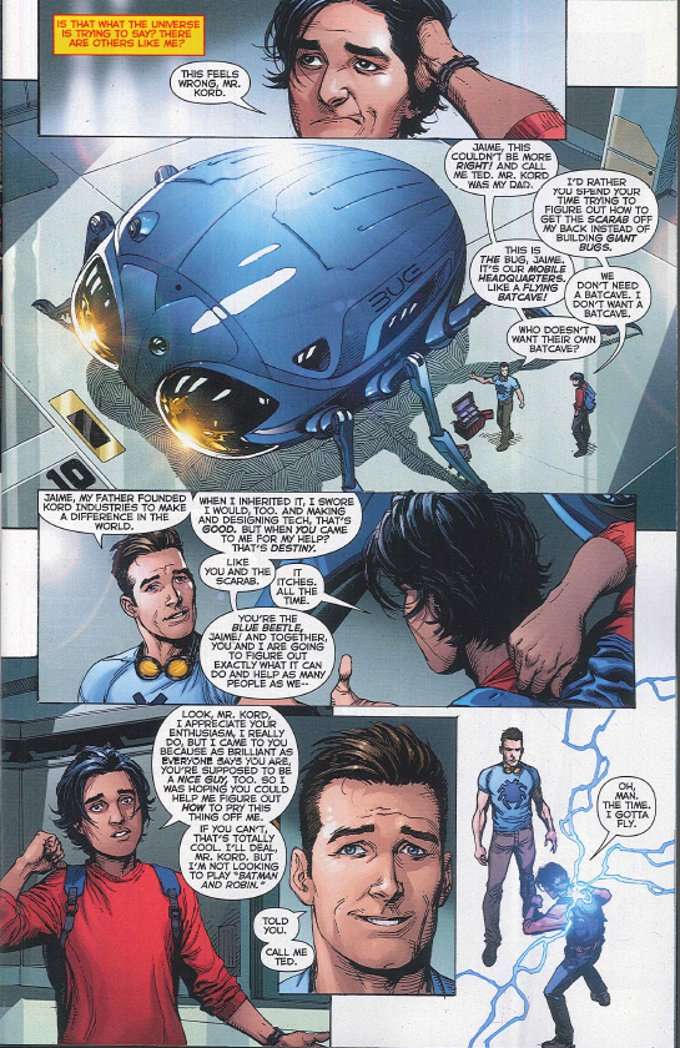
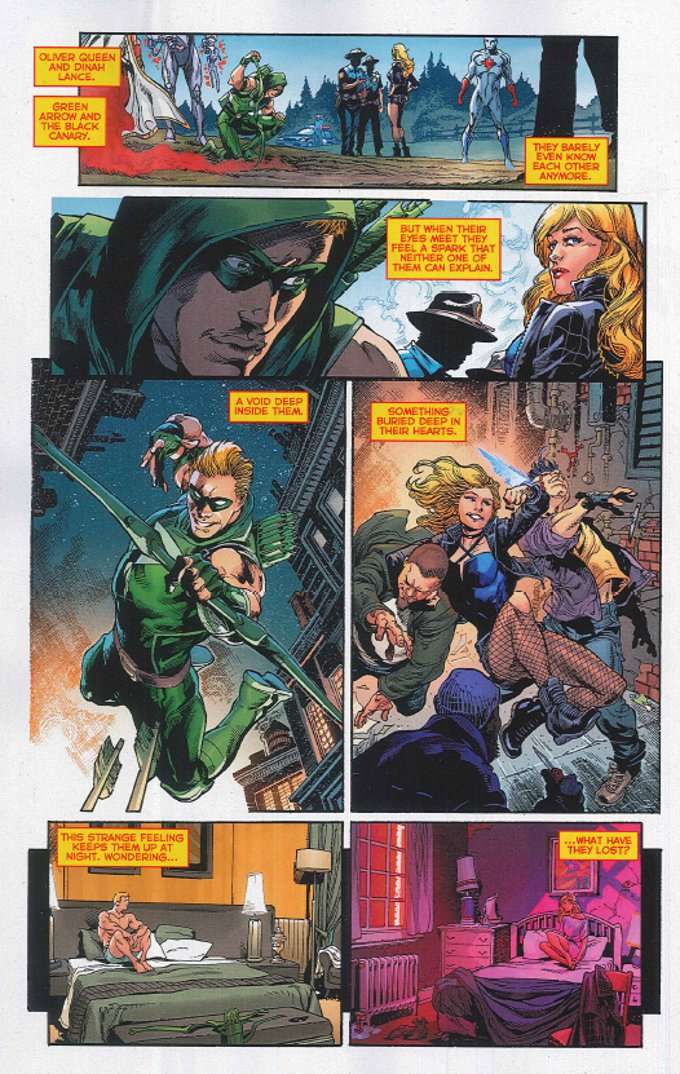
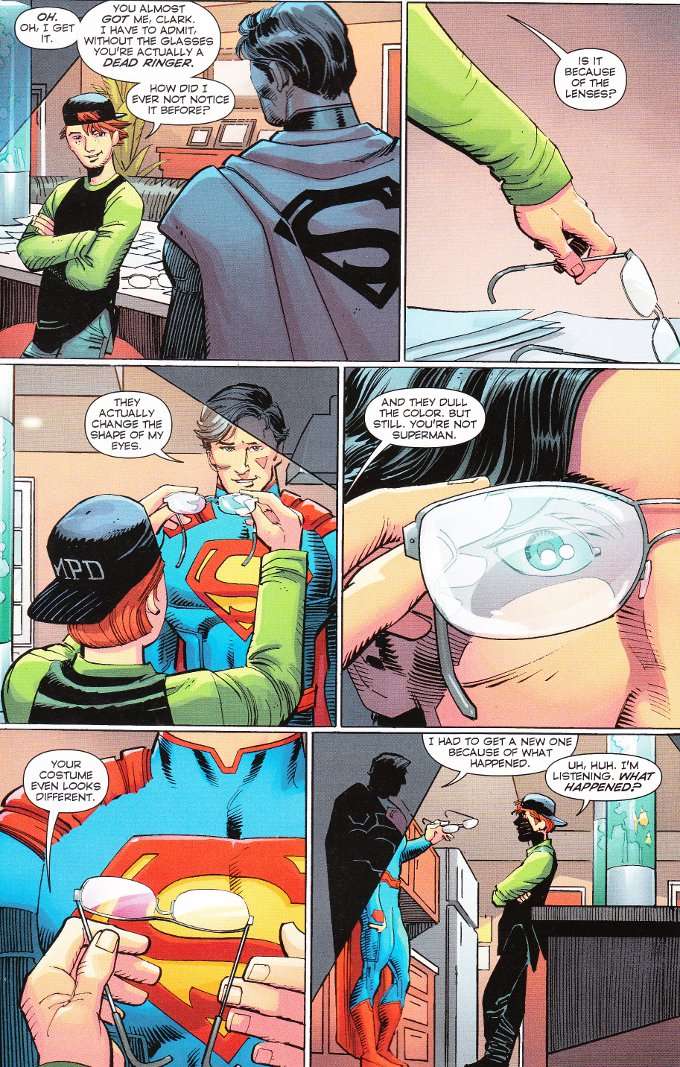
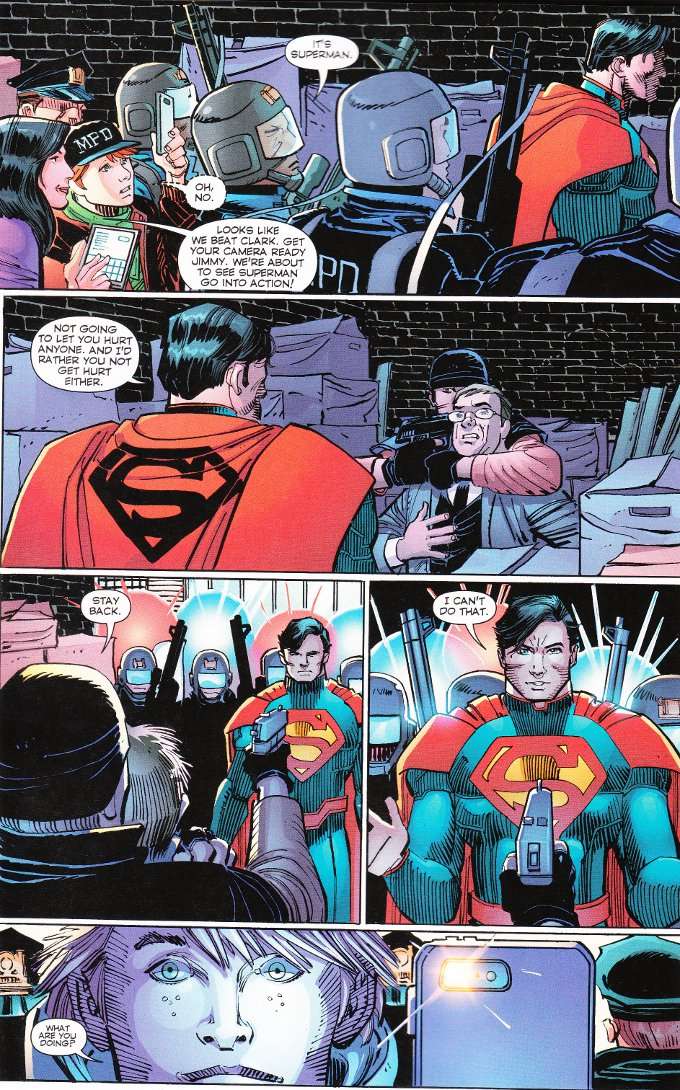
Showing posts with label Geoff Johns. Show all posts

Thursday, December 28, 2017

Doomsday Clock #2 - A Review

Desperately seeking Doctor Manhattan, who he thinks may be the only person capable of saving his world, Ozymandias has devised a mean of tracking his former ally. With the new Rorschach in tow, along with the criminal duo of Mime and Marionette, Ozymandias makes the journey into another universe - one that is foreign to him but well-known to us... 


"Nostalgia. They don't make this anymore."

That sentence, more than anything, seems to sum up Doomsday Clock to date. Thus far the story seems to be little more than the mechanism through which Geoff Johns can get a paycheck for his Watchmen fan fiction. It's well-written, as far as fan fiction goes, but there doesn't seem to be any finer artistic point behind the story so far - all theories regarding how this ties into the foundation of the current DC Comics timeline aside.

It must be said that Gary Frank and Brad Anderson do put on a fantastic show illustrating it all. Though very little seems to be happening in terms of an overall plot, what action exists in this issue is well-handled and laid out well in the classic nine-box grid pattern utilized so well by Dave Gibbons. All in all, the execution of this issue is competent but one still wonders if there's any higher purpose other than giving Alan Moore one more reason to lay a death curse upon the management of DC  Comics.

 The Final Analysis: 6 out of 10. Fantastic artwork but the story seems rudderless so far.

Wednesday, April 19, 2017

Batman #21 - A Review

Returning to his investigation of the mysterious blood-soaked button that materialized in The Bat-Cave shortly after the return of the first Wally West, Batman makes a shocking discovery. Summoning Barry Allen to ask for assistance after he detects the influence of The Speed Force at work, Batman quickly finds himself facing a new foe - one who claims to be an old enemy!


Those hoping for quick answers to the mysteries posed by DC Universe Rebirth #1 in this issue will be sorely disappointed. Batman #21 ultimately does little but give us more mysteries to ponder. It must be said, however, that those mysteries are well-presented and that Tom King's script - based on a plot by Geoff Johns - does a fine job of setting up the story to come.

Apart from the titular Button, there is little obvious connection to Watchmen in the main plot of this issue. Subtextually, there is a mirror story, seemingly unrelated to the main action, which parallels the battle between Batman and the apparent villain of this issue in a way similar to the stories within stories of Watchmen.

The influence of Watchmen is more obvious in the artwork. Most of the pages - saving a few splashes - display the three-by-three grids utilized throughout Watchmen. Jason Fabok masterfully constructs surprisingly detail-driven pictures within the confinement offered to him, with Brad Anderson utilizing a perfect palette to finish it all.

Final Analysis: 8 out of 10. A solid start.

Wednesday, May 25, 2016

DC Universe Rebirth #1 - A Spoiler-Free Review

The cynic in me chuckled at the first page of DC Rebirth #1. First page of a new book meant to revamp the whole of the DC Comics Universe (again!) and - in theory - bring in new readers looking for an entry point, and what do we start with? An editorial note saying we should read Justice League #50 and Superman #52 before reading this issue.

 After that, the cynic didn't laugh once.


This book is good. Damn good. An all-star line-up of artists make every page poster-worthy. Textually and metatextually, the conceit at the center of this issue's story is brilliant. It is a great story, told by the perfect narrator to explain just what went wrong with the DC Universe as it is now.

Once the dust is settled I will do a more in-depth review, discussing what worked about this issue in detail. Right here, right now, I will say only this. Rebirth is the shot in the arm that DC Comics needed and the future is looking bright indeed.


I still have some reservations about what is to come. And the cynic does wonder if the various editorial teams will manage to hold to the vision of love and legacy that Geoff Johns put forth in this issue. But I have hope after reading this book that things will improve. And that is something new.

DC Rebirth #1, as a single story, is a good one. It's a love letter to everything I love about DC Comics and a renewal of many of the things we've been missing. And even if you're not a DC fan... in fact, especially if you're not a DC fan...you should check this issue out to get a sample of what we've all been missing.

Sunday, March 22, 2015

Superman #39 - A Review

Superman's most recent adventures have left him exhausted and in a reflective mood. So Clark Kent has decided to share his secret identity with his best friend, Jimmy Olsen. But Jimmy doesn't quite believe him and Clark's in no position to show off his powers! A day together may teach both young men a lesson - about what truly makes a man Super and how it feels to be ordinary.


Aspiring creators take note. You don't have to introduce cosmic threats beyond imagining for Superman to punch. You don't have to spend hundreds of millions of dollars on special effects to bring Superman to life. Just read this story and learn the same lesson Jimmy Olsen does about who Superman truly is and how it has nothing to do with power and everything to do about giving of yourself to help others. It's a lesson that Geoff Johns knows well and more comic writers need to understand.


The artwork for this issue is the equal of the story.  John Romita Jr. and Klaus Janson turn in some of their finest work ever. And the colors by Hi-Fi lend the whole affair a unique vibrancy that leaves the artwork just jumping off the page. This is one of the best Superman comics I've ever read, bar none.

Sunday, February 15, 2015

Superman #38 - A Review

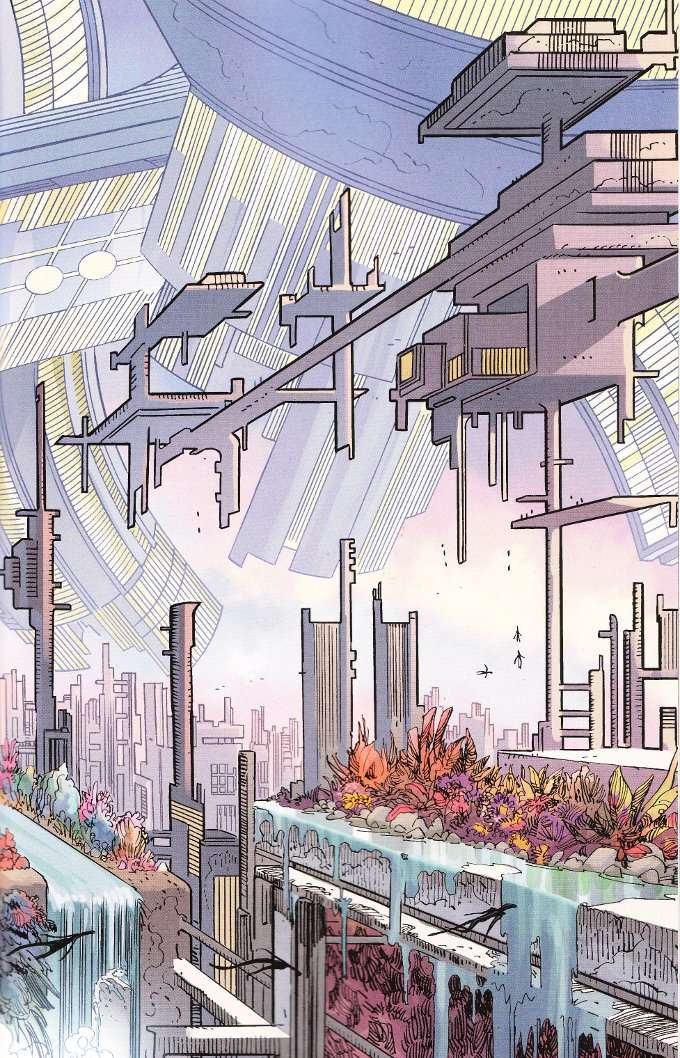
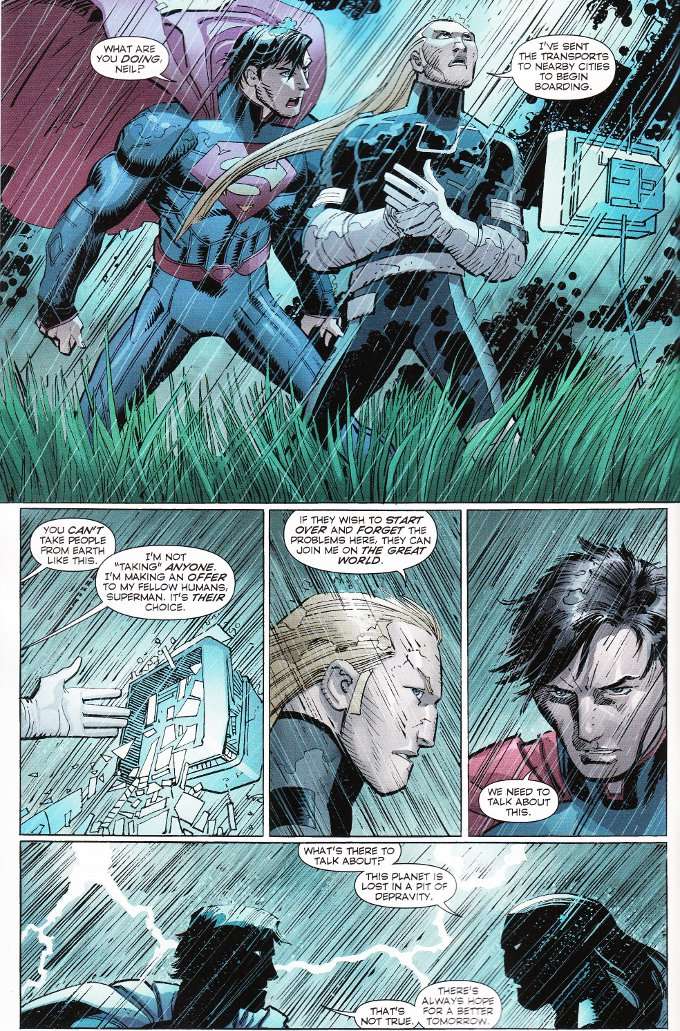
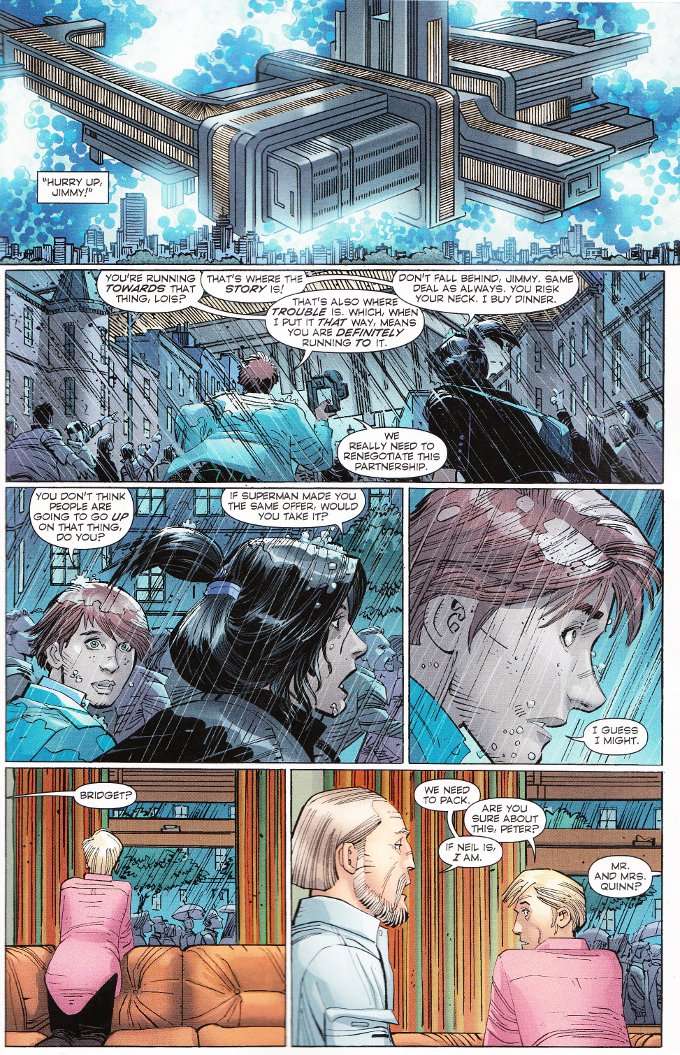
Despite the best efforts of Superman and Ulysses, the fourth-dimensional planet known as The Great World has been destroyed.  Now an enraged Ulysses has turned upon Superman.  And in order to save his adopted home-world, Superman must do the impossible and fight his former friend!


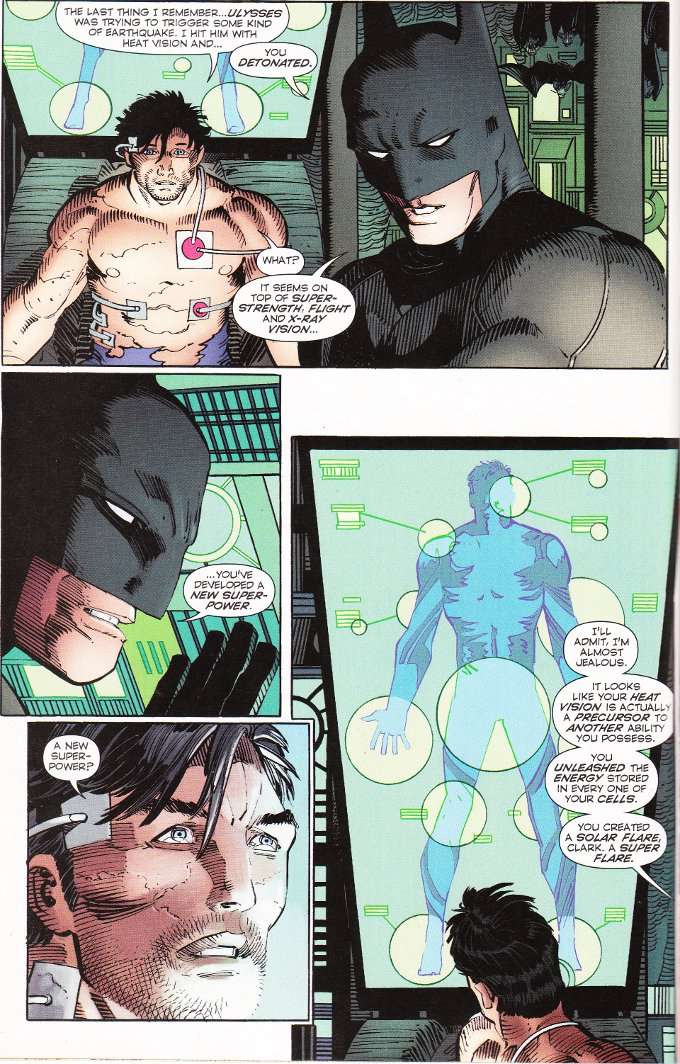
Geoff Johns is one of the best writers in the business and his love for Superman and the mythos of Superman has been clear throughout this arc.  Ulysses' story comes to a satisfying conclusion and Johns has a lot of fun with the idea of a new Super-power that Batman dubs "The Super Flare".  Yet the best parts of this issue are the little character moments, such as Clark Kent's hanging out with Jimmy Olsen and Alfred the butler's fretting over his inability to clean Kryptonian fabric.


John Romita Jr. is also considered to be one of the best artists in the American comic book industry and this issue shows why. There is a grittiness to JRJ's work that seems an odd fit for Superman yet somehow it works.  Why it works is unquantifiable but it does work.

Sunday, December 28, 2014

Superman #37 - A Review

Superman #37 should not work nearly as well as it does. The shocking revelation at its heart isn't at all surprising nor is its conceit of a utopia with a hidden dark secret particularly original. Heck, at this point it would have been more original and surprising if the extra-dimensional home of newbie superhero and Clark Kent's new best friend Ulysses really was all it was promised to be.


So why is it that this comic is as good as it is despite a trite and cliche premise?  Simply because Geoff Johns understands Superman. And while this kind of story is Science Fiction 101, putting Superman into this kind of situation - where Superman is playing the skeptic against blind idealism - is a novel idea that works well within the context of the story.  Clark is a reporter by trade, after all, and a big part of Truth, Justice and The American Way is about seeking the Truth and dealing with it, no matter how ugly and uncomfortable it is.


The artwork is comparable to the story in that it is by-the-book by the standards of the team involved but that standard is a high one and the final product is enjoyable. John Romita Jr. isn't as famous for splash pages or background work as some artists but his work here is eye-catching and memorable.  The inks of Klaus Janson and Laura Martin's color further enhance things.

Thursday, November 27, 2014

Superman #36 - A Review

Ulysses - strange visitor from another world, possessing powers far beyond those of mortal man - has come to the conclusion that humanity is doomed.  Unable to think of any way to turn his amazing powers toward fixing the world of his birth, he has instead elected to take six million people to the Fourth Dimension, to the better world which raised him. Naturally, this is a source of great concern to Superman, who is starting to wonder if the paradise which Ulysses spoke of is truly as grand as he claims.


Geoff Johns understands Superman as few writers today do.  His Superman is the epitome of hope and idealism, as he should be.  Johns also realizes the importance of Lois Lane and Jimmy Olsen to the oeuvre of Superman and does a fine job using them to explore the problems with Ulysses' promises from another perspective.


What can I say about the art of this book that hasn't been said already?  John Romita Jr. is in fine form here, with inker Klaus Janson giving the finished art a much lighter touch than usual, as befits the lighter and brighter aesthetic of Superman compared to other projects JRJ and Janson collaborated on in the past.  This vibrant feeling is further enhanced by the colors of Laura Martin.

Tuesday, October 28, 2014

The Flash Episode Guide: Season 1, Episode 4 - Going Rogue

For a summary of the episode guide layout & categories, click here.


Plot

Felicity Smoak comes to Central City for a visit, but Barry will have little time to enjoy it even after he escapes Iris' misguided attempts to play matchmaker. A cold, calculating bank robber named Leonard Snart is after a rare Khandaqian gem and he never gives up once he sets his eye on a target.

After The Flash thwarts his first attempt at stealing the gem in route to the museum, Snart turns his treacherous mind toward one question - how do you slow down the fastest man alive?  Luckily, one of his contacts just got a hold of a very special gun. A gun that someone at STAR Labs designed just in case they had to stop The Flash cold...


Influences

Showcase #8 (Captain Cold's first appearance), Superman: The Movie (Barry's line about train travel being safe) and more classic The Flash comics than anyone could name but mostly Geoff Johns' run on The Flash (Johns did quite a bit to develop Snart as a character and co-wrote the script for this episode).


Performances

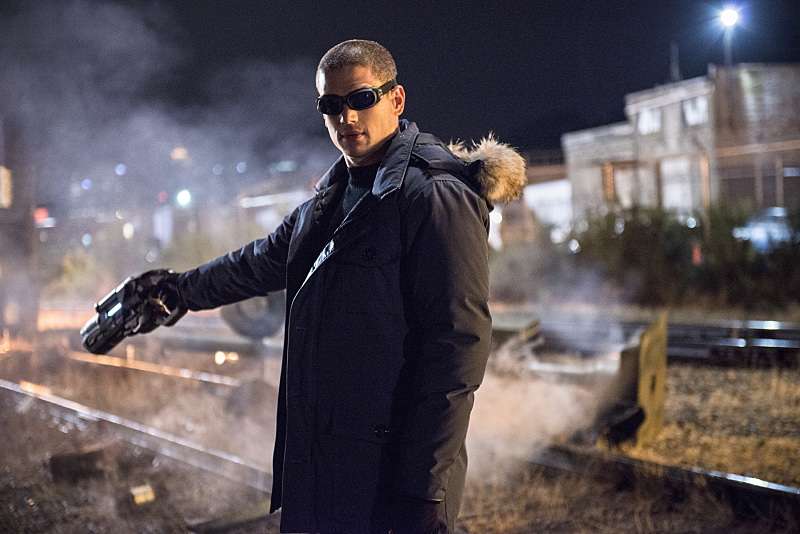
Wentworth Miller nails the character of Captain Cold, as written by Geoff Johns.  Cool and controlled, but not without a thief's code of honor (no killing cops or guards unless they threaten you first, no harming women or children EVER) and some sense of humor (his treatment of the one boy during his tour of the museum).  If this casting and writing is a sign of things to come with this show's casting, the future is bright indeed.


Artistry

The special effects in the train-crash scene are easily the equal of those utilized for Quicksilver in X-Men: Days of Future Past.


Flash Facts

As the episode opens, Barry is testing his ability to multitask by playing ping-pong with Cisco, chess with Dr. Wells and the board game Operation with Caitlin... all at the same time.

Leonard Snart, as presented here, is almost precisely as he appears in the original comics, at least in terms of personality, intelligence and background.

At one point, Barry chuckles about the name Leonard Snart and says it's nearly as bad as Bartholomew.  Barry's full name is Bartholomew Henry Allen.

As in the comics, Snart was the son of an ex-cop, who was an abusive drunk who beat his wife and children.

At one point, Snart mentions a grandfather who used to take him to a crummy diner with a great view.  In the comics, Snart's grandfather was his one positive male role-model and he did indeed take a young Leonard to many different places along his route as an ice delivery man.  He also always bought Leonard and his younger sister ice cream.

As in the comics, Snart begins planning how to stop The Flash after one of his robberies is thwarted by Barry Allen.  However, in the original comics, Snart was caught and began plotting his revenge while in prison.

In the original comics, Snart read up on kinetic energy and thermal motion while in prison.  When he was paroled, he broke into a lab and stole everything (including a miniature cyclotron) he needed to build a gun capable of slowing molecular motion himself.  The show, more realistically, has Snart stealing a weapon capable of slowing The Flash down rather than developing it himself.

In the comics, Captain Cold wore a blue and white fur costume with a hooded coat along with a pair of skier's anti-glare glasses.  His uniform on the show is similar and maintains the same blue and white color scheme with a fur-trimmed hood and anti-glare goggles.

For the record, Captain Cold's weapon of choice is a freeze ray. Not an ice beam. That's so Johnny Snow. Who knows nothing.

The curator at the Central City Museum who contacts Joe is named Dexter Myles. In the comics, Dexter Myles is the name of the curator of The Flash Museum.

The gem Snart is after comes from the country of Khandaq - a Middle-Eastern nation in the DC Universe, best known as the homeland of the Shazam villain Black Adam.

Harrison Wells knows who Felicity is and indeed had considered her as a potential recruit for STAR Labs.

Felicity asks if Barry could run so fast that he would crumble to dust inside his costume.  This is actually what happened when Barry died saving the multiverse in Crisis On Infinite Earths.

Felicity also asks if Barry's accelerated speed is accelerating his aging. This did happen in quite a few classic Flash comics...

The man Captain Cold is speaking to at the end of the episode is named Mick.  Given the references to playing with fire, this is probably Mick Rory - the man who eventually becomes the super-villain Heat Wave.


Technobabble

Surprisingly, Cisco's talk about temperature and speed being opposites is accurate and the explanation he gives regarding how a gun that can slow molecular motion could freeze things solid is taken straight from the comics.

The Freeze Ray gives Barry a third degree case of frostbite and we're told that if it weren't for his accelerated healing factor he would have died.

Cisco's Freeze Ray is powered by a compact cryo-engine that can achieve Absolute Zero.


Dialogue Triumphs

Barry: (off-camera, while running on his treadmill) Wanna see how fast I can run backwards?!
(Loud Crash from off-camera as Caitlin, Felicity, Cisco and Dr. Wells look on)
Caitlin: Don't worry. He heals fast too.

Leonard Snart: Once the armored car called 911 we had 182 seconds before any cop could be on the scene. No one could get there fast enough to stop us. But something did. And you lost your cool. You know the rules, we don't shoot guards or cops unless it's the only option. We don't need the heat.

Felicity: Just go! Stay safe! And I'm talking to air now, which is just weird. And I'm still doing it!

(After Captain Cold destroys a door by freezing it solid)
Guard: Freeze!
Captain Cold: (pause) You want to end up like that door?

Felicity: Remember when you told me you had a little experience, liking someone who didn't like you the same way? That was Iris, right?
Barry: How did you know?
Felicity: It's the little things. The way you linger on her when she isn't looking, the smile you fake to play the part. The quiet dreams you keep to yourself.
Barry: Like you and Oliver. Takes one to know one. I'm afraid it will change everything.
Felicity: It will, but maybe that's not such a bad thing? What is wrong with us? We are perfectly perfect for each other.
Barry: Yet we're sitting here pining for people we can't have. I guess what they say is true. Opposites do attract.


Continuity

The security company handling delivery of the gem Snart is after is Blackhawk Security (A111)

Felicity says she learned about Barry's secret identity by listening in to his and Oliver's conversation from F101/A301.

Caitlin tells Felicity that it's nice to see her again.  It was revealed in A219 that Felicity, Caitlin and Cisco all met when Felicity came to visit Barry at STAR Labs while he was in a coma.

Barry mentions the metahuman villains Marton (F101) and Nimbus (F103).


The Bottom Line

Perfect.  Absolutely perfect.  The introduction of Captain Cold is perfect.  The drama between Felicity and Barry is perfect.  Easily the best episode of the series so far.

Superman #35 - A Review

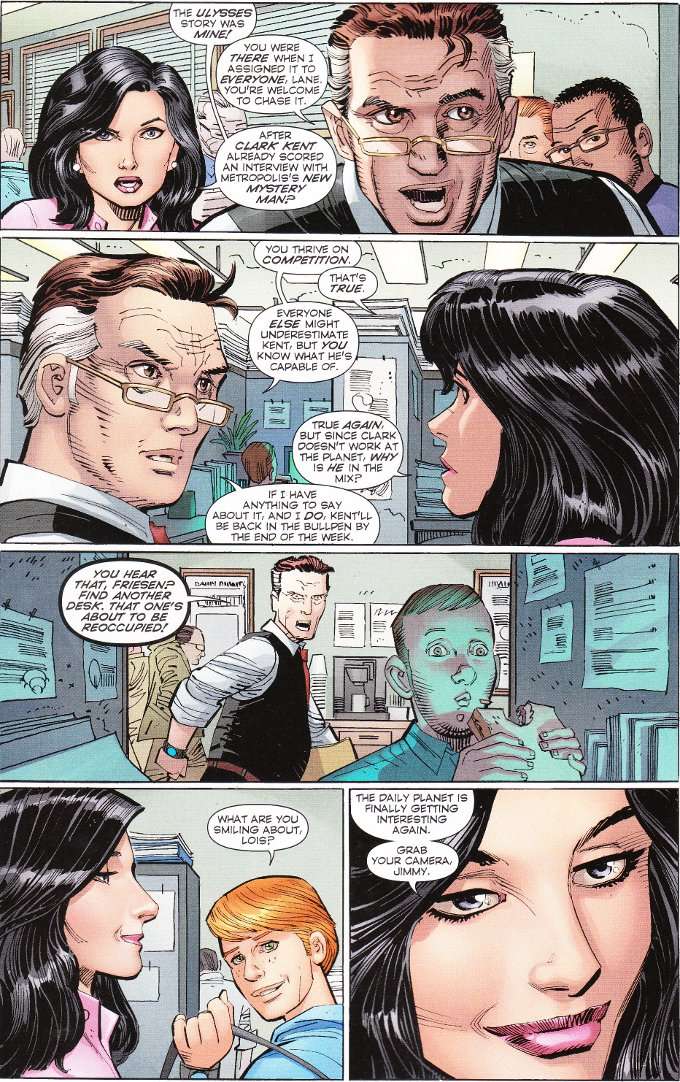
There is a moment early on in Superman #35 where Lois Lane declares that "The Daily Planet is finally getting interesting again."  It's a bit of sarcastic meta-commentary on the part of Geoff Johns and Lois Lane is the perfect person to voice the sentiment. Ever since the New 52 reboot, there has been precious little of The Daily Planet staff in the Superman books and very little was done with them the few times they did show up. Lois Lane in particular was reduced in stature, transformed from Clark Kent's friendly rival to a mean girl who kept ignoring nice-guy Clark.


To paraphrase a line from Mark Waid, most of the recent Superman comics put more emphasis on "the Super" over "the man". That is entirely the wrong way to write a Superman story. Geoff Johns knows this and the current "Men Of Tomorrow" arc has centered less upon thrilling action sequences and more upon Clark Kent, as he attempts to teach the technically-human but totally-alien hero Ulysses about morality and what it means to be human. We still get some thrilling action, of course, but the focus is on the spirit of Superman - the friend who always there to help.


Thinking on it, that may be why John Romita Jr., Klaus Janson and Laura Martin were selected to be the art team for this particular story.  JRJ has a well-deserved reputation for being able to put a great deal of heart and energy into scenes of two people just talking.  Colorist Laura Martin modulates the palette subtly throughout the issue, with Superman's usual bold costume colors becoming more muted in the quieter moments. And Klaus Janson does his usual stellar job in making the bright moments all the brighter through creative shadow construction.

Tuesday, October 7, 2014

The Flash Episode Guide: Season 1, Episode 1 - Pilot

For a summary of the episode guide layout & categories, click here.


Plot

Nine months after being struck by lightning, forensic scientist Barry Allen wakes from a coma and quickly discovers that the accident has given him the power of super-speed.  The scientists at STAR Labs want to analyze Barry and find some way to use him to benefit mankind but Barry thinks he has a higher purpose than being a guinea pig. When reports reach the police of a bank robber who seems to be able to control the weather, Barry concludes that he wasn't the only one empowered by the accident and that he may be the only one who can stop the criminal before he does some major damage to Central City.


Influences

The Flash: Rebirth (Barry's childhood as depicted in the flashbacks), Showcase #4 (the comic which first told Barry Allen's origin story) Sherlock (the visual cues and words overlaid on the crime scene as Barry examines evidence) and the Sam Raimi Spider-Man movies (the opening/closing narration by Barry and Barry's overjoyed reactions while testing his powers.)


Goofs

The scene with Barry Allen and Oliver Queen is incredibly goofy. And Oliver Queen must have super-speed himself to put his mask on so quickly at the end of his conversation.


Performances

Grant Gustin wows in his first run on the center stage as The Flash.  Every note is played perfectly and the charisma he displayed in his first appearances playing Barry Allen on Arrow seems to have increased.  With most of the supporting cast being given only basic development (well, this IS the pilot) it falls to Gustin to bear the burden of carrying most of the episode and he succeeds admirably.

The best scene in the episode?  Barry's meeting with his father in prison, with Henry Allen played by John Wesley Shipp, who played Barry Allen in the 1990 The Flash TV series.  Both actors nail the emotional resonance of the scene.


Artistry

The special effects for the final battle in which Barry must neutralize a tornado using his super-speed are phenomenal and set a new standard for what can be accomplished on a television series budget.

The music is perfect, particularly the speed-building orchestral Flash theme.


Flash Facts

Barry Allen, in the original comics, was a blonde.  In terms of personality, however, Barry is pretty much as he is depicted on the show: a good-hearted geek who works as a crime scene investigator for the Central City Police Department. As the show opens, he is 25 years old.

Iris West, in the original comics, eventually became Barry Allen's wife. Her history in the comics is rather complicated compared to what we know of her in the show. In the comics, she's a reporter who could give Lois Lane a run for her money.  The two were not originally childhood friends nor were they raised together. And yes, Iris wasn't originally black.  Iris was also sent back in time from the 30th Century by parents who were trying to save her from some cataclysm... like Superman.

Detective Eddie Thawne is likely related in some manner to Eobard Thawne - a scientist from the 25th century who was also an obsessive Flash fanboy.  He would later get speed powers and go on to become The Flash's greatest enemy - Professor Zoom, The Reverse Flash.

In the comics, Caitlin Snow is the real name of the super-villain Killer Frost.  A STAR Labs scientist doing research on perpetual motion engines, a lab accident transformed her into a "heat vampire" who had to drain the warmth from human bodies to survive and - indirectly - generated extreme cold around her.

In the comics, Cisco Ramon is the real name of the superhero Vibe, who gained the power to emit powerful blasts of sonic energy after being exposed to a piece of alien technology.

The Science And Technology Advanced Research Laboratory - aka STAR Labs - in the comics was originally founded by a man named Garrison Slate.  In the reality of The Flash TV Show, the founder is a scientist named Harrison Wells.  This name may be a tribute to science-fiction writer H.G. Wells, who wrote on a number of subjects that would not be out of place among STAR Labs' studies, including alien technology, invisible men and time travel.

Detective Joe West is an original creation with no relation to any of Iris's fathers in the comics. Iris' birth father was a man from the 30th century named Eric Russell, who had his daughter sent back in time.  Iris's adopted father was a man named Ira West, who was a physicist - not a cop.

David Singh was the name of the director of the crime lab for the Central City Police Department and Barry's boss in the original Flash comics.  Here, he is a police captain, who has no direct oversight over the lab but still seems to favor quantity of cases solved over quality work, like his comic book counterpart.

Detective Fred Chyre - Joe West's partner, who dies in the shoot-out with the Mardon brothers - is named for a reoccurring character from Geoff Johns' run on The Flash.  The comics version of Fred Chyre was an beat cop rather than a detective.

The weather-manipulating Clyde Mardon is something of an original creation, though heavily based upon a number of characters from The Flash comics.  In the original Flash comics, Clyde Mardon was a scientist trying to develop a way to control the weather. His prototype Weather Wand was stolen by his career criminal brother, Mark Mardon, who killed Clyde with a lightning bolt and began to commit crimes under the name The Weather Wizard.  Later, Mark Mardon developed the ability to manipulate the weather without the need for his wand.  In the New 52 Flash comics, Clyde Mardon was named Claudio Mardon and a crime boss who was killed by his brother, Marco Mardon, who acquired weather control powers from a device called a Genome Recoder.

Barry's parents - Nora and Henry Allen - both appeared for the first time in Flask #126 in 1962.

As in the comics, Henry Allen is a medical doctor.

Barry's father's nickname for him is Slugger.

The death of Nora Allen, as depicted here, is taken from the comic The Flash: Rebirth by Geoff Johns (who co-wrote this episode).  The yellow lightning that killed Nora is indeed a man with super-speed, as Barry later speculates. In the comics, it was Professor Zoom, who went back in time to alter Barry Allen's past for the worse.

Barry Allen's inability to be on time is a running gag straight from the comics.

Barry is good enough at his job (or at least enough of a car buff) to identify a get-away car based on the tire track without any reference material.

The purse snatcher to grabs Iris' bag is played by Curtis Braconnier - a.k.a. Colton Haynes' stunt double on Arrow.

Eddie Thawne is a recent transfer from Keystone City.  In the DCU, Keystone City is the sister city of Central City and the home town of the original Flash, Jay Garrick and the third Flash, Wally West. The two cities have been likened to Kansas City, Kansas and Kansas City, Missouri.

The timeline for Barry's accident is changed slightly from its depiction in the Arrow episode 209 - Three Ghosts.  There, Barry missed the cut-off of the line to get inside STAR Labs.  Here, Barry does attend the first part of the ceremony, but leaves to chase after the purse-snatcher who steals Iris' bag before going back to his lab.

Barry is a Lady Gaga fan.

Barry spends nine months in a coma. This is symbolic of his rebirth as The Flash and may be a literal pun on the title of the story The Flash: Rebirth which inspired much of this episode.

Harrison Wells claims to have been left unable to walk by the accident with the STAR Labs particle accelerator.  17 people were killed by the accident with many more injured.  One of the dead was Caitlin Snow's fiance.

The broken cage with the GRODD sign at STAR Labs is a reference to Gorilla Grodd - a well-established Flash villain who is a talking gorilla with psychic powers.

Iris Allen works in a coffee shop.

The laundry van Barry uses to make a soft landing when he first discovers his ability to run super fast belongs to a business called Gambi Cleaners.  This is a reference to Paul Gambi - a character from the original Flash comics who was a tailor who acted as a costume designer for many of The Flash's supervillains.

The air field where STAR Labs conducts the speed test of Barry's limits belongs to Ferris Air. Comics fans will recognize this as the employer of test-pilot Hal Jordan aka The Green Lantern. Ferris Air also appeared in the first season of Arrow, with Oliver Queen thwarting an attack that was meant to destroy a Ferris Air jet.

Caitlin Snow does not smile much.

Dr. Wells' pose in his wheelchair while wearing sunglasses as he and his team are blown back by Barry's running may be a visual reference to the Blown Away Man used in advertising for Maxwell Cassette Tapes.

Barry clocks out at just over 300 MPH during his speed test.

Barry breaks his arm upon impacting with a water barrel.  We're told he heals the break completely in three hours.  Given that a broken arm takes three to ten weeks to heal, this gives Barry the ability to potentially heal from injuries 560 times faster than a normal human.

Barry's father is being held in Iron Heights Penitentiary.  Iron Heights is also the name of the prison in Arrow and it was the name of the high-security prison for super-villains in the original Flash Comics.

Iris began dating Eddie Thawne while Barry was in a coma.  They are both trying to keep this secret from her father.

Barry's clothes spark while running toward Starling City.  This was a frequent problem in The Flash comics and required Barry creating a friction-proof costume.

Starling City is 600 miles from Central City.

Barry notes there was a sharp increase in unexplained deaths and missing people during the nine months he was in a coma - potentially the work of other metahumans.

Cisco says that Barry will have to run over 700 MPH to neutralize a tornado.  This is just under the speed of sound at sea level. (761.2071 MPH)

Running around a tornado in the opposite direction to reverse it is a frequent stunt in The Flash comics.

By episode's end, Joe West is aware of Barry's secret identity. He agreed to keep it but asks Barry not to tell Iris about it in order to keep her safe.

It is Cisco who designs The Flash's emblem so that Barry's costume doesn't look boring.

The end scene reveals that Harrison Wells is capable of walking and does not need glasses.

Wells accesses a future newspaper - the April 25, 2024 edition of the Central City Citizen - through a device that vaguely resembles a Motherbox - a piece of high technology from the DC Universe, utilized by The New Gods, capable of all manner of amazing things.

The newspaper's front page has a picture of Barry in costume and reads FLASH MISSING - VANISHES IN CRISIS.  This is likely a reference to Crisis On Infinite Earths - the comic story in which Barry Allen sacrificed himself to save the universe.  This seems to be born out by secondary headline - RED SKIES VANISH - as the skies turning red was a part of the strange things that happened during the event.

The newspaper also has a secondary headline - WAYNE TECH / QUEEN INC MERGER COMPLETE.  This is a reference to the companies of Bruce Wayne (a.k.a. Batman) and Oliver Queen (a.k.a. The Arrow).  Curiously, Oliver's company in Arrow is currently known as Queen Consolidated.


Technobabble

Barry describes Harrison Wells as the world's greatest expert on quantum theory.

Barry's analysis of the poop found at the crime scene determines that it is cow manure laced with an antibiotic that is rare enough that he narrows the location it came from to four local farms.

Barry develops abs while in a coma.  Caitlin Snow explains this by saying that Barry's muscles - which should be atrophied - are instead in an chronic and unexplained state of cellular regeneration.

FEMA classified STAR Labs as a Class 4 hazardous location following the accident.

Dr. Wells describes the accident with the STAR Labs particle accelerator as an anomaly.

While hospitalized, Barry's heart was beating so fast an EKG couldn't register it, creating the appearance that he was flat-lining while in the hospital.  The hospital experienced odd power outages at the same time Barry was having these episodes, which were misdiagnosed as cardiac arrest.

Cisco designs a radio head-set for Barry with a camera, modified from a design used to block battlefield background noise or - in Barry's case - potential sonic booms.

The anomaly released "unknown energies", including anti-matter, dark-energy and x-elements, after a dimensional barrier ruptured.

Metahumans is the term coined by STAR Labs for people with super powers.  This is also the term used to describe people with genetic super powers in the DC Universe.

The costume Cisco designs for Barry is modified from a design he was using to create a new fire-fighter suit.  It is made of a reinforced tri-polymer that is heat and abrasive resistance.  The aerodynamic design should help Barry maintain control and it contains sensors the STAR Labs tam can use to monitor him from a distance.

Caitlin Snow is able to track Clyde Mardon by using STAR Labs satellites to track meteorological abnormalities.  She found a sudden drop in barometric pressure at a farm outside the city.

Cisco tracks Mardon generating winds up to 200 MPH.  He notes this could eventually lead to an F5 Tornado.  F5 Tornadoes are any tornado that generates winds over 200 MPH.

Mardon's ability to control the weather seems to offer some immunity to the effects of his own powers.  Otherwise, it's hard to explain how he could survive being in the middle of a tornado.


Dialogue Triumphs

Barry Allen: To understand what I'm about to tell you, you need to do something first. You need to believe the impossible.  Can you do that?  Good.  You see that red blur?  That's me.  That too.  There I am again.  My name is Barry Allen.  I'm the fastest man alive.

Nora Allen: It's better to have a good heart than fast legs.

Joe West: Why in the hell would God need to rob banks?!

Harrison Wells: You can do this, Barry. You were right. I am responsible for all of this. So many people have been hurt because of me and when I looked at you, all I saw was another potential victim of my hubris. And yes I created this madness, but you, Barry - you can stop it.  You CAN do this! Now, run, Barry, RUN!

The whole scene between Barry Allen and his father as they visit in prison.


Dialogue Disasters

Oliver Queen: Watching over your city like a guardian angel.  Making a difference. Saving people... in a flash!


Location

Barry runs to Starling City to discuss what has happened to him with Oliver Queen (aka The Arrow)


The Bottom Line

Perfect. Just perfect.  The special effects are amazing, the script establishes Barry Allen as a likeable protagonist and sets up the core idea of the show smoothly.  The only real problem is that the large supporting cast is barely given enough defining characteristics to develop further in the future, but that's a frequent problem with pilots.  I predict this show will become a fast favorite.

Saturday, September 6, 2014

Superman #34 - A Review

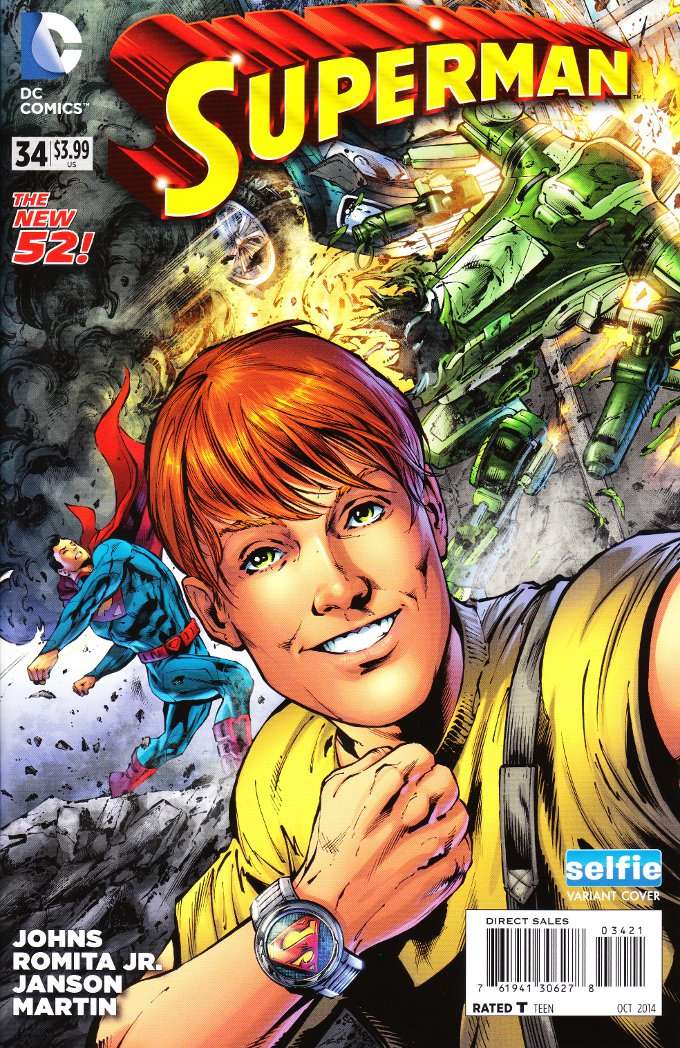
A quick comment upon the cover of this issue.  I was less than enamored of the Selfie Variants that each DC Comics title had this month.  I disapprove of variant covers as a general rule and felt that this gimmick did not work for a lot of characters.  That being said, this one is damn good and a perfect send-up of the concept and the characters involved.  Because Jimmy Olsen would totally do this in the middle of a battle.


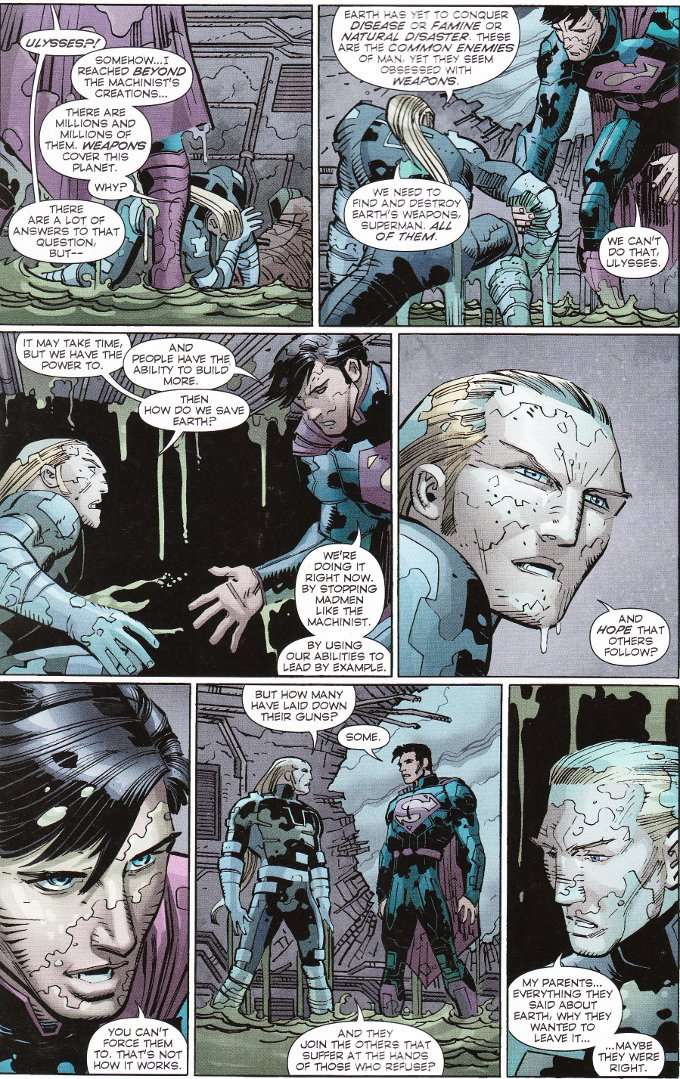
Curiously, Jimmy Olsen and the rest of the Daily Planet crew are absent from this issue.  The focus is once again upon Ulysses - strange visitor from another dimension, who has turned to Superman for guidance as he finds himself in what turns out to be the world of his birth.  The first part of this issue continues on from last month's closing revelation - that Clark Kent was able to track down Ulysses' scientist parents and uncovered the truth of how they sent him away in circumstances that mirror what Clark's own birth parents did to save his life.

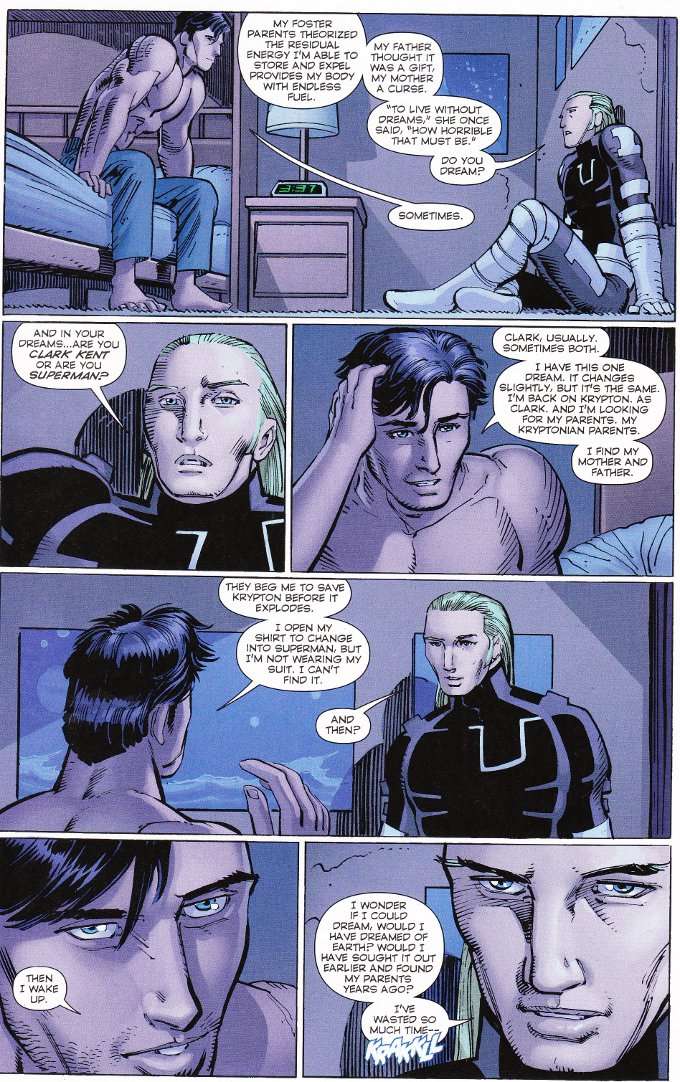
Geoff Johns is in fine form here and the better part of the issue is spent explaining Ulysses's background and exploring the growing friendship between himself and Clark.  It is a slow story but it is still an enjoyable one and the reader feels Clark's subtle joy at having helped someone get the family reunion that he can never have.  There's also a bit of humor in how Clark is still a more human person than Ulysses, who thinks nothing of coming into Clark's apartment at night to watch him sleep because he had a sudden bout of curiosity regarding why he didn't need to sleep when Clark does and whether or not Superman dreams as normal humans do.  But worry not, action fans - the two heroes do team up against a new villain by the issue's end!


Unsurprisingly, the artwork by John Romita Jr.and Klaus Janson is as good as one would expect.  The action, once it starts, is well displayed but JRJ is just as capable of rendering the softer, quieter moments that this script requires..  The coloring by Laura Martin is also praise-worthy, with a variety of palettes being used throughout to subtly indicate the story's multifarious settings.

Sunday, July 27, 2014

Superman #33 - A Review

Superman #33 is something unusual in that it is a Superman book that barely contains any action. The focus here isn't on big climactic battles or costumed madmen but upon the staff of the Daily Planet, who are as confused as the rest of Metropolis about the appearance of a mysterious new hero fighting alongside Superman.  Clark Kent is short on answers as well, but he intends to learn the origins of the mysterious man called Ulysses...


Writer Geoff Johns' love for these characters is apparent and it is good to see the Daily Planet staff back in action.  The scenes with these characters are enjoyable, introducing us to these characters without feeling over-expository.  Johns is famous for his gift for dialogue - and there is some good comedy here - but the most effective sequences in this issue may be the ones that are free of text.

There are a number of scenes  in this issue where the story is told purely through the pictures.  We learn more about Ulysses as a person watching him examine Clark Kent's apartment than we do in any of the dialogue.  There is also an effective silent sequence in which we see Clark putting his investigative skills to the test.


Superman #33 is fairly light on action.  And yet, it is one of the best Superman comics I've read in recent memory.  This book remembers that what makes Superman super is his infinite capacity for wanting to help other people and that doesn't always mean punching a bad guy.  If you like Superman, you'll love this book.  And if you don't like Superman, well, maybe this book will take you a step closer to doing so.

Monday, July 21, 2014

Five Reasons Oliver Queen Is Awesome

Despite the popularity of the show Arrow, fans of Oliver Queen still get a lot of guff about our favorite hero being a half-hearted Batman rip-off.  While it may be true that Green Arrow spent a goodly portion of The Silver Age following in Bruce Wayne's footsteps, later comics turned Oliver Queen into his own man.

So what is it that separates Oliver Queen from all of the other billionaire playboy superheroes and all of the other archery-based superheroes?  Besides epic facial hair, of course.  Well, the man said it best himself in JLA #123.

"...I can't leap tall buildings in a single bound and I don't wear any fancy power rings. Hell, I'm not even the world's second greatest detective, whatever THAT means. But I am a guy with a hell of a lot of chatzpah. And that's got to count for something in a crisis, right?"

More than anything, Oliver Queen is defined by that word - chatzpah.  Call it guts, nerve, boldness, balls or just plain audacity if you want to use a ten-dollar word.  Oliver Queen is a man who will say the unthinkable, attempt the impossible and just plain refuse to back down no matter how badly the deck is stacked against him.

To that end, I've put together a list of five deeds that I think exemplify Green Arrow's awesomeness.  And to make it fair, I've eliminated all of the stories where he dies a heroic death in the name of his principals.  Because that is its own Top Five list.


5. Oliver Queen - The One Man Justice League. 


As Seen In: The Dark Knight Returns & The Dark Knight Strikes Back

I'll admit this one is implied more than it is stated.  But the facts are there on the page.  For those who haven't read The Dark Knight Returns, it's a classic Batman story set in an alternate future where superheroes were made illegal in the United States and a middle-aged Bruce Wayne comes out of retirement to become Batman one last time.  The sequel, The Dark Knight Strikes Back, is not as well regarded but it continues the story of DKR and shows what happened to all of the other Justice League members.

Apart from Superman, Green Arrow is the only Justice League member who appears in The Dark Knight Returns.  We don't get the full details of his story but we do get enough to paint a vivid picture.  Oliver Queen was in prison for a while, escaping five years previously.  He spent that time on the run, striking against the corrupt American government as best he could from overseas.  And at some point before Ollie was imprisoned, Superman was responsible for him losing an arm.

The Dark Knight Strikes Back reveals the fates of the other JLA members.  Wonder Woman and Captain Marvel joined Superman in working for the American government, which we find out is secretly being run by Lex Luthor and Brainiac.  The rest of the team either went into hiding in remote locations or were captured and imprisoned by Luthor and Brainiac.

Logically, that means that for a time, both before being imprisoned and afterward, Oliver Queen was The Justice League.  He was the one hero who didn't back down or give up or agree to fade into the shadows in a world that was going to Hell.  And he did that while single-handedly facing two of the world's most dangerous villains and three of the most powerful superheroes on the planet.

And when I say single-handedly, I mean that in the literal sense as well.  Yet despite that disadvantage, he could still use a bow with Olympic-level accuracy.  Even though he had to pull the bow-string back with his teeth!


4. Oliver Queen Holds His Own Against The Forces Of Apokolips.


As Seen In: Final Crisis #4

At the time of this story, Black Canary was the leader of The Justice League.  And as Apokolips once-again tried to invade the Earth in the name of Darkseid, The JLA Watchtower was attacked.  Knowing the importance his wife held in planning a retaliation against the invaders, Oliver Queen stayed behind to hold off the pursuit as the rest of the team teleported to safety.  

One man with a quiver full of arrows against a horde of soldiers with the strength and endurance of Superman, riding giant hunting hounds and a few brainwashed superheroes as well?  Doesn't sound like much of a fight.  And it isn't.  Ollie tears them apart.

He brings down the hounds and the soldiers with them.  And if Ollie hadn't stopped to try and talk some sense into a brainwashed Black Lightning, he might well have won.  But he didn't and one good shock to the system was all it took to bring Oliver Queen down long enough for a mind-control helmet to be slapped down on his head.

This battle would rank higher, but this fight was a loss for Oliver Queen.  And yet it was a victory, because Ollie did accomplish his goal of buying enough time to let the love of his life and the rest of his teammates get to safety.  And while the villains may have technically won the fight,  it was a hard-won victory that shouldn't have been nearly as difficult as Oliver Queen made it.


3. Oliver Queen Overcomes The Black Mercy


As Seen In: Green Lantern (Vol. 4) #8

Created by Alan Moore for his Superman story For The Man Who Has Everything, The Black Mercy is a sentient alien plant with telepathic abilities.  Parasitic in nature, the plant latches on to a host, to whom it broadcasts a hallucination of an ideal life.  The host slowly wastes away, blissfully unaware that its body is being sucked dry by The Black Mercy in the real world as their every fantasy is seemingly brought to life.

So how strong is a Black Mercy plant?  Strong enough that even Superman couldn't break free of its control without Batman pulling it off of him by force.  And then when it latched on to Batman, Robin had to pull the plant off of Batman for him to be freed of its influence.  Even Hal Jordan was unable to resist the lure of the perfect world that The Black Mercy created for him.

And yet... Oliver Queen did.  He resisted.  He saw through the illusion and dragged himself and Hal back to reality after a single Black Mercy plant latched on to them both.

After the fact, Hal Jordan guessed that the plant had chosen to focus on him since his will was stronger and that instead of giving Ollie a vision of what really would be his ideal world, it had given him what Hal thought would be Ollie's perfect world within the context of Hal's perfect life.  Fine and dandy.  Except that does nothing to explain why Hal Jordan thought to set-up Oliver with Connor Hawke's mom (a woman Ollie hadn't seen in decades and whom Hal had never met) and why there was no place for Dinah Lance or Roy Harper in Ollie's "perfect life".

I think Hal is kidding himself.  I think the truth is that The Black Mercy may be strong enough to cloud the mind of Superman, subvert the fortitude of Batman and even overcome the willpower of a Green Lantern.  But that's nothing compared to Oliver Queen's ability to question everything around him.


2. Oliver Queen Resists Poison Ivy


As Seen In: Batman/Green Arrow: The Poison Tomorrow

Dennis O'Neil earned his place in comics as a living legend with his work in the 1970s on both Batman and Green Arrow.  It was he who developed Green Arrow into the modern-day Robin Hood we know and love and turned Batman into a Dark Knight Detective once more.  He teamed the heroes together in The Brave and The Bold and a few more times besides!  And yet, I think O'Neil's 1992 graphic novel The Poison Tomorrow may be the best thing he ever did with both of these heroes together.

The Poison Tomorrow sees Batman and Green Arrow joining forces after they discover they are working the same case from different angles, with Oliver Queen racing time to save Black Canary's life.  The trail leads from a diseased scientist to Poison Ivy and a plot to use toxic baby food to make a fortune selling an antidote.  In the exciting climax of the story, Batman moves to stop the first shipment of the tainted food as Green Arrow retrieves the antidote from Poison Ivy, who is currently hiding out in a housing development that was built on a toxic landfill!

To his credit, Ollie does try to go in protected.  But he didn't count on how hard it was to draw a bow while wearing a Hazmat suit.  Or on Ivy having a muscle-bound henchman who shared her immunity to toxic waste.  Deciding he can risk the poisoned environment for long enough to hand out a beating, Ollie slips out of the suit and beats down the henchman only to be confronted by Ivy herself.

Ivy, being Ivy, pours on the charm along with the pheromones.  The full "oh my brave hero, let me take care of you" act.  And for a moment, Ollie is tempted.  He's taken a few good lumps from the henchman and he's starting to feel the effects of the toxins around him.  And a little voice tells him he's as good as dead anyway - what harm could one kiss do?  But Oliver Queen's love for Dinah Lance is too strong to be overcome by such cheap tricks.  And with one open-handed strike to the face, Green Arrow shuts Poison Ivy down.

A few years ago, I achieved a modicum of fame for taking Judd Winick to task for his depiction of Oliver Queen as an unrepentant womanizer who cheated on Dinah Lance continually.  This story was largely responsible for my attitude.  Because while a lot of stories show how passionate Oliver Queen is in his love of Dinah Lance, I don't think any story has ever quite so well depicted just how strong that love truly is and how love is a more powerful force than lust any day of the week.  That's why I have nothing but contempt for anyone who tries to sum up Oliver Queen as "a horndog who chases skirts and can't stay faithful".


1. Oliver Queen Walks Out Of Heaven.


As Seen In: Green Arrow (Vol. 2) #10

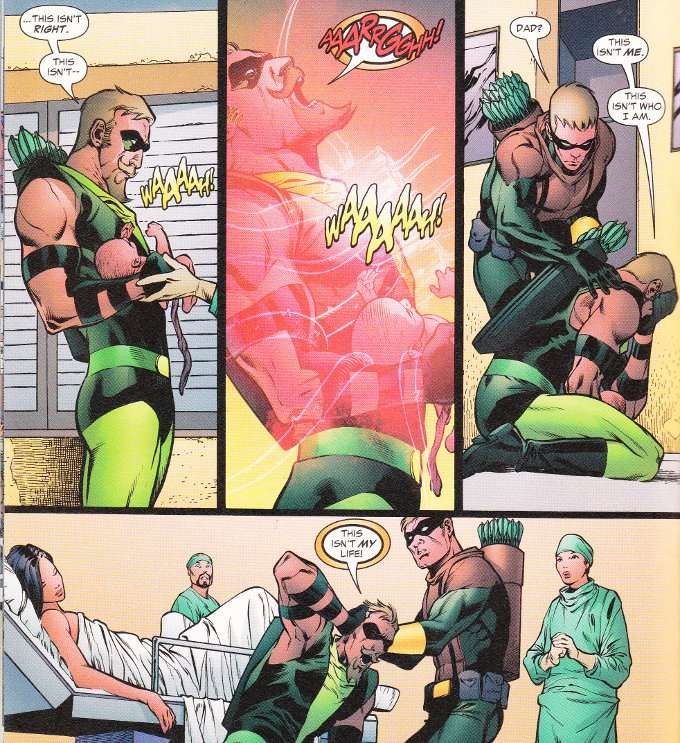
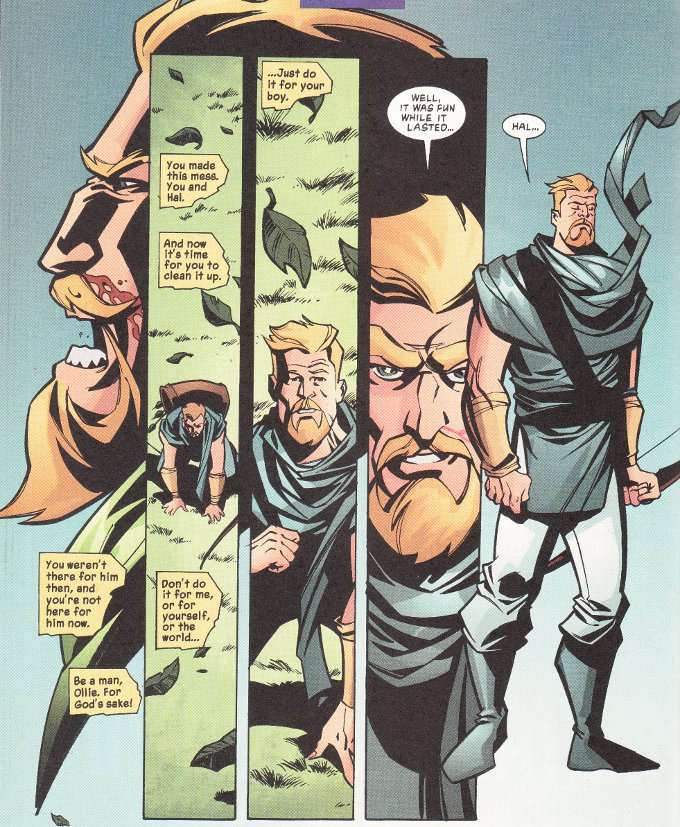
Oliver Queen was dead.  Astonishingly, to him at least, he went to Heaven.  Or some kind of paradise where he had found the peace that was denied him in life.  As such, when his best friend Hal Jordan (who, at the time, possessed the power of all but one of the Guardians of the Universe) breached the boundaries between worlds to offer him a second chance at life, Oliver Queen turned it down.  But he did agree to let Hal bring him back after a fashion, creating a soulless clone that would possess all of Oliver Queen's memories up to a certain point.

This "hollow Ollie" would go on to reestablish the name of Green Arrow in Star City in Kevin Smith's Quiver and become a target for all manner of supernatural evil.  When that evil threatened Connor Hawke - Oliver Queen's illegitimate son - the hollow Ollie was somehow able to breach the boundaries of Space and Time to deliver his older, wiser self a much-needed dressing down.  That and the knowledge that his son needed him was enough to stir Oliver Queen into action and demand to be returned to Earth.

Oliver Queen defied his enemies.  He defied his friends.  He defied his government and alien invaders.  He overcame a mind-controlling parasite and the most powerful seductress on Earth.  And all of that is awesome.  But for sheer awesomeness, I don't think anything can top Oliver Queen finding the strength of will to walk out of paradise.


Agree?  Disagree?  I await your comments.

Thursday, June 26, 2014

Superman #32 - A Review

To be quite blunt, I don't like a lot of the changes that The New 52 has brought to Superman.  I don't like having both of The Kents dead.  I don't like the idea of Superman and Wonder Woman dating.  And I don't like Clark Kent having been turned into Peter Parker with better musculature.

As such, I quite happily wrote off the Superman books a while ago.  I was never the biggest Superman fan to begin with, although I did like what Grant Morrison was trying to do with Action Comics before his departure.  I was looking forward to what Andy Diggle was going to do before he decided to leave that series after one issue.  And I was enjoying Supergirl before it was decided it should tie in more closely to whatever Scott Lobdell was trying to do with the Superman books at the time.

So what brought me back for this issue?  Two creators whose work I've always respected, even on the rare occasions when I didn't enjoy it - Geoff Johns and John Romita Jr.


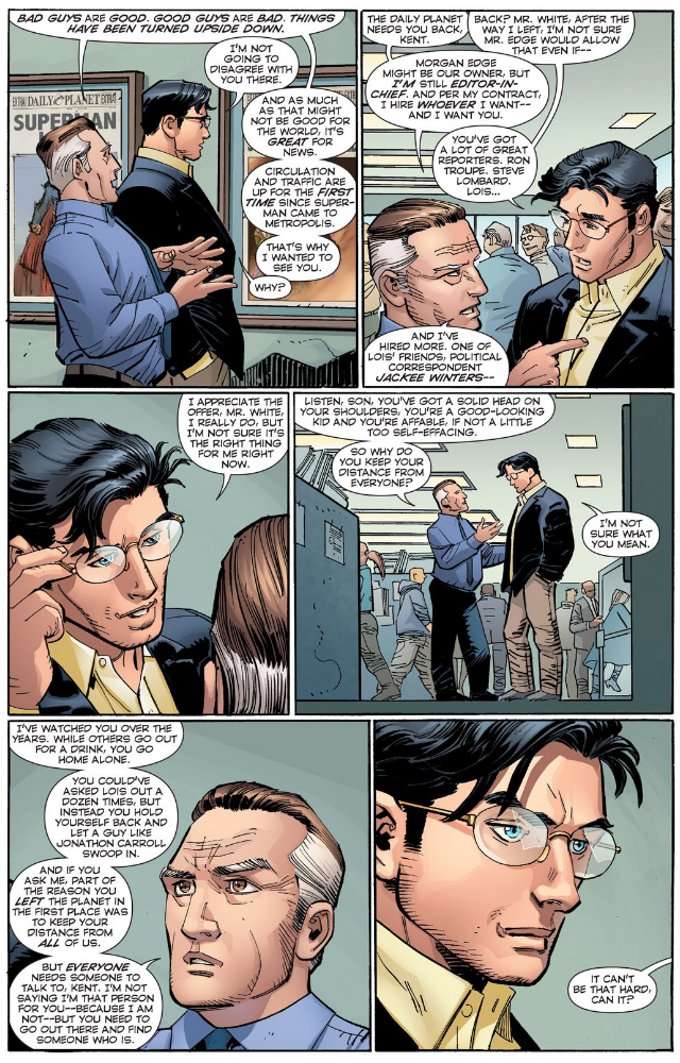
Johns seems to be trying to re-establish the connections that earlier writers forsook.  This issue sees Clark being rehired at The Daily Planet and Perry White encouraging Clark to try and build more personal connections with people - something his life as Superman afford him little chance to do outside of his circle of superhero co-workers.  The book also introduces a new hero, who promises to be someone Clark can bond with on a more personal level than with Batman or Wonder Woman.

I think Johns hits the meta-textual nail on the head with White's assessment.  One of the biggest problems with Superman books of late - and many Superman stories in the past - is that there has been too little of Clark making connections with other people.  "The 'Super' has been put before the 'Man', to paraphrase Mark Waid in Kingdom Come, and the books have suffered for it.  Superman cannot just be about punching giant monsters.  It has to be about helping people as well.

Thankfully, when the time for monster-punching does come, John Romita Jr. proves as skillful as ever in depicting the action.   Whether he's choreographing involved fights or rendering talking heads, Romita is one of the best.  He's held up as one of the greats in the business for a reason and that reason is evident throughout this issue.

Thursday, December 12, 2013

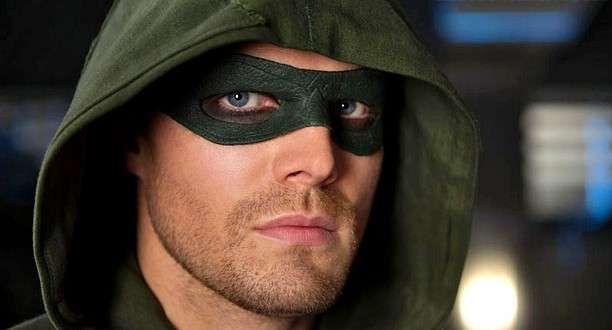
Arrow Episode Guide: Season 2, Episode 9 - Three Ghosts

For a summary of the episode guide layout & categories, click here.


Plot

With Ollie still recovering from his injuries at the hands of Brother Cyrus and an accidental injection of blood thickener, he might be forgiven for forgetting that it's almost Christmas.  As Roy Harper searches for answers in the mysterious murder of a local artist and Ollie continues his hunt for the people building an army of super-strong soldiers, The Arrow will be visited by three spirits - ghosts from his past with messages about his future.  Is Ollie going mad?  Or merely taking his first difficult steps out of the darkness and into a brighter future?

On the island, Oliver, Sara and Shado are at the mercy of Professor Ivo and Ollie will be forced to make a sadistic choice between both of the women he's loved.


Influences


Charles Dickens' A Christmas Carol
(the appearance of three ghosts inspire a man to change his ways at Christmas time), Green Arrow: Year One (The Island sequences), Green Arrow: Quiver (Slade's line about Oliver looking like he saw a ghost is virtually identical to a running gag line about various people seeing a back-from-the-dead Oliver Queen), Green Arrow: The Archer's Quest (Barry Allen makes Oliver Queen - and the rest of the Justice League - costumes made of compressed fabric) and The Flash: Rebirth (more references to the Geoff Johns revamp of Barry Allen's origin story).


Goofs


Barry seems to forget about his boss's threats regarding his job from last episode, staying in Starling City for at least two more days to help out around the Arrow Cave.


Performances


We've seen Stephen Amell and Caity Lotz show their acting chops playing three or four variants of the same person on this show.  Manu Bennett can now be added to the list of  actors on this show who have accomplished this feat.  This episode sees him playing the tough-guy mask Slade Wilson wears on the island, the vulnerable man who fell in love with Shado, the ghost of Oliver's memories of Slade and - finally - the modern Slade, still alive and well and holding a grudge.


Artistry


The whole of the scene with Ollie fighting Slade's ghost in the Arrowcave.  Writing .  Music.  Performances.  Cinematography.  Lighting.  Everything is perfect.

While I generally like Geoff Johns' writing, I haven't always liked how he's portrayed Oliver Queen in the comics.  And yet this episode - co-written by Johns and series writer Ben Sokolowski  - prefectly captures three essential points to Oliver's character in the lessons he is taught by his ghosts.  Shado tells Oliver that he should fight to protect the living - not to honor the fallen.  Slade tells Oliver that the real reason he fights is to atone for his own sins.  Finally, Tommy reminds Oliver that sometimes you fight because someone has to fight back.


Trivia


Barry suggests Oliver wear a mask made of compressible micro-fabric.  This is the same material in the comics that Barry eventually uses to create his costume as The Flash, folding it up inside a ring to be easily retrieved when he needs to change.

In the story Green Arrow: The Archer's Quest, it is revealed that Barry made costumes of the same compressible micro-fabric material for his teammates in The Justice League before it was pointed out that only a person with super-speed could effectively utilize such a ring.

Cyrus Gold was the name of the man who - in the Golden Age Green Lantern comics - became the zombie villain Solomon Grundy.  Though the exact details of what sort of man he was differ from retelling to retelling, most of them agree Cyrus Gold was not a nice man.  The best story refers to him as a gentleman of ill repute and the worst of them identify him as a miser and a pedophile!  Rising form the dead as a zombie with no memory of who he was, Gold was dubbed Solomon Grundy after the nursery rhyme character since the only thing he could recall of his past was being born on a Monday

The founder of STAR Labs is identified as Harrison Wells.  In the comics, the founder of STAR Labs was named Garrison Slate.

Quentin Lance's former partner is named Lucas Hilton.  This is also the name of a cop character created by Arrow Executive Producer and comics writer Andrew Kreisberg , during his run on the Green Arrow/Black Canary comic.

Slade's line about Ollie seeing a ghost is very similar to a line repeated in Green Arrow: Quiver.  In that story,  Oliver Queen comes back from the dead and says that line to people who are astonished to see him.

The Asian reporter covering the particle accelerator story in Central City is named Linda Park.  This is a reference to a reporter from The Flash comics, who eventually married Wally West - a.k.a. The original Kid Flash and Barry Allen's successor as The Flash.

In the original The Flash comic, Barry Allen gained super-speed powers after being thrown through a shelf full of chemicals while being struck by lightning.  It is unknown what role the multifunctional particle accelerator has, if any in his origin in the Arrow universe.  However, it did appear that Barry was already moving faster than his surroundings immediately before the lightning strike. 


Technobabble


Barry determines that Ollie was injected with a coagulate which causes his blood to become unnaturally thick.  He treats this by injecting Ollie with rat poison.  Most rat poisons are anti-coagulates that kill rodents by thinning their blood over an extended period.  While the same base chemicals are used in drugs to treat overly-thick blood, it should be noted that most doctors do not recommend taking rat poison as an alternative to prescribed medication.

Barry is able to recreate a fingerprint by adding a gel-based polymer to the residual oils from Brother Cyrus' skin from where he grabbed Ollie's neck and cut the skin.

Oliver says the reason he doesn't wear a mask is that it won't conform perfectly to his face and would hinder his ability to aim while on the run.

Barry suggests Oliver look into a mask made of compressible micro-fabric to hide his identity, saying that green grease-paint isn't very effective at hiding his identity.  By episode's end, he has made such a mask for Oliver. 


Dialogue Triumphs


(Looking at the arrow in Roy's leg)
Ollie: (gripping the arrow with both hands) Roy?  This is going to hurt.
Roy: My anger's dulling the pain.

(As Ollie is working out and trying to shoot a bouncing tennis ball, his arrow is caught by Slade)
Slade:
What's the matter, kid?  You look like you've seen a ghost.

Slade:
You're not a hero. Or a friend. Or a brother. You are nothing. 
(Ollie turns away from him)
Slade:
Do not turn your back on me!  Not again!
Ollie:
You're gone.
Slade:
Wherever I am... it's time you joined me!

Tommy:
I know I called you a murderer but you are not.  You are a hero.  You beat the island.  You beat my father.  So fight, Oliver.  Get up and fight back! 

(When explaining to Brother Blood why he does not want The Arrow killed)
Deathstroke:
Death would be a release from this life and his sentence has yet to be carried out.  I'm going to tear everything he cares about away from him.  Destroy those who choose to follow him.  Corrupt those he loves. Once he has lost everyone and everything he values, I will drive an arrow through his eye.


Continuity


Shado is confirmed to be dead.

Slade is confirmed to be alive and holding a grudge against Oliver.

Felicity refers to when Moira shot Oliver and he turned to her for help (114) and when he revealed his identity to Diggle in order to save his life (103), while arguing with Oliver about her revealing his secret identity to Barry Allen.

Moira decorates the house for Christmas alone, saying she won't be throwing a big party this year, referring to the disappointing turn out for the party in 208.

Ollie hallucinates Shado twice - once while he's on the table being treated by Barry and later as he's walking down the halls of Queen Manor alone.  She asks him to give up being The Arrow before everyone around him dies.

Diggle confirms that Ollie prefers to be called The Arrow now.

Barry mentions The Arrow's battles with The Dollmaker (203), Count Vertigo (207), Dodger (115) and The Huntress (117).

Blood sends Laurel flowers and asks her to go Christmas shopping with him.

Oliver still addresses Quentin Lance as 'Detective' as The Arrow.

Ivo kills Shado after Oliver throws himself between Ivo and Sara, after Ivo trains his gun on her.

Laurel discovers that all the blood donors at Blood's drives were required to take a psychological evaluation by the Langford Institute.

Felicity is Jewish.

Felicity and Barry go out to eat together at the Big Belly Burger - not seen since last season.

Ollie hallucinates Slade twice - once on the rooftop of SCPD headquarters while talking to Quentin Lance - the other in the Arrowcave.  Slade tells Oliver that he became The Arrow to atone for his own sins - not make up for his father's mistakes.

Oliver finally tells Diggle and Felicity about Shado.  He tells Diggle about Slade Wilson. 

Diggle admits to seeing the ghosts of soldier friends who he outlived. 

Roy discovers that Max's file photo is stamped with the word Mirakuru - the Japanese name for the Miracle/Miraclo drug. This name will be used henceforth.

Oliver kills Cyrus Gold after triggering an explosion, which sprays more Mirakuru on Gold while collapsing a ceiling on him.  The smart money is we have not seen the last of him.

Ollie hallucinates Tommy during his fight with Brother Blood and Cyrus Gold.  Tommy tells Oliver that Tommy was wrong to call him a murderer and that he is a hero.

Oliver is able to save Roy's life by performing CPR on him after he apparently dies from taking Mirakuru.  He then returns Roy to Thea's room at Queen Manor.  Roy's memory of the event is fuzzy and there's no indication he knows Ollie is The Arrow.

Blood formally announces his run for mayor.

The "friend" who gave Blood the Mirakuru sample is revealed to be Slade Wilson.

Thanks to the Mirakuru, Roy's injuries from last week have healed completely.  It remains to be seen if Roy has gained enhanced strength and reflexes from the injection as well.

Sara lies to protect Ollie when Slade discovers Shado's death.  Slade asks who killed her.  Ollie is about to say "I did" when Sara cuts him off and says "Ivo".

Barry has a bulletin board filled with materials regarding his mother's murder.

Barry Allen is struck by lightning and thrown through a rack of chemicals.

Barry makes Oliver a green mask that Felicity says makes him look like a hero.

 
The Fridge Factor


Pretty much the entire female cast is sidelined for this episode.  Shado and Sara are girl hostages, with Shado being fridged to give Ollie and Slade angst.  Thea and Sin are mostly there to fuss over Roy when he's wounded.  Moira is decorating the Queen household for Christmas in solitude.  Laurel is only there to cry over her father and to further advance Roy's mission.  You know things are bad when lab-rat Felicity proactive female character in the episode and even she spends most of the episode fawning over how awesome Barry and Ollie are.


The Winick Factor


Ollie's defending The Arrow's shooting Roy as a means of keeping him safe is lame even by Ollie's low standards for unbelievable lies.


The Bottom Line


Ignoring the shabby treatment of the female cast, it's a damn good episode, a fitting set-up for The Flash TV series and a fine way to mark the midway point of the season.


Tuesday, October 29, 2013

Justice League #24 - A Review

Is it possible for a good fight scene to salvage an otherwise uninspired comic?  Perhaps, but Justice League #24 is not the book to make that case.  Geoff Johns has written many great books but this, I'm sad to say, is not one of them.

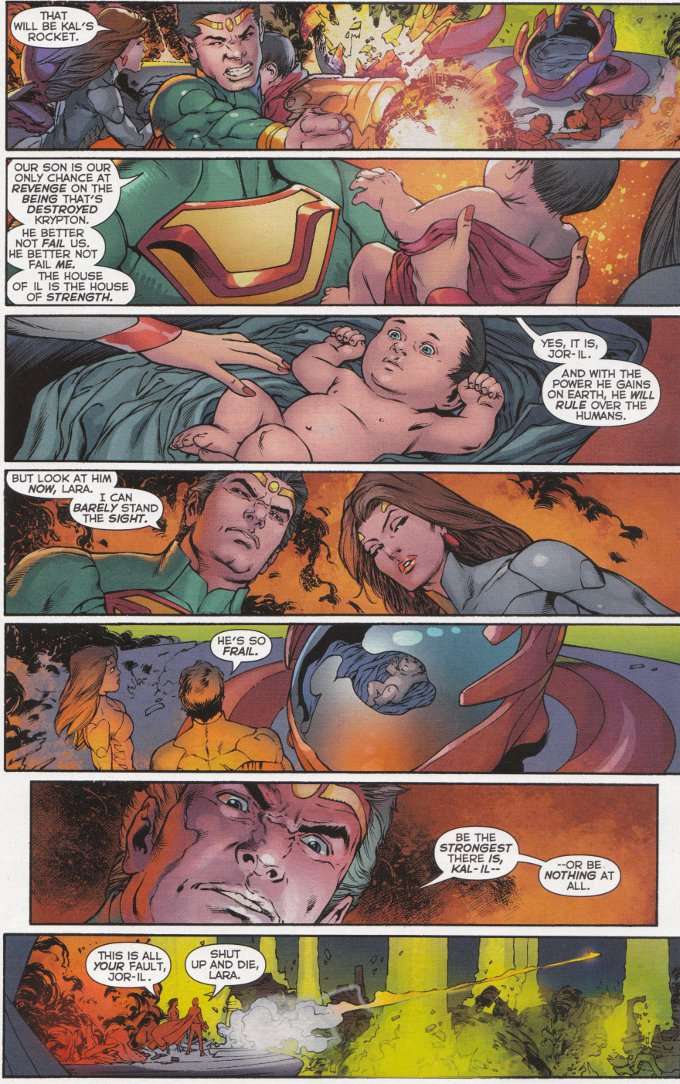
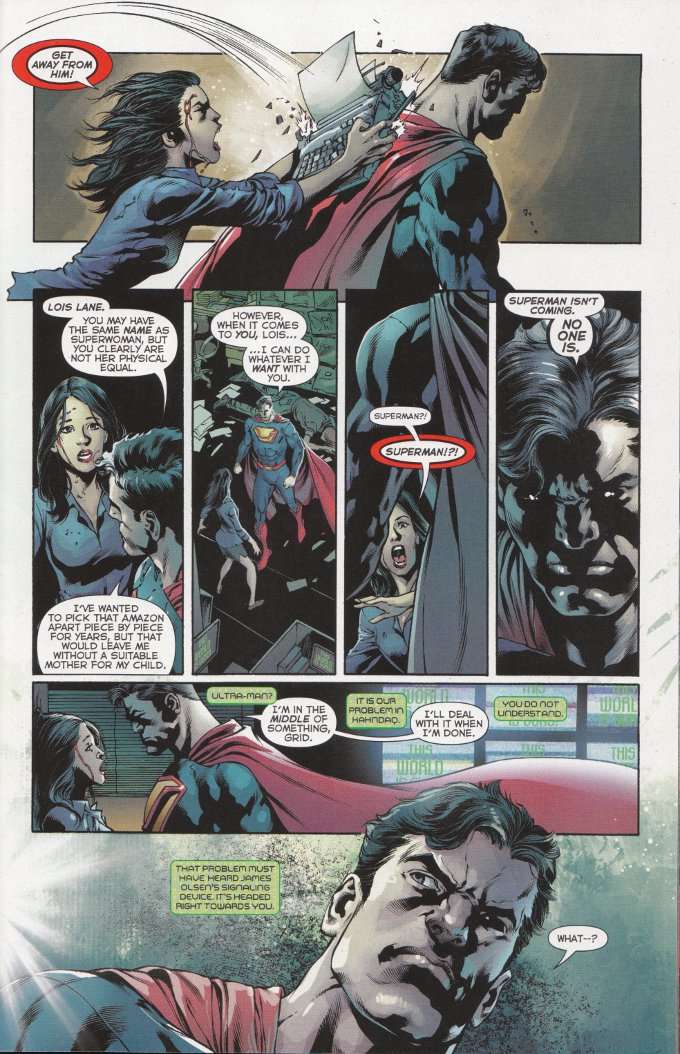
Most of the issue is devoted toward telling the detailed origins of the villainous Ultraman - Superman's evil counterpart from the parallel Earth Three.  Alert fans will note that this story is largely identical to the origins of Superman as depicted in Johns' own Superman: Secret Origin, with a little bit of Grant Morrison's Earth 2 thrown in for good measure.  We see Jor-Il (gedit?) fighting the equally evil masses of Krypton over the last escape pod off their world and The Kents as opportunistic drug addicts rather than as good and decent farmers. 


If this sounds bleakly depressing, it should.  Johns goes over the top in showcasing what a miserable a place Earth Three is and in establishing Ultraman as a conscienceless rapist and murderer.  The whole affair is technically well-written yet seems drab and dull in spite of that.  Most readers are already familiar with this story and discussing the details of how Superman and Ultraman's backgrounds differ, while undoubtedly a fun intellectual exercise for comic geeks, makes for a dull story.

Johns almost manages to salvage this affair with the eleventh-hour arrival of an unexpected hero.  Fans of Johns' excellent JSA run will appreciate this sequence and it is a good, old-fashioned superhero fight.  And yet, it is not enough to forgive the monotony of the early parts of the book. 


The artwork is similarly mixed.  Ivan Reis' pencils are excellent as always but this book proves that an inker can make or break your artwork.  Three different inkers worked on this book and the differences in their styles are obvious.  The Krypton sequences are under-inked.  The sequences where Ultraman terrorizes the staff of The Daily Planet are over-inked.  A few pages manage to be just-right but the credits page annoyingly offers no details as to which inkers are responsible for which pages.

All in all, this book is giving me little reason to continue reading Justice League and further reinforcing my opinion that skipping Forever Evil was a good idea.  With an uneven and overly familiar story backed by confoundedly inked artwork, there is little to recommend this book.

Sunday, August 18, 2013

Justice League of Ameica #7 - A Review

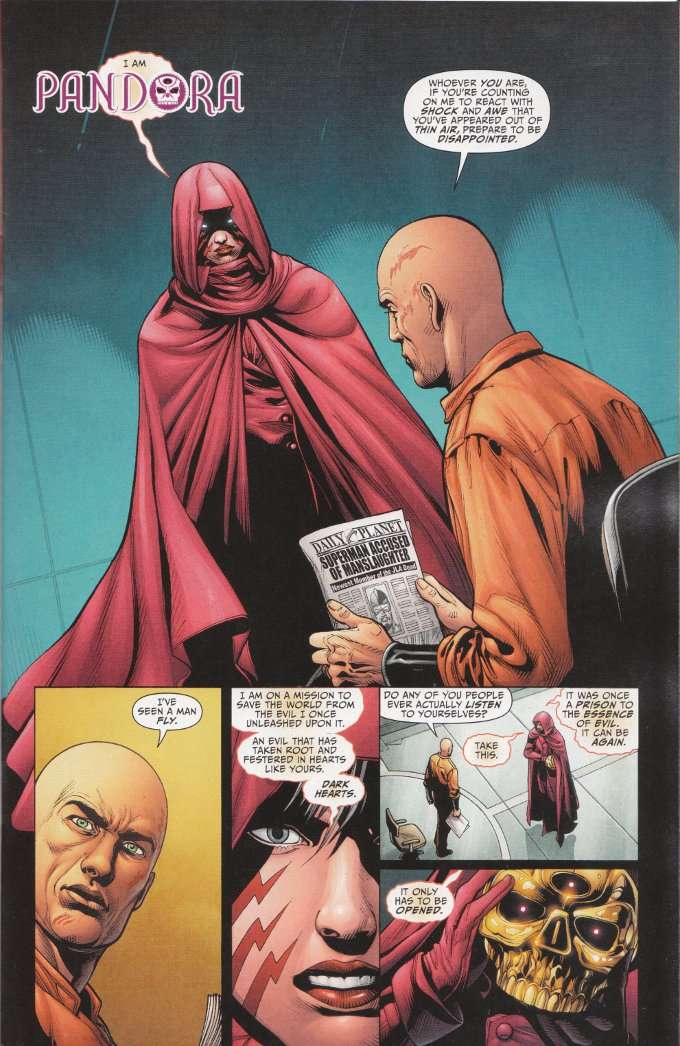
As with the previous chapters of The Trinity War, the best moments of Justice League of America #7 are those brief character moments unconnected to the main plot. Nowhere is this better illustrated than in the opening scene where Pandora confronts an imprisoned Lex Luthor.  Lex is his gloriously snide self and Pandora is... well, a living plot device with no purpose but to push the story forward.


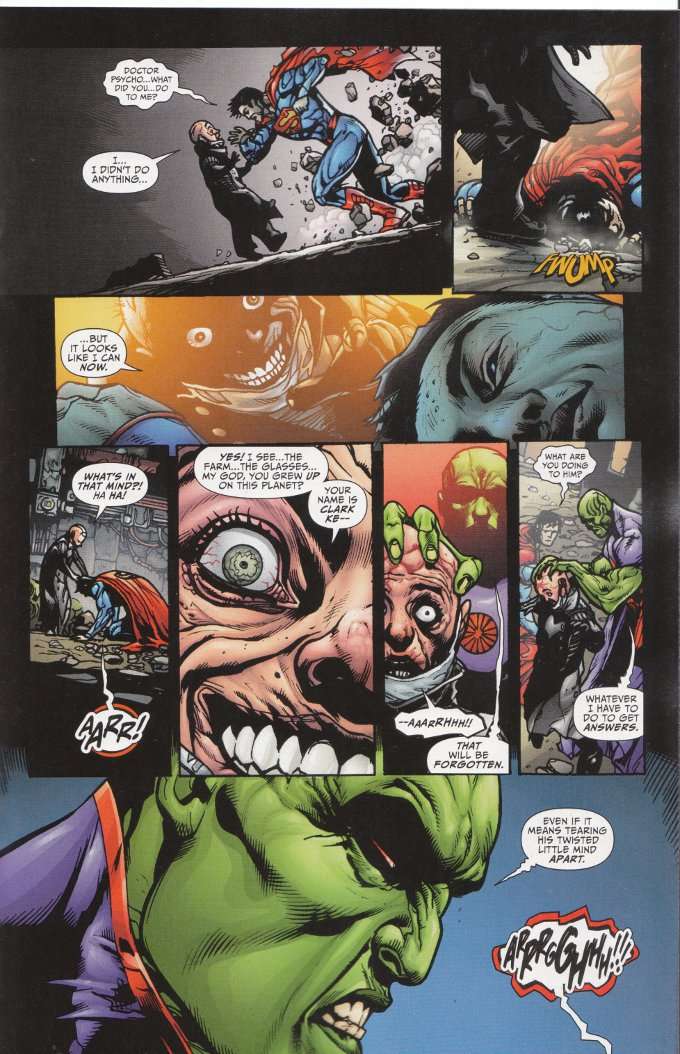
The action of the issue plays out well enough but the moments readers are most likely to find memorable are the quieter scenes where the characters are allowed to talk and play off one another.  Yet Johns and Lemire do find ways to sneak character-development into the action.  Consider the scene where Question's team of League members confronts Dr. Psycho and Martian Manhunter is given a chance to distinguish himself from Superman in terms outside of his super powers.  


The artwork of Doug Mahnke continues to amaze.  His pencils are clear enough and offer a goodly portion of detail without becoming cluttered in the smaller panels.  The book's inking continues to be it's biggest flaw, with a team of five inkers with differing styles rendering the final look of the book inconsistent despite there only being one penciler.

Saturday, July 20, 2013

Justice League of America #6 - A Review

Justice League of America #6 is far less than the sum of its' parts.  This is not to say that the book is totally without merit - far from it!  Geoff Johns and Jeff Lemire give us many great character moments and some wonderful drama but all of this is incidental to the rather lackluster plot involving the so-called Trinity of Sin and Pandora's Box.


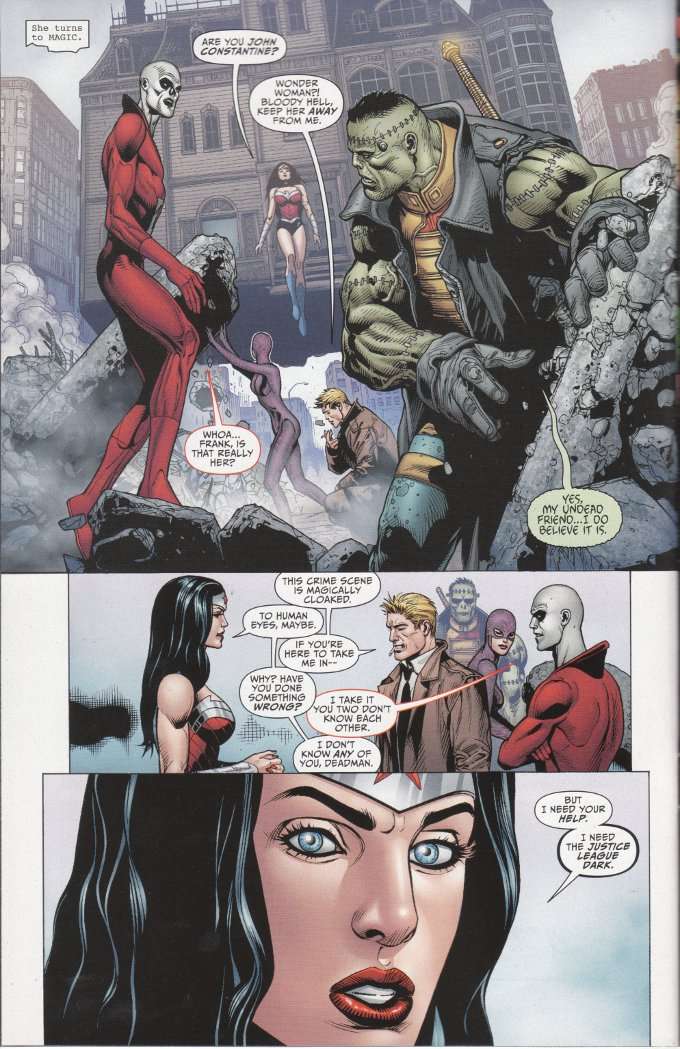
Honestly, this book would be much more enjoyable if Johns and Lemire were free to ignore the big epic battles between vaguely defined supernatural forces and just focused on letting the characters be themselves for a time.  Many of these characters are green and undefined, particularly in the case of the new Justice League members.  Throwing these characters we've had no chance to get to know and less time to care about beating each other senseless is nowhere near as interesting as watching a brief interaction between Wonder Woman and John Constantine. 

The Goddess of Truth and a magical conman being forced to work together?  Now, THAT is interesting!  I also have to give the writers credit for making Wonder Woman the main focus of this issue and letting her be the one to start investigating the case in earnest.  Diana rarely gets to take the center stage in these big events and I for one am glad to see her in the spotlight!    


The artwork of this issue is as uneven as the story.  DC Comics really needs to stop putting teams of multiple inkers to work on single books.  Doug Mahnke's pencils look decent enough from what I can tell but they are rendered quite differently depending on which of the book's four inkers are working on what pages.  Anyone who doubts the power an inker has on the final look of a book would do well to study this issue and learn the error of their ways.  

Monday, July 15, 2013

Justice League #22 - A Review And A Rant

Remember when super-heroes fought super-villains in the big crossover events?

Seriously.  When was the last time we had a big event book where the heroes fought actual villains rather than other heroes?  And no, alternate universe versions or alien clones of themselves don't count, Flashpoint and Secret Invasion fans.  It's been a while, hasn't it?

I have no objection to heroes fighting other heroes but it seems like that's all the heroes do anymore.  Have we come to the future Mark Waid predicted in Kingdom Come where the villains are underground running the world in secret and the heroes are fighting turf wars over who gets to protect what?  Reading Justice League #22, it's hard to argue that we haven't.

While the plot does feature some random bits involving the Trinity of Sin (i.e. The Question, The Phantom Stranger and Pandora), the main focus of the issue is upon the inevitable battle between The Justice League and the newly formed Justice League of America.  Inevitable, at least, in the eyes of Amanda Waller, who create the JLA specifically to counter the abilities of the original Justice League should they ever work against the interests of the USA.  When the entire Justice League travels to the enemy nation of Kahndaq after newbie hero Shazam crosses the border, Waller sees her chance and sends the JLA in to enforce America's embargo.  Hilarity ensues.   


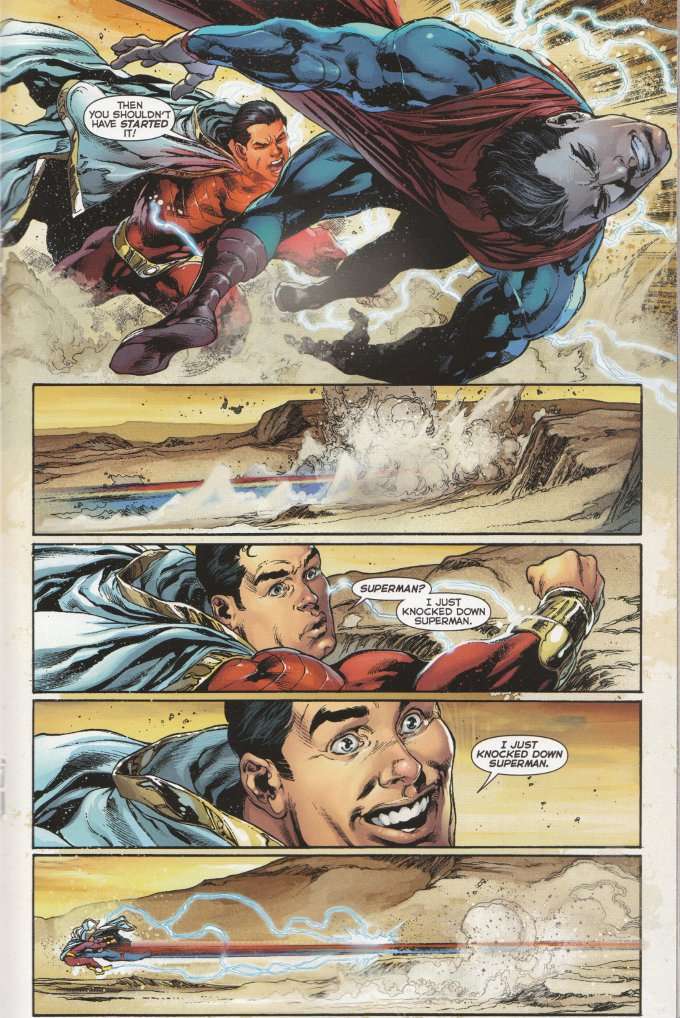
Thus far, Trinity War seems to be DC Comics' answer to Avengers Vs. X-Men -  a violent free-for-all born out of disagreements that could be solved in five minutes if the characters weren't written like complete imbeciles because that is what the plot demands.  While it isn't out of character for Amanda Waller to see The Justice League as a threat to the nation she serves, it seems uncharacteristically short-sighted for "The Wall" to send a group largely made of untested newbies like Vibe, Stargirl and the new Dr. Light into the field against a more experienced enemy.  Superman charges into battle against Shazam without trying to find out if the other hero instigated a battle with the Kahndaq Army - a question you'd think Superman would consider given that he and Wonder Woman were fighting the same army several issues earlier.  And if there was any doubt that the New 52 version of Billy Batson did not have The Wisdom of Solomon, this issue obliterated it.

Ironically, the only thing that makes this story tolerable and indeed prevents it from being  Avengers Vs. X-Men Starring The Justice Leagues  is same thing that makes it so aggravating - the writing of Geoff Johns.  Johns succeeds where Bendis and Company failed by evoking real ethos in a series of short scenes amid all the strum und drang.  Whereas it was hard to find sympathy for either the fascist Captain America or the single-minded Cyclops, one can't help but feel Billy Batson's guilt and admire his determination to do the right thing even as he goes about it in the worst way possible. 

Where Johns fails is by falling into the same trap of manipulation that turned off so many comic readers when Brad Meltzer pulled it in Identity Crisis.  With a single issue, Meltzer was able to do what so many writers had failed to do and make Ralph and Sue Dibny into something beyond a joke - characters who had earned their seemingly accidental place in The Justice League.  He then destroyed the miracle by setting us up to care about Sue and Ralph only to kill one off and turn the other into an shell of their former self.  Johns does the same thing here, sacrificing the brilliant conceit of turning Dr. Light - perhaps the most hated villain of the past 10 years of DC Comics - into a loving family-man, moralist and would-be hero.  There's no small irony that Dr. Light is the one who pleads for peace and tries to get everyone to discuss their differences before his sudden and grisly death, which triggers the superhero smackdown we were promised. 


Rest In Peace, Dr. Light.  We Hardly Knew Ye. 

The artwork by Ivan Reis, Joe Prado and Oclair Albert is as good as one might expect.  I haven't seen a bad issue yet from Reis in the past year, be it on Aquaman or Justice League.  But in this case the artwork is like a candy shell on a rabbit pellet.  Sure, it may look good... but it will leave a bad taste in your mouth.

Despite this, I will attempt to finish this crossover so that you, my readers, do not have to.  Not that I have much choice with it dominating so many of the books I read on a monthly basis.  Still, I will endure even as I wonder how two writers I enjoy so much can create something that leaves me so disgusted.


Monday, July 1, 2013

Justice League #21 - A Review

Justice League #21 is entirely devoted towards Shazam, wrapping up the origin story for Billy Batson in the New 52 Universe.  There is little I can say about this issue without spoiling it - and one of the biggest surprises in recent memory.  Suffice it to say my attitude towards this revamp has done a 180 and I would gladly buy a monthly Shazam series if Geoff Johns and Gary Frank were the creative team.


What prompted this change?  Oddly enough, it was a combination of one inspiring moment in this book and my thoughts on the Man of Steel movie and what characters mean to different people.  I had always associated the character of Captain Marvel and Billy Batson with the honesty and innocence seen in stories such as Kingdom Come and the Clash episode of Justice League Unlimited. Yet on reflection, I found that all of the appearances of Billy Batson in the comics that I liked (chief among them Geoff Johns' JSA) depicted a character who was idealistic despite lacking any illusions of the world being a fair place!  Looking at this issue, I realized that the defining characteristic of Billy Batson isn't innocence - it's optimism.  And there's a world of difference between the two.

Likewise, Billy's role is not that of the wide-eyed innocent.  He is the dream come true of every little guy held down by someone bigger.  He is every person who was ever bullied and wished, if only for a second, that they could turn the tables.  Curious then that so many of his enemies (indeed, all but one in this story) are victims of bullying who ally themselves against Billy due to their jealousy of what he is.  Dr. Sivana is a geeky scientist who longs for the magical power Billy inherited.  Black Adam is an ex-slave who fears losing what power he has now that Billy has replaced him as a magical champion.  Even Mister Mind is a victim of size-discrimination in a way.


I think now that restraining this story as the back-up to Justice League hampered it unfairly.  Given an entire issue to shine, it does just that.  The artwork is as amazing as one would expect from Gary Frank.  Geoff Johns' script inspires and entertains.  Hopefully the whole story will be collected in one volume by itself without The Justice League getting in the way.