
Showing posts with label Dan Jurgens. Show all posts
Showing posts with label Dan Jurgens. Show all posts
Friday, May 27, 2016
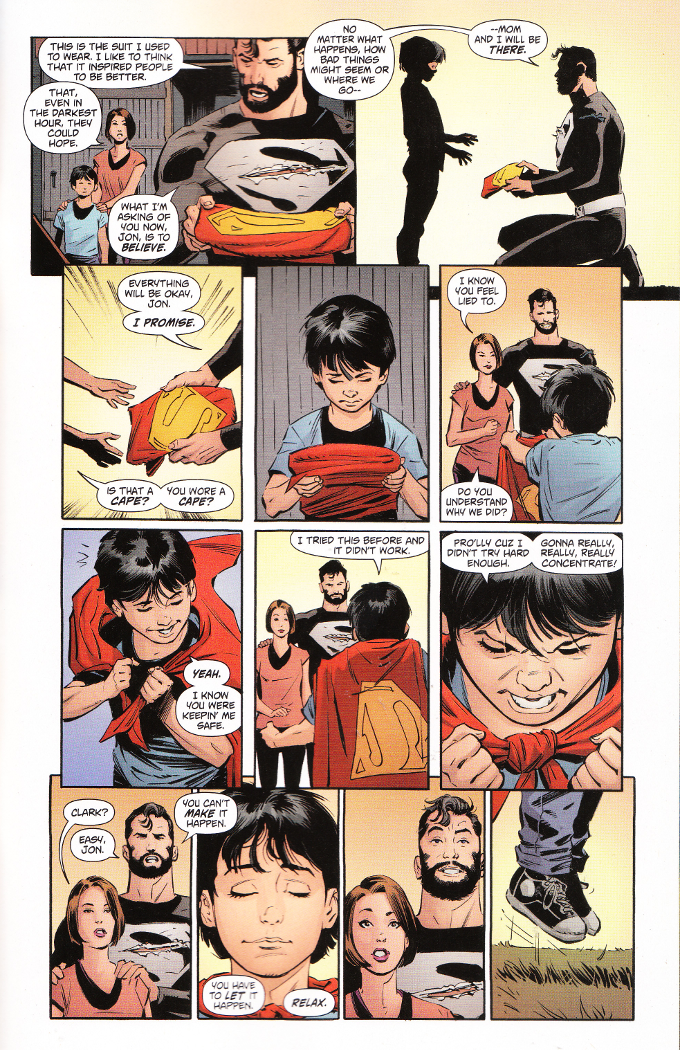
Superman: Lois And Clark #8 - A Review
Superman finally tracks down the mysterious villain who has been making his last few days so difficult. But he may face a more difficult battle when he gets home. It is then he and Lois will have to finally explain to their son Jonathan why they've lied about who they really are for so long...
The action sections of this issue are fine enough but where Dan Jurgens' script truly shines is in the interaction between Clark, Lois and Jonathan. Jurgens captures the essence of who Clark and Lois should be perfectly and Jonathan has grown into an instantly likable character under his pen. The artwork for this issue - provided entirely by the original team of Lee Weeks, Scott Hanna and Jeromy Cox - suits the story perfectly. Hopefully this story will continue to be as enjoyable in the post-Rebirth Superman series.


Sunday, April 24, 2016
Superman: Lois And Clark #7 - A Review
In the wake of Intergang's attempt to kill Lois Lane (aka Author X) and her young son, Jonathan's powers have been revealed. Thankfully, Superman is along shortly to get them to safety. But even Superman may not be able to rebuild the bonds of trust in his own family in the wake of the revelation that he and his wife have been hiding their real selves from their son for his whole life.
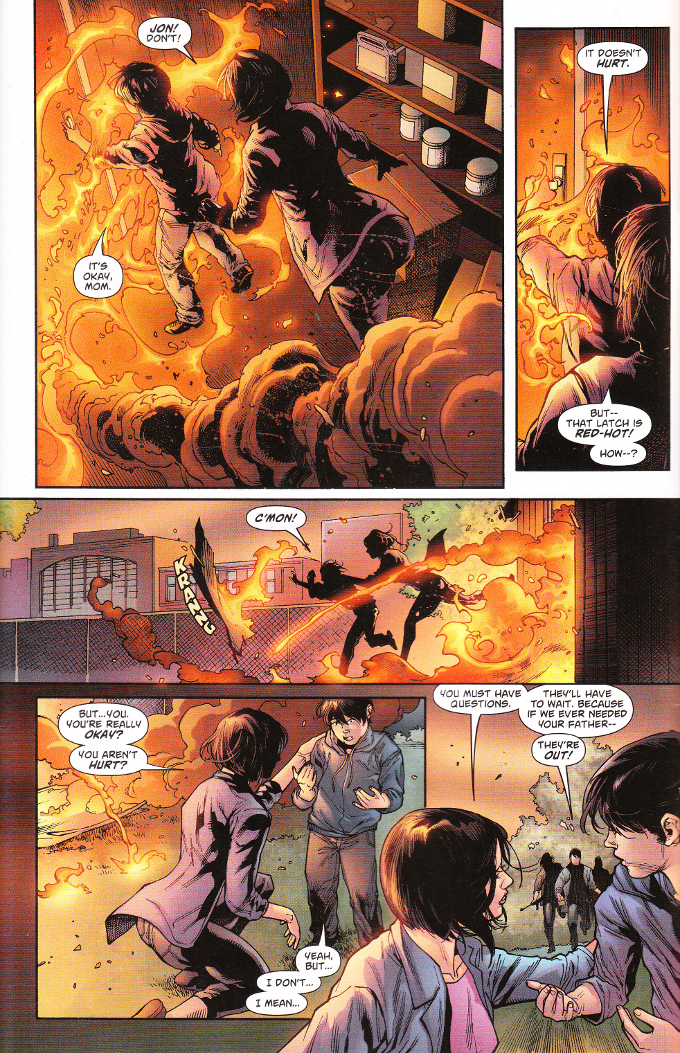
This series has been building up to this moment since the very beginning. And Dan Jurgens plays it out perfectly. Lois, Clark and Jonathan sound like a real family - something that is surprisingly rare in most comic-book portrayals of parents and children interacting with one another.
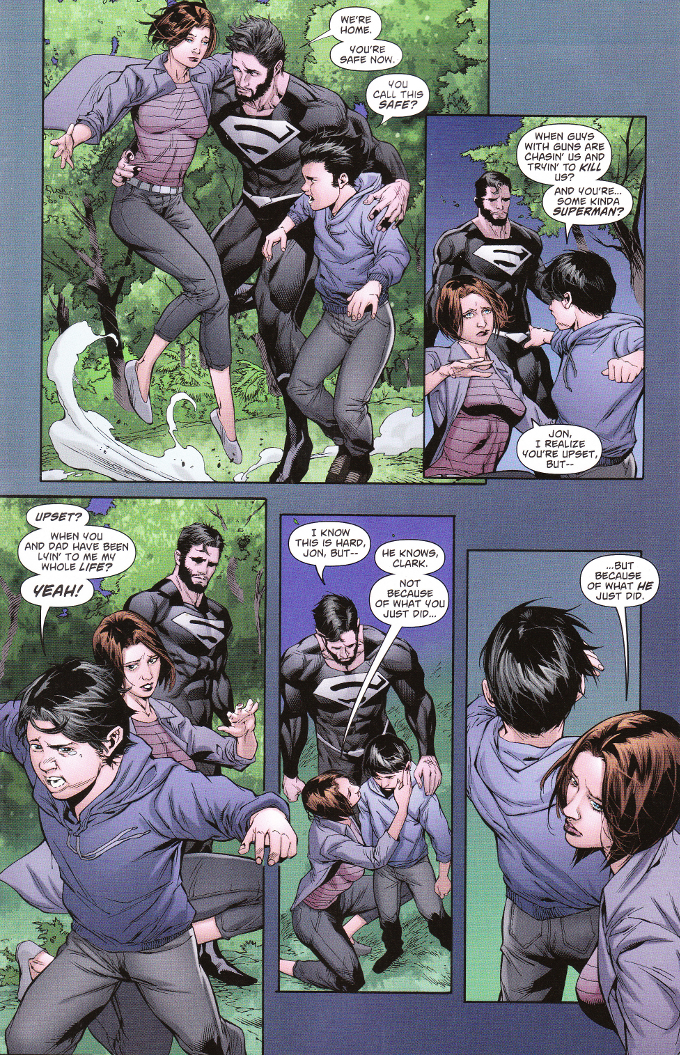
Once again I have to praise the efficiency of the art team on this issue. Typically, when you have two pencilers and three inkers on a comic, the result is chaotic and messy. Shockingly, the visual continuity of this issue doesn't suffer at all despite having numerous cooks working on the dish, so to speak.
This series has been building up to this moment since the very beginning. And Dan Jurgens plays it out perfectly. Lois, Clark and Jonathan sound like a real family - something that is surprisingly rare in most comic-book portrayals of parents and children interacting with one another.
Once again I have to praise the efficiency of the art team on this issue. Typically, when you have two pencilers and three inkers on a comic, the result is chaotic and messy. Shockingly, the visual continuity of this issue doesn't suffer at all despite having numerous cooks working on the dish, so to speak.
Thursday, March 24, 2016
Superman: Lois And Clark #6 - A Review
Intergang makes their move on Author X aka Lois Lane, abducting her and her son. This looks like a job for Superman... but he's otherwise occupied with the super-villain Badrock - start of a new reality show that just became a little too real! Thankfully, salvation may come at the hands of a most unlikely source...
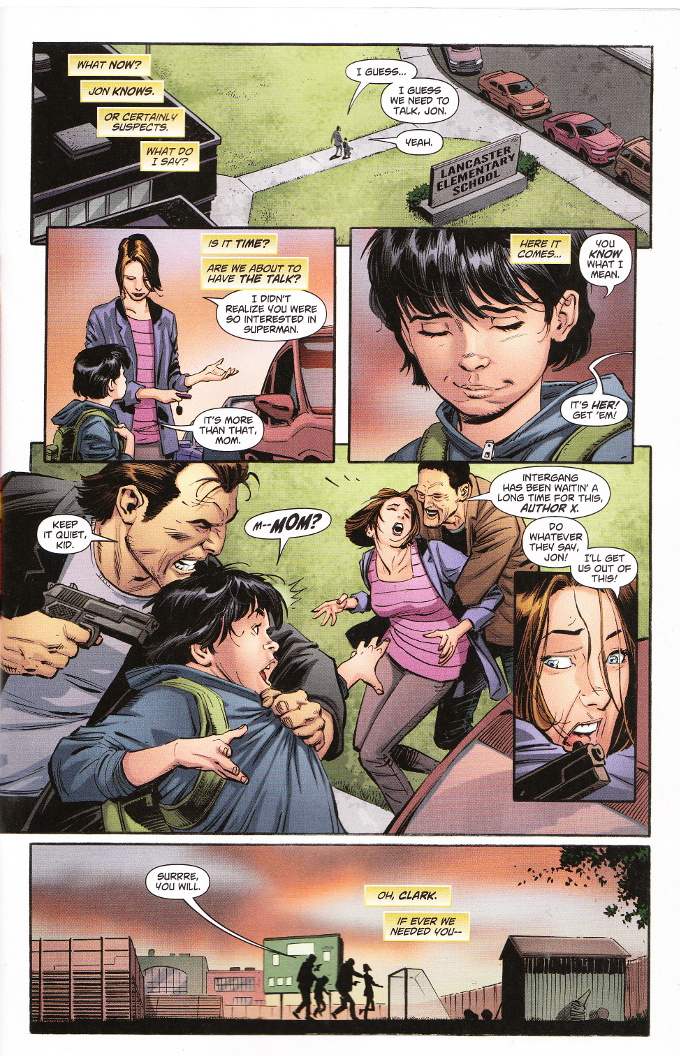
I can't say enough good things about Dan Jurgens writing. Jurgens has been writing Superman for a long time and we can only hope he'll continue to do so once the line-up for Rebirth is announced. This series is quite honestly the best Superman story we've seen in years.
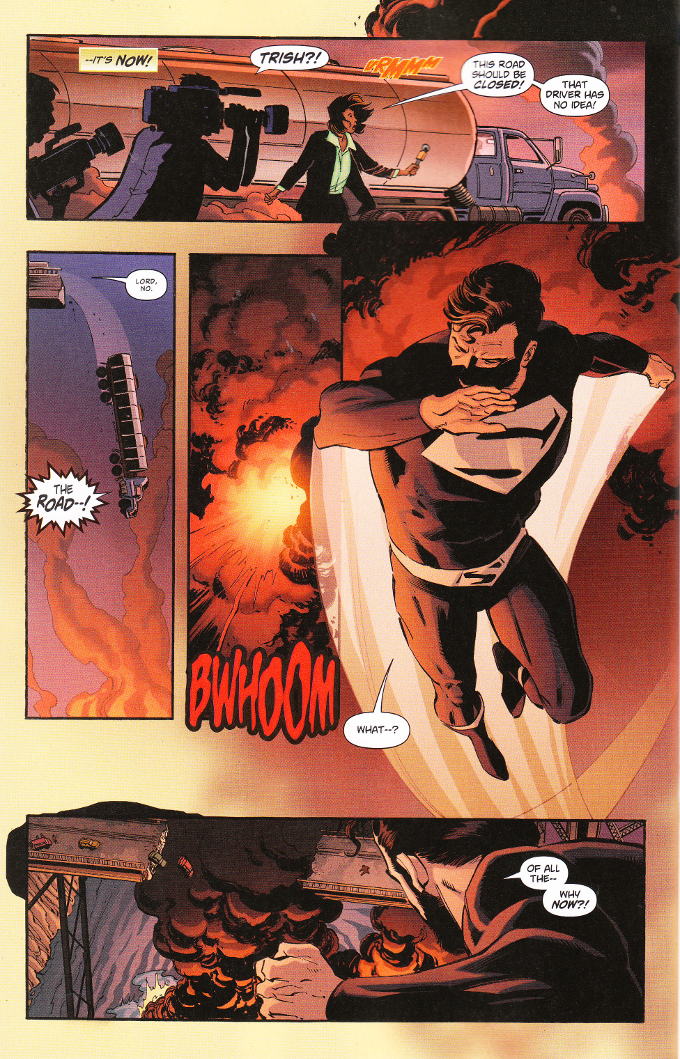
Jurgens' writing is equaled by the quality work of Lois & Clark's art team. Lee Weeks' characters are cleared designed and well-rendered. Scott Hannah's inks achieve the perfect balance between mere outlining of the original pencils and over-enhancing them. And Jeromy Cox's colors are divine.
Jurgens' writing is equaled by the quality work of Lois & Clark's art team. Lee Weeks' characters are cleared designed and well-rendered. Scott Hannah's inks achieve the perfect balance between mere outlining of the original pencils and over-enhancing them. And Jeromy Cox's colors are divine.
Wednesday, March 2, 2016
Superman: Lois And Clark #5 - A Review
The most dangerous villain Clark Kent has encountered upon this Earth - the psychic known as Blanque - has broken loose of his cell in the new Fortress of Solitude. What is worse, he now has control of this world's Hank Henshaw, who may or may not have just gained the powers of his otherworldly counter-part, The Cyborg Superman! It will take all of Clark's power and cunning to save not only his family but the whole world!
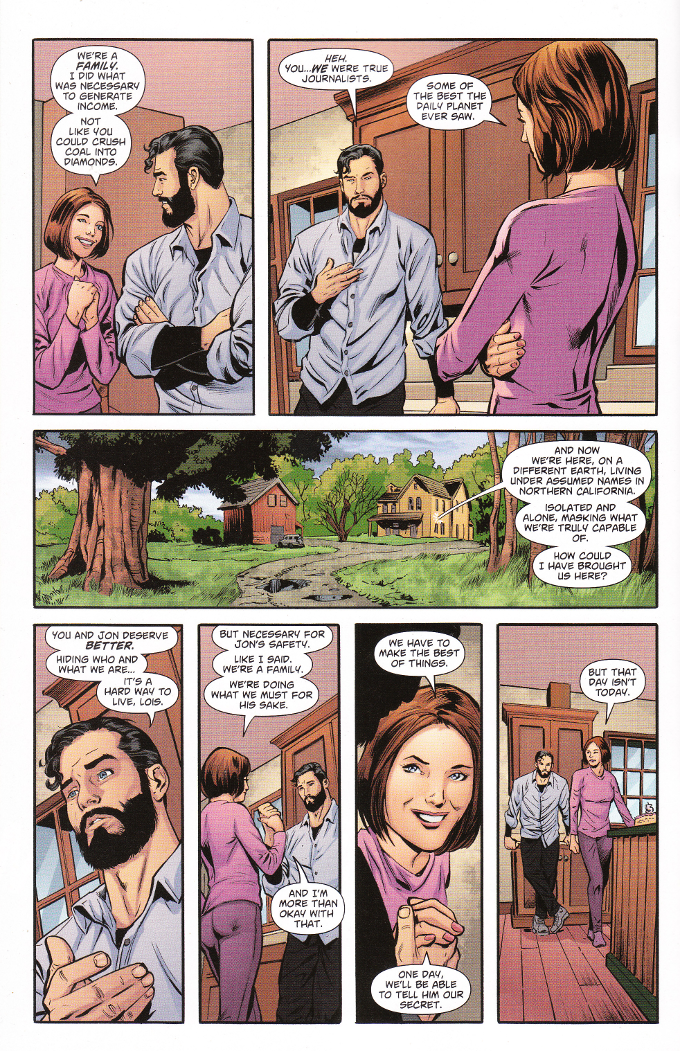
If this issue has a flaw, it is that Lois' storyline regarding her her ordeals with this world's version of Intergang is put on the back-burner for a good, old-fashioned superhero smackdown. That being said, this issue is a good one, as far as good, old-fashioned superhero smackdowns go. Dan Jurgens tells this sort of story well and the issue still has plenty of touching moments of Lois and Clark bonding as a couple in spite of the emphasis on the action.
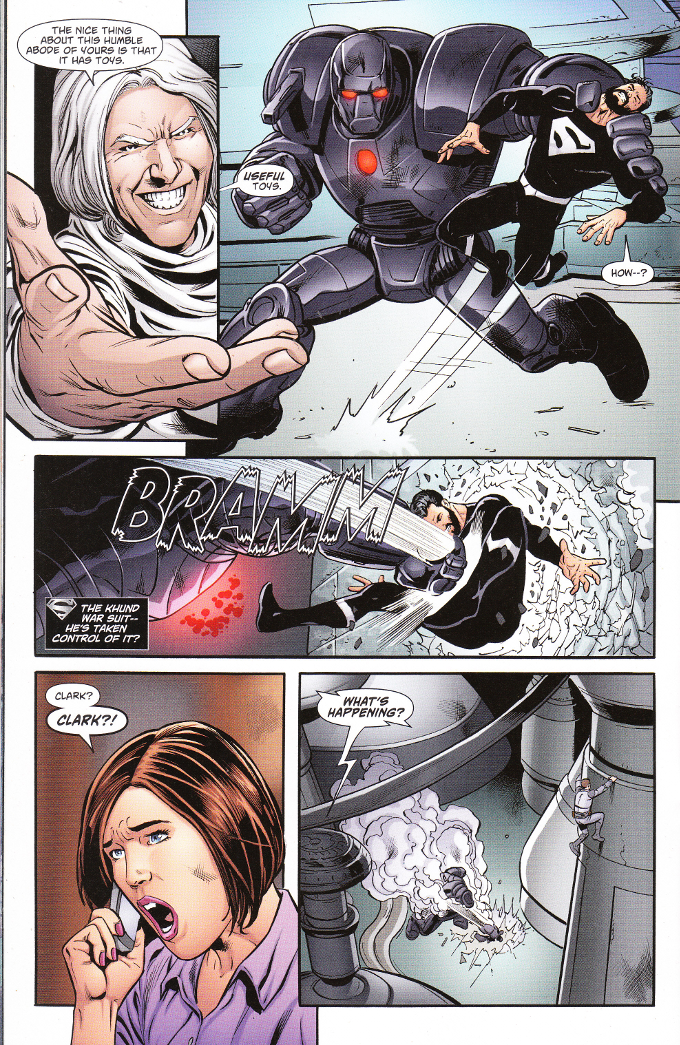
Neil Edwards (most recently seen on The Four Doctors) and Scott Hanna do their usual stellar job on the artwork for this issue. You would never know there were two inkers at work here. And Jeromy Cox's colors are as subtle and suitable as ever.
If this issue has a flaw, it is that Lois' storyline regarding her her ordeals with this world's version of Intergang is put on the back-burner for a good, old-fashioned superhero smackdown. That being said, this issue is a good one, as far as good, old-fashioned superhero smackdowns go. Dan Jurgens tells this sort of story well and the issue still has plenty of touching moments of Lois and Clark bonding as a couple in spite of the emphasis on the action.
Neil Edwards (most recently seen on The Four Doctors) and Scott Hanna do their usual stellar job on the artwork for this issue. You would never know there were two inkers at work here. And Jeromy Cox's colors are as subtle and suitable as ever.
Sunday, January 31, 2016
Superman: Lois And Clark #4 - A Review
As an alien invasion fleet approaches Earth, Superman must prevent Blanque - a powerful psychic he imprisoned inside of his new secret base - from escaping along with a recently empowered Hank Henshaw. Meanwhile, Lois checks in on her editor - the only other person who knew about her investigation into Intergang - and discovers that she has disappeared!
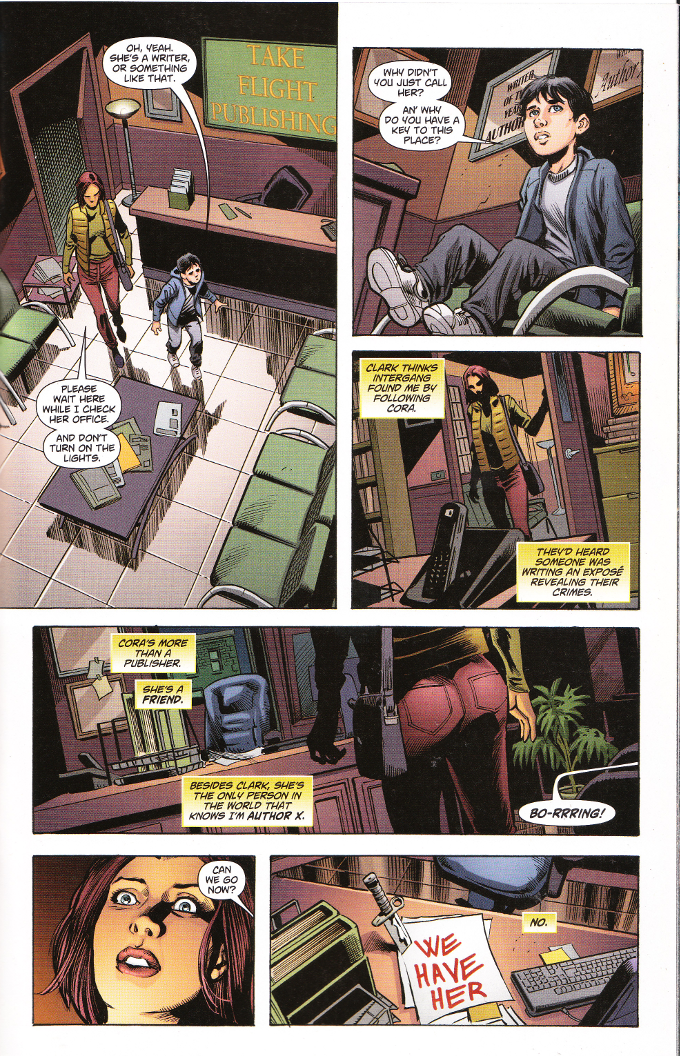
There's quite a lot of metaphorical plates spinning in this story by Dan Jurgens keeps them moving with apparent ease. Both Lois' and Clark's respective storylines get plenty of time in the spotlight. There's even time for a flashback showing how Lois arranged for Clark to get his supersuit in this strange new reality as well as a check-in on the approaching alien fleet.

There's two separate art teams on this issue but you'd never know it from looking. Close examination will reveal the differences between Lee Weeks and Marco Santucci's styles but the differences are not so jarring as to distract away from the flow of the book. The inks by Sergio Carifello and Scott Hanna are likewise well-balanced, with the colors by Jeromy Cox supplying the perfect finishes to the final artwork.
There's two separate art teams on this issue but you'd never know it from looking. Close examination will reveal the differences between Lee Weeks and Marco Santucci's styles but the differences are not so jarring as to distract away from the flow of the book. The inks by Sergio Carifello and Scott Hanna are likewise well-balanced, with the colors by Jeromy Cox supplying the perfect finishes to the final artwork.
Thursday, December 31, 2015
Superman: Lois And Clark #3 - A Review
Satisfied that the threat to his family has been neutralized and that their secret is safe, Clark Kent returns to his Fortress of Solitude. Meanwhile, Lois Lane goes back to work investigating this Earth's version of Intergang. Little do they know that enemies, both old and new, are already working against them...

Whatever you say about Dan Jurgens, you can't accuse him of thinking small as a writer. This issue introduces a number of subplots and new threats for Lois and Clark to contend with. Yet everything is evenly balanced and there's no sense that anything is getting short-shrift. There's even time for some amusing banter between the first couple of comics amid all the set-up.

The artwork proves equally enjoyable. There's three inkers at work, including penciler Lee Weeks, but you'd never know it. The shading is consistent throughout. And the color art by Brad Anderson perfectly enhances the finished pencils and inks.
Superman Annual #3 - A Review
There's two good comics contained within Superman Annual #3. One details the new origin of the immortal conqueror Vandal Savage, tying his origins indirectly into the Superman mythos. The other showcases the problems Clark Kent faces as he continues to try and help people as Superman, despite his waning powers, lack of a secret identity and Lex Luthor running Justice League.
Unfortunately, these stories ultimately exist only as a set-up for the latest big crossover. And that proves to be to their detriment. It's apparently not enough to tell a story which shows that the meteor that empowered Vandal Savage came from a comet that was redirected from Krypton. We can't just tell a story where Clark Kent tells a teary-eyed Lana Lang that he can't just quit being Superman, even without his powers. It's all just build up for yet another excuse to boost sales.

It's a shame because there's some truly great writing on display in this issue. The Vandal Savage story is just plain fun. And the modern story proves the point that what makes Clark Kent Superman isn't his powers - it's his ability to inspire other people to greatness. It also subtly disproves Lex Luthor's postulation - that Superman's existence will cause common people to stop striving to be better - as Lex begins exploiting his power and authority to keep Clark Kent from trying to advance himself. Rarely has Luthor's evil and Clark's goodness been so well and simply exemplified.
The artwork, sadly, isn't quite so evenly handled. The artwork for the Vandal Savage story is grand, showing a good deal of variety as we follow Savage through the ages. The artwork for the Clark story, while skillfully done, utilizes a gritty, more realistic style that doesn't really seem appropriate to the story at hand.
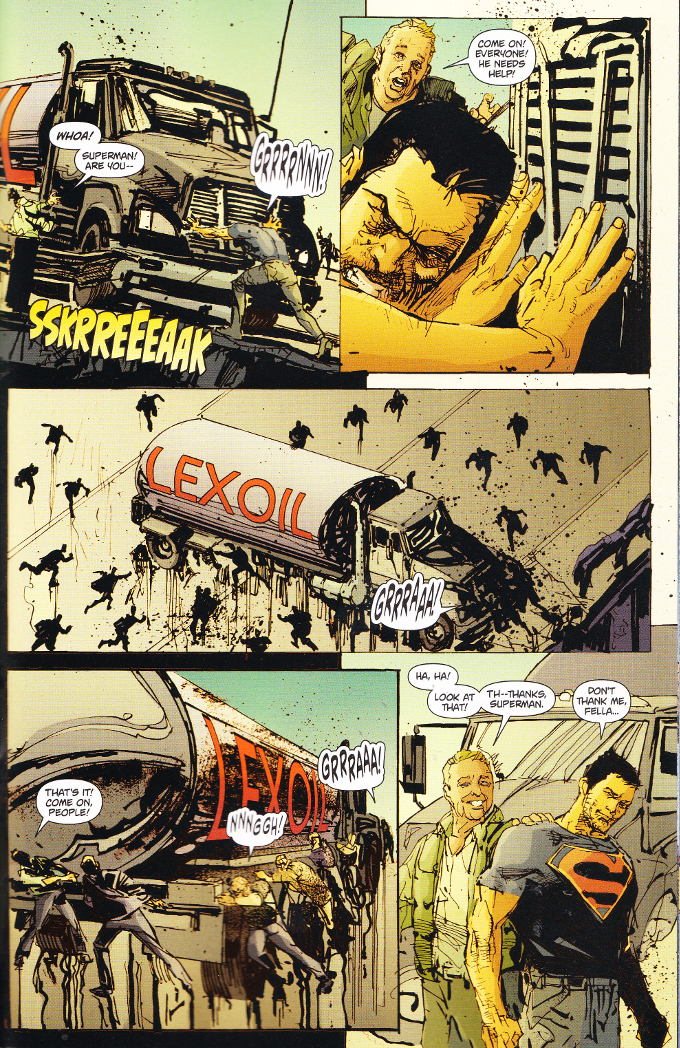
Superman Annual #3 is a model for everything that is right and wrong with DC Comics since the New 52 revamp. There's a number of brilliant innovations and reimaginings of classic concepts and this comic showcases the ideal that the hero aspect of a character is more important than the super one. Yet all of that is undercut by a relentless grittiness that is grim for its own sake rather than to make the light shine brighter and the fact that this story exists only as introduction to yet another sales gimmick.
Unfortunately, these stories ultimately exist only as a set-up for the latest big crossover. And that proves to be to their detriment. It's apparently not enough to tell a story which shows that the meteor that empowered Vandal Savage came from a comet that was redirected from Krypton. We can't just tell a story where Clark Kent tells a teary-eyed Lana Lang that he can't just quit being Superman, even without his powers. It's all just build up for yet another excuse to boost sales.
It's a shame because there's some truly great writing on display in this issue. The Vandal Savage story is just plain fun. And the modern story proves the point that what makes Clark Kent Superman isn't his powers - it's his ability to inspire other people to greatness. It also subtly disproves Lex Luthor's postulation - that Superman's existence will cause common people to stop striving to be better - as Lex begins exploiting his power and authority to keep Clark Kent from trying to advance himself. Rarely has Luthor's evil and Clark's goodness been so well and simply exemplified.
The artwork, sadly, isn't quite so evenly handled. The artwork for the Vandal Savage story is grand, showing a good deal of variety as we follow Savage through the ages. The artwork for the Clark story, while skillfully done, utilizes a gritty, more realistic style that doesn't really seem appropriate to the story at hand.
Superman Annual #3 is a model for everything that is right and wrong with DC Comics since the New 52 revamp. There's a number of brilliant innovations and reimaginings of classic concepts and this comic showcases the ideal that the hero aspect of a character is more important than the super one. Yet all of that is undercut by a relentless grittiness that is grim for its own sake rather than to make the light shine brighter and the fact that this story exists only as introduction to yet another sales gimmick.
Sunday, November 29, 2015
Superman: Lois And Clark #2 - A Review
Thanks to the secret intervention of Clark Kent, The Space Shuttle Excalibur has landed safely, though the crew has mysteriously vanished! This is a matter of great concern to Mr. Chambers - a government agent who seems as mysterious as the incidents he investigates. But Clark Kent has other concerns of his own. Namely, the armed men who are chasing after his wife and son...
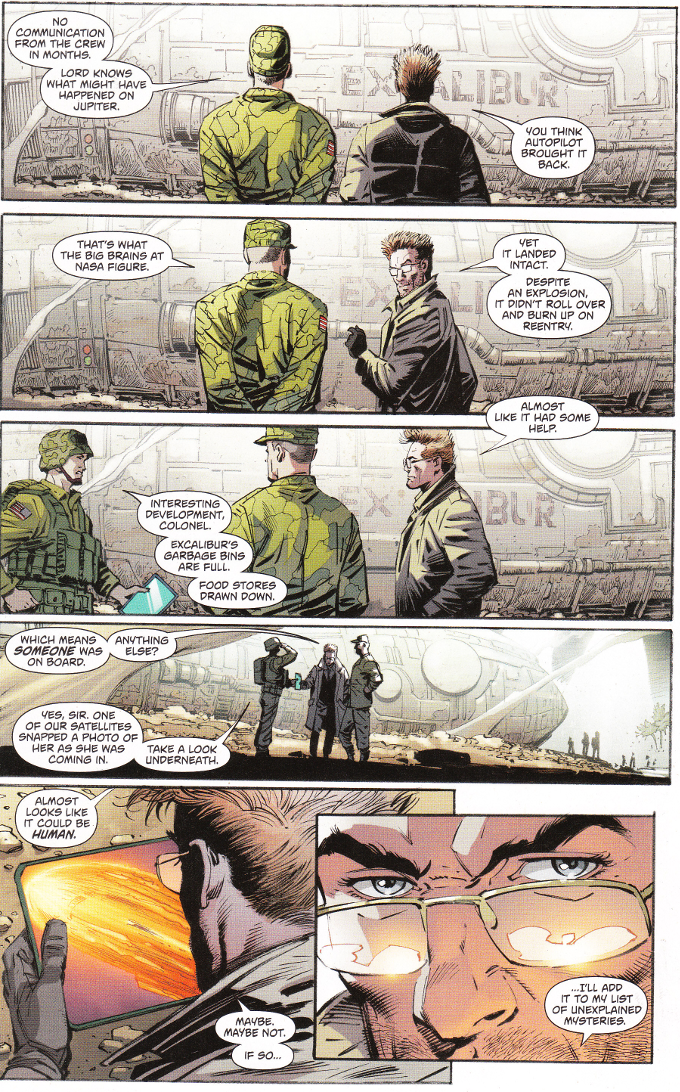
The plot thickens in this second issue of Superman: Lois and Clark, though not much happens beyond laying more ground work for the new series. This is a different kind of Superman story and one I'm glad to see being told. Most of the issue's focus is off of Clark Kent and set on Lois Lane, who proves as capable a heroine as ever in defending herself and her son before Clark shows up.
One wonders how long they're going to try and deny their secret lives as savior of the world and investigative author to their son. This issue shows that Jonathan iss already becoming suspicious of his parents' lies... even without the hint he's discovered his super-hearing at issue's end. Still, the story by Dan Jurgens is tightly-plotted and riveting to read.
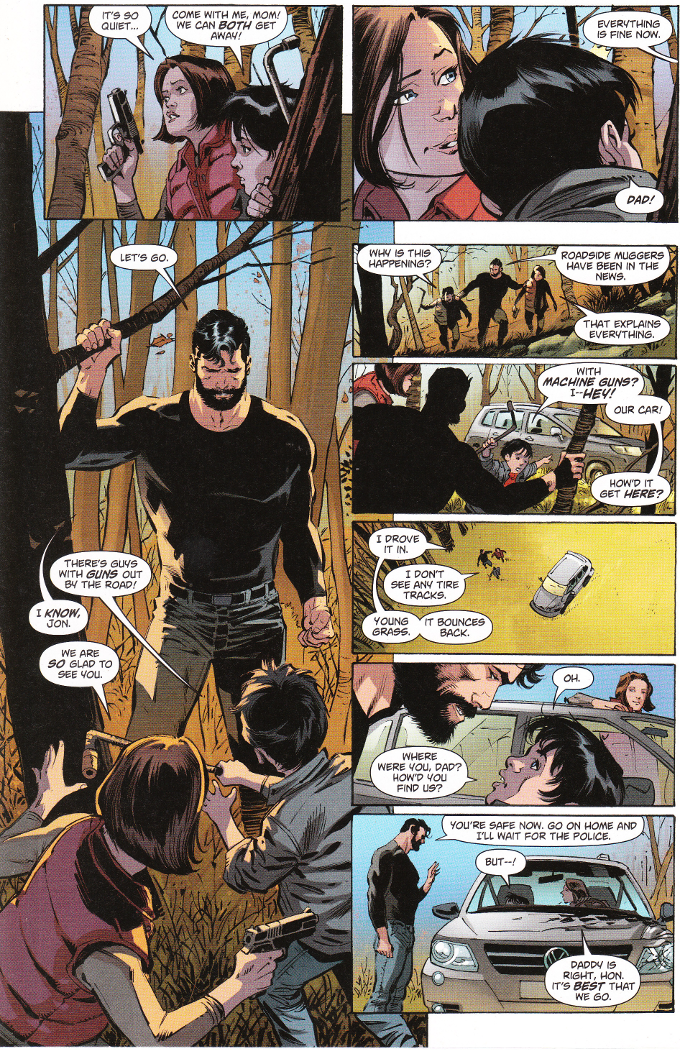
Jurgen's script comes to life perfectly under the art team's direction. Lee Weeks' character designs look great and his pencils are perfectly enhanced by Scott Hanna's inks. And the colors by Brad Anderson are well-chosen.
The plot thickens in this second issue of Superman: Lois and Clark, though not much happens beyond laying more ground work for the new series. This is a different kind of Superman story and one I'm glad to see being told. Most of the issue's focus is off of Clark Kent and set on Lois Lane, who proves as capable a heroine as ever in defending herself and her son before Clark shows up.
One wonders how long they're going to try and deny their secret lives as savior of the world and investigative author to their son. This issue shows that Jonathan iss already becoming suspicious of his parents' lies... even without the hint he's discovered his super-hearing at issue's end. Still, the story by Dan Jurgens is tightly-plotted and riveting to read.
Jurgen's script comes to life perfectly under the art team's direction. Lee Weeks' character designs look great and his pencils are perfectly enhanced by Scott Hanna's inks. And the colors by Brad Anderson are well-chosen.
Tuesday, October 20, 2015
Superman: Lois And Clark #1 - A Review
There was a battle. Cities and their chosen champions, plucked from time and space and pitted against one another for the right to exist. But some of those heroes united during this so-called Convergence and in doing so defeated their captor - a future version of the artificial intelligence known as Brainiac. And leading the charge, as usual, was Brainiac's greatest enemy - Superman!
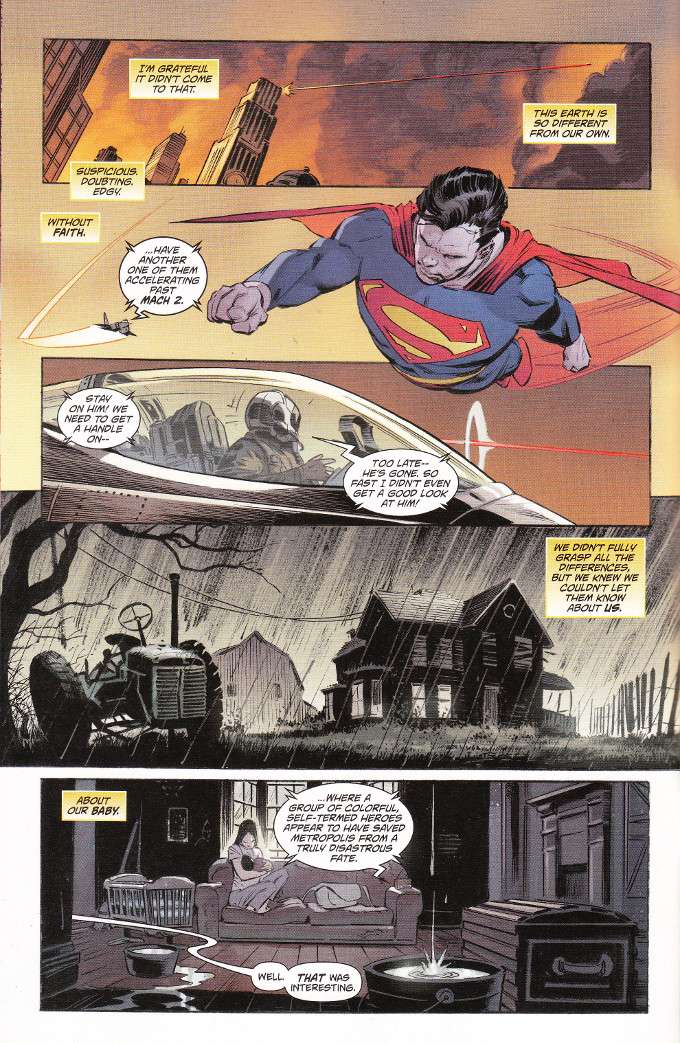
But now The Convergence is ended. And the Clark Kent and Lois Lane of an older Earth - who married and had a son named Jonathan together - find themselves in another world. A world that is darker and more suspicious than their own. A world in need of heroes. But this world has a Lois Lane and a Clark Kent of their own, who have their own destinies to fulfill. So Lois and Clark go into hiding, disguised as an ordinary farm couple, while still doing what they do best.
As the years pass, Lois becomes a famous yet anonymous author of books that expose government corruption. And Clark continues to do what good he can, subtly, when he isn't tending to their farm. It is a good life but it is about to become far more complicated than even they could have imagined!
Attention DC Comics fans who have been displeased by recent events in the Superman books or just generally unhappy with The New 52 universe in general! Our prayers have been answered! They have delivered unto us the Superman/Lois Lane comic we've always wanted! And it is good!
Hyperbolic Old Testament prophet dialogue aside, this truly is a great issue. Dan Jurgens sets up the new status quo and explains away Convergence with economy while delivering a well-placed jab at the reality of the new Earth Prime of The 52 Universe. Jurgens calls it a place without faith, which is an interesting and accurate description of the darker new DC Comics Universe and one senses we're going to see something special here.
It's too soon to tell if this series may be Jurgens' Kingdom Come - the first canon shot against a movement against the increasing cynicism in modern superhero stories. But this issue offers plenty of reasons to be hopeful. If nothing else it's nice to see Lois Lane being treated as an equal to Clark and that she gets her own subplot showcasing how she too has become a different kind of hero in facing a new world.
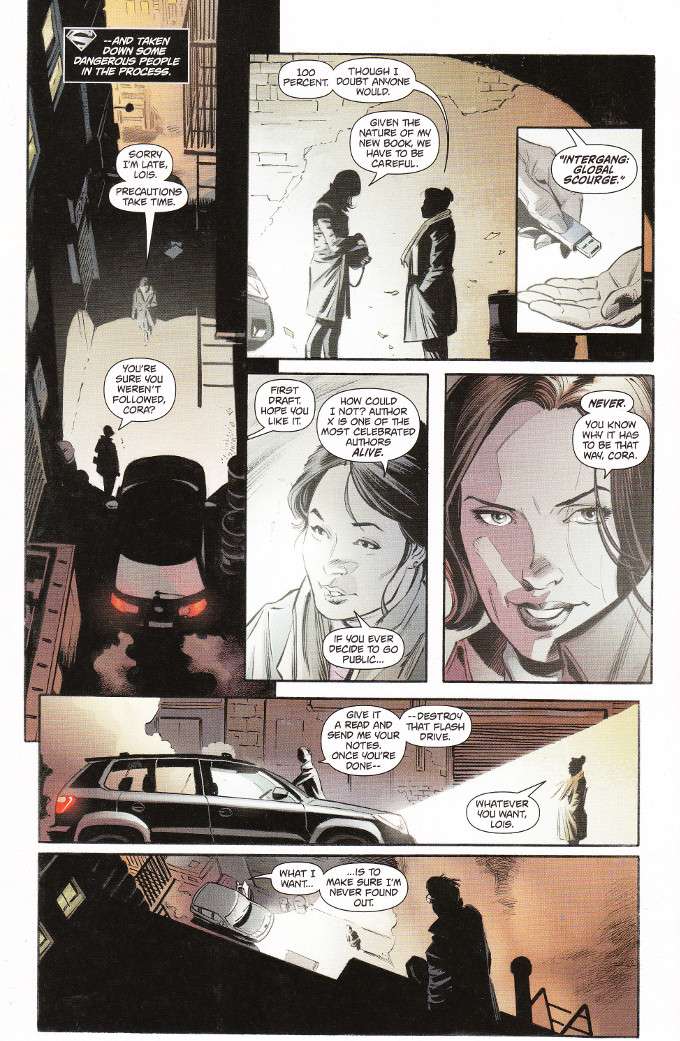
The artwork perfectly matches Jurgens' script. Lee Weeks' characters look wonderful and are perfectly enhanced by Scott Hanna's inks. Of particular note is the coloration by Brad Anderson, who depicts most of the world in muted tones save for the superheroes, who are vibrant and colorful figures that stand out all the stronger for that. Many of the pages depicting Lois' story have a Film Noir aspect fitting of the darker, mystery-filled world that Lois inhabits.
But now The Convergence is ended. And the Clark Kent and Lois Lane of an older Earth - who married and had a son named Jonathan together - find themselves in another world. A world that is darker and more suspicious than their own. A world in need of heroes. But this world has a Lois Lane and a Clark Kent of their own, who have their own destinies to fulfill. So Lois and Clark go into hiding, disguised as an ordinary farm couple, while still doing what they do best.
As the years pass, Lois becomes a famous yet anonymous author of books that expose government corruption. And Clark continues to do what good he can, subtly, when he isn't tending to their farm. It is a good life but it is about to become far more complicated than even they could have imagined!
Hyperbolic Old Testament prophet dialogue aside, this truly is a great issue. Dan Jurgens sets up the new status quo and explains away Convergence with economy while delivering a well-placed jab at the reality of the new Earth Prime of The 52 Universe. Jurgens calls it a place without faith, which is an interesting and accurate description of the darker new DC Comics Universe and one senses we're going to see something special here.
It's too soon to tell if this series may be Jurgens' Kingdom Come - the first canon shot against a movement against the increasing cynicism in modern superhero stories. But this issue offers plenty of reasons to be hopeful. If nothing else it's nice to see Lois Lane being treated as an equal to Clark and that she gets her own subplot showcasing how she too has become a different kind of hero in facing a new world.
The artwork perfectly matches Jurgens' script. Lee Weeks' characters look wonderful and are perfectly enhanced by Scott Hanna's inks. Of particular note is the coloration by Brad Anderson, who depicts most of the world in muted tones save for the superheroes, who are vibrant and colorful figures that stand out all the stronger for that. Many of the pages depicting Lois' story have a Film Noir aspect fitting of the darker, mystery-filled world that Lois inhabits.
Sunday, April 5, 2015
Convergence #0 - A Review
Somewhere outside of space and time, one version of the A.I. Brainiac has grown so advanced as to become god-like! It is no longer enough for it to catalog whole worlds before destroying them, while saving one city for analysis. Now Brainiac has begun destroying whole timelines, preserving one city from each. But the time for study is over and soon these divergent cities shall be pitted against one another in battle for the right to exist!

As far as set-ups for a Crisis event go, Convergence is hardly original. When you get right down to it, most of this issue is just an excuse for yet another Superman vs. Braniac(s) fight. That being said, it's a pretty good fight as far as these things go and the novelty of a completely confused and outclassed Superman is enough of a change of pace to hold the reader's interest.

The artwork proves more imaginative than the script. Ethan Van Sciver performs at his usual level of high quality. And colorist Marcelo Maiolo makes everything look bright and powerful.
Convergence #0 isn't a bad comic but neither is it as epic as a reality-spanning cosmic tale should be. Lackluster, I think, is the word to describe it. All in all, I think I'll skip the main Convergence book and just pick-up those books featuring my favorite characters or writers I'm a fan of.
As far as set-ups for a Crisis event go, Convergence is hardly original. When you get right down to it, most of this issue is just an excuse for yet another Superman vs. Braniac(s) fight. That being said, it's a pretty good fight as far as these things go and the novelty of a completely confused and outclassed Superman is enough of a change of pace to hold the reader's interest.
The artwork proves more imaginative than the script. Ethan Van Sciver performs at his usual level of high quality. And colorist Marcelo Maiolo makes everything look bright and powerful.
Convergence #0 isn't a bad comic but neither is it as epic as a reality-spanning cosmic tale should be. Lackluster, I think, is the word to describe it. All in all, I think I'll skip the main Convergence book and just pick-up those books featuring my favorite characters or writers I'm a fan of.
Tuesday, May 20, 2014
Future's End #1 & #2 - A Review
After reading the lackluster Future's End #0 (which DC Comics released on Free Comic Book Day this year), I fully intended to give this series a miss. I've had my fill of stories involving dark futures, the heroes failing to save the day and enough angst and ennui to fill a dozen Morrisey albums. The fact that the story - at its most basic level - was a blatant rip-off of X-Men: Days Of Future Past didn't help matters.
Still, I happened to read a preview of Future's End #2 and learned that it would involve the funeral of Green Arrow. Being as big a fan of Oliver Queen as I am, that was enough to pique my curiosity. So I picked up the first two issues last weekend to see what I might see.
Not much, as it turns out.
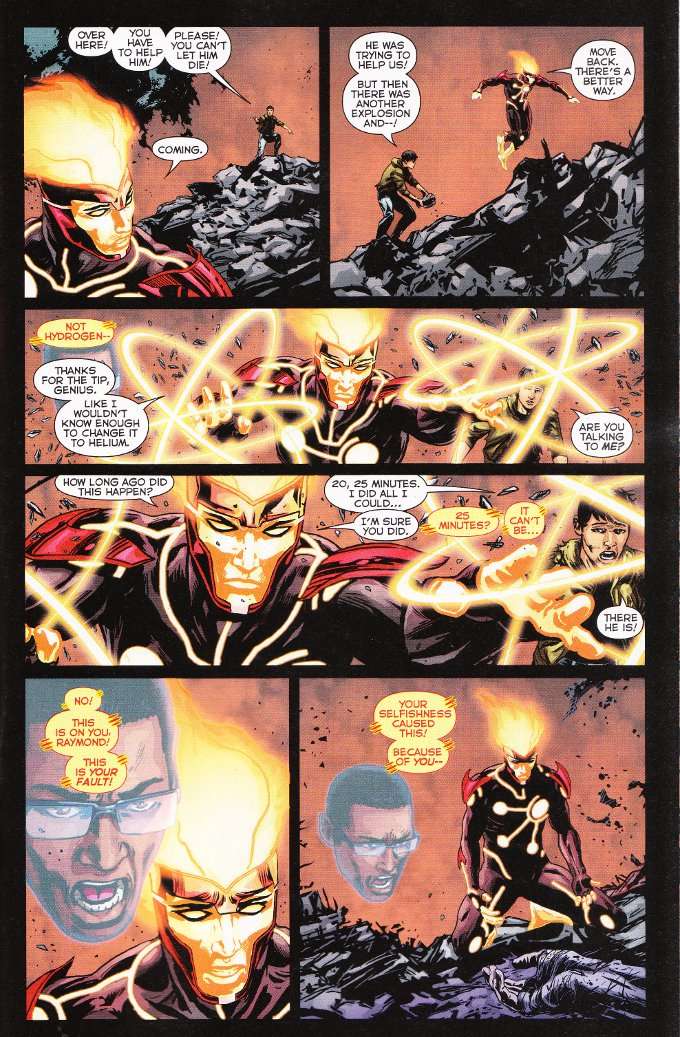
Future's End #1 combines the worst aspects of Countdown and Brightest Day. Specifically, we get to see a lot of heroes die horrible, random deaths and we get to see Ronnie Raymond act like an incompetent, entitled douche-bag. Why DC Comics keeps forcing the unnatural Ronnie Raymond/Jason Rusch partnership is beyond me. I don't know anyone who likes this version of Firestorm and the low sales figures/cancellation of the New 52 Firestorm series would seem to bear out that idea that more people hated it than not.
Indeed, Roy Harper says it best in Future's End #2 when he calls Raymond "a liar... As well as a fraud -- phony -- and a complete and total coward." And he is not wrong. Raymond is directly responsible for Oliver Queen's death and his actions in this issue do nothing to endear him to the reader. Yet I somehow think we are meant to sympathize with Ronnie, because all he wanted to do was sleep with his girlfriend while on the clock at his day job as Oliver Queen was radioing for him, specifically, to help avert a disaster.
This doesn't work. At all.
What does work is the funeral sequence, which has a hint of Jeff Lemire's writing about it. There are so many wonderful, subtle details revealed here. Roy Harper in a red costume modeled on Green Arrow's uniform. Black Canary crying in the background. And Animal Man's eulogy, in which he talks about Oliver Queen leading the rebellion against a second Apokoliptian invasion.
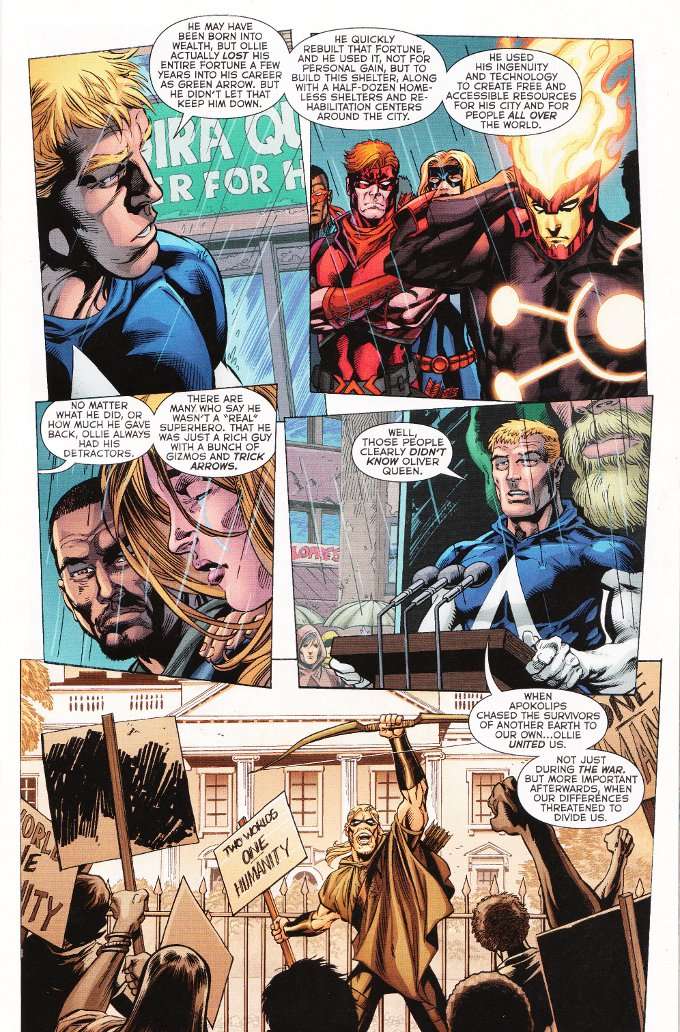
Now THAT is a comic I want to read! Alas, that's the biggest problem with this series and - in many ways - much of the New 52 line so far. We keep getting teased about stories that are far more interesting in abstract than the stories we've been given.
I want to see Green Arrow fighting alien invaders with nothing but sheer chutzpah and a madman's arsenal of trick arrows. I want to see how Roy Harper became his staunchest defender and why Dinah Lance cries the hardest at his death. But most of all, I want a story where the heroes are fighting villains instead of each other.
This is not that story. Maybe Justice League United will become that story in the future?
I hope so. I'd really like to read that story.
Still, I happened to read a preview of Future's End #2 and learned that it would involve the funeral of Green Arrow. Being as big a fan of Oliver Queen as I am, that was enough to pique my curiosity. So I picked up the first two issues last weekend to see what I might see.
Not much, as it turns out.
Future's End #1 combines the worst aspects of Countdown and Brightest Day. Specifically, we get to see a lot of heroes die horrible, random deaths and we get to see Ronnie Raymond act like an incompetent, entitled douche-bag. Why DC Comics keeps forcing the unnatural Ronnie Raymond/Jason Rusch partnership is beyond me. I don't know anyone who likes this version of Firestorm and the low sales figures/cancellation of the New 52 Firestorm series would seem to bear out that idea that more people hated it than not.
Indeed, Roy Harper says it best in Future's End #2 when he calls Raymond "a liar... As well as a fraud -- phony -- and a complete and total coward." And he is not wrong. Raymond is directly responsible for Oliver Queen's death and his actions in this issue do nothing to endear him to the reader. Yet I somehow think we are meant to sympathize with Ronnie, because all he wanted to do was sleep with his girlfriend while on the clock at his day job as Oliver Queen was radioing for him, specifically, to help avert a disaster.
This doesn't work. At all.
What does work is the funeral sequence, which has a hint of Jeff Lemire's writing about it. There are so many wonderful, subtle details revealed here. Roy Harper in a red costume modeled on Green Arrow's uniform. Black Canary crying in the background. And Animal Man's eulogy, in which he talks about Oliver Queen leading the rebellion against a second Apokoliptian invasion.
Now THAT is a comic I want to read! Alas, that's the biggest problem with this series and - in many ways - much of the New 52 line so far. We keep getting teased about stories that are far more interesting in abstract than the stories we've been given.
I want to see Green Arrow fighting alien invaders with nothing but sheer chutzpah and a madman's arsenal of trick arrows. I want to see how Roy Harper became his staunchest defender and why Dinah Lance cries the hardest at his death. But most of all, I want a story where the heroes are fighting villains instead of each other.
This is not that story. Maybe Justice League United will become that story in the future?
I hope so. I'd really like to read that story.
Sunday, April 7, 2013
Common Grounds - A No Flying, No Tights Review
Common Grounds is a lost treasure of the Modern Age of Comics. (That’s not hyperbole. I literally lost my copies of the original six-issue mini-series somewhere along the line and only recently rediscovered the series after chancing upon the trade paperback collection in a used book store.)
There is no over-riding plot or main character in Common Grounds. Instead, writer Troy Hickman presents a series of thirteen vignettes built around the titular chain of coffee shops. Founded by a retired superhero named Big Money, the goal of the chain was to give costumed crime-fighters a place to relax in their masked personas while they were off duty. In an effort to foster understanding and peace, costumed criminals are also welcomed provided they leave their grudges at the door.
These interludes run the gamut from low comedy to high drama, occasionally playing with both comedic and dramatic elements at the same time. The opening story, “Beyond the Speed of Life,” sets this balanced tone perfectly. It tells the story of a reporter interviewing his favorite superhero, The Speeding Bullet, at a nearby Common Grounds location. The Speeding Bullet is a speedster who is widely beloved by the public and acknowledged as one of the greatest heroes in the world. He is also, to the surprise of the reporter, largely unsatisfied with his life outside of heroism. While he loves helping people and is thankful for the opportunities his powers give him, “SB” does express his wish for the ability to slow down on occasion and his desire to live a normal life.
It would be easy to play the problems of a man with super-speed off for laughs or for Speeding Bullet to come off as a bit of a whiner, but Hickman seriously examines how super-speed with the heightened perceptions to match your reflexes would make everyday life a bit more difficult. For instance, being able to eat whatever you want due to a heightened metabolism that burns off excess calories in minutes sounds great in theory, but the fact of the matter is you have to spend more time in the bathroom than a normal person. Why? Well, there are some things you can’t do at super speed. Such is Hickman’s gift as a writer that he can play up the comedy such situations while simultaneously exploring the dramatic elements of the superhero genre.
The book’s cast features a host of other such memorable characters, but my favorite is probably Moshe Chomsky. Moshe is a devout Hasidic Rabbi who somehow developed the power to melt anything he touches. Moshe is an honestly good person who prays for guidance and struggles to find constructive uses for a destructive ability, all while trying to tolerate “the smart-alecks in the media” who dubbed him “The Acidic Jew,” with good humor. There’s no small amount of irony that such a potentially deadly power should wind up in the hands of someone so ill-disposed toward violence and hurting people and it is fun to watch Hickman play off the clichés of comics (which demand that anyone with fire powers have a temper or anyone with cold powers be emotionally distant) in this way.
This is one of the best-looking comics series I’ve ever had the pleasure of reading, featuring an all-star roster of artists. Dan Jurgens does the lion’s share of the work, having drawn six of the thirteen vignettes but there’s not a single scrub in the line-up. Michael Avon Oeming. Ethan Van Sciver. Chris Bachalo. Carlos Pacheco. Angel Medina. Sam Kieth. The legendary George Perez. You’d be hard pressed to get one artist of this caliber for a mini-series, let alone all of these fine artists!
Common Grounds is a must read for any fan of the superhero genre, as well as those who typically dismiss superhero stories as childish fantasies. There are some truly complex stories here, with none of the gore or overt sexuality one usually expects in a Top Cow graphic novel. Indeed, apart from some frank discussions about superhero sexuality ala the Man of Steel/Woman of Kleenex debate, there’s no material in this collection I would consider objectionable for a teenage audience.
Common Grounds
by Troy Hickman
Art by Dan Jurgens, Michael Avon Oeming, Ethan Van Sciver, Chris Bachalo, Carlos Pacheco, Angel Medina, Sam Kieth and George Perez
ISBN: 9781582408415
Top Cow Productions, 2007
Publisher Age Rating: (13+)
Monday, February 25, 2013
Green Lantern #17 - A Review
Green Lantern #17 is the first part of another four-month long, four-comic spanning mini-series. So for those of you who were feeling burned out after Rise Of The Third Army, I'm afraid I have some bad news. We're only halfway done.
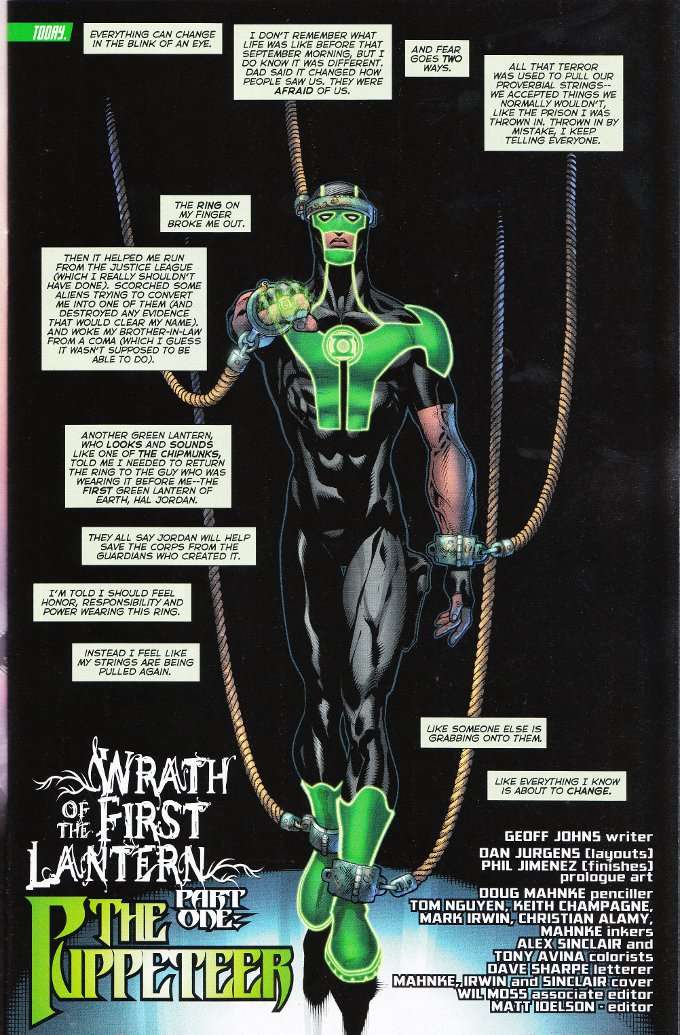
The good news is that this first part of Wrath of The First Lantern is far faster in cutting to the chase than it's predecessor. The bad news is that we don't get nearly enough exposition into who The First Lantern was and how he gained the power that even The Guardians seem to fear. Thankfully, we do learn something of his motivations, how he first came into contact with The Guardians and why he's now working against them. And the other plotline - involving newbie Green Lantern Simon Baz having his first encounter with the villain Black Hand - is interesting enough, though seemingly unconnected to the main storyline.
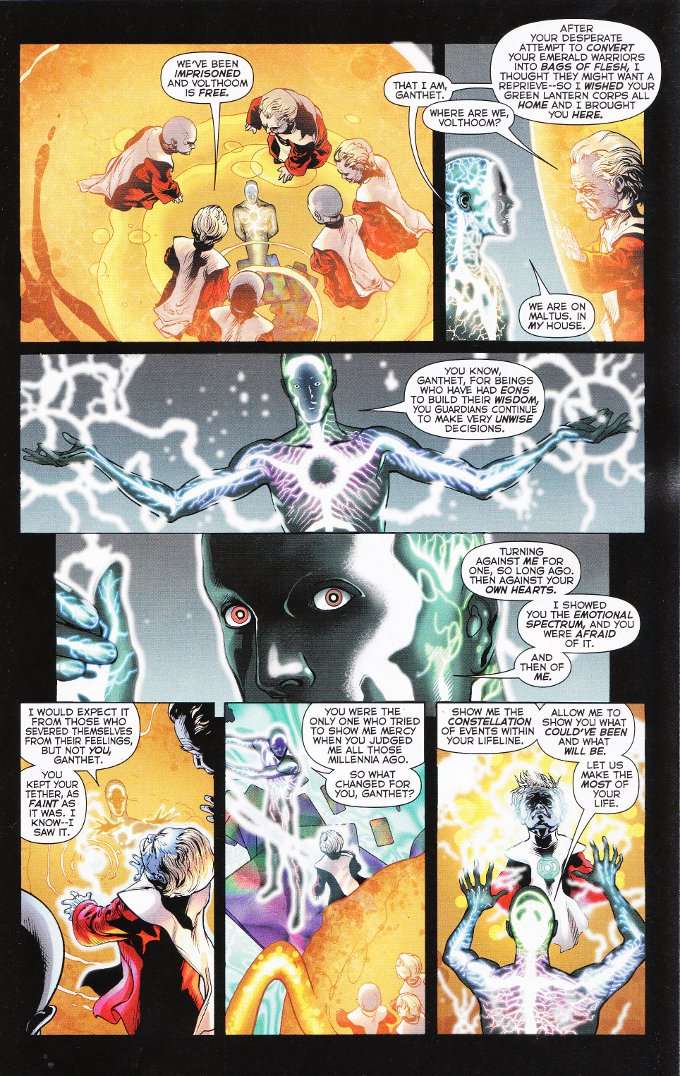
While the storyline may be drawn out, at least the artwork is as gorgeous as ever. Doug Mahnke and his team of inkers deliver the same quality work we've come to expect on this title. Guest artists Dan Jurgens and Phil Jimenez also deliver an exciting prologue, which evokes images from classic DC Comics as we see just how The First Lantern and The Guardians originally met.
I'd like to say this is a good entry point into the Green Lantern title. Certainly, Geoff Johns has written it to be a beginning. Sadly, there's too much leading into this story one must be broadly familiar with to fully appreciate it, so on those grounds I cannot recommend this issue save to those already reading Green Lantern.
The good news is that this first part of Wrath of The First Lantern is far faster in cutting to the chase than it's predecessor. The bad news is that we don't get nearly enough exposition into who The First Lantern was and how he gained the power that even The Guardians seem to fear. Thankfully, we do learn something of his motivations, how he first came into contact with The Guardians and why he's now working against them. And the other plotline - involving newbie Green Lantern Simon Baz having his first encounter with the villain Black Hand - is interesting enough, though seemingly unconnected to the main storyline.
While the storyline may be drawn out, at least the artwork is as gorgeous as ever. Doug Mahnke and his team of inkers deliver the same quality work we've come to expect on this title. Guest artists Dan Jurgens and Phil Jimenez also deliver an exciting prologue, which evokes images from classic DC Comics as we see just how The First Lantern and The Guardians originally met.
I'd like to say this is a good entry point into the Green Lantern title. Certainly, Geoff Johns has written it to be a beginning. Sadly, there's too much leading into this story one must be broadly familiar with to fully appreciate it, so on those grounds I cannot recommend this issue save to those already reading Green Lantern.
Wednesday, February 15, 2012
52 Catch-Up: Green Arrow #1-6
I don't think any book in the New 52 line-up has disappointed me more than Green Arrow. Not because of anything in the book itself but more because of the promise that wasn't fulfilled.
As regular readers know, Green Arrow is one of my favorite characters and I was of the opinion that most of the people writing him in the last decade had no idea what they were doing. So when it was announced that Oliver Queen would be getting a fresh start under the pen of J.T. Krul - whose work with the character during Brightest Day I liked - well, I was cautiously optimistic.
As I noted in my review of the first issue, J.T. Krul gave us a good set-up. The basic concept of Oliver Queen being this universe's version of Steve Jobs was a solid start and a nice modernization of the character's classic origins as a billionaire playboy. We were given a brief look at Ollie's support team at both his day and night jobs. Krul also managed to establish what sets Green Arrow apart from similar heroes, apart from his archery gimmick - his skills as a tracker, his hatred of people who abuse their power and his motivations for being a hero - with surprising subtlety.

Sadly, the potential of the first issue went largely untapped and Krul never expanded upon the one hint he gave as to how Oliver Queen's past may have differed from the old Green Arrow before leaving the book with Issue #3. Krul's three issues are, for the most part, standard superhero action fare. Do not misunderstand me - it's good superhero action fare. But this isn't what the opening issues of a new series should be like.

To my mind, an opening arc should firmly establish the main character's past and character for new readers. But these opening issues don't really do that. Apart from the aforementioned hint we aren't given any information at all about Oliver Queen's past or motivations for having become a crime-fighter. Was he washed up on an island and forced to fight a drug cartel for the freedom of an enslaved tribe? Did he discover a secret marijuana farm and force the hippies running it to take him back to civilization at arrow point? Was he abducted by Chinese slavers and forced to think up lucky numbers in a fortune cookie factory? We don't know!
Oddly, this lack of a back-story is more of a hindrance to long-time fans rather than new readers. I know I was anxious to see how the relationships between Green Arrow and his extended family would be different in the New DCU. Heck, I was anxious to see if there would even be an extended family. It turns out there isn't. This book is firmly set in the new Year One, before Roy Harper was adopted and apparently before Green Arrow met Black Canary, despite a promise at the end of Issue #2 that she would appear in Issue #3. She did not.
Another problem is that none of the supporting characters are developed past a one-sentence summary. Naomi is a sassy hacker grrrl. Jax is a pacifist weapon designer. Nobody seems to have any life outside of helping Ollie do what he does or - in the case of Queen Enterprises CEO Emerson - being an annoyance. Yet Emerson gets a scene suggesting that his motivation for riding Ollie so hard is because of his friendship with Ollie's father and his worries that Ollie is wasting his potential. It's a nice touch, making Emerson a much more complex character with a few simple panels and these opening issues could have used more brief scenes like this.

I mentioned before that Krul did a good job of establishing Ollie's basic character in the first issue. One way he did this was by giving Green Arrow the perfect villainous foil in a gang of publicity-hungry supervillains. No matter what the incarnation, there's nothing Green Arrow should hate more than people who abuse their power and hurt others like it is nothing.

Though I disagree strongly with the equation Naomi makes between supervillains posting their crimes on-line and being cheered for it and people who play violent video games. Wouldn't a comparison to the people who watch Jersey Shore, cheering the antics of a group of morally reprehensible publicity whores be more apt? Just saying.

While I can quibble with the characterization and the metaphors, I cannot quibble with the action nor with how well it is illustrated. Dan Jurgens or George Perez would be a fine artist to put on any book. Put the two of them together though, with Jurgens doing layouts and Perez doing finishes and you have something unique that captures the best of both artists. The characters all have a classic Perez feel to them but the form and flow of the panels is more structured, with just as much detail to the setting as there is to the characters. Most importantly, all of the characters have unique designs that make them easily identifiable even in the long shots.

Issues 4-6, co-plotted by artist Dan Jurgens and writer Keith Giffen, suffer from similar problems to those I described in the first three issues. There's a lot of well-designed and well-drawn action sequences but the characterization is still shallow, at best. What is worse, someone is stealing jokes from the a movie about another billionaire playboy superhero, which leaves me questioning just how coincidental it is that Oliver's executive assistant is a hyper-competent redhead.

Does this seem familiar to anyone else, somehow? Anyone?
All issues of parody or plagiarism aside, the plot of this trio of books doesn't have as much punch as the first three. The focus here is upon two new villains - Blood Rose and Midas. Blood Rose is a standard issue gun-totting femme fatale with super-strength. Midas, a slightly more original creation, was a scientist whose injuries at the hands of a group of eco-terrorists turned him into an avatar of pollution. Think Swamp Thing mixed with The Toxic Avenger... but evil! Heck, Alec Holland even gets name dropped!

Blood Rose wants to see Oliver Queen suffer slowly before she eventually kills him. Why? Good question - one Oliver actually asks her point blank and one she refuses to answer. There is a hint in the artwork that she may have known Oliver at one point in the past but nothing is ever explained.

Midas, for his part, has a much simpler motivation - he's a nerd who never had any luck with women before his accident and his relationship with Blood Rose is the closest thing he's ever had to real intimacy. He does what she wants to make her happy and appreciate him more. Which only serves to make the ending of this arc and the lack of explanation as to how these two ever hooked up even more nonsensical.
However, the confusing plot and lack of back-story for the characters is not the least of this arc's problems. The art is full of continuity errors and one great big whopping WTF moment, when Oliver Queen is apparently shot in the head and survives! I suppose the bullet is meant to have just grazed the front of his forehead but given that the gun was aimed at the back of his head before he tried to move, Ollie shouldn't have had a chance to dodge. ESPECIALLY considering the twist ending which... well... pretty much confirms there's no way Ollie could be faster than Blood Rose and certainly not fast enough to dodge bullets.

Ollie doesn't even have a bandage or signs of a wound when he goes after Midas and Blood Rose afterward! The blame for this can probably be laid on artist Ignacio Calero, who took over pencil finishes on the final issue. George Perez, he ain't.

In the end, all my grousing is completely meaningless given that Issue #7 will bring a new creative team to this book - Writer Ann Nocenti (most famous for her work on Daredevil and creation of Typhoid Mary) and artist Harvey Talibao (Most recently seen working on a Silver Surfer mini-series for Marvel). With any luck, they'll be sticking around for a while and we can finally get a look at Oliver Queen's past. Either way, you can be sure I'll be covering it!
As regular readers know, Green Arrow is one of my favorite characters and I was of the opinion that most of the people writing him in the last decade had no idea what they were doing. So when it was announced that Oliver Queen would be getting a fresh start under the pen of J.T. Krul - whose work with the character during Brightest Day I liked - well, I was cautiously optimistic.
As I noted in my review of the first issue, J.T. Krul gave us a good set-up. The basic concept of Oliver Queen being this universe's version of Steve Jobs was a solid start and a nice modernization of the character's classic origins as a billionaire playboy. We were given a brief look at Ollie's support team at both his day and night jobs. Krul also managed to establish what sets Green Arrow apart from similar heroes, apart from his archery gimmick - his skills as a tracker, his hatred of people who abuse their power and his motivations for being a hero - with surprising subtlety.
Sadly, the potential of the first issue went largely untapped and Krul never expanded upon the one hint he gave as to how Oliver Queen's past may have differed from the old Green Arrow before leaving the book with Issue #3. Krul's three issues are, for the most part, standard superhero action fare. Do not misunderstand me - it's good superhero action fare. But this isn't what the opening issues of a new series should be like.
To my mind, an opening arc should firmly establish the main character's past and character for new readers. But these opening issues don't really do that. Apart from the aforementioned hint we aren't given any information at all about Oliver Queen's past or motivations for having become a crime-fighter. Was he washed up on an island and forced to fight a drug cartel for the freedom of an enslaved tribe? Did he discover a secret marijuana farm and force the hippies running it to take him back to civilization at arrow point? Was he abducted by Chinese slavers and forced to think up lucky numbers in a fortune cookie factory? We don't know!
Oddly, this lack of a back-story is more of a hindrance to long-time fans rather than new readers. I know I was anxious to see how the relationships between Green Arrow and his extended family would be different in the New DCU. Heck, I was anxious to see if there would even be an extended family. It turns out there isn't. This book is firmly set in the new Year One, before Roy Harper was adopted and apparently before Green Arrow met Black Canary, despite a promise at the end of Issue #2 that she would appear in Issue #3. She did not.
Another problem is that none of the supporting characters are developed past a one-sentence summary. Naomi is a sassy hacker grrrl. Jax is a pacifist weapon designer. Nobody seems to have any life outside of helping Ollie do what he does or - in the case of Queen Enterprises CEO Emerson - being an annoyance. Yet Emerson gets a scene suggesting that his motivation for riding Ollie so hard is because of his friendship with Ollie's father and his worries that Ollie is wasting his potential. It's a nice touch, making Emerson a much more complex character with a few simple panels and these opening issues could have used more brief scenes like this.
I mentioned before that Krul did a good job of establishing Ollie's basic character in the first issue. One way he did this was by giving Green Arrow the perfect villainous foil in a gang of publicity-hungry supervillains. No matter what the incarnation, there's nothing Green Arrow should hate more than people who abuse their power and hurt others like it is nothing.
Though I disagree strongly with the equation Naomi makes between supervillains posting their crimes on-line and being cheered for it and people who play violent video games. Wouldn't a comparison to the people who watch Jersey Shore, cheering the antics of a group of morally reprehensible publicity whores be more apt? Just saying.
While I can quibble with the characterization and the metaphors, I cannot quibble with the action nor with how well it is illustrated. Dan Jurgens or George Perez would be a fine artist to put on any book. Put the two of them together though, with Jurgens doing layouts and Perez doing finishes and you have something unique that captures the best of both artists. The characters all have a classic Perez feel to them but the form and flow of the panels is more structured, with just as much detail to the setting as there is to the characters. Most importantly, all of the characters have unique designs that make them easily identifiable even in the long shots.
Issues 4-6, co-plotted by artist Dan Jurgens and writer Keith Giffen, suffer from similar problems to those I described in the first three issues. There's a lot of well-designed and well-drawn action sequences but the characterization is still shallow, at best. What is worse, someone is stealing jokes from the a movie about another billionaire playboy superhero, which leaves me questioning just how coincidental it is that Oliver's executive assistant is a hyper-competent redhead.
Does this seem familiar to anyone else, somehow? Anyone?
All issues of parody or plagiarism aside, the plot of this trio of books doesn't have as much punch as the first three. The focus here is upon two new villains - Blood Rose and Midas. Blood Rose is a standard issue gun-totting femme fatale with super-strength. Midas, a slightly more original creation, was a scientist whose injuries at the hands of a group of eco-terrorists turned him into an avatar of pollution. Think Swamp Thing mixed with The Toxic Avenger... but evil! Heck, Alec Holland even gets name dropped!
Blood Rose wants to see Oliver Queen suffer slowly before she eventually kills him. Why? Good question - one Oliver actually asks her point blank and one she refuses to answer. There is a hint in the artwork that she may have known Oliver at one point in the past but nothing is ever explained.
Midas, for his part, has a much simpler motivation - he's a nerd who never had any luck with women before his accident and his relationship with Blood Rose is the closest thing he's ever had to real intimacy. He does what she wants to make her happy and appreciate him more. Which only serves to make the ending of this arc and the lack of explanation as to how these two ever hooked up even more nonsensical.
However, the confusing plot and lack of back-story for the characters is not the least of this arc's problems. The art is full of continuity errors and one great big whopping WTF moment, when Oliver Queen is apparently shot in the head and survives! I suppose the bullet is meant to have just grazed the front of his forehead but given that the gun was aimed at the back of his head before he tried to move, Ollie shouldn't have had a chance to dodge. ESPECIALLY considering the twist ending which... well... pretty much confirms there's no way Ollie could be faster than Blood Rose and certainly not fast enough to dodge bullets.
Ollie doesn't even have a bandage or signs of a wound when he goes after Midas and Blood Rose afterward! The blame for this can probably be laid on artist Ignacio Calero, who took over pencil finishes on the final issue. George Perez, he ain't.
In the end, all my grousing is completely meaningless given that Issue #7 will bring a new creative team to this book - Writer Ann Nocenti (most famous for her work on Daredevil and creation of Typhoid Mary) and artist Harvey Talibao (Most recently seen working on a Silver Surfer mini-series for Marvel). With any luck, they'll be sticking around for a while and we can finally get a look at Oliver Queen's past. Either way, you can be sure I'll be covering it!
Thursday, October 20, 2011
52 Pick-Up - Week One
Since my recent Internet outage has left me somewhat behind, I've opted to do something akin to the old Fast Thoughts reviews from my old blog regarding all of the new DC Universe books I was trying again after the first month of 52 new #1s.
Welcome to the first installment of 52 Pick-Up.
ACTION COMICS #2 - Captured by Lex Luthor and General Lane, Superman must endure some horrific tortures as he bides his time waiting for an opportunity to escape. Morrison and Morales continue give us the best Superman comic in recent memory as they reestablish the key elements of the Superman mythos. We see our first appearance of John Henry Irons and John Corben (a.k.a. The Man Who Will Be Metallo) and what I think is the first appearance of Brainiac in this new reality. But Morrison still finds ways to bring something new into the mix, not only giving us a plausable-sounding scientific explanation for how Superman's heat vision would work (i.e. focused microwaves) but finding new uses for Superman's powers, such as using his microwave vision to scramble electronics. Highly recommended.
GREEN ARROW #2 - Concerned about Green Arrow's success in taking out their party pals, a group of celebrity supervillains make plans to draw out the Emerald Archer. We get a lot character scenes this time around, watching Ollie go through a typical workday. Not surprisingly this involves as little "work" as possible, opening with him playing basketball with the local star athlete, meeting with his personal assistant briefly to bump back as many appointments as possible and then heading to the lab to test-drive the new trick arrows. Still an enjoyable book, with plenty of action in the beginning and end. And bonus - the last page promises we'll see Black Canary next issue!
STATIC SHOCK #2 - Recovered from his apparent injury at the end of last issue, Virgil is as shocked that his powers apparently let him reattach a severed limb as we are, figuring that the only thing that saved him was his attacker using an atom-thick blade that cut so neatly his electrical powers automatically fused the flesh back together. While this is a cool explanation that cements just how powerful Virgil is, it still seems like a total cheat. There's still no explanation for why Static has two sisters now, though we do find out that one of them is a clone of the other and that Virgil feels responsible for it... somehow. This book is stumbling a bit but the action scenes are still great, though McDaniel's pencils are getting a little sloppy on the long-shots. I may give this one another issue but this may be moving to "Wait For The Trade" status.
Welcome to the first installment of 52 Pick-Up.
ACTION COMICS #2 - Captured by Lex Luthor and General Lane, Superman must endure some horrific tortures as he bides his time waiting for an opportunity to escape. Morrison and Morales continue give us the best Superman comic in recent memory as they reestablish the key elements of the Superman mythos. We see our first appearance of John Henry Irons and John Corben (a.k.a. The Man Who Will Be Metallo) and what I think is the first appearance of Brainiac in this new reality. But Morrison still finds ways to bring something new into the mix, not only giving us a plausable-sounding scientific explanation for how Superman's heat vision would work (i.e. focused microwaves) but finding new uses for Superman's powers, such as using his microwave vision to scramble electronics. Highly recommended.
GREEN ARROW #2 - Concerned about Green Arrow's success in taking out their party pals, a group of celebrity supervillains make plans to draw out the Emerald Archer. We get a lot character scenes this time around, watching Ollie go through a typical workday. Not surprisingly this involves as little "work" as possible, opening with him playing basketball with the local star athlete, meeting with his personal assistant briefly to bump back as many appointments as possible and then heading to the lab to test-drive the new trick arrows. Still an enjoyable book, with plenty of action in the beginning and end. And bonus - the last page promises we'll see Black Canary next issue!
STATIC SHOCK #2 - Recovered from his apparent injury at the end of last issue, Virgil is as shocked that his powers apparently let him reattach a severed limb as we are, figuring that the only thing that saved him was his attacker using an atom-thick blade that cut so neatly his electrical powers automatically fused the flesh back together. While this is a cool explanation that cements just how powerful Virgil is, it still seems like a total cheat. There's still no explanation for why Static has two sisters now, though we do find out that one of them is a clone of the other and that Virgil feels responsible for it... somehow. This book is stumbling a bit but the action scenes are still great, though McDaniel's pencils are getting a little sloppy on the long-shots. I may give this one another issue but this may be moving to "Wait For The Trade" status.
Tuesday, September 13, 2011
Justice League International #1 - A Review
When Justice League #1 came out, many fans (including your humble author) were somewhat disappointed to find that the first issue focused upon Batman and Green Lantern. The issue was good – few disputed that. It was a simple matter of expectations. We saw seven of the World’s Finest heroes on the cover and we wanted to see all of those heroes on the cover in the book! By contrast, Justice League International #1 is quick to introduce us to its’ whole line-up and equally quick to establish the book’s concept.
Fearful of independent superhero groups like The Justice League, The United Nations Security Council vote to form an international superhero team made up of proven heroes from their various member nations. Nominations are made, rejected and eventually a team of eight is formed, with superheroic spokesman Booster Gold being appointed team leader. But Booster has little time to start forming the other heroes into a true team, as the group is almost immediately dispatched to investigate the disappearance of a UN research team in Peru.

The artwork in this book is top-notch. I loved Aaron Lopresti work on Wonder Woman and he proved to be the perfect choice for this book. Lopresti’s characters always seem active, even when they are standing still – which is fortunate as much of this issue depicts people standing around talking. Lopresti also has a great eye for detail, with little things like the tread of Batman’s boot as he kicks out toward the reader getting special attention. Inker Matt Ryan is thankfully wise enough to leave most of Lopresti’s pencils untouched, save for a thin outline. This, coupled with Hi-Fi’s palette, leaves the entire book looking vibrant and vitalic– everything a superhero comic should be.

Ensemble pieces are difficult beasts for a writer to manage. There is always a danger that the writer will extensively focus on certain characters while pushing others into the background. I fear that is the case here, with writer Dan Jurgens – Booster Gold’s creator - focusing heavily upon Booster Gold. Booster is even the focus of scenes where he isn’t present, with Guy Gardner and Batman discussing Booster as Guy explains his reasons for quitting the JLI team and Batman explaining his reasons for joining it without UN approval.

With so much of the focus on Booster, the rest of the cast is confined to the background and the book suffers for it. Oddly, Guy Gardner gets the most development despite barely being in the book at all! Rocket Red and August General in Iron are given little characterization beyond being proud, jingoistic warriors for their respective nations. Yet even they are given more characterization than the female members of the team. You can count the number of lines Fire has on one hand and none of them show off the “fiery spirit” we are informed she has. Ice doesn’t do much better, save that her dialogue hints at the team-mom personality she had in the previous JLI book. Vixen has a limited number of lines and doesn’t even get a sentence describing her powers for new readers. And newcomer Lady Godiva doesn’t display any powers, save the ability to single-handedly push the Women's Rights movement back thirty years.

Justice League International is a different book from Justice League. And variety being the spice of life, that is a good thing. I’d be lying if I said I wasn’t concerned about the lack of development most of the cast has received so far, but I think Dan Jurgens was playing to his strengths with this first issue and hope he will showcase the rest of the cast in future issues. As it is, with the amazing artwork by Lopresti and company, this is still a book to keep an eye on and I plan to give it some more time to impress me.
Thursday, September 8, 2011
Green Arrow #1 - A Review
I imagine that the biggest challenge in revamping Green Arrow had to have been finding a way to differentiate Oliver Queen from all the other billionaire playboys turned vigilante in the comics world. Even as a Green Arrow fanboy – perhaps the biggest one in the world – I have to admit that isn’t an easy task. While many adjectives can be applied to the character of Oliver Queen, ‘original’ is not one of them.

Right from the start, Green Arrow was Batman with a quiver instead of a utility belt. Despite this, thanks to some innovative storytelling by the likes of Jack Kirby and Mort Weisinger, Green Arrow’s adventures remained in print throughout the 1950s at a time when other superheroes books were failing left and right. A revamp in the late 1960s under the team of Dennis O’Neil and Neal Adams saw The Emerald Archer receive a new look and a new attitude, as Oliver Queen lost his fortune, found enlightenment and became a modern-day Robin Hood and champion of the oppressed.

As time passed, the character of Oliver Queen has been revamped again and again. From Mike Grell’s portrait of an aging activist confronting his mid-life crisis to the idealistic outcast abandoned by both his family and community J.T. Krul created last year, there has been little consistency to the character of Oliver Queen. One writer envisions him as a loving family man. Another writes him as an unrepentant horn dog, who will bed anything with breasts and a pulse. One author portrays him as an outspoken but well-meaning champion. Another depicts him as a blustering blowhard who barely has the intelligence to dress himself. This problem has plagued Green Arrow to the point that even the people writing his title were unsure whether or not he had ever actively cheated on long-time girlfriend Black Canary.
Thankfully, the universe-wide revamp has given author J.T. Krul – returned to write Green Arrow after having written the book post-Blackest Night – a chance to start over with a clean slate. Krul is now free to ignore several decades of messy continuity and shoddy characterization and get to the true soul of Oliver Queen, restoring The Green Arrow to his former glory, positioning him once more in a place of honor in the pantheon of DC Comics heroes.
Well, we can hope, right?

At first glance, it seems Krul has done little to set Oliver Queen apart from the other billionaire playboy vigilantes. Indeed, it appears that he may have borrowed heavily from the recent cinematic revamp of another billionaire hero from the Marvelous Competitor. Oliver Queen runs his secret vigilante operation out of a hidden lab in the middle of his own business. There’s an anxious executive trying to slowly take over all of Queen Enterprises. There’s even a red-haired secretary tasked with keeping everyone distracted while Oliver Queen is out playing hero.

Thankfully, most of these trappings are nods to the original Green Arrow series, which pre-dated Iron Man by several decades and they are common enough to every comic book with a Rich Idiot With No Day Job protagonist.
How then does Krul set Oliver Queen apart from the rest of the pack?

First, Krul emphasizes Green Arrow’s status as a hunter. Whatever criteria you may use to compare him to similar heroes, Green Arrow is a tracker first and foremost. The first time we see him, he is following a trail and plotting just how to best go about attacking his quarry -in this case, three wanted super-villains who are living it up in a ritzy nightclub.
Secondly, Krul stresses Green Arrow’s status as an outlaw. This may not be uncommon in the new DCU (consider Batman and Green Lantern’s fight with the police in Justice League #1) but it is made clear from the start that Green Arrow has just as much to fear from the police as he does from the supervillains. That is a broad change from how superheroes have usually been viewed in the DC Universe, though it is nothing new for Green Arrow who has lived the outlaws’ life on three separate occasions before this issue.
Next, Krul highlights Oliver Queen’s conscience. Bruce Wayne became a hero because of a child’s vow affirming the love of his parents. Tony Stark became a hero out of guilt for the lives he inadvertently helped destroy. But Oliver Queen does what he does because it is right. Because it is wrong for the strong to prey upon the weak and because if he does not stand up, who will?


Finally, Krul showcases Oliver Queen’s attitude. More than any other hero, Green Arrow represents the heroic swashbuckler spirit. He goes into battle with a smile on his lips and a witty retort at the ready, no matter what the odds. He is Douglas Fairbanks facing three men at once. He is Errol Flynn, striding into the great hall with a poached deer slung across his shoulders. He is Cary Elwes wrestling a giant. He may fall in the end but he will go down fighting.
Speaking of swashbuckling, I must note that this issue gives us plenty of action. Indeed, it has the most action of any of the DCnU comics I’ve read so far. And all of it is masterfully illustrated by Dan Jurgens and George Perez – two pros whose names are synonymous with quality comics.
Do I have any complaints? Yes, but they are meager ones. Chief among them is that much of Oliver’s new supporting cast has not been given any characterization past “the smart hacker chick” or “the competent secretary”. The most well developed of Ollie’s team at Q-Core is Jax; a pacifist weapons designer who Ollie brought in to design and test all of his trick arrows. Hopefully they will get further development in future issues.

I’m also not pleased by the revelation that Oliver has some secret guilt that has driven him to become Green Arrow and that no indication is given as to what event he is talking about, save that he stood by and did nothing and that people died because of it.
Not only is this disappointing because it adds a level of angst to a comic that had been happily free of it until this point but it likely means that Andy Diggle’s excellent Green Arrow: Year One mini-series is no longer canon. I don’t recall Oliver sitting idle while people died in that story, though a large number were probably killed because of his actions and his best intentions.
All in all, I rather enjoyed this issue and I’m cautiously optimistic about this new take on Green Arrow. A part of me longs for the family man who just happened to be a superhero as written by Kevin Smith. And a part of me is nostalgic for the days when Eddie Fyers and Connor Hawke roamed the highways of America looking for adventure and people to help. But what’s past is past and all the wishing in the world can’t turn back time.
As it is, I’d say that this new Green Arrow is on-target.
Subscribe to:
Posts (Atom)