Showing posts with label Manuel Garcia. Show all posts

Monday, July 1, 2013

Justice League Of America #4 & #5 - A Review

WARNING: SPOILER HEAVY REVIEW.


I resisted reviewing Justice League of America #4 last month, during the height of some rather heated discussion during a major controversy.  The subject of "fridging" (i.e. killing off, depowering or otherwise causing bad things to happen to a female character purely to create drama for a male character) had come up and this time the victim was Catwoman - apparently killed in action as she was infiltrating the hideout of the Secret Society of Super-Villains.  I say apparently because I suspected from the start that the death would be some kind of fake-out. 

Why?  Well, I couldn't discuss the clues without spoiling the whole story but there was some cynicism at play as well.  You can't kill off a major character well-known to the public without the comic publisher releasing a press release these days and Catwoman's "death" took everyone completely off-guard.  If they were really going to kill off Selina Kyle, they would have made a bigger deal about it.

I was also reluctant to review the book because I disagreed with discussing the "death" and labeling it as a fridging, because the larger part of the issue lacked the unsubtle sexism that lies at the heart of every fridging I've ever seen.  For the majority of the issue, I thought Catwoman was portrayed as the adaptable badass she should be.  She was able to free herself from captivity easily enough and was continuing her mission without needing to be rescued by the team that was coming in after her.  She even took down one super-villain by herself before superior numbers proved her undoing.
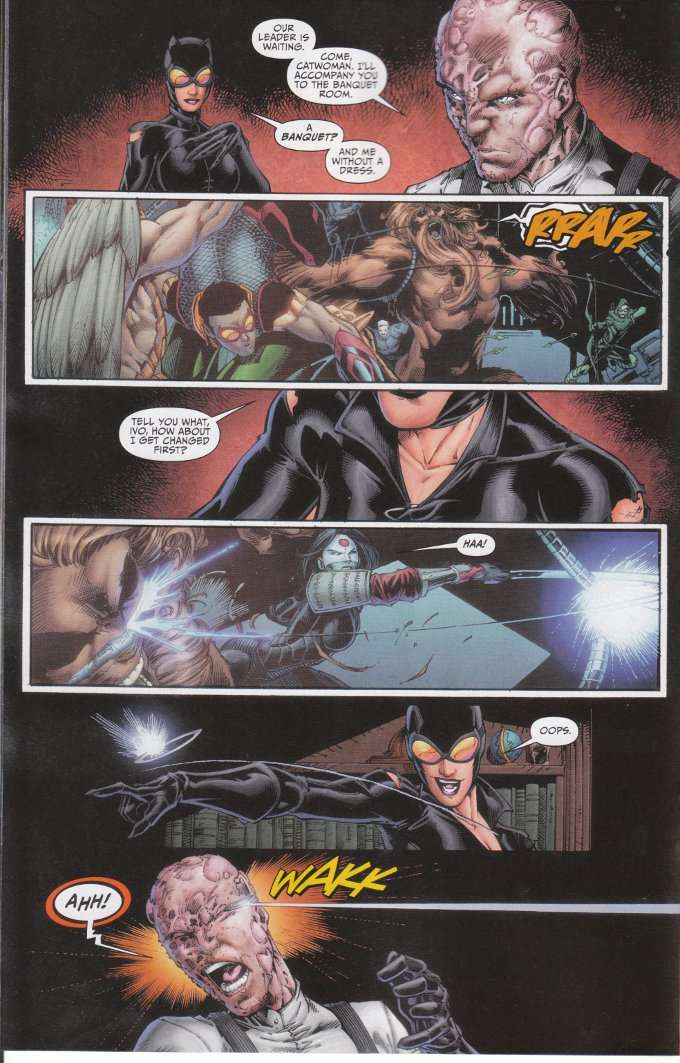

After being captured, Catwoman tried to play off of the fears of her captors, knowing as well as Batman that criminals are a superstitious, cowardly lot.   She said that killing her would only bring Batman down upon them like a ton of bricks.  To her surprise, this gamble achieved the opposite of what she wanted..  The leader of the villains said that getting Batman's attention was their entire goal just before shooting Catwoman in the head.

I didn't consider this scene to be a fridging by the technical definition.  While the bad guys said that killing her was a means toward creating drama for a male character (i.e. kill her to make Batman angry) they had just as much reason to kill Catwoman for what she had done and what she had seen as a result of her actions throughout the issue.  Annoying Batman was just a bonus.  

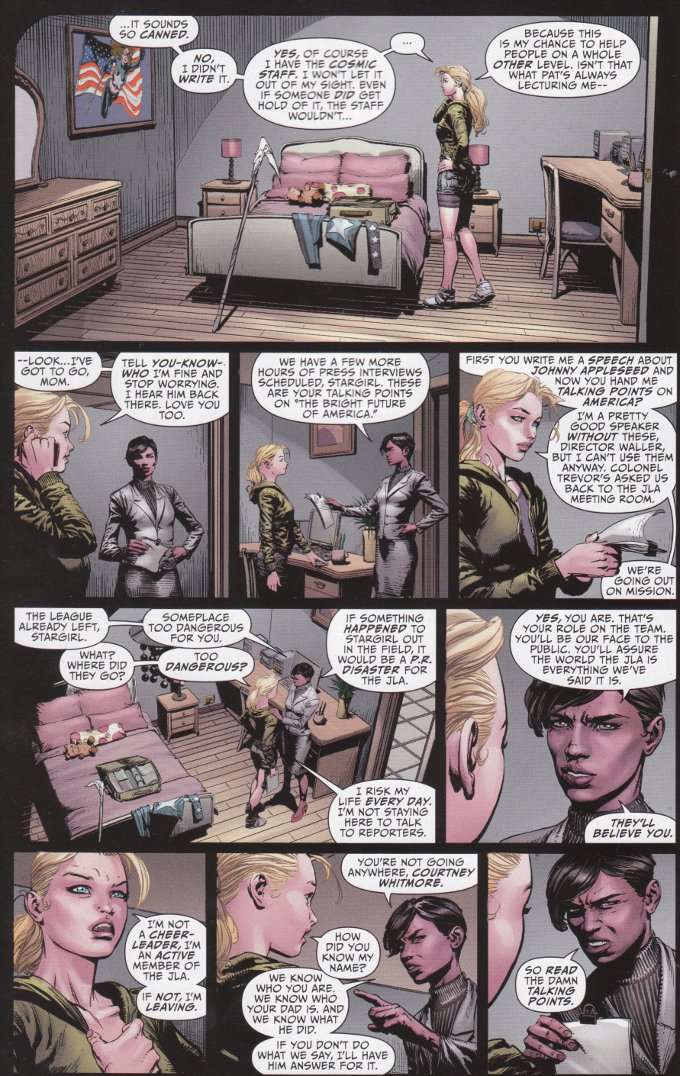
Now, I DID find the artwork and layout of the scene to be incredibly exploitative.  The final shot of a dead Selina was particularly disturbing, being almost fetishistic in how it was drawn by artist Brett Booth. And yet, I resisted writing a review and condemning the book on that point because it didn't add up.  I couldn't believe that Geoff Johns - who is usually so good about avoiding this sort of thing in his writing - would allow the fridging of a major heroine this early in a major storyline.  Particularly given that another major subplot of Justice League of America #4 involved Stargirl's rebelling against her assigned role as the team's poster-girl/spokesperson and sneaking along on an actual combat mission.


As you can see from the above scan, Justice League of America #5 rewarded my faith.  Stargirl kicks major ass and proves her worth to the team beyond Public Relations.  And I shan't spoil how but rest assured that Catwoman is alive and kicking and the rumors of her death have been greatly exaggerated.  I'm still not too crazy about how the fake-out was milked but I must admit some honest surprise at the resolution, despite some foreshadowing that was obvious in retrospect.      
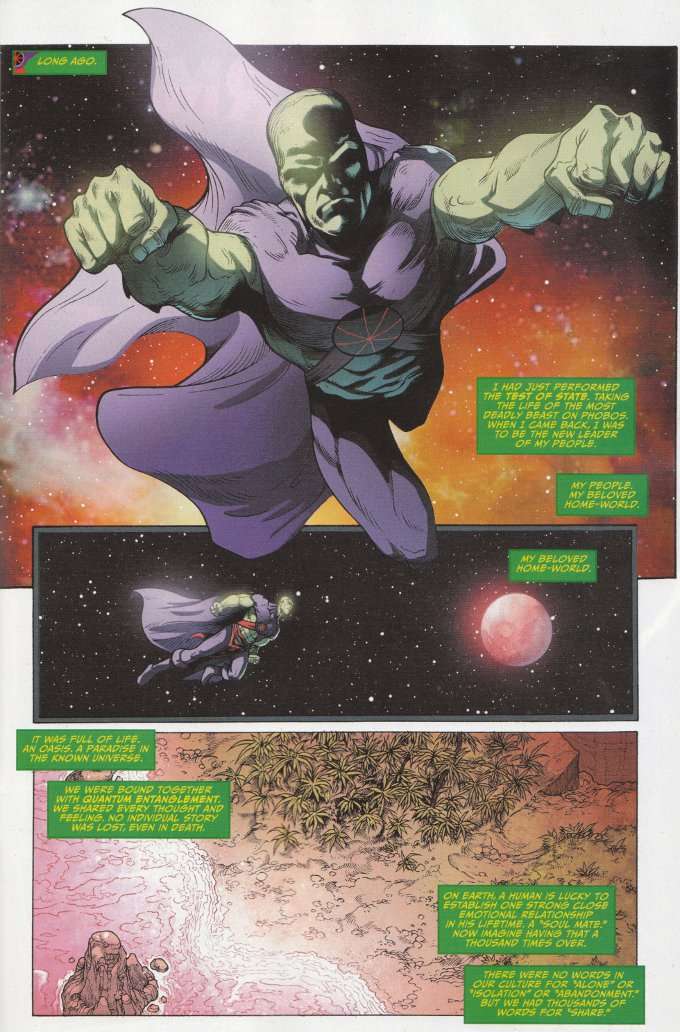

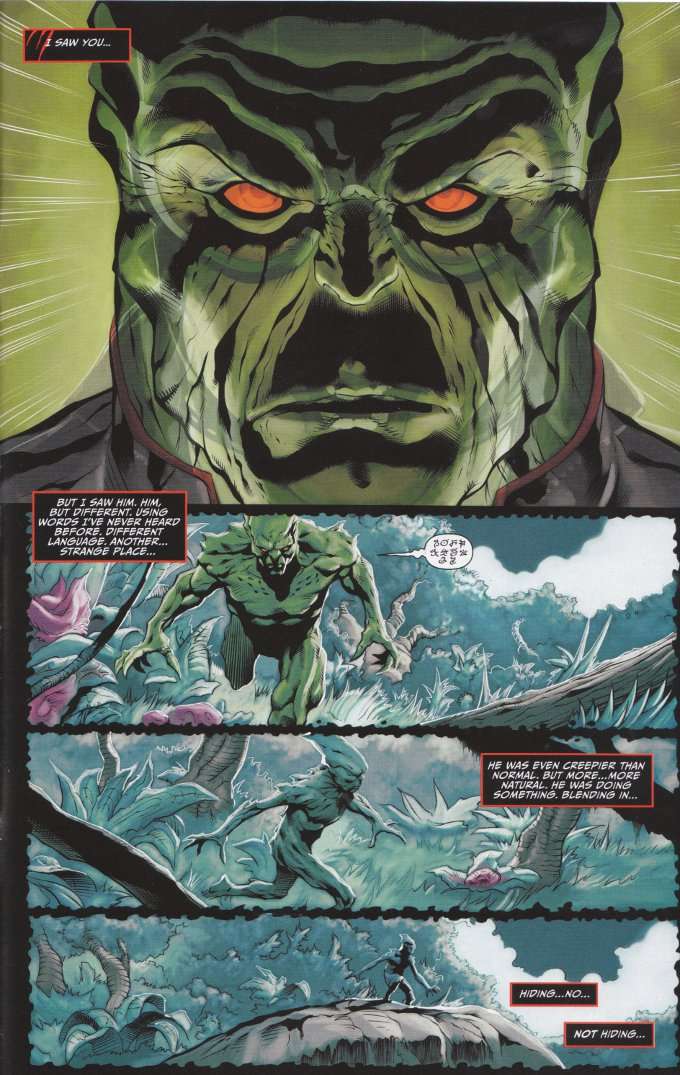
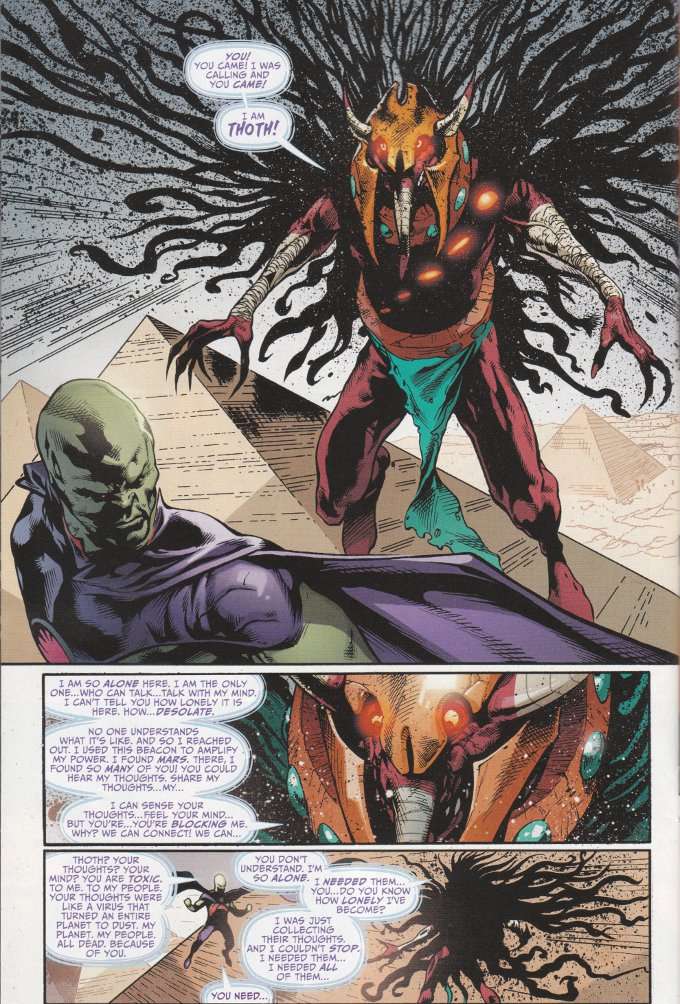
The back-up story by Matt Kindt, focusing upon the origins of The Martian Manhunter is impressive as well.  Kindt has revamped the origin somewhat, changing the specific cause of death for the entire Martian race and giving The Martian Manhunter a new means of traveling to Earth.  Issue #4 gives us a look at a Martian culture that is truly alien yet instantly recognizable and sympathetic once it is lost.  Issue #5 has him following the trail of the killer to Earth and discovering a malevolent telepath who may prove to be his greatest enemy ever.  Issue #4 and Issue #5 have different art teams, but they're both top-notch and incredibly good.


Bottom Line: If you were scared away from Justice League of America because of any fears of sexism, I'd say you should give it a shot.  I'm not happy about how the otherwise skillful Brett Booth laid out the aforementioned scene but otherwise I found his art to be quite good.  Apart from that one Trigger-Warning worth scene, there's nothing objectionable in this book and between Stargirl, Catwoman, Katana and Amanda Waller there's a lot for lovers of strong female characters to enjoy.  Now, if only it had Black Canary too...

Wednesday, May 29, 2013

Aquaman #20 - A Review

When Geoff Johns first introduced the idea of The Others during his second big Aquaman storyline, I wished that more time had been spent developing the team and showing their adventures.  Made up of a variety of unique characters whose only common bond was possession of a magical Atlantean artifact. The Others represented something I feel that The New 52 was largely lacking - history, diversity and something we hadn't seen before.  Guest Writer John Ostrander takes a closer look at these characters while introducing a new team member in this interlude issue, which shows the surviving Others taking on a mission that Aquaman can't, due to all the things that currently have him busy in Death Of A King.


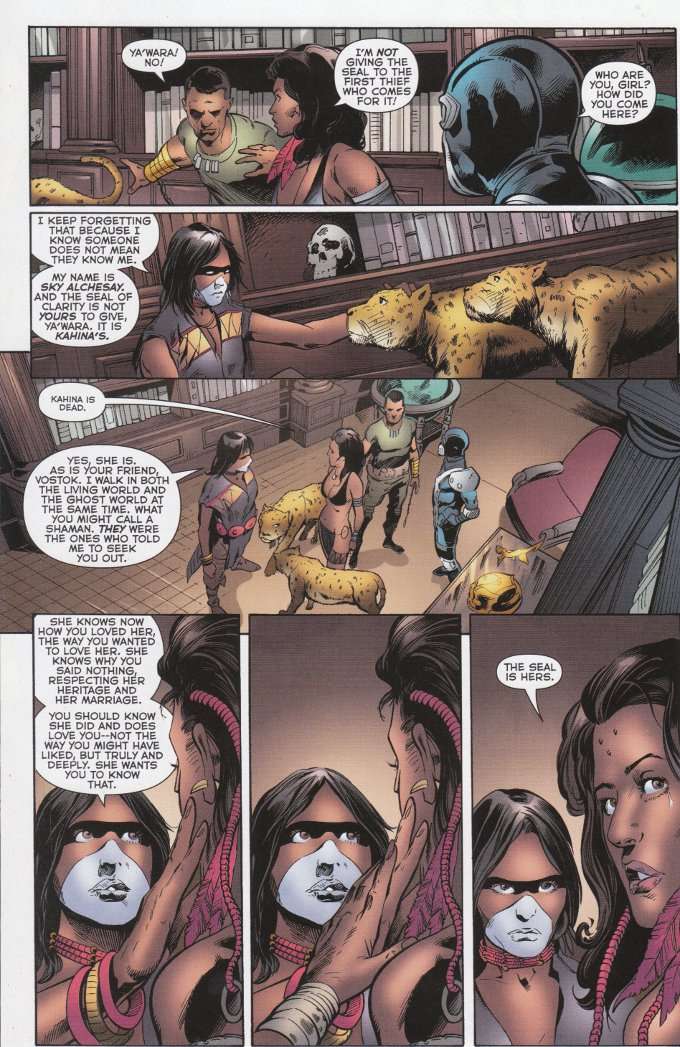
Those familiar with Ostrander's work on Suicide Squad will find much to enjoy with his script here.  Like The Suicide Squad, The Others are made up of people who do not always get along with one another but are professional enough to put aside their disagreements for the common good - one way or the other.  Ostrander also deserves some credit for further diversifying the team, introducing a new Native America hero, who avoids being stereotypical despite her mystic origin.  Ostrander also reveals something of Ya'wara (the only jungle-princess character I can think of in modern comics who isn't a blonde-haired Caucasian) and her romantic preferences that further sets the character apart from the common cliche.


Sadly, the art fails to live up to the script.  Manuel Garcia's pencils are competent enough and his figures are crisp and clear in places.  The problem lies with the inkers, of which there are four.  Anyone who doubts the power of an inker to make or break a comic would do well to take a look at this issue and take note of how the inking in this book is far from uniform.  The inking is too thick in some places, too thin in others and just right in a rare few moments.  I applaud DC Comics efforts to give work to as many artists as possible but it would be nice if this book had a single inker or greater effort was made to ensure a more consistent look. 

Monday, May 27, 2013

Justice League of America #3 - A Review

Justice League of America #3 is the kind of story Geoff Johns writes best, in my humble opinion. Johns is best known today for his grand space epics yet my favorite Johns' stories were always his smaller, more character-driven works.  Our main story here reminds me quite a bit of Johns' JSA and Hawkman, featuring a lot of small scenes which unveil more of our less-developed cast members as the team continues to investigate a secret society of super-villains. 

My favorite moment, perhaps out of an obvious personal bias, involves Stargirl and some discoveries regarding her family and home-life that definitely set her apart from the character Johns created for Stars and S.T.R.I.P.E. as a fledgling writer.  I still want to know where her Cosmic Staff came from since there isn't a Ted Knight on this Earth to have built it.  Is there?  Maybe? 


David Finch does his usual excellent job on the pencils, with Richard Friend offering a friendly assist on the inks.  Finch's style approaches photo-realism without seeming traced or posed.  His inks subtly shade the surroundings in a way that adds to the drama of Johns' script.  Consider in the above page how Stargirl is always in the light while Walker's face is always half-shadowed or turned away from the reader, symbolizing both their roles on the new Justice League of America team - The Star and The Shadow.  Face and Hand.

The back-up story by Matt Kindt is a rousing good read as well.  This story focuses upon Martian Manhunter performing a mind-scan on Catwoman to confirm her motivations and trustworthiness before she is allowed to join The Justice League of America.  This sequences serves as a far better introduction to Catwoman's character than anything else I've seen in the New 52 thus far.  It reminded me somewhat of Jim Butcher's descriptions of a wizard's soul-gaze in The Dresden Files books even before the bit where Selina is somehow able to stare back into J'onn's mind and gets a glimpse of just how alien he truly is.


This second story is ably illustrated by Manuel Garcia with inks by David Beaty.  The team does a fine job of depicting both the dark alleys and urban sprawl that makes up most of Catwoman's memories as well as the otherworldly forest that make up J'onn's memories of hunting on another world.  It is a perfect complement to Matt Kindt's story.

Justice League of America is everything you could hope for in a JLA book.  If you haven't started reading it already, it's not too late to catch up.  I think you'll enjoy it.