Showing posts with label Justice League. Show all posts

Monday, November 20, 2017

Justice League #33 - A Review

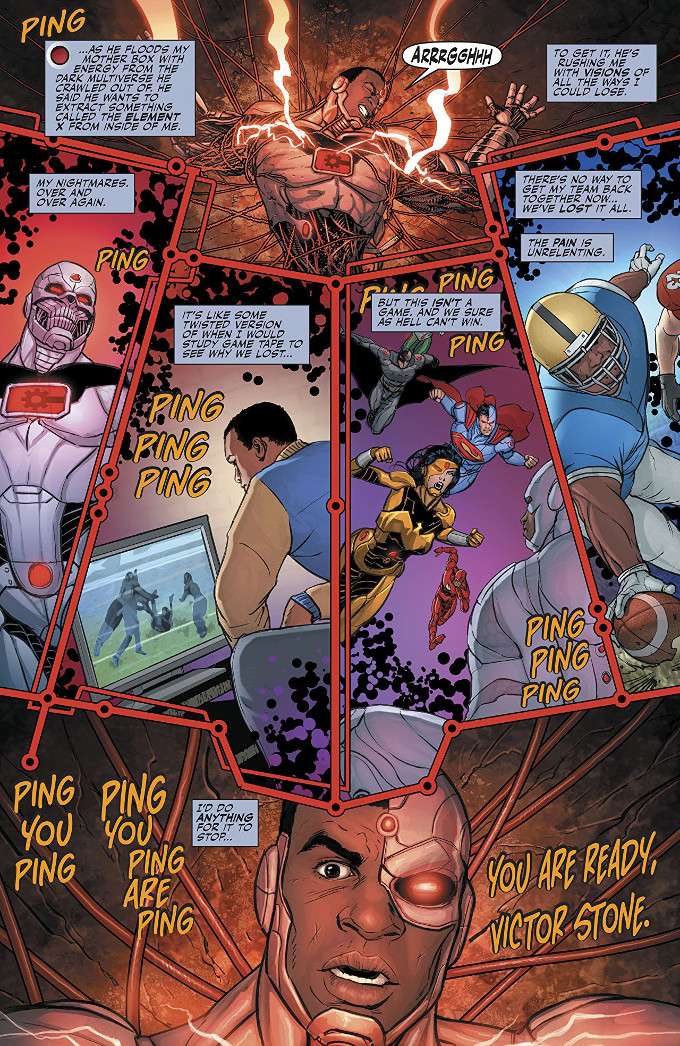
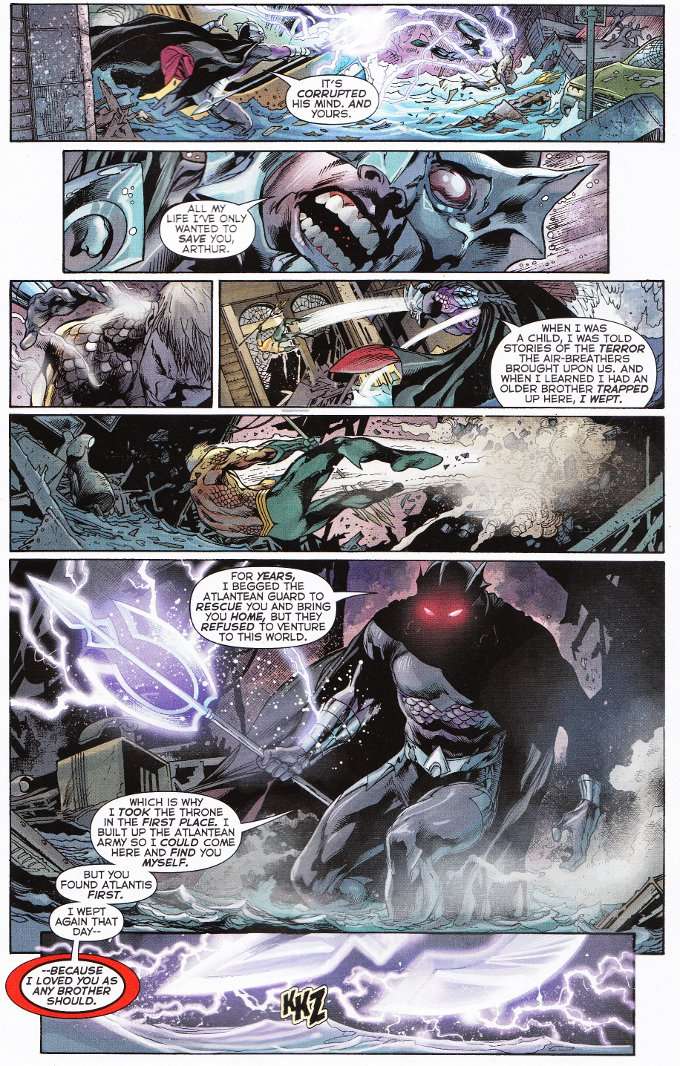
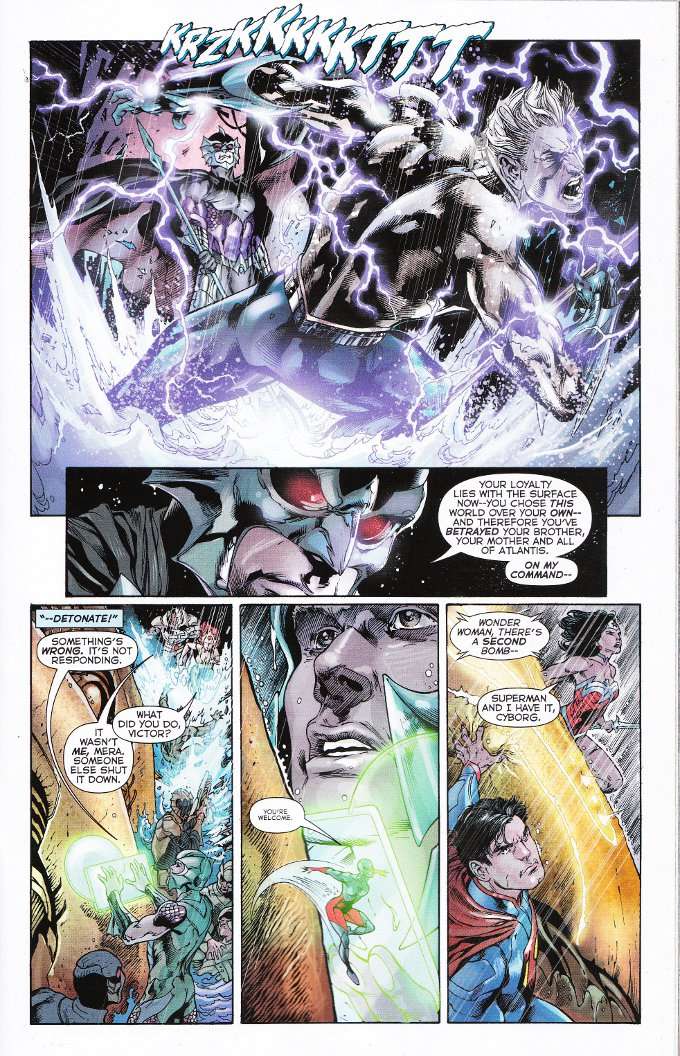
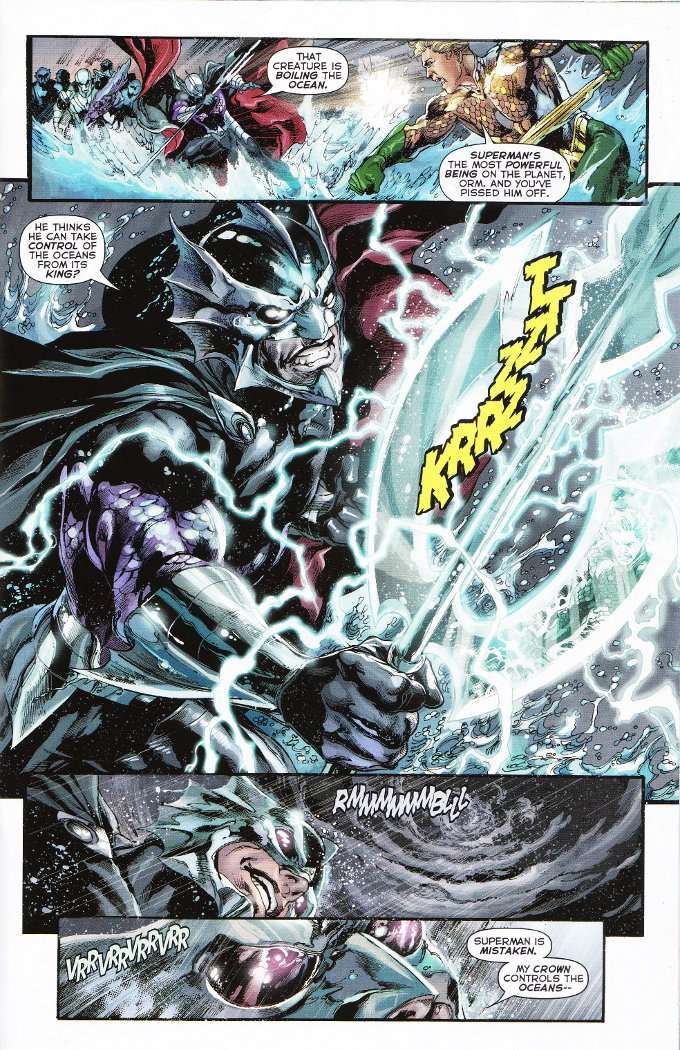
With the rest of The Justice League in the clutches of The Dark Knights, if falls to Cyborg to save the day. Yet doing so many require Victor sacrificing what remains of his humanity to fully empower the Motherbox that powers his cybernetics. Will he make the ultimate sacrifice for the sake of all reality?


Despite being largely devoted to explaining Cyborg's powers and setting up the next part of the Dark Nights Metal event, Justice League #33 is an enjoyable little book. Teen Titans fans will be glad to know the story also reaffirms the friendship between Cyborg and Raven (something missing in the Rebirth reality) and there's a sequence I'm fairly certain is a nod to one of the better episodes of Teen Titans Go!  The artwork is equally brilliant, with the colors of Arif Prianto and Jeromy Cox giving the pencils and inks of Tyler Kirkham and Mikel Janin an almost painted appearance at times.

The Final Analysis: 7 out of 10. It would have been higher if they'd confirmed the song Cyborg plays to inspire himself is "The Night Begins To Shine"

Friday, November 3, 2017

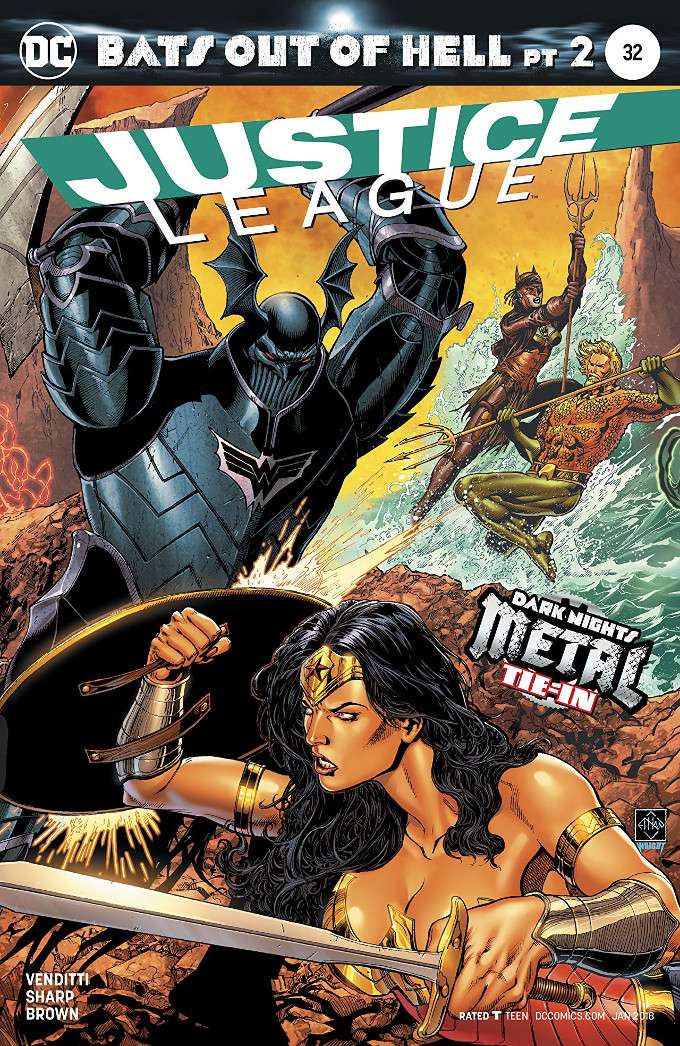
Justice League #32 - A Review

Batman is lost. Superman is trapped in another universe. And now The Dark Knights have used Cyborg to trap what remains of The Justice League in "Bat Caves" designed to drag them down before their inevitable deaths!


Justice League #32 is a thrilling piece of filler. There's not much to be found here beyond non-stop action but Robert Venditti's script presents that action well enough as The Justice League faces down their counterparts in The Dark Knights.

Liam Sharp's artwork is as finely detailed and well-presented as one would expect based on his recent work on Wonder Woman. Adam Brown does an equally impressive job on the color art. In terms of plotting relative to the rest of Dark Nights Metal, this issue may not be essential, but it is enjoyable for what it is.

The Final Analysis: 6 out 10.

Thursday, December 29, 2016

Justice League Vs. Suicide Squad #2 - A Review

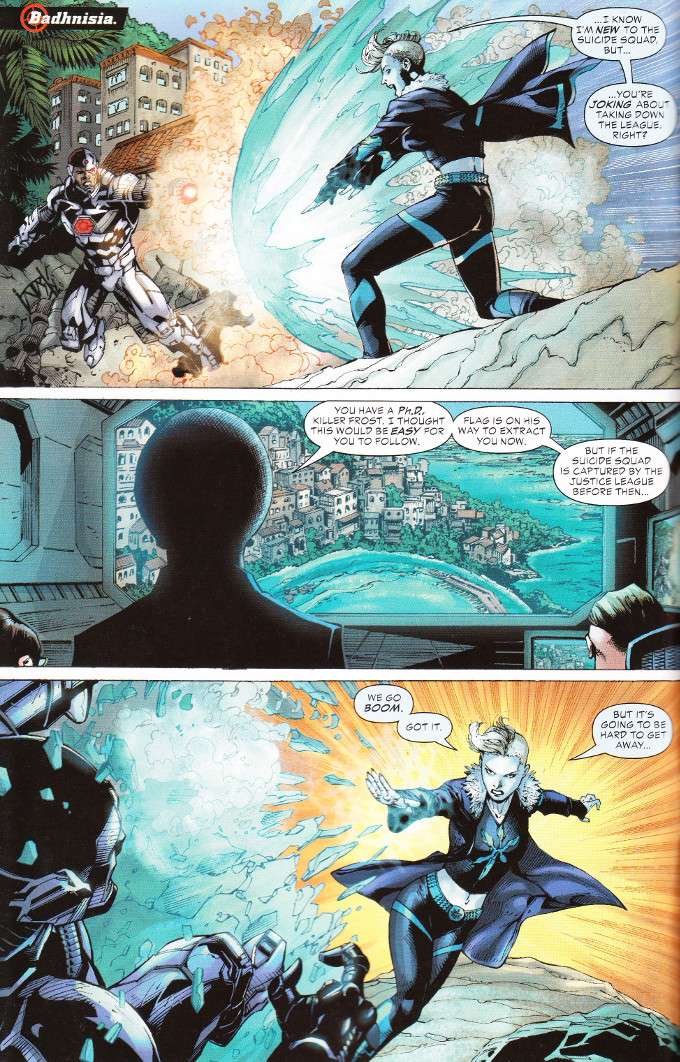
Cornered by The Justice League while in the middle of a mission, The Suicide Squad have only two choices - get blown up by The Wall or hold on long enough for Rick Flagg to air-lift them out of there. It's not much of a chance but there is one thing The Suicide Squad has that The Justice League doesn't - nothing to lose for trying.


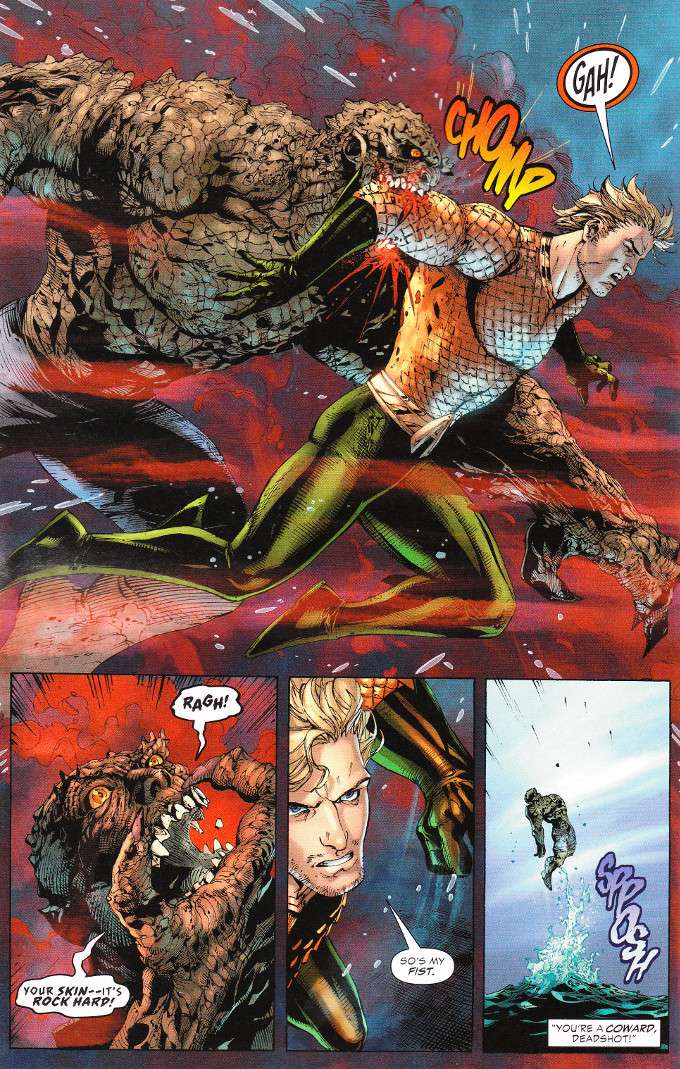
This issue is much more in line with what I expected from this series when I first heard of the concept - mindless action with an emphasis on the 'mindless' aspect of the action. Most of battles here are anti-climactic, though there are a few amusing moments such as Aquaman's fight with Killer Croc.

Unfortunately, most of the Justice League members here seem horribly out of character, with an unusually vicious Batman telling Deadshot he'll never be more than a common killer and a horrifically judgmental Wonder Woman telling Harley Quinn that she could never be friends with a deranged killer. This is ignoring the continuity problems I've heard about from other reviewers, such as Batman's commendation of Deadshot ringing false given a recent storyline when Batman tried to offer a group of criminals - including Floyd Lawton - a shot at redemption as part of his team!


At least the artwork looks good, but that's damning with faint praise. Tony S. Daniel, Sandu Florea and Alex Sinclair do a fantastic job depicting the spectacle of battle. Shame there's not much more to this comic than that. I'm uncertain at this point if I'll bother picking up Issue 3, despite the strong first issue.

Thursday, December 22, 2016

Aquaman #13 - A Review

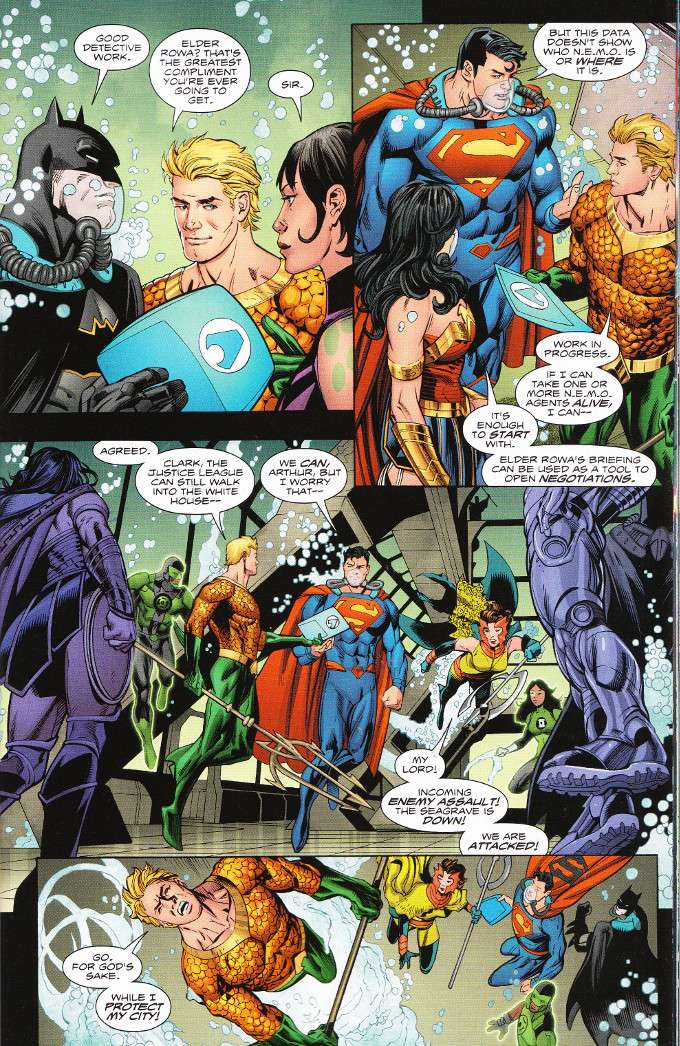
NEMO's attacks on The United States and Atlantis continue. Aquaman has evidence of their attempts to start a war between the two nations but still needs the final bit of proof - an actual NEMO soldier who can prove the existence of the secret group. Now, as his allies in the Justice League move to convince the American government that Atlantis is innocent of the attacks on them, Aquaman must fight to protect his people.


Dan Abnett moves the story of The Deluge through its various subplots like a master plate-spinner. There's a lot going on, with a combination of political drama, war thriller and superheroics making up the action of this issue. Despite the different genres and tones involved, the story is fact-paced and not a bit of it feels unnecessary or drawn out.


The artwork proves equally energetic and exciting. Scot Eaton, Wayne Faucher and Gabe Eltaeb are to be commended for their seamless workmanship on this series. This is one of the best-looking books on the stands today!

Wednesday, July 6, 2016

Justice League: Rebirth #1 - A Review

They are the World's Finest heroes. But in the wake of Superman's death and the disappearance of Hal Jordan - the first Green Lantern of Earth - they are not what they once were. Still, there is another Superman and two rookie Green Lanterns - both of whom shall reveal themselves as The Justice League face their greatest challenge yet!


I can't fault David Finch entirely for this issue feeling like I walked into an action movie twenty minutes after it started. The recent events of the Superman and Green Lanterns books defy easy explanation and Finch does well enough trying to bring the pre-52 Superman, Simon Baz and Jessica Cruz into play. I can, however, fault Finch for the decision to tell this story out of sequence, with the original Justice League members discussing the new Superman joining the team before they meet him.

I can also fault Finch for the atrocious artwork in this issue. The poses are all forced and the facial expressions are hilariously awful. The inking by Scott Hanna and Daniel Henriques is unevenly applied. Alex Sinclair's colors aren't bad but there's only so much you can do to change a cowpie by painting it.

Monday, May 4, 2015

Superman #40 - A Review

Still recovering from his battle with Ulysses, Superman is in a bit of an odd state. On the one hand, he's discovered a new power that allows him to expel the solar energy in his body with explosive results. On the other, his defenses have never been lower and for the first time in his life he is truly feeling human sensations. It's a bit of an adjustment, but with a little help from his friends, he'll get by.


By all rights, I should hate everything about this comic. It's just so goofy and out-of-synch with everything I've seen of The Justice League in The New 52. It features a smiling, wise-cracking Batman, for crying out loud!

And yet, I love it.

I like having a Batman who threatens to bill Clark Kent for the jet fuel he used flying out to retrieve Clark from a remote location. I like Aquaman jokingly covering Wonder Woman's eyes after Clark accidentally burns off all his clothes experimenting with his new powers. I like the joy that Superman takes in truly being able to eat without the sensations being enhanced to the point where he's overwhelmed by the individual flavors.

This book may be goofy but it isn't dull.  I'd go so far as to say it's fun.

What John Romita Jr. did with this book - as a writer and artist- is remarkable. It's a fun, simple, well-drawn one-shot - something almost as rare in American comics these days as a writer/artist doing most of the work on a single comic for a big-name publisher.  I'm anxious to see what Gene Yang will be doing with this series but a part of me will wonder if maybe we should have kept JRJ on to run the show for a bit.

Monday, October 13, 2014

Batman #35 - A Review

There's no easy way to summarize the main story of Batman #35 so I'll just come right out and say it. It's one year in the future, sometime after the events of Batman Eternal, and Batman fights most of the Justice League. If you just said "Oh, awesome!" then that's all you really need to know regarding whether or not you'll like this book.  It is as awesome as it sounds.


If, perhaps, you are somewhat cynical about the quality level of yet another story where Batman effortlessly takes down superheroes with more powers and just as much experience as him, know this. He doesn't exactly take them down easily and the methods employed by Batman as designed by Scott Snyder are well and truly unique. No Kryptonite rings or vibrating bullets this time!  If nothing else, this issue is worth picking up to see the ever astonishing Greg Capullo and Danny Miki give us their visual spin on The Justice League.


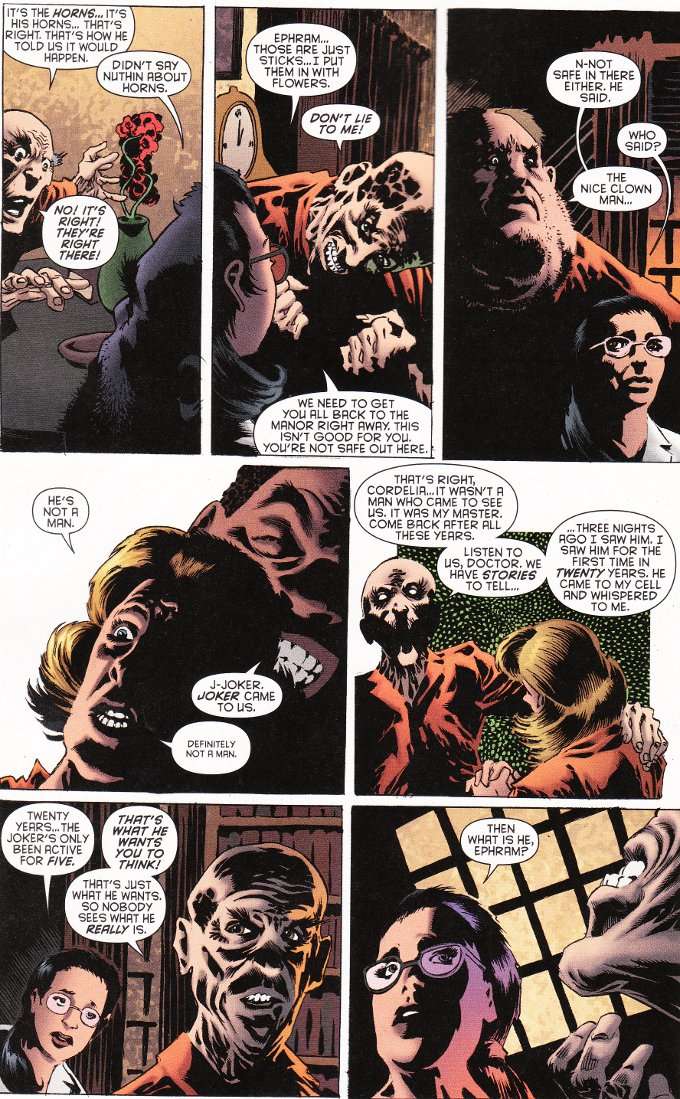
But if superheroic slug-fests are not your cup of tea, you may find the back-up story more to your liking. Written by James Tynion IV, it concerns five Arkham inmates telling stories about The Joker.  The tone is a bit closer to the Batman comics of the 1990s than more recent fare and it seems a bit more appropriate for a Vertigo title as a result.  It seems fitting then that this story should be illustrated by the indescribable Kelley Jones, who did a fair bit of work on both Batman and Sandman back in the day.  Jones' horrific style is a perfect match for Tynion's tale and this issue is well worth picking up for this story alone.

Tuesday, October 29, 2013

Justice League #24 - A Review

Is it possible for a good fight scene to salvage an otherwise uninspired comic?  Perhaps, but Justice League #24 is not the book to make that case.  Geoff Johns has written many great books but this, I'm sad to say, is not one of them.

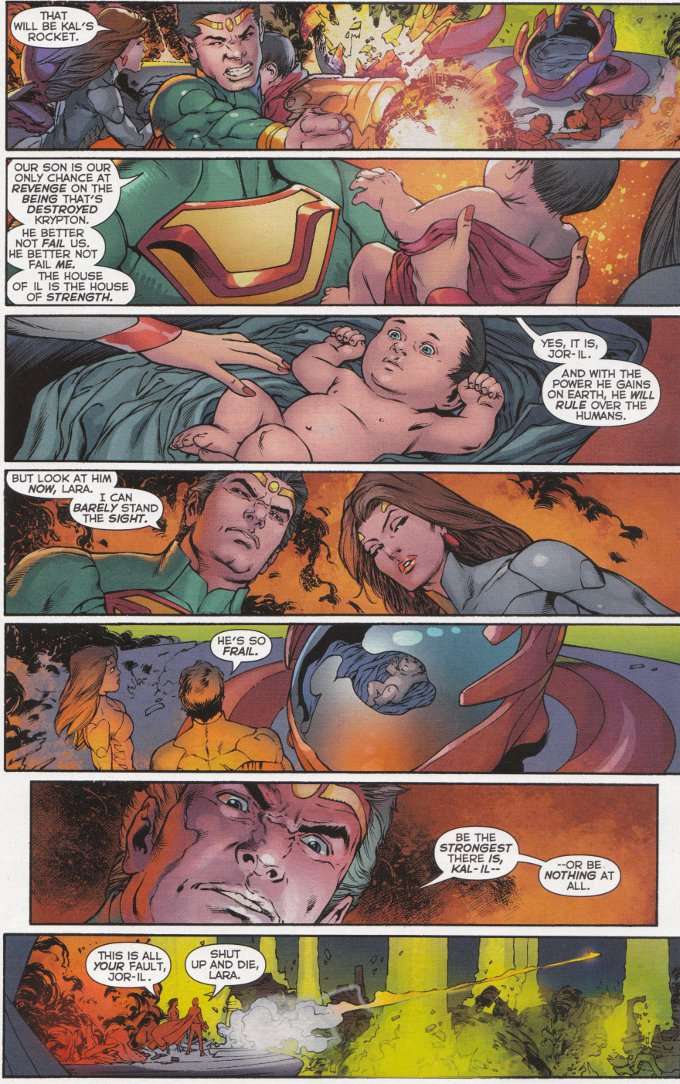
Most of the issue is devoted toward telling the detailed origins of the villainous Ultraman - Superman's evil counterpart from the parallel Earth Three.  Alert fans will note that this story is largely identical to the origins of Superman as depicted in Johns' own Superman: Secret Origin, with a little bit of Grant Morrison's Earth 2 thrown in for good measure.  We see Jor-Il (gedit?) fighting the equally evil masses of Krypton over the last escape pod off their world and The Kents as opportunistic drug addicts rather than as good and decent farmers. 


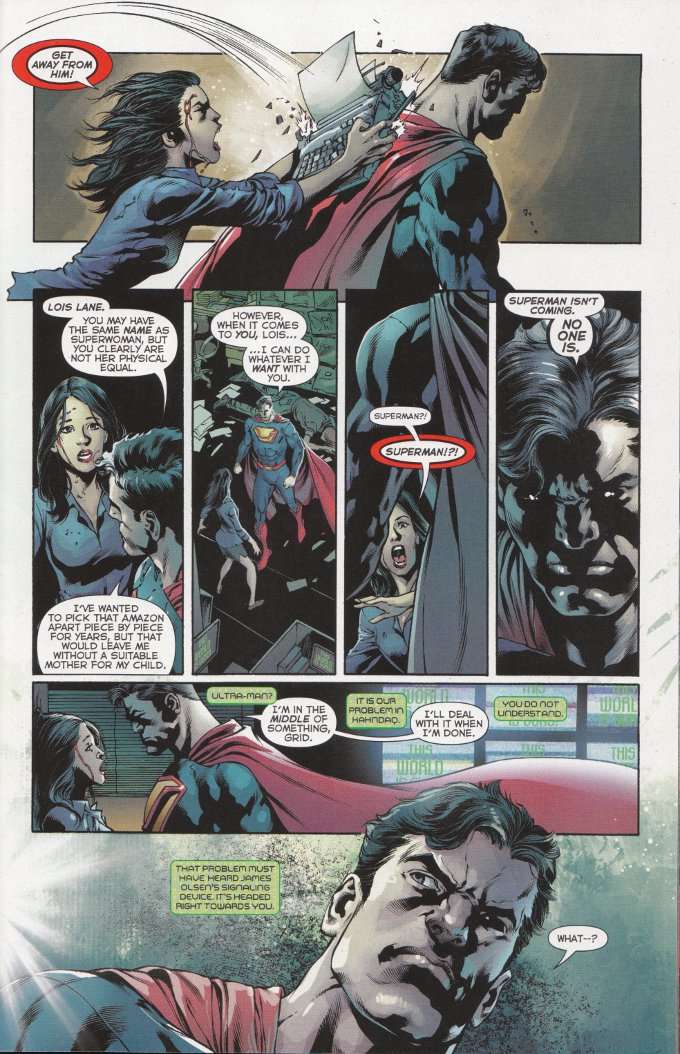
If this sounds bleakly depressing, it should.  Johns goes over the top in showcasing what a miserable a place Earth Three is and in establishing Ultraman as a conscienceless rapist and murderer.  The whole affair is technically well-written yet seems drab and dull in spite of that.  Most readers are already familiar with this story and discussing the details of how Superman and Ultraman's backgrounds differ, while undoubtedly a fun intellectual exercise for comic geeks, makes for a dull story.

Johns almost manages to salvage this affair with the eleventh-hour arrival of an unexpected hero.  Fans of Johns' excellent JSA run will appreciate this sequence and it is a good, old-fashioned superhero fight.  And yet, it is not enough to forgive the monotony of the early parts of the book. 


The artwork is similarly mixed.  Ivan Reis' pencils are excellent as always but this book proves that an inker can make or break your artwork.  Three different inkers worked on this book and the differences in their styles are obvious.  The Krypton sequences are under-inked.  The sequences where Ultraman terrorizes the staff of The Daily Planet are over-inked.  A few pages manage to be just-right but the credits page annoyingly offers no details as to which inkers are responsible for which pages.

All in all, this book is giving me little reason to continue reading Justice League and further reinforcing my opinion that skipping Forever Evil was a good idea.  With an uneven and overly familiar story backed by confoundedly inked artwork, there is little to recommend this book.

Monday, July 15, 2013

Justice League #22 - A Review And A Rant

Remember when super-heroes fought super-villains in the big crossover events?

Seriously.  When was the last time we had a big event book where the heroes fought actual villains rather than other heroes?  And no, alternate universe versions or alien clones of themselves don't count, Flashpoint and Secret Invasion fans.  It's been a while, hasn't it?

I have no objection to heroes fighting other heroes but it seems like that's all the heroes do anymore.  Have we come to the future Mark Waid predicted in Kingdom Come where the villains are underground running the world in secret and the heroes are fighting turf wars over who gets to protect what?  Reading Justice League #22, it's hard to argue that we haven't.

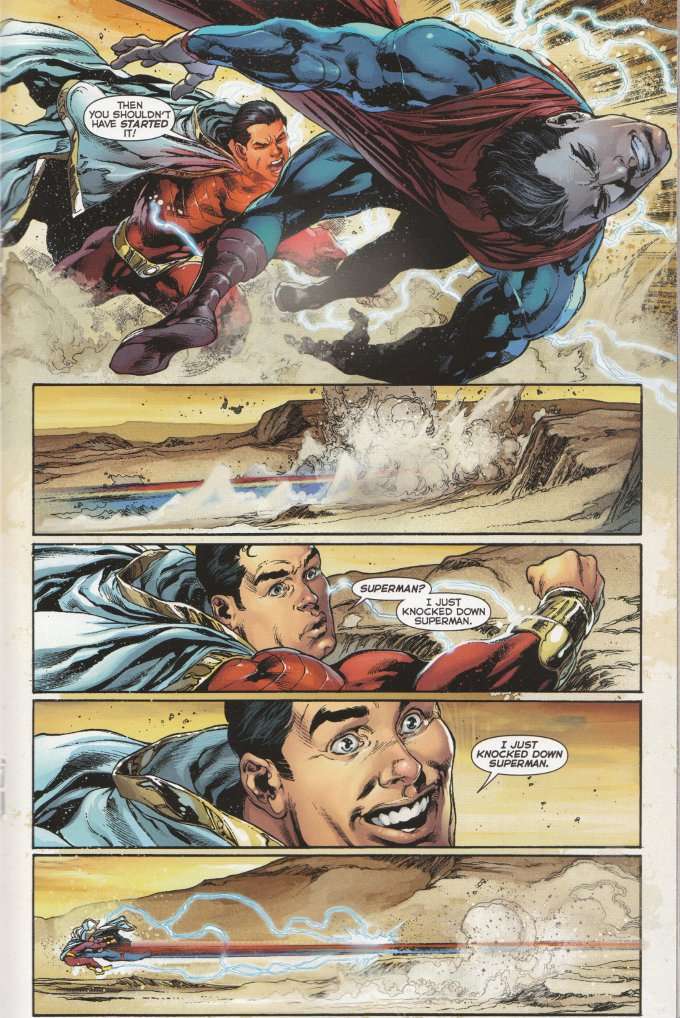
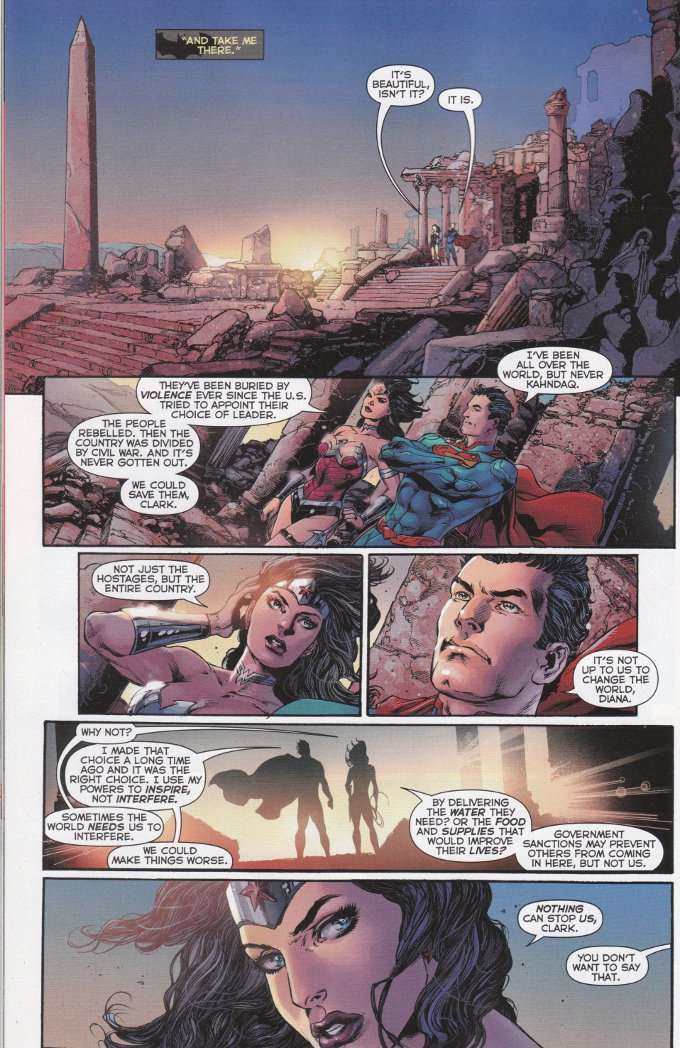
While the plot does feature some random bits involving the Trinity of Sin (i.e. The Question, The Phantom Stranger and Pandora), the main focus of the issue is upon the inevitable battle between The Justice League and the newly formed Justice League of America.  Inevitable, at least, in the eyes of Amanda Waller, who create the JLA specifically to counter the abilities of the original Justice League should they ever work against the interests of the USA.  When the entire Justice League travels to the enemy nation of Kahndaq after newbie hero Shazam crosses the border, Waller sees her chance and sends the JLA in to enforce America's embargo.  Hilarity ensues.   


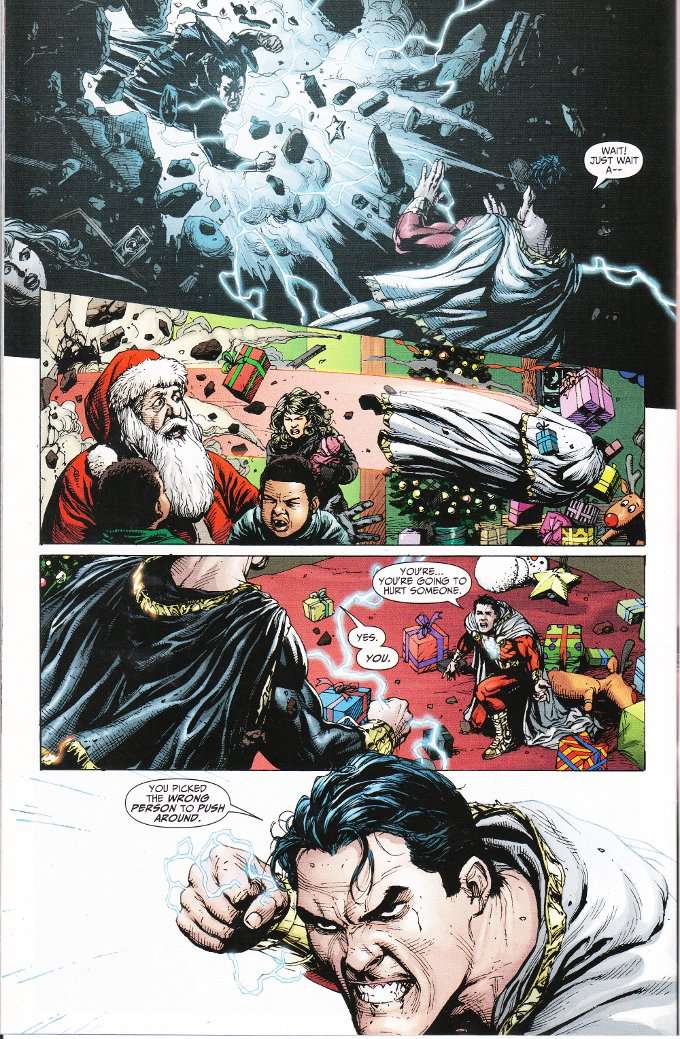
Thus far, Trinity War seems to be DC Comics' answer to Avengers Vs. X-Men -  a violent free-for-all born out of disagreements that could be solved in five minutes if the characters weren't written like complete imbeciles because that is what the plot demands.  While it isn't out of character for Amanda Waller to see The Justice League as a threat to the nation she serves, it seems uncharacteristically short-sighted for "The Wall" to send a group largely made of untested newbies like Vibe, Stargirl and the new Dr. Light into the field against a more experienced enemy.  Superman charges into battle against Shazam without trying to find out if the other hero instigated a battle with the Kahndaq Army - a question you'd think Superman would consider given that he and Wonder Woman were fighting the same army several issues earlier.  And if there was any doubt that the New 52 version of Billy Batson did not have The Wisdom of Solomon, this issue obliterated it.

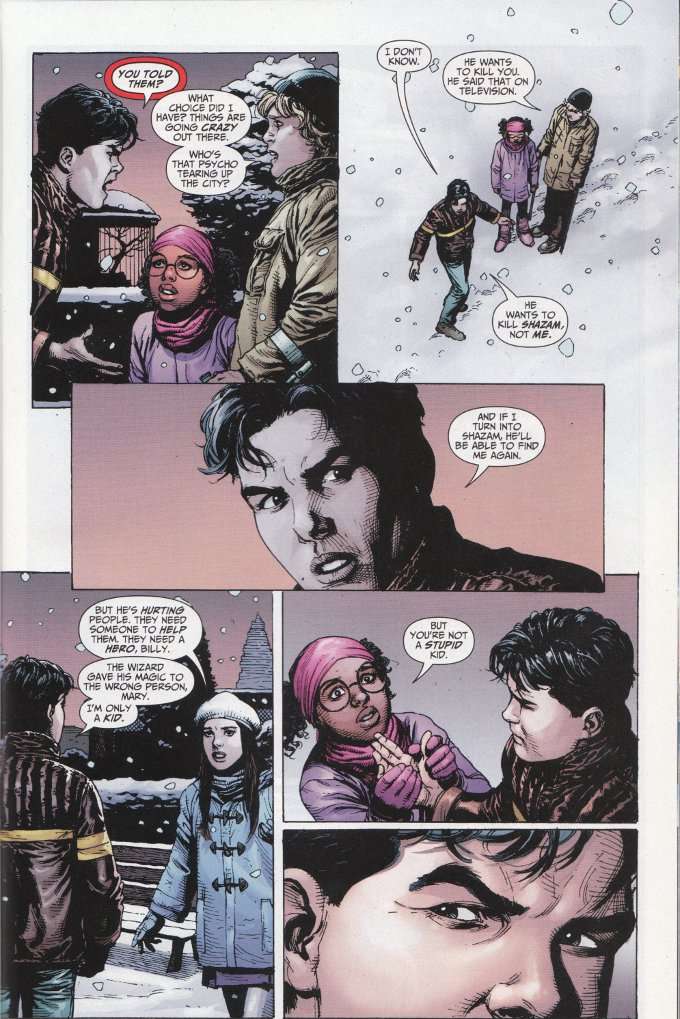
Ironically, the only thing that makes this story tolerable and indeed prevents it from being  Avengers Vs. X-Men Starring The Justice Leagues  is same thing that makes it so aggravating - the writing of Geoff Johns.  Johns succeeds where Bendis and Company failed by evoking real ethos in a series of short scenes amid all the strum und drang.  Whereas it was hard to find sympathy for either the fascist Captain America or the single-minded Cyclops, one can't help but feel Billy Batson's guilt and admire his determination to do the right thing even as he goes about it in the worst way possible. 

Where Johns fails is by falling into the same trap of manipulation that turned off so many comic readers when Brad Meltzer pulled it in Identity Crisis.  With a single issue, Meltzer was able to do what so many writers had failed to do and make Ralph and Sue Dibny into something beyond a joke - characters who had earned their seemingly accidental place in The Justice League.  He then destroyed the miracle by setting us up to care about Sue and Ralph only to kill one off and turn the other into an shell of their former self.  Johns does the same thing here, sacrificing the brilliant conceit of turning Dr. Light - perhaps the most hated villain of the past 10 years of DC Comics - into a loving family-man, moralist and would-be hero.  There's no small irony that Dr. Light is the one who pleads for peace and tries to get everyone to discuss their differences before his sudden and grisly death, which triggers the superhero smackdown we were promised. 


Rest In Peace, Dr. Light.  We Hardly Knew Ye. 

The artwork by Ivan Reis, Joe Prado and Oclair Albert is as good as one might expect.  I haven't seen a bad issue yet from Reis in the past year, be it on Aquaman or Justice League.  But in this case the artwork is like a candy shell on a rabbit pellet.  Sure, it may look good... but it will leave a bad taste in your mouth.

Despite this, I will attempt to finish this crossover so that you, my readers, do not have to.  Not that I have much choice with it dominating so many of the books I read on a monthly basis.  Still, I will endure even as I wonder how two writers I enjoy so much can create something that leaves me so disgusted.


Monday, July 1, 2013

Justice League #21 - A Review

Justice League #21 is entirely devoted towards Shazam, wrapping up the origin story for Billy Batson in the New 52 Universe.  There is little I can say about this issue without spoiling it - and one of the biggest surprises in recent memory.  Suffice it to say my attitude towards this revamp has done a 180 and I would gladly buy a monthly Shazam series if Geoff Johns and Gary Frank were the creative team.


What prompted this change?  Oddly enough, it was a combination of one inspiring moment in this book and my thoughts on the Man of Steel movie and what characters mean to different people.  I had always associated the character of Captain Marvel and Billy Batson with the honesty and innocence seen in stories such as Kingdom Come and the Clash episode of Justice League Unlimited. Yet on reflection, I found that all of the appearances of Billy Batson in the comics that I liked (chief among them Geoff Johns' JSA) depicted a character who was idealistic despite lacking any illusions of the world being a fair place!  Looking at this issue, I realized that the defining characteristic of Billy Batson isn't innocence - it's optimism.  And there's a world of difference between the two.

Likewise, Billy's role is not that of the wide-eyed innocent.  He is the dream come true of every little guy held down by someone bigger.  He is every person who was ever bullied and wished, if only for a second, that they could turn the tables.  Curious then that so many of his enemies (indeed, all but one in this story) are victims of bullying who ally themselves against Billy due to their jealousy of what he is.  Dr. Sivana is a geeky scientist who longs for the magical power Billy inherited.  Black Adam is an ex-slave who fears losing what power he has now that Billy has replaced him as a magical champion.  Even Mister Mind is a victim of size-discrimination in a way.


I think now that restraining this story as the back-up to Justice League hampered it unfairly.  Given an entire issue to shine, it does just that.  The artwork is as amazing as one would expect from Gary Frank.  Geoff Johns' script inspires and entertains.  Hopefully the whole story will be collected in one volume by itself without The Justice League getting in the way. 

Monday, May 27, 2013

Justice League #20 - A Review

 Justice League #20 is something of a mess, in terms of both story and artwork.  Reportedly, the main story was laid out by one man and then illustrated by three different pencilers and three different inkers.  Art by committee works even less often than writing by committee and it really doesn't work here.  Even accounting for the differing styles at work, everything looks horribly uneven.


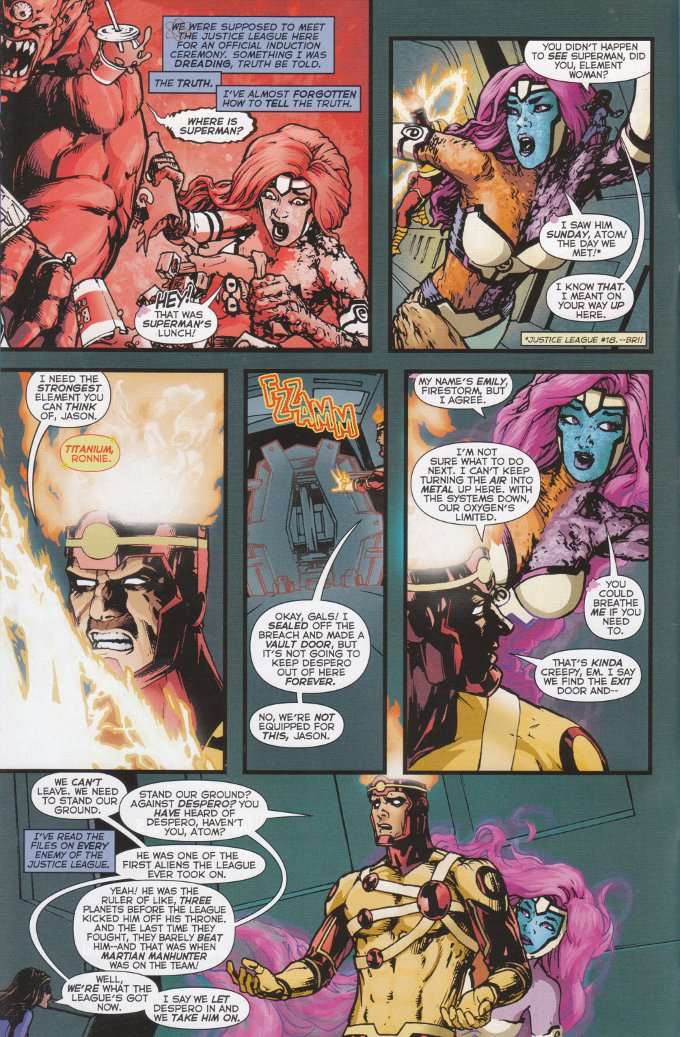
The story by Geoff Johns, focusing primarily upon the newest members of The Justice League as they fight the telepathic powerhouse Despero, isn't much better.  Johns does his best but the underdogs fighting outside of their weight class story has been done to death.  Not helping matters is that much of the "charm" of this issue depends upon your enjoyment of the flighty bimbo that is Element Woman or the continual squabbling of the two teenagers who make up Firestorm.  And given that Fury of Firestorm was cancelled this month, it appears that the vast majority of comics fandom find the antics of Ronnie Raymond as tiresome as I did when they played this exact same conflict out during Brightest Day

There's only two things that save this comic at all.  The first is the Shazam back-up story, which finally seems to be gaining some legs or maybe I'm just viewing it more sympathetically now that Billy Batson is beginning to act like the hero he should be.  The other bright side in all this is a scene involving several of the Justice League founders and Superman having a talk with Batman about his creation of protocols to take down every other member of the Justice League... including himself. 


This book seriously needs one artist, one inker and one person deciding its' look.  The multiple teams working on the main story this time around do not work well together.  And Johns would do better to develop his new characters alongside the established crew for a time rather than throwing them all into a spotlight that none of them deserve yet. 

Wednesday, April 24, 2013

Justice League #19 - A Review

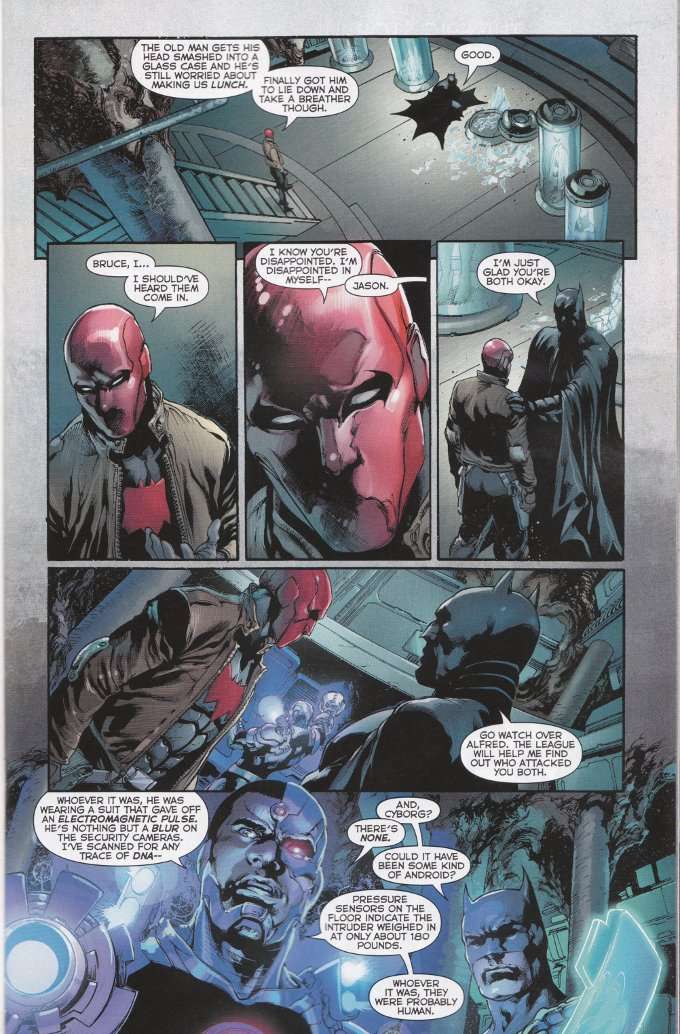
It is a credit to Geoff Johns' skill as a writer that he manages to do in two pages what Scott Lobdell and Judd Winick failed to do in two years - make Jason Todd into a sympathetic figure.  This is perhaps the most minor of the subplots we see in Justice League #19 yet it is perhaps the most compelling.  It's certainly more interesting than watching Ronnie Raymond and Jason Rusch arguing with one another (honestly, didn't we get enough of this in Brightest Day?) or the revelation that the new Atom can use her powers to play her favorite MMORPG from the inside... I think.  That sequence isn't particularly clear, though it is a nice nod to the old Sword of The Atom series.


The actual meat of the issue is more enjoyable, with Batman coping with a burglary in the Batcave that bodes ill for the entire team and Wonder Woman encouraging Superman towards a more proactive approach to crime-fighting.  There's a lot going on here and Johns is no doubt setting things up for the upcoming Trinity War storyline.  Thankfully, he does a good job keeping his ducks in a row.  I just wish he hadn't bothered with some of the story-lines that do little to develop the already well-established characters.

Ivan Reis continues to flourish as the series' new penciler, despite being somewhat crippled by a team of three inkers.  Does the book look bad?  No, but you can tell that three different artists were handling the inking duties.  There's little sense of continuity and cohesion visually.  Any who doubt the power of an inker to completely change the feeling of a penciler's work would do well to check out this issue.


I shan't bother offering my two cents on the Shazam back-up anymore.  You all know what I'm going to say at this point and I'm sick of saying it, over and over and over again..  Johns' script is good, but I loathe the new take on Billy Batson, who doesn't feel at all like he should.  Gary Frank's art is far better than the story deserves.  They had to call this Shazam because this mess sure isn't Captain Marvel.  Blah blah yakkity smackity. 

Tuesday, March 26, 2013

Justice League #18 - A Review

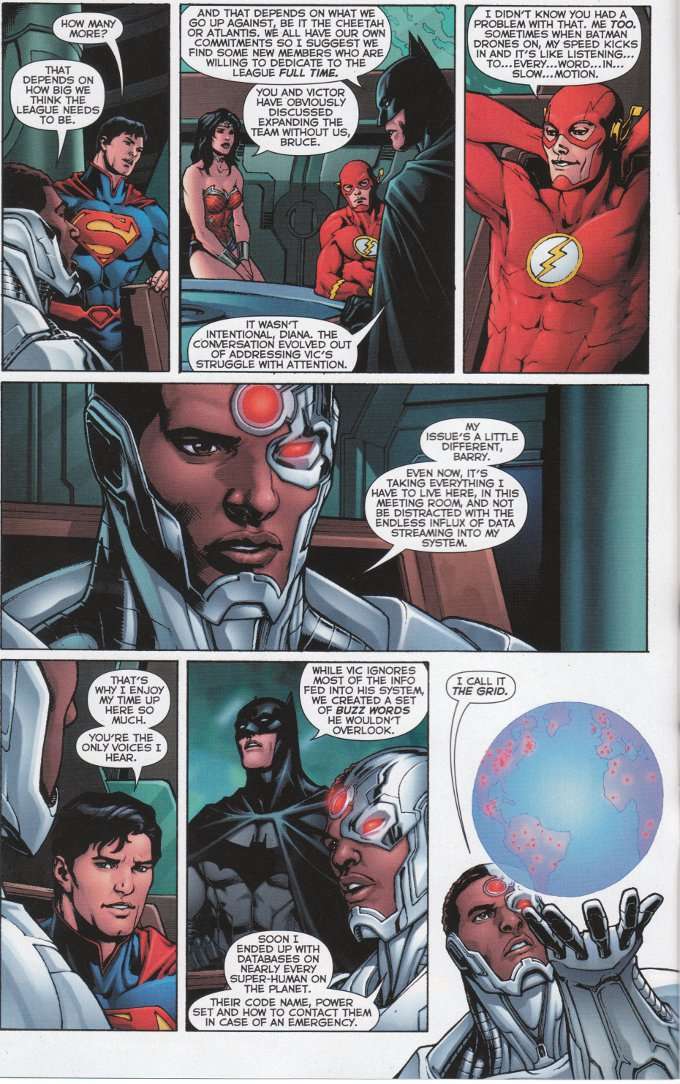
It is an odd thing that Justice League #18's greatest strength is also its' greatest weakness.  The early scenes where the core members of the Justice League are discussing recent events and their need to expand the team in the wake of some extensive disasters are well-paced character-building moments.  Yet the later scenes - where the potential recruits are brought in to mix and mingle with the team - seem rushed and forced in comparison.  There are too many players on the stage in this moment and it proves beyond even Geoff Johns' ability to balance a large ensemble to manage these moments. 


The back-up story involving the origin of Shazam continues to limp along.  I'm still not fond of this revamp of the classic Captain Marvel concept but there are some good moments here - chief among them the scene where Billy's foster brothers and sisters go searching for him to offer an encouraging word.  I wish Johns would decided on a tone for the series at large, as the opening scenes with the villainous rich man Mr. Bryer are far too melodramatic to be taken seriously in anything other than a classic Captain Marvel comic yet the general tone of the series has been darker and grittier. 


While I may grouse about the stories, I cannot complain about the artwork.  Everything here looks gorgeous.  Gary Frank makes Shazam appear far better than it has any right to.  And Jesus Saiz, who illustrates the Justice League section of the book, deserves to be assigned to one title rather than doing fill-in jobs on a variety of books.

UPDATED: ARGUS To Feature In Arrow


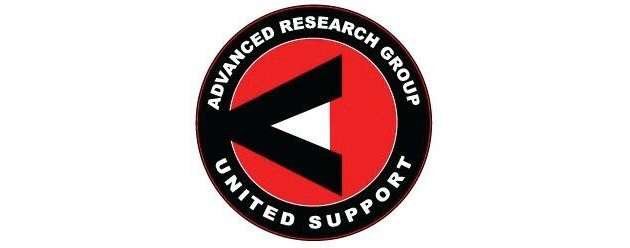
SOURCE: THE CW’S ‘ARROW’ SEASON 2 TO INTRODUCE DC COMICS ORGANIZATION A.R.G.U.S.

Arrow Executive Producer Marc Guggenheim tweeted the above image to his followers, with the comment "Coming Soon To Arrow".  Already speculation is rife about what this may mean.

A.R.G.U.S., for those of you not following the New 52 comics, is an organization funded as an off-shoot of the Department of Homeland Security.  Originally founded under the command of Col. Steve Trevor, the purpose of ARGUS was to allow the United States government to offer logistical and military support to The Justice League.  When the JL decided to go independent, Trevor was removed from power and replaced with Amanda Waller.  At present, the two are working together to build a new Justice League of America with Trevor acting as the team's field commander.

Why is this significant?  Because in the lead-up to Justice League of America, Oliver Queen was recruited by Steve Trevor to go undercover and investigate rumors of an organized body of super-villains - a Secret Society, if you will.  And in addition to acting as the government's go-to person with organized superhero groups, Amanda Waller is also in charge of The Sucide Squad - a government project that puts convicted super-criminals to work on covert operations in exchange for time taken off their sentence.  One of the most prominent members of the Suicide Squad is Deadshot.

See where I'm going with this?

The original acronym was Advanced Research Group Uniting Superhumans - obviously a different acronym than what we see above.  So why the change?  Clearly they don't want to go bringing super-powers into the reality of Arrow just yet.  But having a government agency put Ollie to work would be in keeping with the theme in the current Green Arrow and Justice League comics to say nothing of the Mike Grell comics that had a hand in inspiring the current show.

So... does this mean we're going to see The Suicide Squad with some non-powered villains and maybe some other no-powered heroes? 

UPDATE:
Marc Guggenheim contacted me on Twitter personally to make the following corrections.

1. ARGUS will be showing up during Season 1.  NOT Season 2.

2. The upcoming SHIELD show has nothing to do with the decision to bring ARGUS into Arrow.  "Just saw a cool opportunity and took it."

Personally, I'm relieved.  Arrow is a great show as is and enough of a success on its' own terms that it doesn't need to go aping the formula of another show that hasn't even aired yet.

Tuesday, February 26, 2013

Justice League #17 - A Review

There's little I can say about Justice League #17 that I haven't said already about the other issues in the Throne of Atlantis mini-series.  There is much I fear to say for the sake of spoiling a story that did manage an honest twist or two in the tale.  However, I think I can safely say that this final chapter does rock the status quo of both the Aquaman title as well as Justice League.  Big changes are afoot - that much is certain!


The plot is as good as one would expect from Geoff Johns.  The drama between Aquaman and his brother Orm is cranked up to 11 as the two do battle with words as well as with magical artifacts.  Johns has given Orm far greater depth than I think he's ever had in any other story and I thank him for it.  Indeed, Orm has become so sympathetic a figure, I find myself sympathizing with him more than I do Aquaman.


The excellent artwork of  Paul Pelleiter and  Ivan Reis brings this series to bed.  There's some amazing, poster-worthy pages here, my favorite being a spread of The League charging into battle.  And yet it's the little details - such as The Atom escaping from the inside of an Atlantean doomsday device - that make Reis' art so interesting.   

Sunday, February 3, 2013

Justic League #16 - A Review

Ocean Master has always had a rough time of it as a character. It's bad enough being an Aquaman villain to begin with.  Imagine being a bad guy whose sole motivation is being jealous of Aquaman's superpowers.  That was Ocean Master back in the Silver Age.  He was Arthur Curry Sr's son by a human woman.  No powers.  No resources.  Just a burning hatred for the bastard half-brother who got superpowers while you didn't.  Things weren't much better in the Dark and Modern Ages, where he was a thinly-veiled Loki rip-off  with vague magical powers fueled by a demonic trident.

Geoff Johns has changed this all yet again in the New 52 reality but this time he has created an Ocean Master worthy of the name.  No petty criminal or scheming courtier this time!  This Orm, now Aquaman's half brother by the same Atlantean queen, is a credible threat even without the might of the Atlantean army backing him up.  With defined magical powers that let him influence both water and the weather, this Ocean Master proves menacing enough to hold the heaviest hitters of the Justice League at bay single-handed!  We're left with the impression that Aquaman's pleading for an end to the fighting is less out of a desire for peace but more from an honest fear he may not be able to stop his brother if things come to a head.  


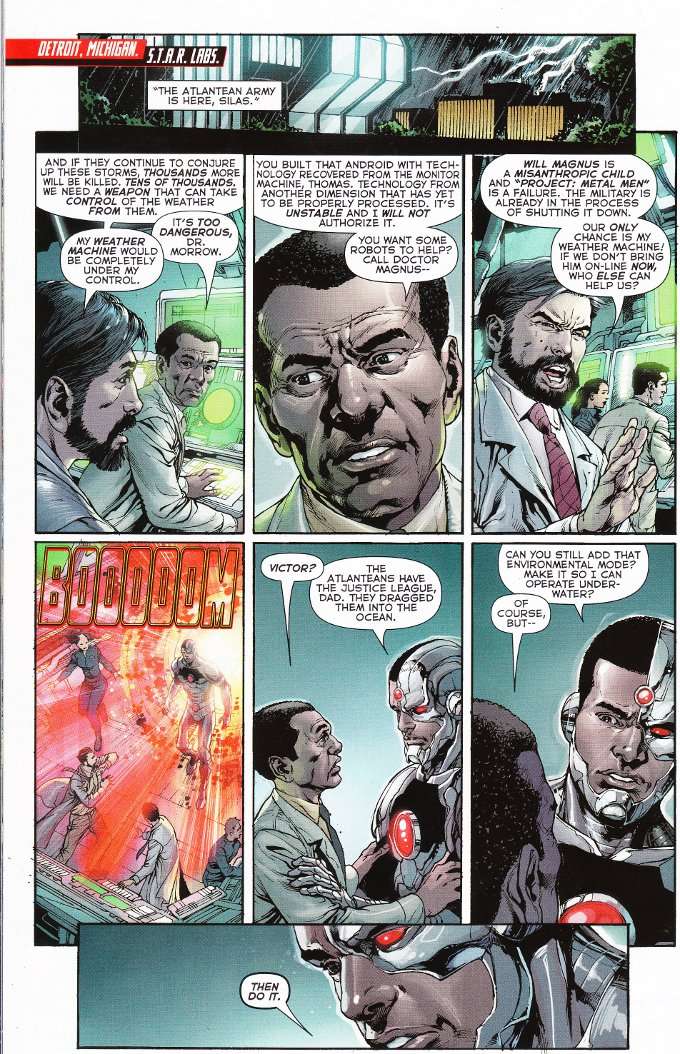
Johns has a gift for taking these classic concepts and redefining them and it's one of the things I find most enjoyable about his writing.  The other thing that makes Johns brilliant as a storyteller is the way he manages to work such wonderful character moments into his stories while hinting at things to come.  A good example of this comes in a brief interlude at S.T.A.R. Labs, where a certain Dr. Morrow is monitoring the Atlantean controlled-weather attacks and asks permission to test a robotic weather-control machine he's been working on. 

Longtime Justice League fans will appreciate the reference but everyone will appreciate the scene in which Victor Stone a.k.a. Cyborg confronts his father about upgrading his body to allow him to breathe underwater.  The on-going conflict regarding Vic's fears of losing his humanity as more and more of his body is replaced with mechanical parts has barely been touched upon in recent issues, save for occasional scenes of Cyborg refusing to discuss a newly developed upgrade.  It says volumes in this moment, when his superhero colleagues are in need, that Vic is willing to put all his fears and objections aside for the sake of his friends.  THAT is heroism in a nutshell as well as why Geoff Johns is one of my favorite writers.    


The artwork in this issue is excellent, as always.  Ivan Reis offers up the same breath-taking pencils that made his recent run on the main Aquaman book so memorable.  Everything is beautiful and this is one of the best-looking books on the shelves today.  Gary Frank is equally amazing in the Shazam back-up story.


The Shazam back-up story - long the millstone around this book's metaphorical neck - didn't bother me as much this time around.  I suspect it's because Billy, for all of his petty acts of crime in the past issues, finally began to act like the hero I expect him to be in this issue.  I think I'll be able to live with this new take on (not) Captain Marvel if things continue in this manner, with Billy taking his power more seriously and realizing what he can do to help people besides himself.

Sunday, December 30, 2012

Justice League #15 - A Review

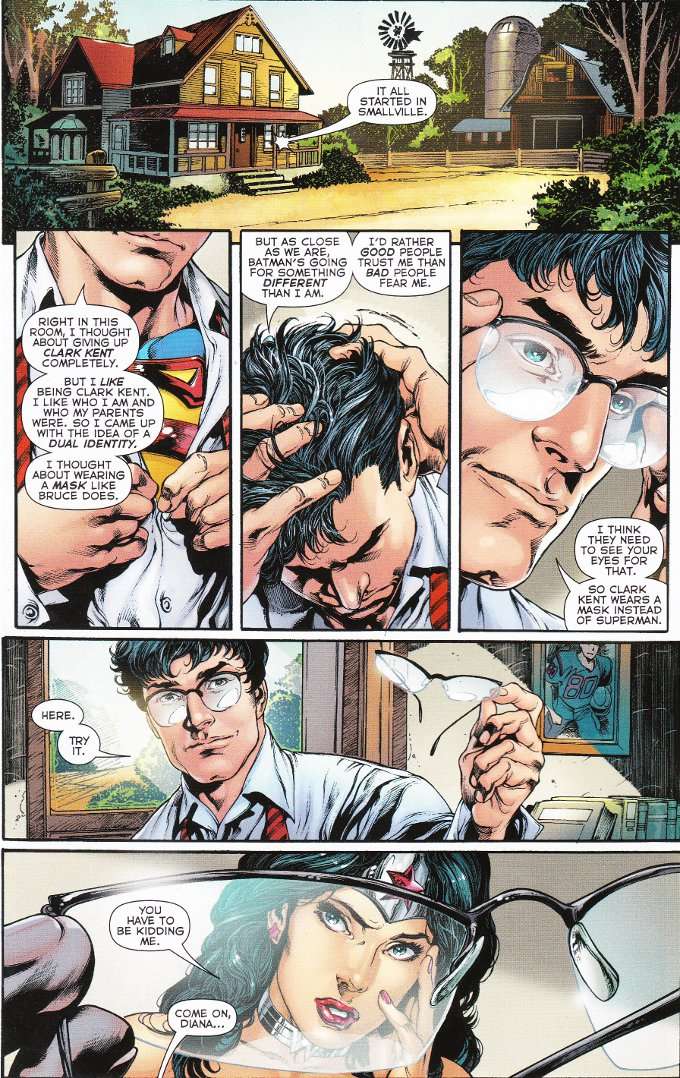
Justice League #15 kicks off the long-awaited Throne of Atlantis crossover between the Aquaman and Justice League titles.  Yet for my money, the best parts of the book have little to do with the crossover and everything to do with the people behind the costumes and superpowers.  Take for instance the page below, which has done far more to define Clark Kent as a character than anything I think I've seen in any other book in the New 52 so far.


It's the little moments like this that have made author Geoff Johns beloved as a writer and made this title worth reading, though it was far slower to get going than many would have liked.  The backbone of the issue is found in scenes such as this, the scene where Cyborg talks with his father and even the scene where Aquaman and Batman team up to take on several of The Scarecrow's minions.  But don't think for a second that doesn't mean the action-packed moments aren't good too.  Far from it!  And Johns' plot involving an Atlantean invasion of the surface world offers excitement aplenty to go with the fine character scenes.


The artwork by Ivan Reis and Joe Prado - most recently seen on Aquaman - can be summed up in only one word.  Phenomenal.  Reis has an amazing eye for detail  and Prado knows when to merely outline Reis' pencils and when to shade them heavily.  Reis is also a good visual storyteller, whose panels flow naturally and easily even on the two-page spreads.

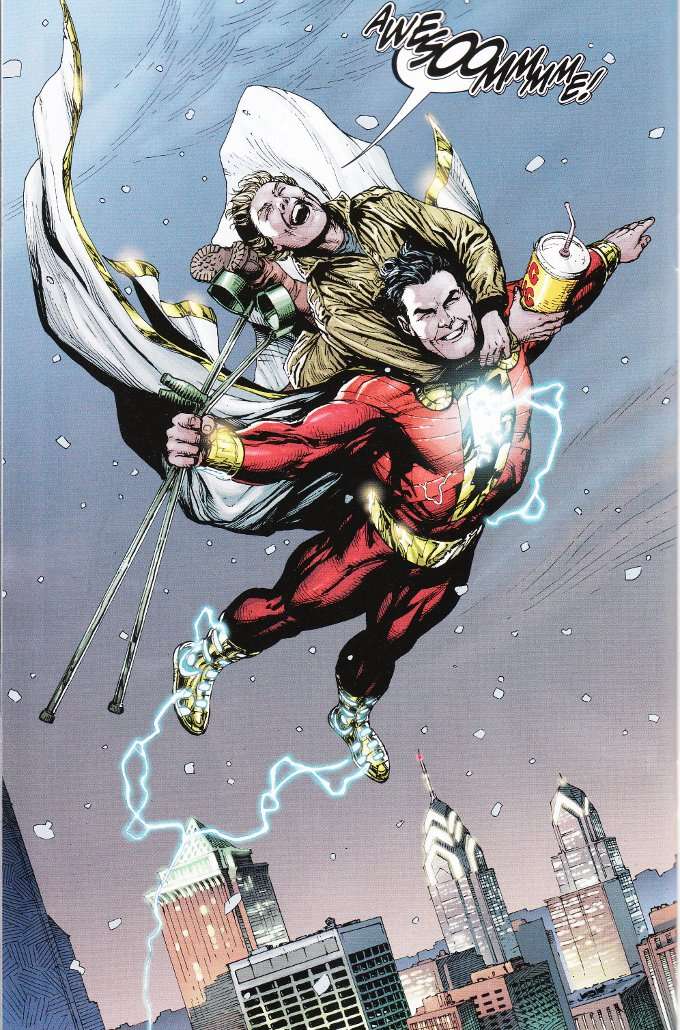
I wish I could praise the Shazam back-up story as highly.  The artwork by Gary Frank is as wonderful as Reis's work but the base concept of Billy Batson as a juvenile delinquent leaves me cold.  It doesn't add anything to Billy as a character to make him a smart-ass punk.  Indeed, his basic decency and inherent nobility was one of the things that set him apart from other teen heroes in the past.


Incidentally,  whatever happened to The Wisdom of Solomon that's supposed to warn Billy away from being dishonest or foolish?  I can't help but think it must have gone the way of Wally West and Donna Troy, since the plot of this story is dependent on the "hilarity" that ensues after Billy uses his powers to hack an ATM so he can get the money to buy beer.  There are some brief moments worthy of the Captain Marvel legacy, such as Billy and Freddy's joy at discovering that Billy can fly but these moments are too brief and too few in number.

This issue is worth picking up if you haven't given Justice League a shot before now.  But do yourself a favor and skip the back-up story.

Monday, November 26, 2012

Justice League #14 - A Review

First, a correction.  In my review of the last issue of Justice League, I took issue with a part of the new origin for the villain The Cheetah.  Specifically, I took issue with how the comic said that she was empowered after cutting herself on a knife recovered from a tribe in the Amazon Jungle and became possessed by a goddess of the hunt.  I asked why, if she had been empowered by a South American goddess, she had taken the name of an African predatory cat. 

What I missed was that the jungle the team journeyed to at the end of the comic was in The Congo - not The Amazon.  Further, this issue does explain how this knife - dubbed The Godslayer - had been used in Africa to bind one hunter goddess/cheetah spirit and made its' way to South America, where it wound up in the possession of the aforementioned Amazon tribe.  My apologies to Geoff Johns for the error.

Now that that's said, on with THIS issue... 
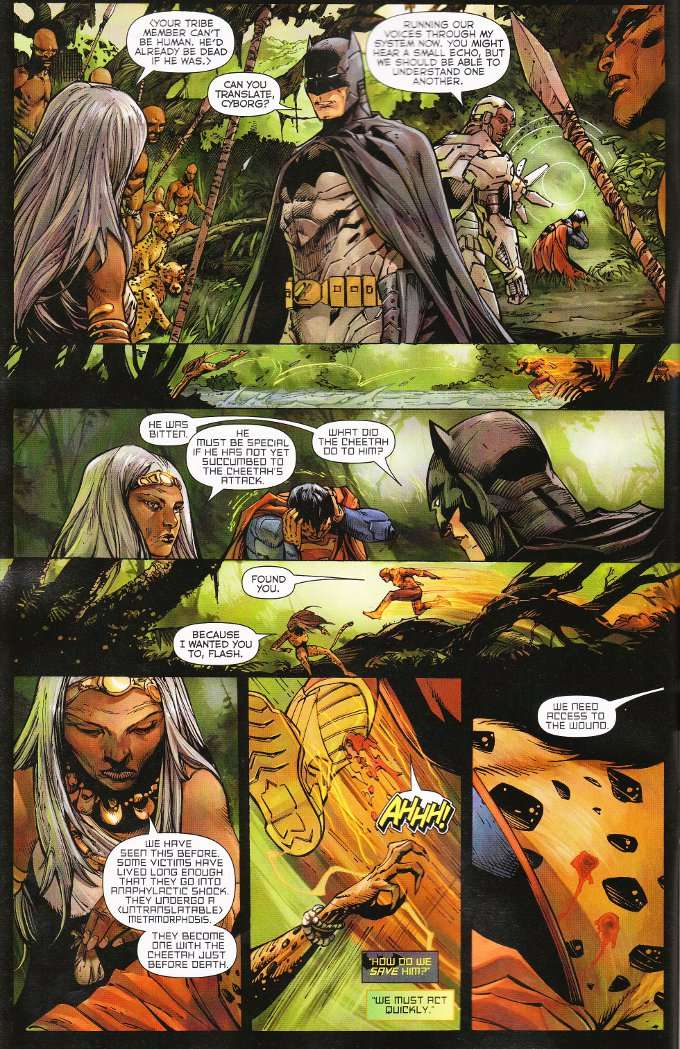


Justice League #14 offers a lot of material I wish we'd seen in this title sooner.  Still, there's no point in crying over what should have been done earlier.  The fact of the matter is that, for the first time in a long time, this book did more right than it did wrong.

The first half of the book focuses upon our team as they have to cope with the dual threat of The Cheetah running loose and a magically poisoned Superman growing ever-closer to death.  There's a lot of nice little touches here, but three stand out for me in particular.  First, the conceit of having Superman be the teammate placed in danger and - for once - through means other than a piece of Kryptonite is a novel one and really helps to sell the drama.  The second is Johns' use of Cyborg, whose powers are used in a uniquely creative fashion.  (At least I've never seen Cyborg act as a universal translator before!)  Finally, there is Aquaman's brief, wordless moment of awesome in which Johns once again showcases how Aquaman's powers are far from useless.

I think I like Tony S. Daniel more as an illustrator than I do as a writer.  His depiction of The Cheetah and her jungle realm is appropriatlye savage and would not look out of place in a Tarzan story.  He also does well with the more mundane scenes later in the second half of the book when we get to the other major subplot in need of resolution.
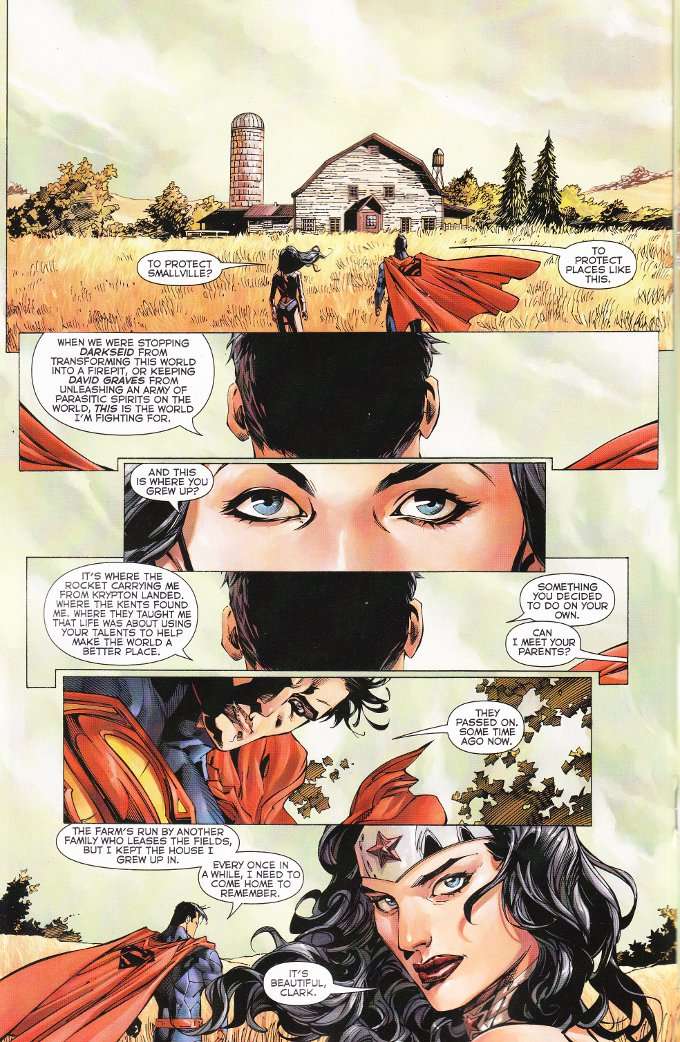


One big complaint that many DC Comics fans had about the declaration that Superman and Wonder Woman were now a couple lay in how sudden the declaration was made.  There was no build-up in Justice League to suggest such a thing was happening - no hint of romance or even a suggestion that the two viewed one another as anything but teammates.  While it may be too little, too late, the second half of this book is  a step in the right direction.  It focuses upon Superman attempting to show Wonder Woman who he really is - not in the sense of his secret identity but by showing her places that are important to him and taking her to do things that remind him of the people they are protecting.  This is something that the Amazon Princess has never spent much time doing and it helps to emphasize the main difference between the two heroes.  Wonder Woman, first and foremost, is a warrior.  Superman, first and foremost, is a protector.  Both characters get some much needed development and the idea of a romance between the two seems a little less forced as a result.

Less enjoyable, however, is the back-up story featuring Shazam.  Or, as I'm quickly thinking of him in my own head, Sham-zam.  I had hoped we were done with these back-up stories after last month's excellent story involving Green Arrow and Steve Trevor teaming-up.  But it was not to be.

Thankfully, we see very little of Billy Batson this time around, save for a scene in which he and his cohort Freddy buy Billy a trenchcoat to cover up his costume and ponder how to spend the rest of the $20 they were given for saving a woman from a mugger.  Most of the story focuses upon Black Adam, learning something of how the world has changed since he last walked upon it and further learning that some things have not changed.  Namely, the powerful still stomp upon the weak for their own glory, though the pharaohs now call themselves CEOs. 
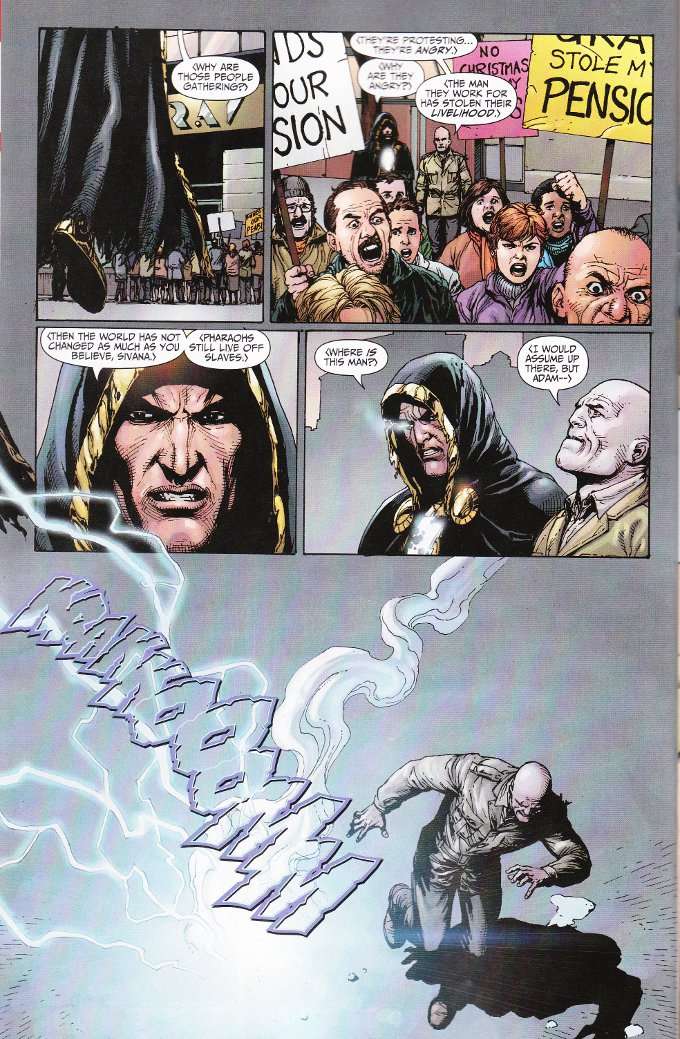

Is it wrong that I find myself cheering Black Adam in this story?   Should I NOT be rooting for him to slap some sense into Billy?  Because Johns' take on Black Adam so far seems to be exactly the same as how he wrote the character back in JSA and so far Black Adam has been the most heroic person in this book ignoring - you know - the whole dropping a pension-stealing CEO to his death thing.

Gary Frank's artwork is still uniformly excellent.  Indeed, I'd argue it's far better than this story deserves.  I'm hard pressed of a way to describe precisely why I find Frank's work so good.  Like the old saying says, I don't know much about art but I know what I like.  Well, I do know a bit about art and I like this.  So take that for what it's worth.

All in all, this book is definitely worth your four bucks.  I had been on the fence about it for a while but for now I'm in, if only to see what Johns does with his upcoming crossover with Aquaman.

Monday, November 5, 2012

Justice League #13 - A Review

Justice League #13 provides another example of how infuriating many of the New 52 books by Geoff Johns have been.  Like Johns' Aquaman, this issue offers us a look at a larger DC Universe while at the same time offering us surprising little insight into that universe.  While this issue does offer several good bits of character business, it is icing on a bland cake.
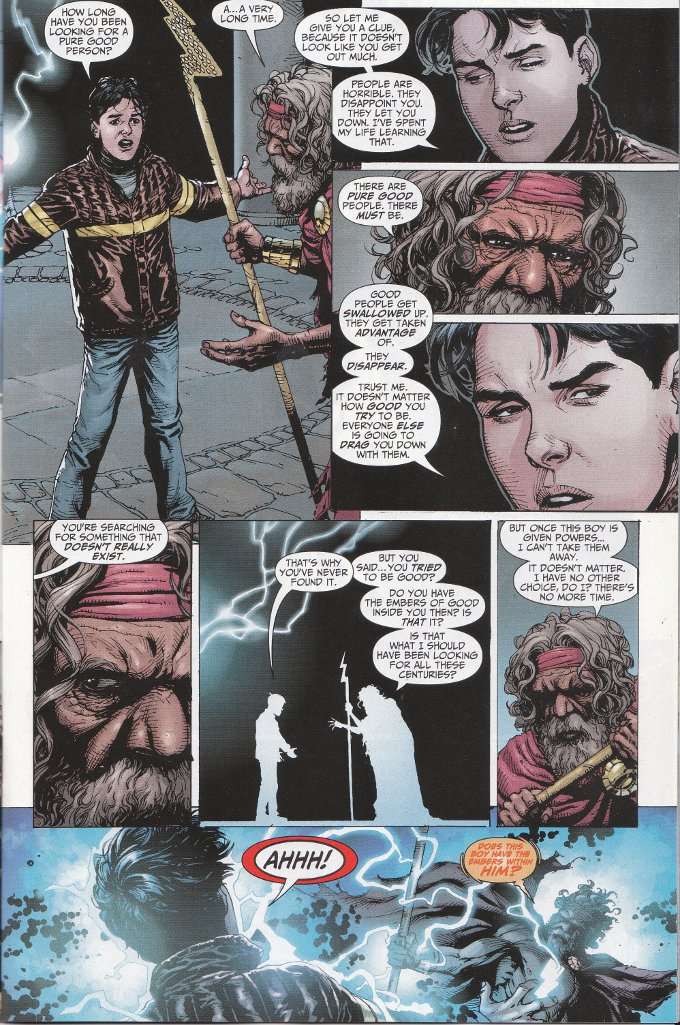
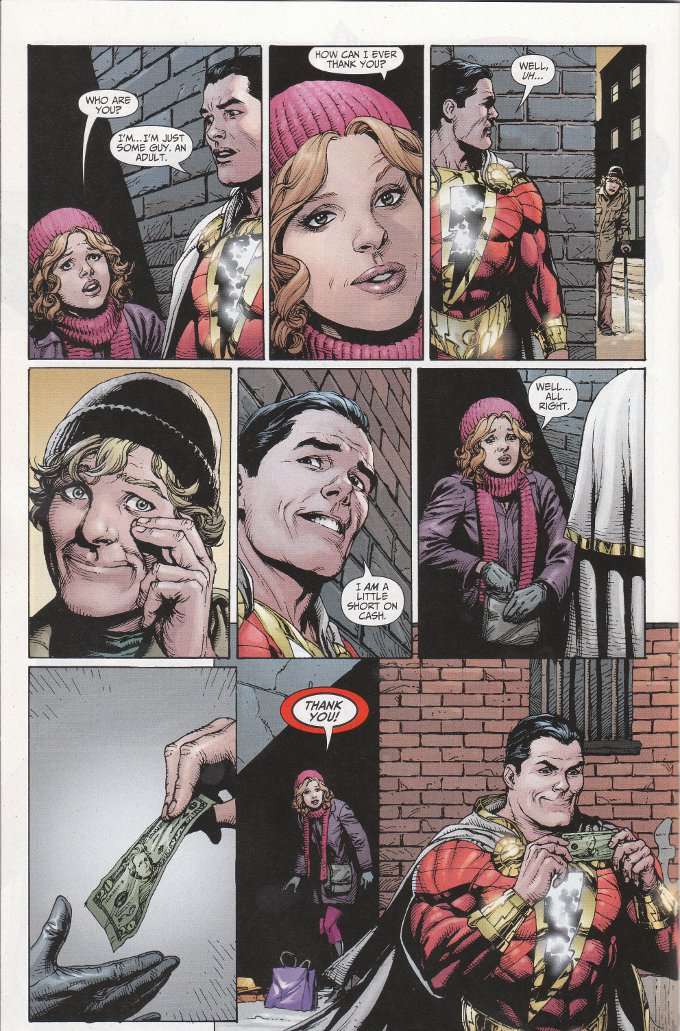

The main plot focuses upon the League's attempts to capture The Cheetah - once again the closest thing to an arch-enemy that Wonder Woman has.  Her background has changed slightly, with archeologist Barbara Minerva now having been a one-time ally of Wonder Woman who became possessed by a goddess of the hunt after accidentally cutting herself with a ritual knife belonging to a lost tribe in the Amazon jungle.  Why she took the name of an African predatory cat when her powers come from a South American goddess is not explained.

As always, Johns is at his best when he forgets the story and focuses on making his characters characters.  The best moments in this issue are the little scenes where the heroes are allowed to be people.  The awkward moment when Wonder Woman and Superman discuss the kiss they had in the heat of the moment last issue.  Barry Allen's reassuring Victor Stone that he is still more man than machine as the two discuss the recent shake-up of their teams.  And the real prize of this issue - a back-up story co-written with Animal Man writer Jeff Lemire, in which we see Steve Trevor and Oliver Queen discussing evidence Green Arrow found that a covert super-villain team exists.


The art is largely excellent.  Tony Daniel, fresh from Detective Comics, does a fine job of rendering the action of the main story, with savage pencils defined by the inks of Richard Friend & Batt.  Less memorable is the back-up story drawn by Brad Walker, whose Oliver Queen looks far-too baby-faced for my liking and indeed seems to look like a young boy in some panels!

Ultimately, the biggest problem with Justice League is that it fails to seem like the flagship title of the company.  Everything here is competent but Justice League should be more than that.  It should be amazing - an action movie on paper!  And this... this just isn't that exciting or enthralling.

Tuesday, September 25, 2012

Justice League #0 - A Review

I'd say that Justice League #0 is the greatest collection of false advertising and empty promises I've seen all year except for one thing - it's an election year in America.  But in all seriousness, this issue was an all-around disappointment.  There is no Justice League to be found here.  Instead we get the continuing misadventures of Billy Batson - #2 on the list of children I most want to see repeatedly slapped, just behind Joffrey Baratheon of A Game Of Thrones.


This issue finally brings us the moment we've been waiting for six months - when bratty Billy meets s wizard, who grants him magic powers by saying the word Shazam.  As hinted before, the wizard - like Diogenes - has been seeking a purely good and honest soul for quite some time.  But unlike Diogenes, he thought he actually had a chance of success.  Not surprisingly, being a mouthy jerk and petty crook, Billy fails to past the purity test.  But being a mouthy jerk, Billy points out that nobody is purely honesty and good - a fact that has somehow been missed by one of the wisest men on the planet for several thousand years.  This leads the wizard to test Billy to see if he has the potential to be good, decide "What the heck?" and give Billy his power just before dropping dead. 

It takes Billy about three minutes to start abusing the holy gift he's been given.  He destroys the car of the local rich jerk and contemplates stealing a fancy new suit that is less conspicuous than his hooded cape and tights.  Thankfully, Billy does have scruples enough to step in after he and his foster-brother stumble across a mugger at work.  Unfortunately, those scruples stop just short of accepting payment from the woman he just saved.


To say that this story defiles everything Billy Batson & Captain Marvel represent would be an epic understatement.  I don't think they decided to have Billy go by the name Shazam because that's what most people outside of comics call the character anyway or because of the continual legal battles with Marvel Comics over the Captain Marvel name.  I think The Powers That Be at DC Comics decided to call this character Shazam because they knew there was no way in Heck that they could ever get away with trying to sell this character to Captain Marvel fans under the name Captain Marvel.

The only justification for Billy's retconned personality I can think of is the misguided belief that an idealistic young man granted power because of his pure spirit has no place in the modern DCU.  To see Billy acting the way he does in this issue is painful.  And to see Geoff Johns writing this story doubles that pain - partly because Johns put the idea that Billy Batson needs to be modernized and made more cynical to bed during his excellent JSA run and partly because - ignoring that Shazam is a betrayal of everything Billy Batson should be - Johns does pace the story well and deliver some good dialogue. 

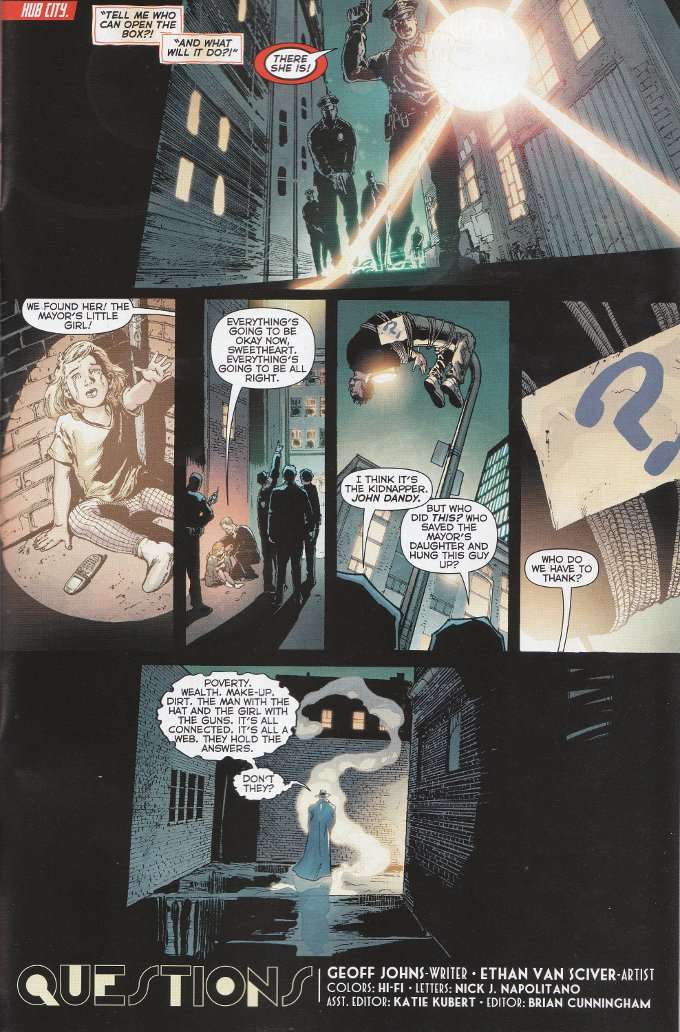
Thankfully, regardless of what I think of the story, the artwork is amazing throughout.  Gary Frank does a good job illustrating the Shazam story while Johns' frequent Green Lantern collaborator Ethan Van Sciver lends his talents to the back-up story.  This brief tale finally introduces us to the mysterious pink-cloaked woman who has been popping up around the New 52 universe as well as another classic hero we haven't seen before now.


Still, no amount of fine artwork can make this book palatable.  What matter that the face be pretty when the heart is cold and dead?

Billy Batson is supposed to be a decent kid in spite of his hard-luck life.  His positive attitude in the face of all the evils of the world is what leads to his being rewarded with the power to help others.  The character is all about the innocence of youth and the power of idealism.  Even Frank Miller understood that and didn't try to force Captain Marvel into a darker, grittier role when he wrote The Dark Knight Strikes Back.  And it was Billy who took Superman to task for being blinded by his hatred of Lex Luthor in the excellent Justice League Unlimited episode Clash Of The Titans


Let's end this review with some Wisdom of Solomon, shall we?

"I believe in fair play. I believe in taking people at their word, and giving them that benefit of the doubt. Back home, I've come up against my share of pretty nasty bad guys, but I never had to act the way they did to win a fight. I always found another way. I... I guess I'm saying I like being a hero, a symbol, and that's why I'm quitting the Justice League. You don't act like heroes anymore."

That's why I think I'll be quitting Justice League, too.  Nobody in it acts like a hero anymore.