Showing posts with label stupidity. Show all posts

Wednesday, March 11, 2015

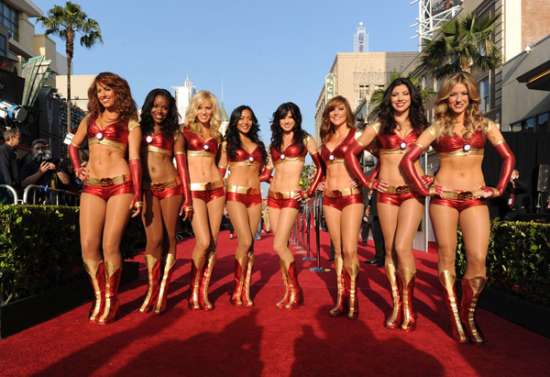
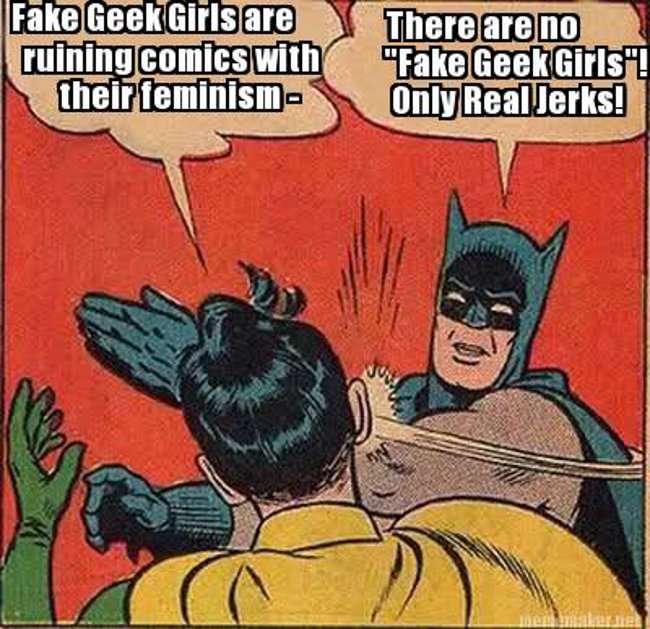
Fast Thoughts On "The Progressive Effort To Ban Booth Babes And Sexy Cosplay"


I'm not going to link to the article that inspired this. I refuse to give them any more traffic.  If your Google-Fu is strong, you should be able to find it easily enough.

Suffice it to say, there's a conspiracy theory going around about a progressive women's effort to ban booth babes from major conventions and how this is the opening salvo before banning sexy cosplay and professional cosplayers who sell pin-up style pictures of themselves at conventions.  The evidence that this is happening?  PAX's ban on booth babes!

Personally,  I find it hilarious that Penny Arcade Expo is being accused of "social justice warrioring" given that the con is run by the same people responsible for The Dick Wolves Fiasco. And I also find it hilarious that - based on the comments I've seen on this issue - most of the people in favor of the booth-babe ban are the same people who support Gamergate.  Not the dreaded feminists or comic book girls!

The honest truth is that every time the topic of banning booth babes or sexy cosplay from conventions has come up before, the movement was always driven by conservative elements. From Pat Broderick's claims that "cosplay are just selfies in costume" to Tony Harris' complaints about cosplaying women preying upon innocent young men, women are always blamed for tarting up the noble and innocent world of comic books.  Never mind that Wizard World sells booth space to strip-clubs...

The sad truth is that sex sells. This is true throughout Western culture and is not limited to the fandom arena. This is why we have cheerleaders at sporting events and why there is a whole sub-category of restaurants devoted toward the female wait-staff wearing very little clothing.

And while I take personal offense to the idea that I can be persuaded to buy anything just by flashing a little cleavage, I refuse to believe that the sudden push to remove booth babes and sexy women from conventions is being driven by angry feminists.  Not when feminist comic writers like Gail Simone and Kelly Sue DeConnick routinely repost cosplay pictures on their Twitter accounts and ask fans to send in pictures of themselves dressed like the characters from their books. Nor when there are companies like Charisma Plus Two, who procure genre-savvy models for those who need one.

Wednesday, January 21, 2015

Red Sonja: The Black Tower #4 - A Review

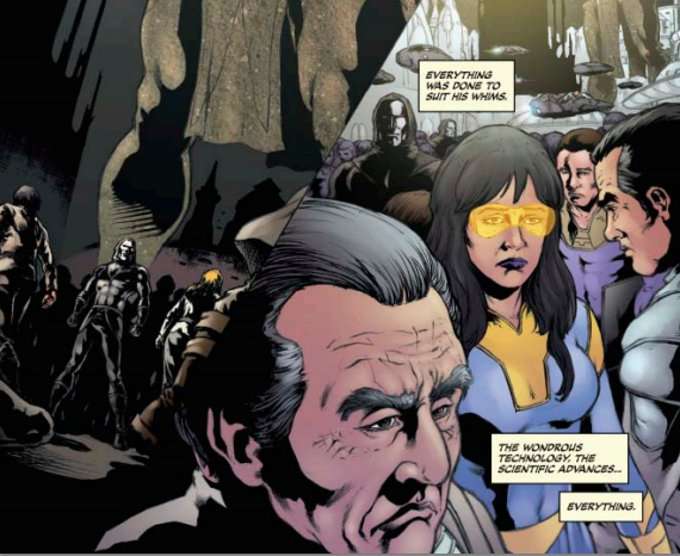
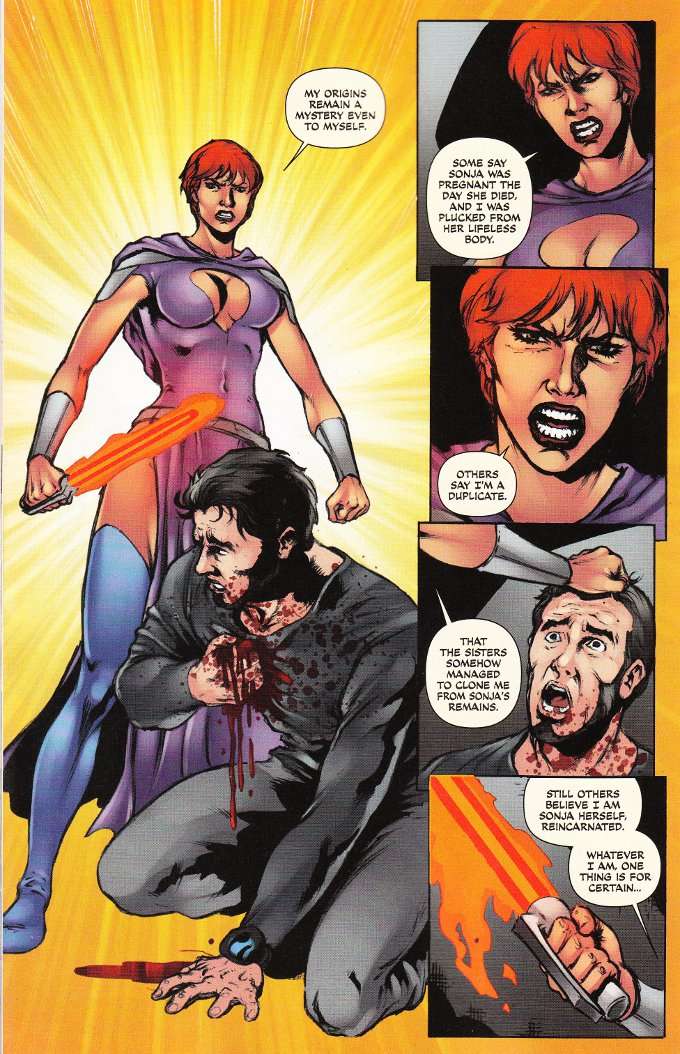
And so it was that Red Sonja was killed by Thraxis - God of The Black Tower!  And lo were the people of Hyboria enslaved. Even the random superheroine who was there for some reason.

Okay - maybe that's just futuristic clothing that Thraxis was kind enough to give the enslaved. We're honestly not that sure about the time scale between chapters here.


But there were those who would resist inspired by the legends of Red Sonja - The Spawn of The She-Devil! But they all got killed almost instantly and inspired Thraxis to become even more cruel. So screw them. And forget we mentioned them, because they aren't at all important to this story.

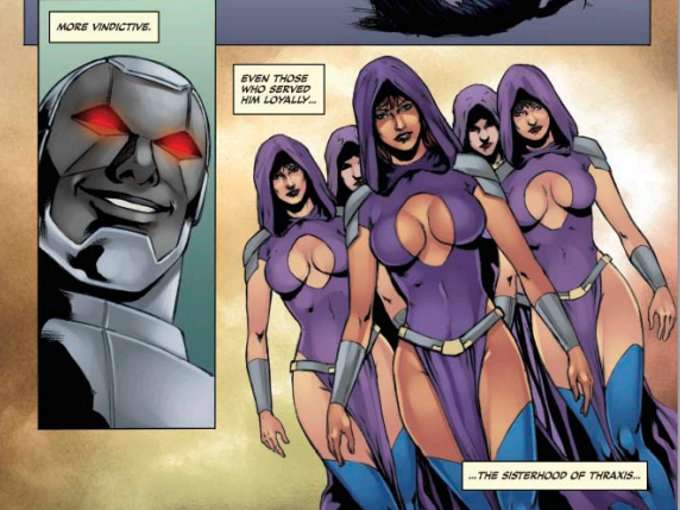
What is important is that Thraxis was awesome. And he had a harem of totally hot smoking babes who would do anything to make him not kill them or send them to the mines.

Is Hyboria doomed?  How will this story end when our heroine got killed in the last chapter? Does anybody actually care at this point?


How does the story of Red Sonja: The Black Tower - a tale that has thus far involved dragon-riding, robots, lightsabers, ray guns and flying saucers -  become even more convoluted in its final chapter?

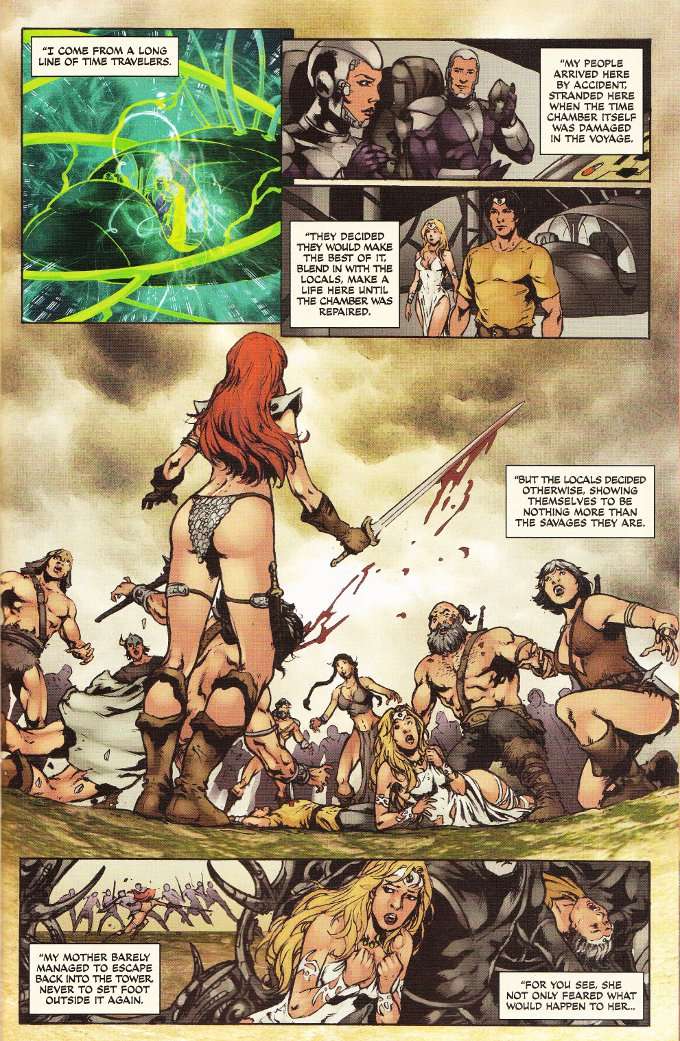
By introducing time travel.

I'm not even kidding. It turns out that the attractive couple we saw get killed WAY back in the first chapter were time-travelers.


Mom hung on just long enough to deliver her son, who was raised by the robots in the tower and he was able to use the advanced technology to watch the outside world, developed a crush on Red Sonja and then became this monstrous warlord to get revenge on the people who killed his parents.  Oh, and he killed Sonja after realizing there was no way she'd ever surrender to him.

He explains all this to an attractive redhead who wishes to serve the living god more directly. And I don't need to say anything more because you already know how this is going to end.

Just one question remains - how is this possible?


You have to love it when the writer can't be buggered to choose just which hackneyed plot twist he should use and just decides to say A Wizard Did It. The irony being that this is one of the few genres where that would be a legitimate explanation...

Is a comic truly bad if you find yourself amused by it?  I'll leave such questions to other scholars. For me, it is enough to say that Red Sonja: The Black Tower seems incredibly conflicted as to just what kind of story it is trying to tell.

The worst part is not the introduction of science-fiction elements into the Hyborian world or the vague plot. It is the fact that the base plot is virtually identical to the much reviled Avengers #200, with the only difference being that our villain beheads the woman of his dreams rather than raping her and that she (or her clone/daughter/spirit/whatever) gets revenge by going back in time to kill an innocent woman ala The Terminator.

It's a distasteful comic. And I feel sorry that the genuinely skilled Cezar Razek will have this book on his resume. Hopefully he'll be able to draw a much better Red Sonja story in the future.  Better yet, let's get Amanda Conner (who did the cover for this issue) to write and draw a Red Sonja comic!

Thursday, April 17, 2014

My Concise Response To Anyone Who Thinks Rape Threats Are An Appropriate Response To Anything


SOURCE: IN YOUR FACE JAM: Anatomy Of A Bad Reaction 

SOURCE: Fake Geek Guys: A Message to Men About Sexual Harassment 


I have little time and even less patience to deal with this issue.  I think Brett White and Andy Khouri did a fine job discussing this issue and the most recent scandal in the above-linked articles.  But because dealing with this problem is the responsibility of all men of conscience, I decided I should offer my own thoughts, however briefly.

Here then is my statement to anyone who thinks that a disagreement over anything - much less comic books - is justification for a rape threat.


GO FORNICATE WITH YOURSELF, YOU STUNTED MOUTH-BREATHING MAN-CHILD!


Thank you.

Saturday, September 7, 2013

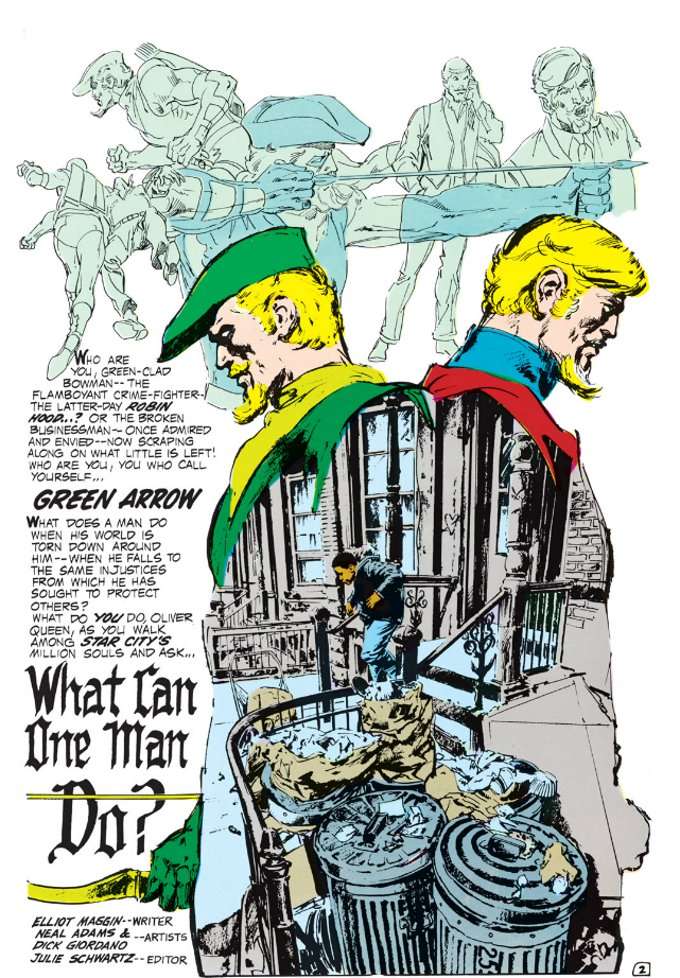
What Can One Man Do Against The Death Of Hope?


Earlier this week, I wrote a column in response to the recent ruckus regarding  J.H. Williams III and W. Haden Blackman leaving Batwoman.  For those who missed the news, the creative team quit in the wake of DC Comics Editorial declaring that they didn't want Kathy Kane and her girlfriend Maggie Sawyer to get married.  My article was based around the idea that the comics industry in general seems to have acquired a fear of depicting happily married superheroes, with most of the married superheroes at DC Comics having been rendered single by the New 52 revamp and Peter Parker still single because of Joe Quesada's belief that a deal with the devil is less inherently sinful than a divorce.

The digital ink was barely dry when another scandal involving DC Comics emerged later that afternoon.  This time the source of trouble was a contest for amateur artists, vying for a chance to depict Harley Quinn in the #0 issue of her upcoming solo book.  The catch?  All four panels are meant to depict Harley Quinn attempting suicide in a number of comedic ways, with the final panel depicting her naked and in a bathtub.  Some fixated upon the nudity aspect of the contest but most were outraged by the suicide element.  Particularly since next week is National Suicide Prevention Week.

I've been struggling with how to speak about this for the batter part of a day.  More than any character in recent memory, Harley Quinn had always been portrayed as one of the most fun characters in comics.  And try as I might, I can't think of a better metaphor for the state of affairs at DC Comics right now than a suicidal Harley Quinn.

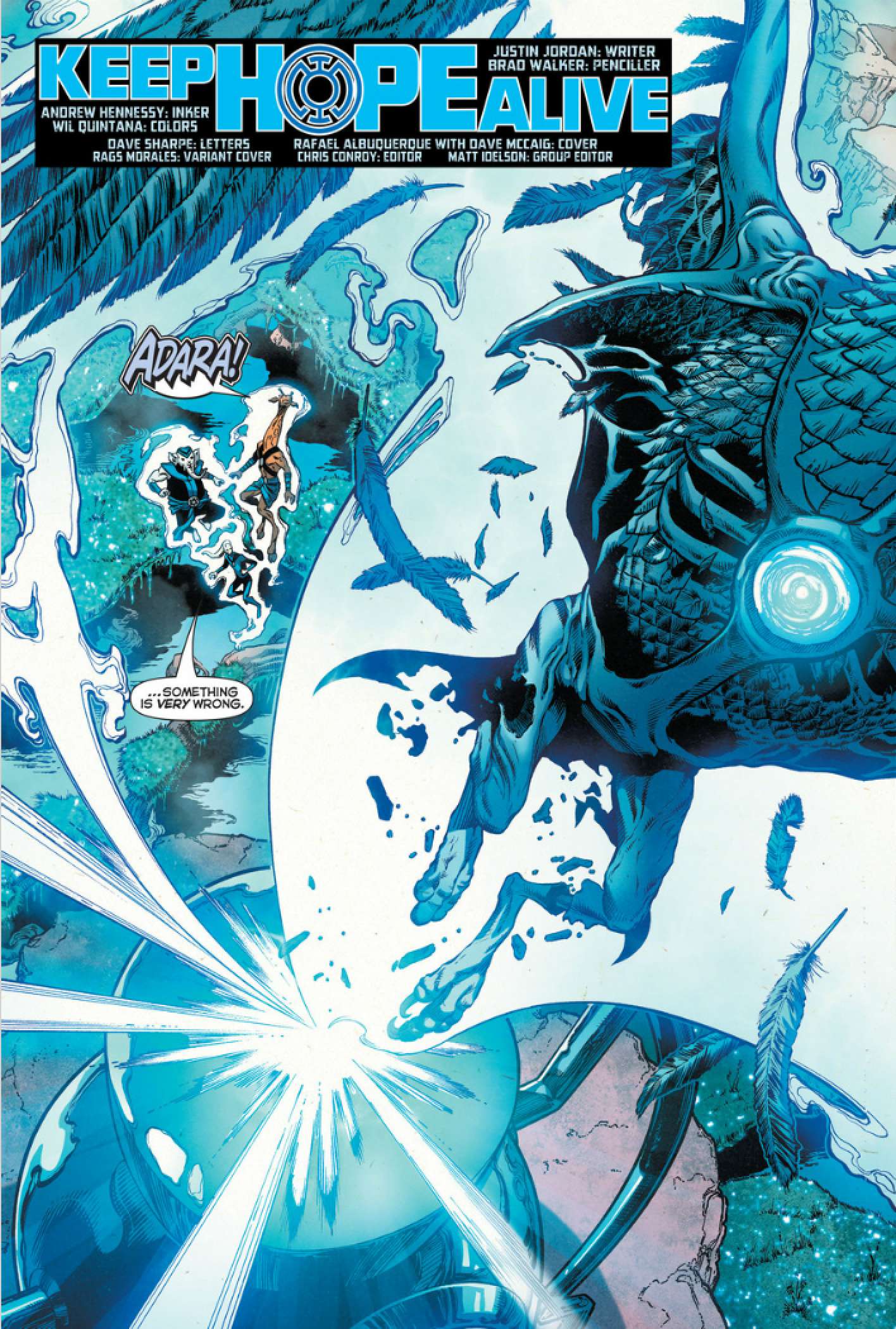
As it turns out, I didn't have to think of a better metaphor.  For I learned today that Hope has literally been erased from the New 52 universe! Metaphors are completely meaningless at this point.  For all better writers and critics than me have spoken about the sense of all hope and joy being removed from the DC Universe in recent months, never did we suspect it would soon be a literal truth.


So the question that has been on my mind for the past few hours has been how - how do we fight this?

Protest?  It's already been made abundantly clear that our opinions as mere fans are completely meaningless to The Powers That Be.  So far the only instance where public outcry made a difference was in getting Gail Simone rehired on to Batgirl and even that may have been due entirely to the threat of decreased orders from the distributor.

Boycott?  In most cases, we're already not buying the offending books.  Those offended by Tony Daniel's dismissal of a female fan's concerns over a romance-based Superman/Wonder Woman book that was likened to Twilight by reassuring her there would be just as many butt shots of Superman as of Wonder Woman can't effectively boycott the title without The Powers That Be using that as justification for the belief that all their fans are 45 year old men and that women don't read comic books.

Jessica Mills touched upon another challenge before us quite eloquently in her recent column - DC Comics and Institutionalized Sexism – Purchasing Power is Not Power.  She touches upon the aforementioned  problems with boycotts while pointing out another problem.  Namely that boycotting an entire company does little to strike against the management and only hurts the artists and writers whose work we are enjoying.

"Telling people not to buy DC Comics as a way to change things at DC Comics is short sighted and dismissive.  Not buying those comics means readers have to, not only give up on beloved characters, but pull their support of talented and dedicated writers, artists, and others"

 "I like reading comics.  I love Gail Simone’s work.  I love Greg Rucka’s work.  I’m not going to stop supporting THEM because the DC leadership refuses to acknowledge the terrible decision-making that continually alienates a large portion of their client-base."


I'm in a similar fix.  Any pledge not to buy any more Batwoman comics is meaningless since I was reading the series as the collected editions became available at my local library.  Refusing to buy the upcoming Harley Quinn book would send a message against Amanda Conner - an artist whom I have been dying to see on a monthly series again for some time now.  And boycotting the company as a whole will only hurt Jeff Lemire and Gail Simone and all the other creators whose work I am enjoying.

I already know from experience that boycotts don't work.  I boycotted all things Marvel Comics for a goodly while over One More Day, wrote some rather good articles about why the storyline was a bad idea and it did nothing.  Eventually I focused my personal boycott on all things Spider-Man, purely so I could justify seeing The Avengers and supporting Joss Whedon (Browcoats Forever!).

So what can I do?  What can one man do?


And then it hit me.  We fight them the same way we do a bully.  We treat them as we would any disruptive child who makes a mess just to get attention.  We ignore them. 

Marvel Comics editor and One More Day apologist Tom Brevoort let the secret slip - that they see even bad publicity as good publicity and bad attention is still attention.  That they fear apathetic fans far more than angry fans because angry fans are still buying the comics.

So this is where I will start.

As a fan, I'm not going to pick up any more books out of habit in the hope that they're building toward something big.  If they can't do something to keep me entertained for one issue, it's not worth my time.

As a critic, I'm not going to bother writing reviews for long-running series or crossover events just to keep people informed as to what is going on.  If the book isn't worth reading most of the year, why should I care about it for the three months it's involved with the books I do care about?    

No more angry rants drawing curiosity .  No more hash-tagged Tweets giving you free publicity.  And no more second chances.  I'm that sort of a man.

Thursday, September 5, 2013

Fear And Loathing Of Love And Marriage In Superhero Comics


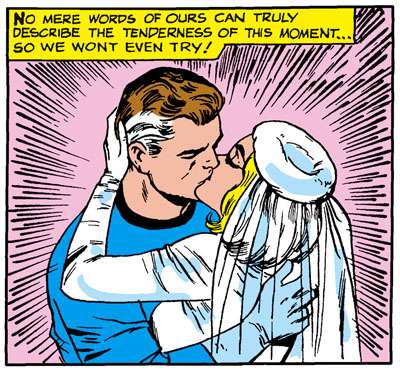
Who said that comic fans don't want to see people getting married?

What prompted this question is today's news that J.H. Williams III and W. Haden Blackman are leaving Batwoman as of Issue #26, citing editorial interference in their plans to have Kathy Kane and Maggie Sawyer get married.  Williams was quick to note that DC Comics' objection was to marriage in general - not a marriage between two lesbians.  The evidence does bear him out, given that nearly every major married couple in DC Comics pantheon of superheroes has either been broken up since the New 52 revamp or not appeared at all. 

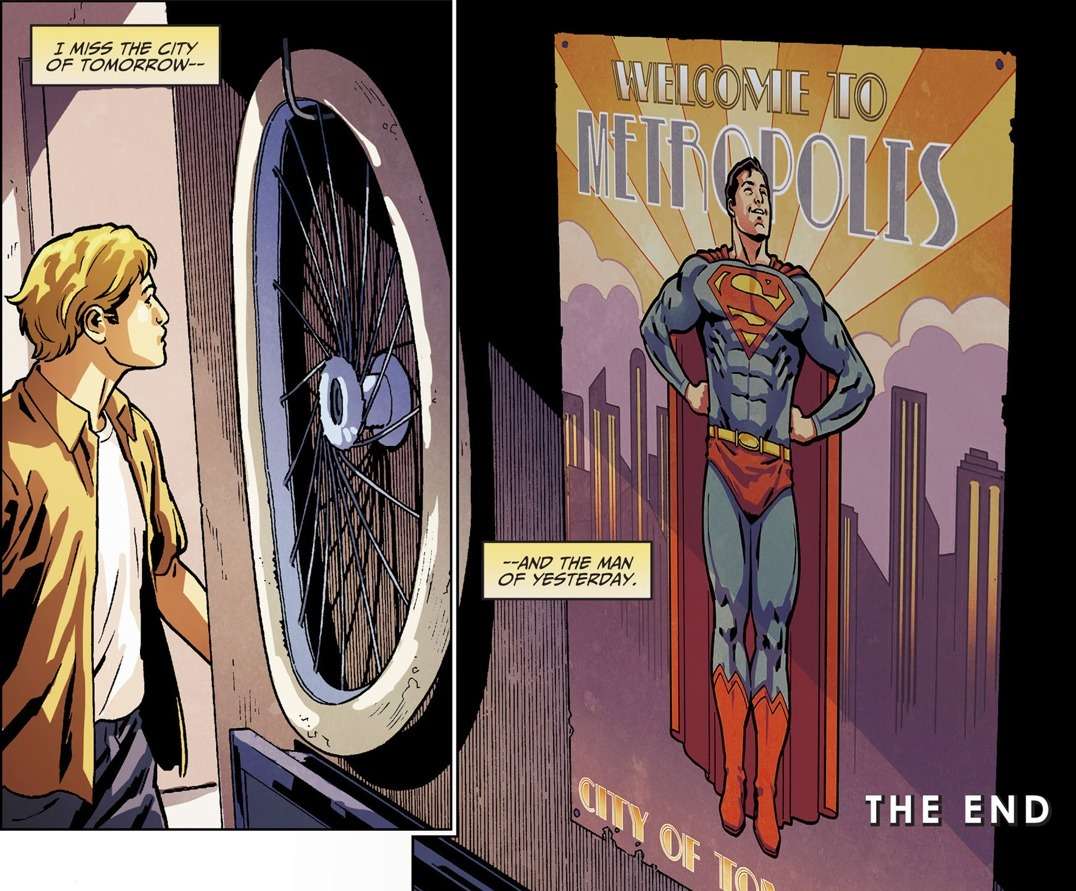
Clark Kent and Lois Lane?  Not an item.  Barry Allen and Iris West?  Flirting but he has a new girlfriend.  Wally West and Linda Park?  Don't even exist!  Ditto Ralph and Sue Dibny.  Heck, the only married couple I think is still around is Aquaman and Mera and they've interacted so little in his book you'd hardly know they were married!

Of course DC Comics is far from alone in being guilty of this sort of thing.  Do the words One More Day ring a bell?  Does everyone remember how that whole mess started because Joe Quesada thought the reason Spider-Man's sales were dropping were because the fans couldn't relate to a happily married Peter Parker?  Do anyone but me and the guys writing Spider-Fan.org remember that they tried killing Mary Jane off because of that theory and all it did was upset the fans?

"But Starman," I hear you metaphorical masses say.  "Superheroes get married and divorced all the time!  It's a common element in drama in many genres!" 

That is true, dear masses.  Yet there is a world of difference between simple drama preventing marriage from occurring and a refusal to consider a plot element completely. 

It seems that the very idea of marriage itself is under attack in our comics due to some mistaken belief that young readers do not want to read about married couples.  This seems odd given the belief some publishers have that their key demographic is 45-year old males, but that's a whole other argument.  So we still have the question - where did this idea come from?

Any ideas?  I'd love to hear about them.

Wednesday, February 20, 2013

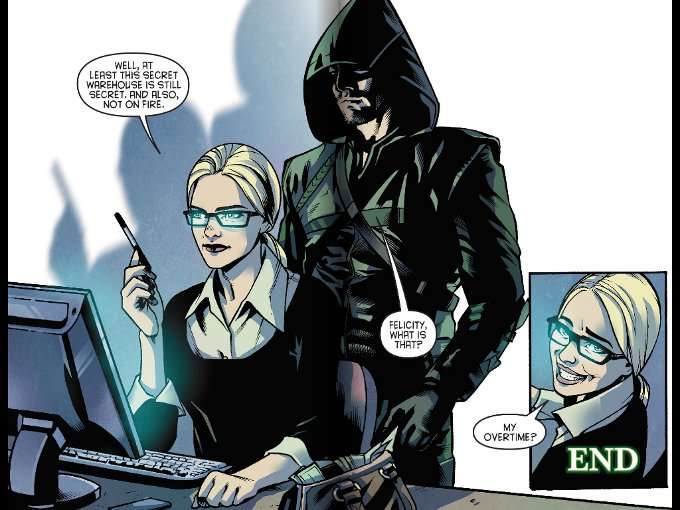
Off Target: Arrow #20 (Web Comic)

It's no secret to anyone who has been reading my Arrow Episode Guide that I dislike the character of Felicity Smoak.  It's all due to the way the character (or lack thereof) is written.  Felicity is a variant on the one-note, delightfully-quirky stock character that film critic Nathan Rabin dubbed the Manic Pixie Dream Girl.  There's several variants of this - like the Manic Pixie Prostitute (see Pretty Woman) and Felicity's particular variant, The Manic Pixie Geek Girl. 

Whatever the variant, their purpose in any story is roughly the same - to act in delightfully unconventional ways while helping the male protagonists in whatever they're doing.  Never mind what their own dreams and aspirations are or what personality traits they might have besides "charmingly awkward" or "cute if she'd take those glasses off".  They have no reason for existing beyond inspiring the hero to change his life (if they're a love interest) or helping the hero in their goals.


I'm here to appeal to the geeks who are still pissed we haven't seen a boxing glove arrow yet!

That's what annoys me about Felicity in a nutshell.  She's supposed to be this brilliant character but she's nothing more than a walking plot device, who is only as smart as the script requires her to be this week.  Felicity has no background or personal drive - she's just there to answer whatever questions the plot requires this week.  Noted science-fiction writer Arthur C. Clarke once said "Any sufficiently advanced technology is indistinguishable from magic."  That's quickly becoming the case on Arrow, where that cute blonde with the glasses in the IT department of Queen Consolidated has become a scientific super-genius capable of not only rebuilding a bullet-riddled hard drive but also analyzing a drug and determining what part of town it was made in due to the water content.  Because....she has glasses and is good with computers?

Arrow #20 is a good example of everything I dislike about Felicity and what her presence does to the show.  But the hackery in this story goes far beyond even Felicity's existence as a one-note plot device.  Indeed, this comic transcends hackery to become something sublimely amusing.


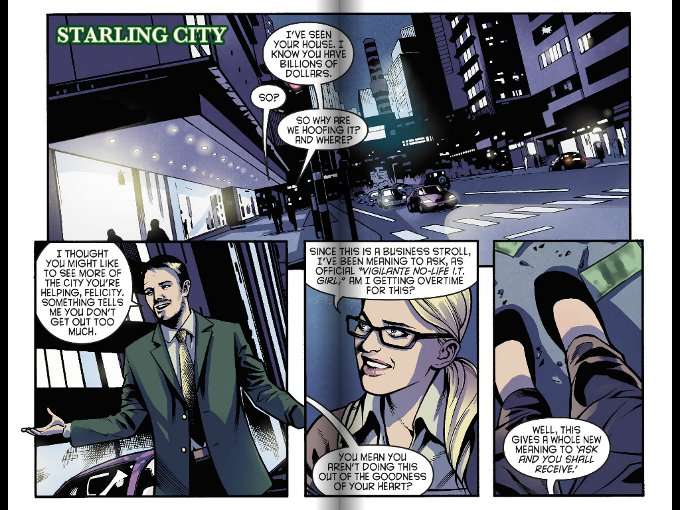
We open a Starling City street, where Oliver Queen is taking Felicity Smoak out to "see the city you're helping".  Why?  Well, Ollie figures she's the type that doesn't get out much.  Because she's a girl who wears glasses and is good with computers!  Yeah... I love Ollie as a character but there are times when he can be kind of a privileged dick in spite of his good intentions.  This is one of them. 

So, at this point fans of the show are probably wondering three things...

1. Didn't Felicity say last week that she had no interest in helping Ollie with the vigilante stuff?

2. Wouldn't a famous playboy and local celebrity like Oliver Queen going out with some lowly IT girl attract a lot of the attention that Ollie's been trying to avoid?

3. Where the heck is Diggle, who is supposed to be Ollie's shadow whenever he's out in public?  Especially when he's out in public?

Well, there's all perfectly logical reasons for all of that.  You see - LOOK AT THE KITTIES!


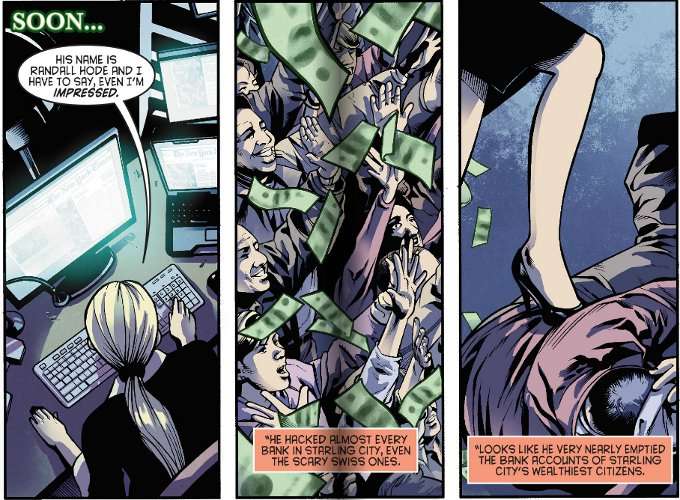
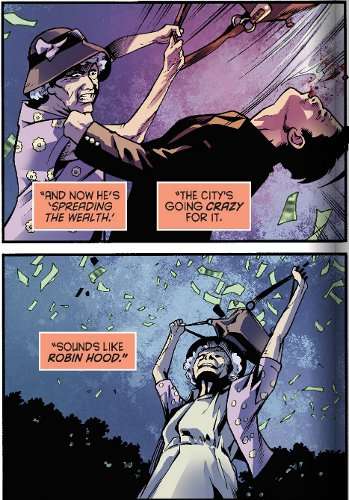
So before this can turn into She's All That and Ollie can spirit Felicity away for a full makeover, dress shopping and a trip to get her contact lenses, the two of them notice that it is raining money.  Literally.  Greenbacks are raining from the sky and the good people of Starling City are going crazy.  Thankfully, all it takes is one trip back to the Arrow Cave for Felicity to get on-line and figure out what's going on.  How?  Well, she's good with computers!  And she has glasses!


Somehow, she figures out that the man responsible for this is named Randal Hode and that he's...

A) hacked the ultra-secure bank accounts of the wealthiest people in Starling City.
B) converted their collective savings into $100 bills and loaded them into a plane
C) taken the plane in the air and begun making like Robin Hood.

Now, I'm sure that another three questions have come to your minds...

1) Don't banks have all sorts of physical and electronic safeguards that prevent large quantities of cash from being withdrawn all at once?

2) Wouldn't it have taken a lot longer for one guy to load billions of dollars in cash onto a plane than the timeline of this story allows?

3) Randall Hode?  Seriously?  That's the name we're going with for this Robin Hood wannabe? 

 Well, there's a very good reason why this isn't stupid or impossible.  You see - LOOK AT THE KITTIES!


Now, normally Ollie could get behind the rich jerks who are apparently running Starling City into the ground getting their just deserts.  But  Hode's plan is causing mass hysteria, with old ladies attacking defenseless, fit young men roaming the streets.  I'm not even joking or making a gratuitous Monty Python reference - THIS ACTUALLY HAPPENS!


Sadly, this is not Madame Fatal.


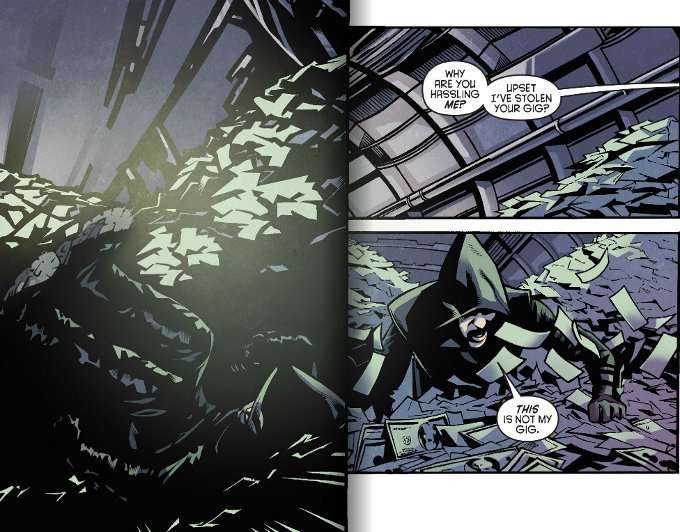
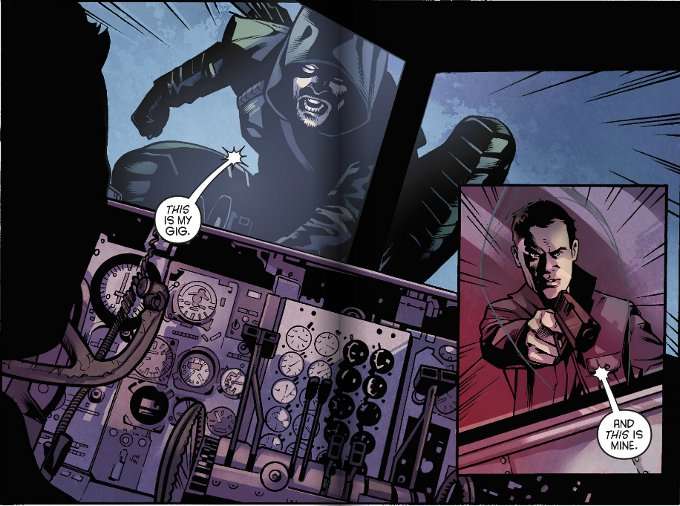
Thankfully, getting onto a moving plane flying at 10,000 feet is a simple matter when you're a master archer with a Zip-Line Arrow.  Soon, Ollie is on-board Hode's plane.  Naturally, Hode is less than thrilled and opens up the bay doors of the plane completely, in an effort to flush Ollie out.  


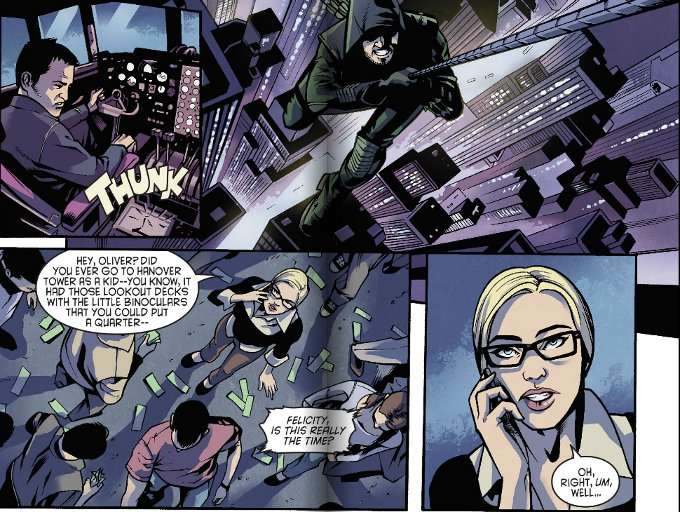
Thankfully, Ollie has a mini-crossbow tucked into his sleeve and enough cable tied to the bolt to create a last-minute lifeline to stop him from plummeting to certain doom.  It's at this point that Felicity, who is back out in the street amongst the rioting civilians, calls to ramble at him in her uniquely endearing way about the local architecture.  Specifically, Hanover Tower. 


Can you guess why Felicity felt the need to call Ollie with this information right now?

1) She's leading into a tearful confession about how she loves Ollie, she has always loved Ollie and she doesn't care how impractical it is - she WILL wear the fishnets for him.

2) She just got a side-job with the Starling City Tourism Bureau and is being paid to call people and tell them about the finer points of the city skyline.

3) He's about to run into said building.

...

I don't know what's dumber.  The fact that Felicity felt she had to call Ollie about this when he's hanging on for dear life or the fact that Ollie actually DID fail to notice the rather large skyscraper bearing down on him.

Thankfully, Ollie's not so far down that he can't double-time climb up his cable, just barely missing the building.  He's further able to climb onto the plane and - somehow - moves around to the front to jump down on the front of the plane.  Now, I don't know planes but I do know from the view that we got of the front of it earlier that this particular plane has a rounded nose.  So I'll be darned if I can figure out how Ollie has enough space to kneel there,  even ignoring the fact that he's 10,000 feet up and traveling at a great enough speed for the plane to remain airborn!

Does the phrase "bug meet windshield" mean anything to you?


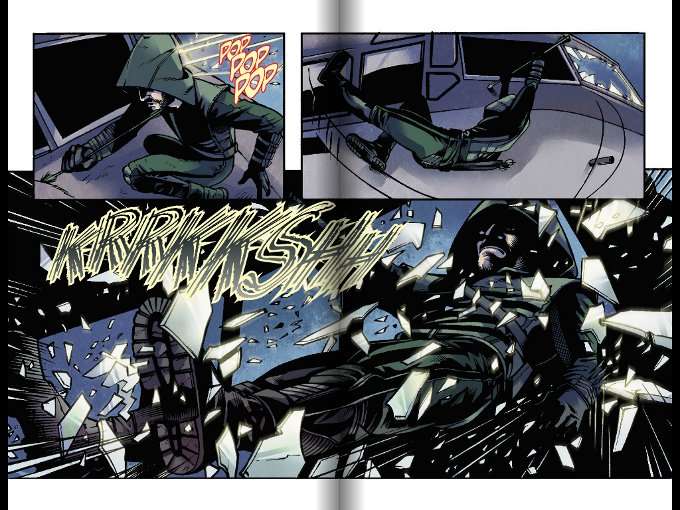
But that's okay!  I can go with this!  We'll just assume that the plane does have enough space for Ollie to kneel down and that he's got some kind of magnetic grips on his adventuring boots.  That still doesn't explain how Ollie is able to drive an arrow into the side of a plane with one hand and use that as a pivot to kick his way through an airplane window.
  

Screw you, physics!

Do I even need to begin to explain what's wrong with all of that?

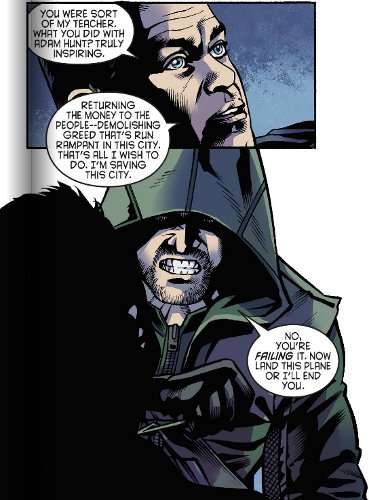
Ollie pins Hode down, as Hode says he was directly inspired by Ollie and how he wanted to do something about the greedy people who are ruining the city.  But Ollie apparently has given up on the recruiting drive (given his track record with intentionally recruiting help in his war on corruption, who can blame him?) and despite the advantages a man who can hack every bank in Starling City has to offer, Hode isn't nearly as easy on the eyes as Helena Bertinelli was.  So Ollie skips past the "You can reform" speech he gave Huntress and Firefly and moves right on to threats of violence and death.


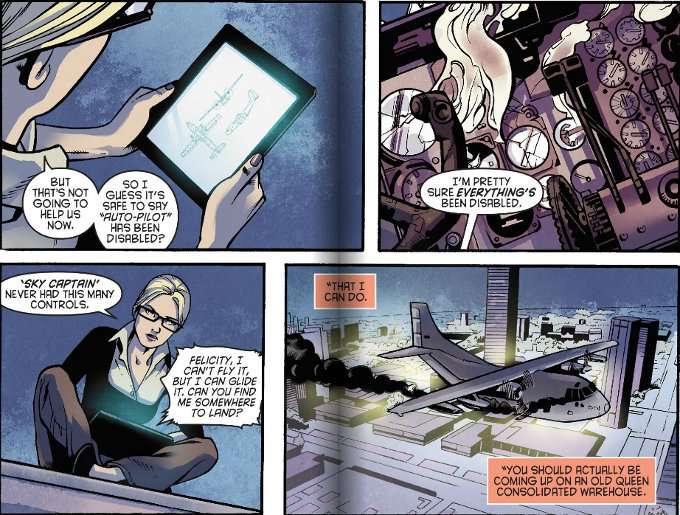
Ollie renders Hode unconscious which Felicity - newly relocated to a rooftop somewhere - points out is kind of stupid since Ollie has no idea how to fly a plane.  Well, Ollie says he used to watch his dad fly a plane all the time and has picked up enough to know how to glide it.  Felicity and her Windows 8 tablet come to the rescue as she's instantly able to hack in and take a look at the plane's controls. 

No.  Really.


This is why the FAA makes you turn your electronic devices off on the plane.
 They're afraid you'll find out ANYONE can do this.

In what marks the one realistic, logical thing in this comic, Felicity quickly figures out that flying a plane in real life is much more complicated than running a flight simulator on the Wii and that all of the SCIENCE! in the world won't allow her to pilot the plane with what little she knows.  Thankfully, she is able to play navigator for Ollie and finds an abandoned Queen Industries warehouse for him to glide the plane into safely.  And so our comic ends with our heroes back at the Arrow Cave and Felicity justifying her own cash-grab in the streets.


Seconds later, Ollie said "You have failed this city," and shot her.  She was not missed.  The End.

This comic stinks!  The artwork isn't bad, save that Ollie only seems to have a mustache in some panels instead of his beard but the story is full of continuity problems and just plain stupidity.  Normally Arrow is worth the download but this week it's not even worth downloading to laugh at.

Saturday, February 16, 2013

On Terry Deary and The Modern Library

SOURCE: Libraries 'have had their day', says Horrible Histories author

Terry Deary - author of the Horrible Histories series of children's books has declared that libraries are "no longer relevant" in the modern world.  Claiming that he was " not attacking libraries" but rather "attacking the concept behind libraries", Deary went on to justify library closings by claiming they are putting the book shops and publishers out of business by giving away a product for free.

"...we've got this idea that we've got an entitlement to read books for free, at the expense of authors, publishers and council tax payers."


"The libraries are doing nothing for the book industry. They give nothing back, whereas bookshops are selling the book, and the author and the publisher get paid, which is as it should be. What other entertainment do we expect to get for free?"

I'm not quite sure where to start with how horribly out of date and inaccurate Deary's views are.  But since I was asked for my opinion on this matter, I'll try and walk through this.


1. Public library books are a privilege, not an entitlement 

Most public libraries collect most, if not all, of their funding through local taxes.  By paying taxes in your locality, you support the library and earn the right to use it.  Most libraries are strict about making sure you live in their locality before letting you partake in certain privileges (i.e. checking out materials, using the computers for an extended period, etc.) so the chances of someone freeloading off the system are virtually nil.

2. Public libraries do more than just check out books

Deary complains that books are the only entertainment people expect to get for free.  Clearly, he's never been on The Pirate Bay, where all manner of games and movies can be downloaded along with book scans.  Ignoring the thieves, Deary's view of libraries is antiquated.  Libraries do not just loan out books.  They loan out all manner of materials, including music CDs, audiobooks, magazines and yes, even movies like Roald Dahl's Matilda, which Deary name-dropped in his example of a movie people would pay money to see in a theater and then expect to get for free from a library.  Ironic considering that Matilda is about a library-loving girl who is happier reading than watching TV.  And that's ignoring the value libraries have as a cultural and educational center, offering free classes, technical resources and after-school programming among other services. 

3. Public libraries boost book sales 
 
There's been countless studies that have proven what most library users will tell you - being able to give new authors a try through checking out library books has led to them buying more books.  A 2011 Library Journal study confirmed this. Amazon also confirmed that their ebook sales went up after they started making their ebooks available for libraries to loan out. 

4. Public libraries make books accessible to people who couldn't buy them in the first place.

Deary seems to have fixated on one group of people being library users - the thrifty sorts who won't pay for what they can get for free.  Ignoring my first point for the moment (i.e. these people have paid for the privilege of using the library), Deary forgets another important category of library patrons - those who can't afford their own books. 

Be it the economically disadvantaged or children and teenagers whose parents won't buy them books for one reason or another (Parents like Harry Woodworm from Matilda are sadly real, I'm sad to say) there's a lot of people who depend on the library for reading material that aren't costing the book shops, the publishers or Mr. Deary one red cent because they don't have any money for them to take.   


In conclusion, Deary's views on libraries are as set in the past as his Horrible Histories books.  The fact of the matter is that everyone profits from the existence of public libraries, from the kid at the story time to the publishing executive.  Libraries do far more than give away books and even if they didn't there's no evidence that they are hurting book-sellers and authors.  Indeed, the reverse seems to be the case.   
 

Monday, January 21, 2013

Off Target: Green Arrow (Vol. 2) #88

There's a problem - let's call it The Archer's Complaint, since it comes up just as much with Hawkeye as it does with Green Arrow. 

THE ARCHER'S COMPLAINT: What good is a guy who is really good at using a bow in a world where magic is real, aliens exist and super-powered beings are an established fact of reality?

There's two ways a writer can cope with The Archer's Complaint.  The first method limits the character's activities to dealing with low-level street crime and real-world problems.  This tactic was used by Mike Grell on Green Arrow and is currently used by Matt Fraction on Hawkeye.  The second method showcases the character's mental skills and gives them technology that allows them to level the playing field.  This method was used by Joss Whedon in the Avengers movie and pretty much everyone who wrote Batman in the last two decades.

I mention this because writer Kevin Dooley did not choose either of these paths when he was writing Green Arrow.  Whether it was because he was honestly unable to think of stories where Oliver Queen could be an effective hero or he actively hated the character I have no idea.  Either way, I can't help but notice that the stories Dooley wrote for Cross Roads were the ones where Ollie proved completely ineffective until he changed his methods and standards, whether it was by destroying private property, abandoning finesse for raw power or outright killing an unarmed man that the law wouldn't touch.

With that in mind, let's play some Comic Book Limbo and see how low we can go with Green Arrow #88.


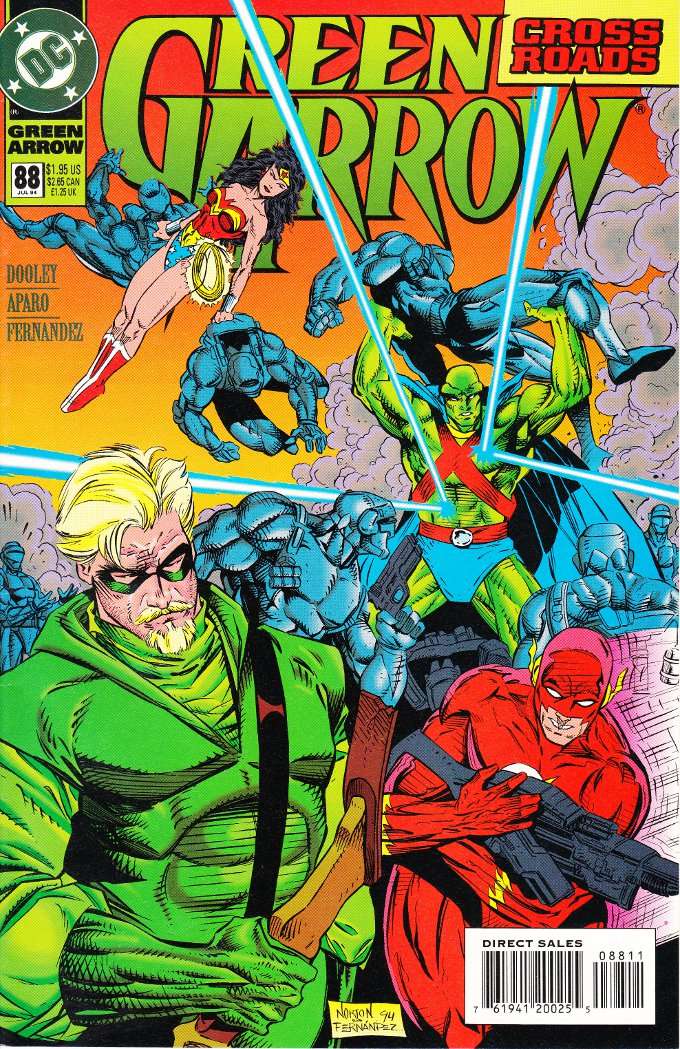
Hey, Wally?  Could you run down to Academy and get me a bow that isn't broken?

This cover is a complete lie.  There's no armored soldiers anywhere in the book.  Ollie isn't in costume once in the whole issue.  His bow never gets broken.  The Flash never shows up.  And - SPOILER ALERT - Ollie never fights alongside his former colleagues in the Justice League.

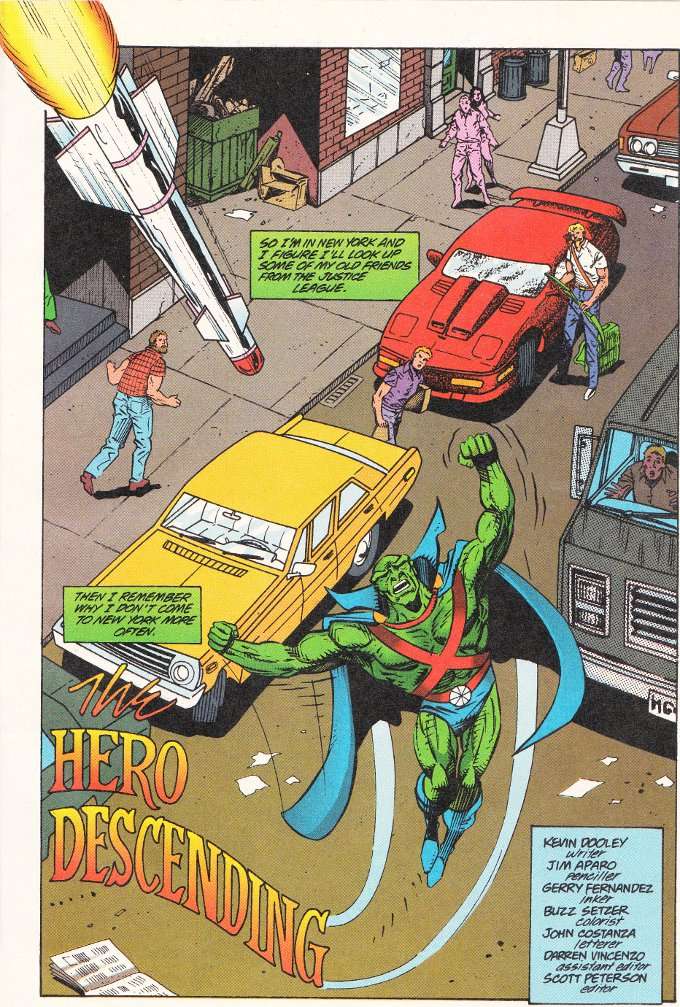
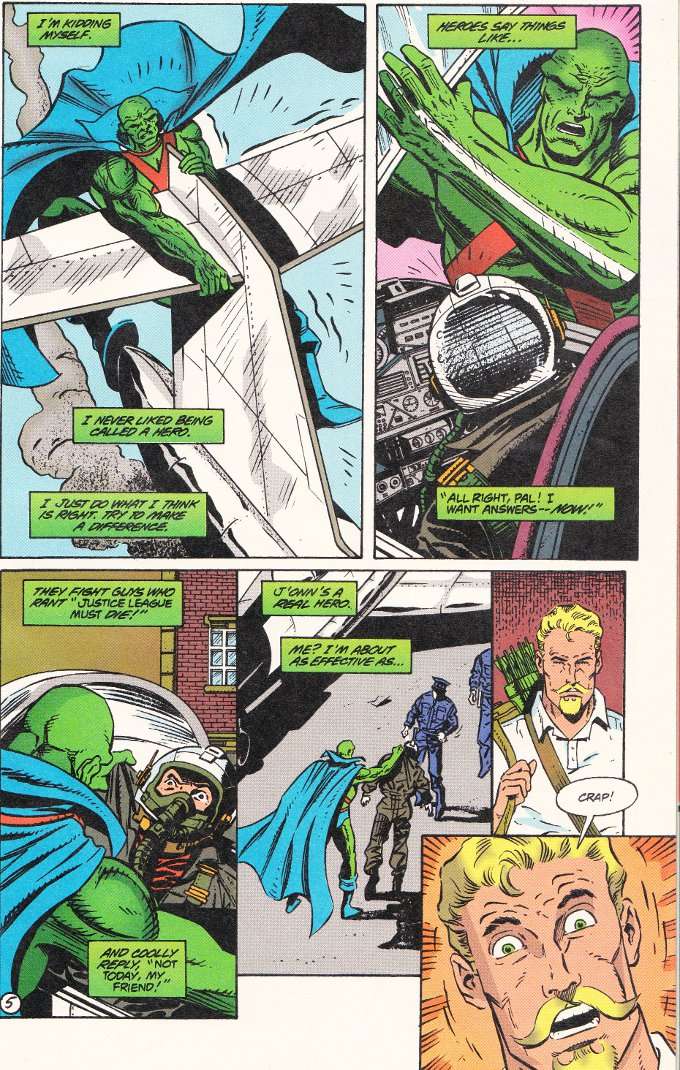
We open on a typical New York City street.  In typical New York City fashion, a missile is about to rain down fiery doom on the populace.  Luckily, The Martian Manhunter is on the scene.  So is Oliver Queen, but nobody notices or cares about him.

For one thing, you can't get theater tickets without taking out a loan these days...

As Ollie watches J'onn effortlessly catch the missile, deflecting it towards a second missile, he thinks back on his days in the Justice League and wonders if they might still have a place for the World's Finest archer.  He dismisses the thought just as quickly, thinking there's nothing a man with a bow can do against a madman in a jet armed with heat-seeking missiles and starts wondering if the other heroes just humored him. 

Get used to this self-loathing, folks.  We're going to be seeing a lot more of it.

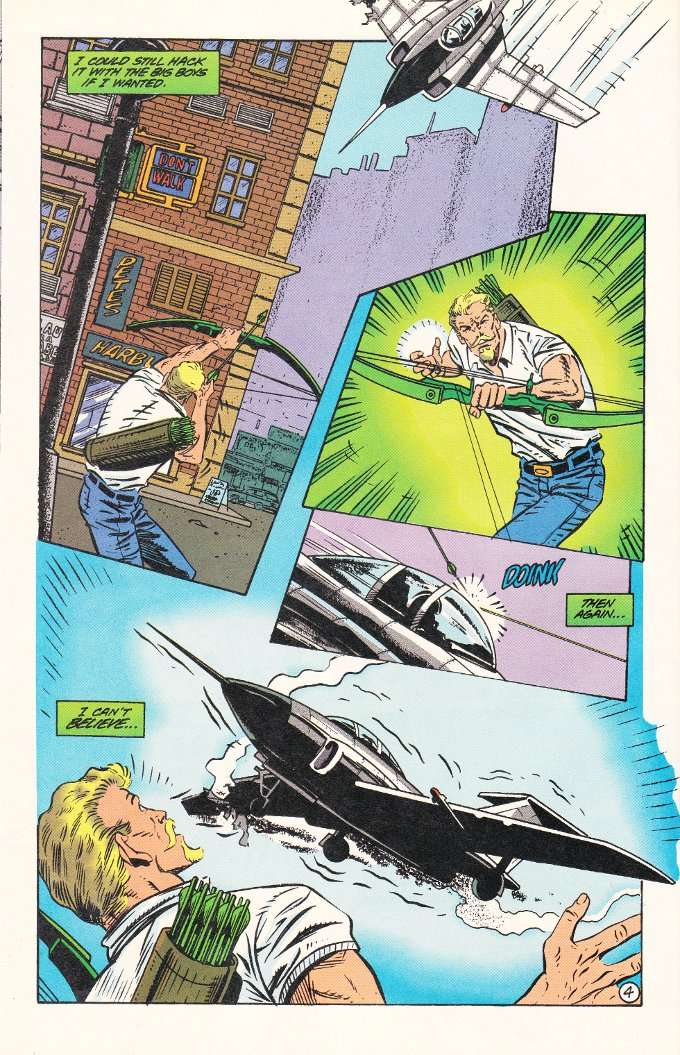
Ollie leaps into action after J'onn punches his way through one of the jet's engines and the plane starts to fall downward.  This leads Ollie to try and shoot the cockpit glass with an arrow.  Wait... Why?  What was he hoping to accomplish?  Kill the pilot in case he was trying to steer the plane to where he could hit someone when he crashed? 


... that you'd be so stupid? Neither can I, Ollie.

No, Ollie's arrow didn't do anything.  It's Martian Manhunter again, righting the plane and bringing it down safely.  The police come up to take the pilot into custody as Ollie looks on.  This would be an ideal time for Ollie to step in, say hi to his buddy J'onn and offer to go commiserate over some cookies and milk at one of Manhattan's many fine diners.  Ollie doesn't do that.  Even though the whole reason he came to NYC was to get in touch with his old friends.

Hey, don't insult crap!  It makes for a very effective fertilizer!

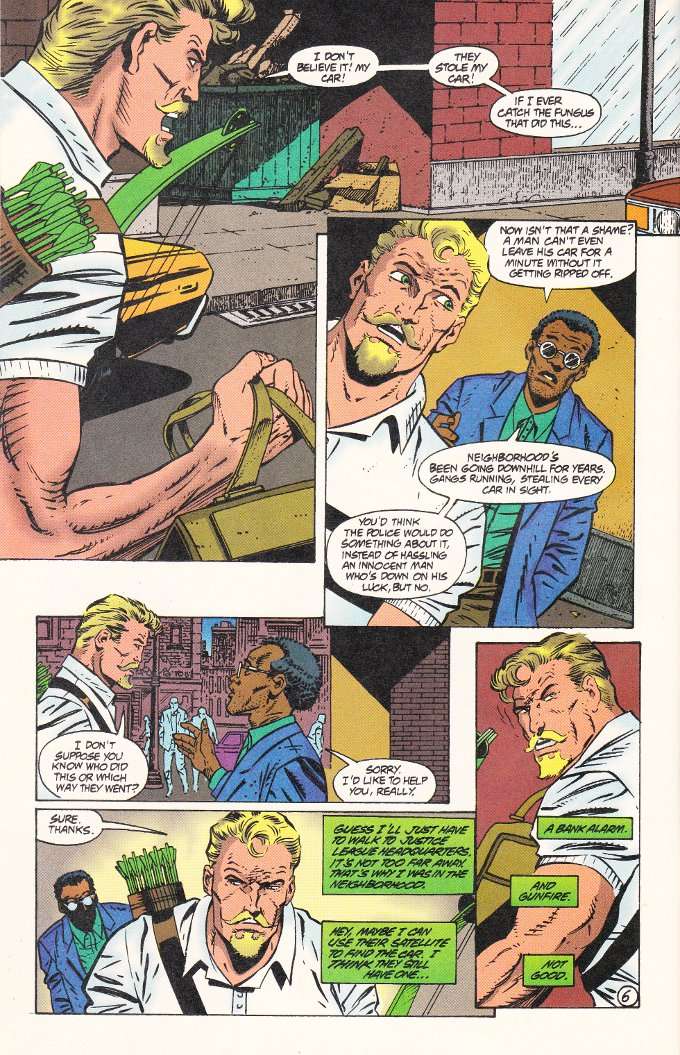
No, Ollie isn't trash-talking himself, for once.  In the minute or so while his back was turned, Ollie's car was stolen.  A surprisingly clean-cut and well-dressed homeless man tells Ollie about how the whole neighborhood has been going to hell in a hand-basket and how the cops are more interested in harassing the homeless then catching criminals.  I'll give Kevin Dooley credit for this much - that is totally accurate in regards to how Mayor Rudolph Giuliani ordered the police to handle the homeless in New York City at that time.


Okay.  Let's pause to consider something.  We're only six pages into this book and we've already had an apparent terrorist attack with a stolen jet, a car theft and now a bank robbery.  All of this has happened within walking distance of the Justice League Embassy.  All of this happening on the same street with the span of about five minutes.  Unlikely?  To put it mildly.

I'll grant you the jet attack since it may have been aimed at the Justice League Embassy itself.  I'll even grant you the car-theft may have been a crime of opportunity, since everyone was distracted by the sudden jet landing.  But I don't think it likely that the neighborhood around a public superhero base would be the kind of place a car thief would routinely hang around waiting to get lucky OR that someone would try to rob a bank near one.  There's a reason the crime rate tends to be lower around police stations and the same principle should apply here.

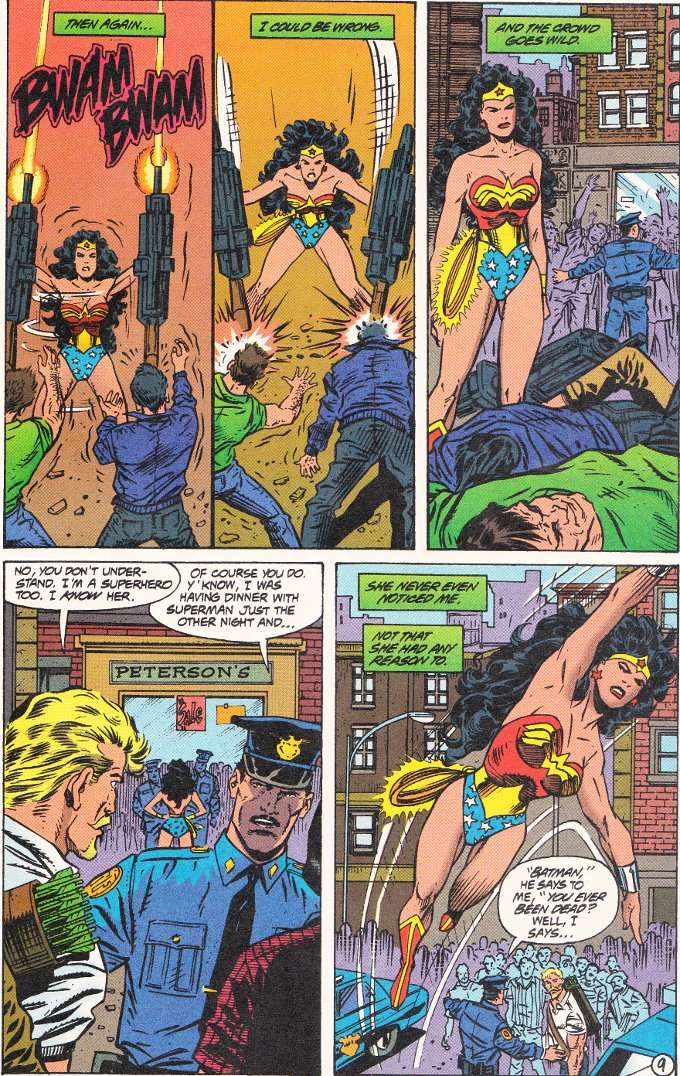
Anyway, Ollie runs toward the sounds of gunfire and finds several police officers pinned down by heavy fire.  As Ollie tries to figure out how he can stand up to a bunch of robbers with high-powered guns, Wonder Woman shows up.  Ollie thinks she has things well in hand and he doesn't have to get involved... until he sees two men with guns sneaking up on Wonder Woman, ready to shoot her in the back at point-blank range.  Ollie is about to shoot at the men, but Diana has matters well in hand again.  This time, Ollie does try to say hello, but the uniform cops are having none of it.


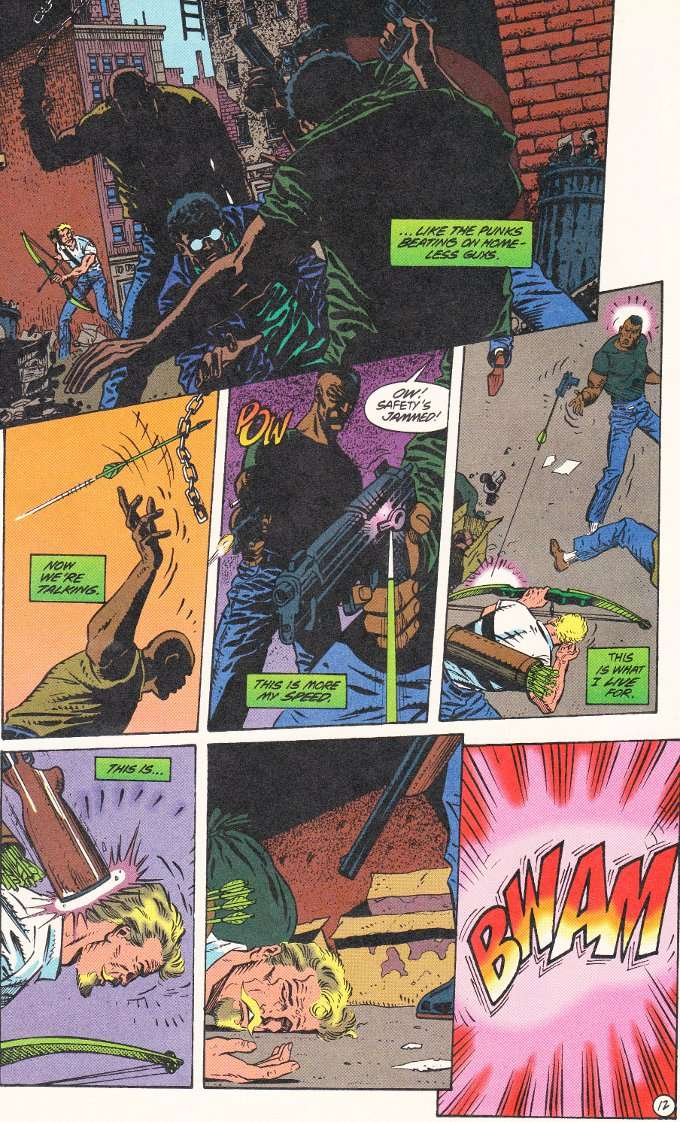
More depressed than ever, Ollie wanders off into an alley and starts playing a variant of kick-the-can that involves shooting it with an arrow rather than kicking it.  After his "can-arrow" passes through an open window and nearly hits a civilian, who sticks his head out the window to yell at Ollie, Ollie hears a ruckus in the next alley over.  By sheer coincidence, it's the homeless man Ollie spoke with earlier getting harassed by some random thugs who seem to be under the mistaken impression that the homeless man has something worth stealing.  Ollie thinks this is just the kind of thing he can handle... right up until someone sneaks up behind him and knocks him unconscious.  


Everybody playing the drinking game at home, do a shot for Ollie getting knocked out.

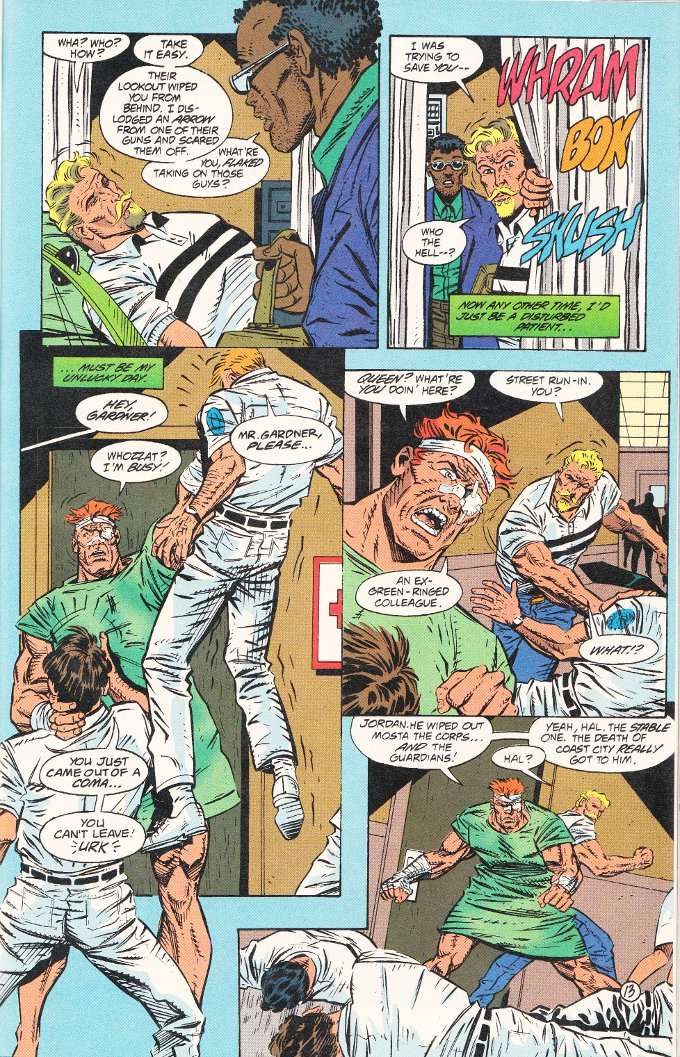
Ollie comes to in the hospital sometime later.  Curiously, despite the fairly strict rules hospitals have about visitors - particularly the victims of violent crimes - the homeless man is waiting with Ollie in his room.  It is he, rather than a nurse, who explains that Ollie got hit from behind by the muggers' look-out. To add insult to injury, he reveals that the only reason Ollie is still alive is because he managed to pull a gun away from one of the muggers and scared them off with it.  So not only is Ollie completely ineffective at fighting alongside other superheroes - he can't even stop a simple mugging!  Our hero, ladies and gentlemen!

Shockingly, there is someone who may be having an even worse day than Ollie and he just woke up in the next room....


Yes, it's Guy Gardner - ex Green Lantern.  Referring to the events of Emerald Twilight (which was going on at the same time as this story), Guy explains how Hal Jordan - greatest of the Green Lanterns and Oliver Queen's best friend - has killed The Guardians of the Universe, absorbed their energy and gone mad with power.  Ollie offers to help as Guy leaves the hospital but Guy is quick to dismiss his help.  "Bow 'N' Arrows Don't Just Hack It," Guy says.

I'm not upset about this part because Guy Gardner honestly is thick-headed enough to not realize that - on the odd chance that 'more force' isn't the solution - maybe having the best friend of the guy you're trying to stop on hand might be a good idea.  Particularly when said best friend has a proven track record of being able to talk to the power-mad lunatic and get him to think about things he never considered before.  I AM upset because Ollie is honestly hurt by Gardner's words about bows and arrows not cutting it and doesn't dismiss them as... well, Guy Gardner being Guy Gardner.

Lacking anything better to do at the moment, Ollie follows the homeless man to the cardboard shantytown where he's currently staying.  He introduces himself as Bernie Feinstein and explains that he's a computer programmer who is down on his luck.  He then introduces Ollie to the rest of his friends, including the guy who runs the place.


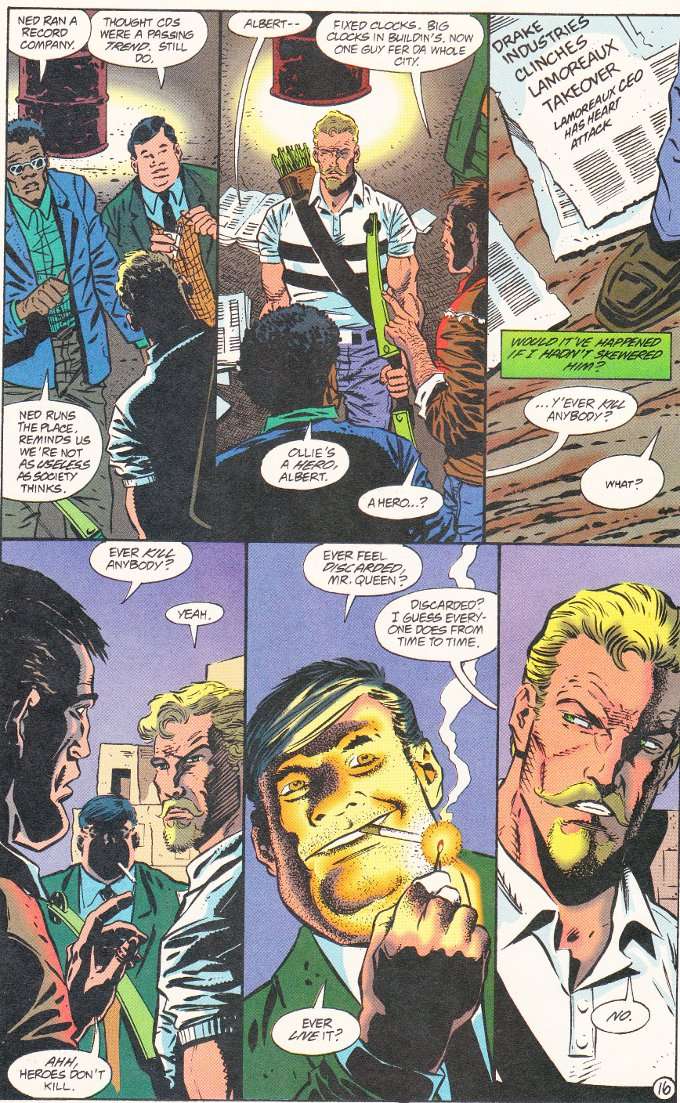
In the middle of this, Ollie is distracted by a newspaper on the ground which talks about Lamoreaux Industries (i.e. the company run by the incestuous rapist Ollie killed last issue) being taken over.  The paper indicates that the CEO died of a heart-attack.  Technically true as Ollie attacked his heart with a cloth-yard shaft.  Ollie muses as to whether or not that would have happened without him doing what he did only to be surprised as Ned asks if he's ever killed someone and is then told that heroes don't kill when he says that he has.  Before Ollie can respond, shadowy figures come out of nowhere, guns a-blazzing.


I'm sure I can find some way to make this bad situation even worse!

Given Ollie's track record so far in this comic and what we've seen of Kevin Dooley's story-telling style so far, what do you think happens next?

A) Martian Manhunter and Wonder Woman, who were finally tipped off that Ollie was in town after Guy Gardner signed in at the JLE and told them Ollie was in the hospital when he left, show up just in time to help Ollie fight the corrupt police.  The issue ends with them going back to the Justice League Embassy for chili, Oreos and milk

B)Ollie single-handedly repels the corrupt police officers, who run away like the cowards they are having not expected anyone to fight back, thus proving the power of one man standing up for what is right.

C) Ollie rallies the homeless men into an army, striking back at their oppressors, thus justifying his status as a modern-day Robin Hood.
 
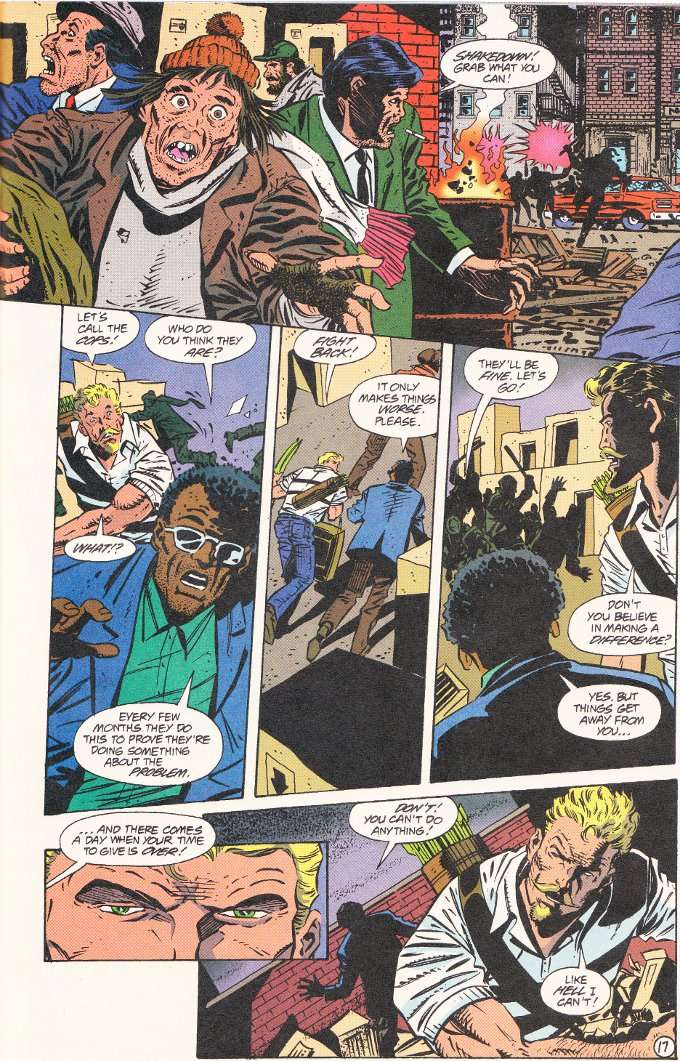
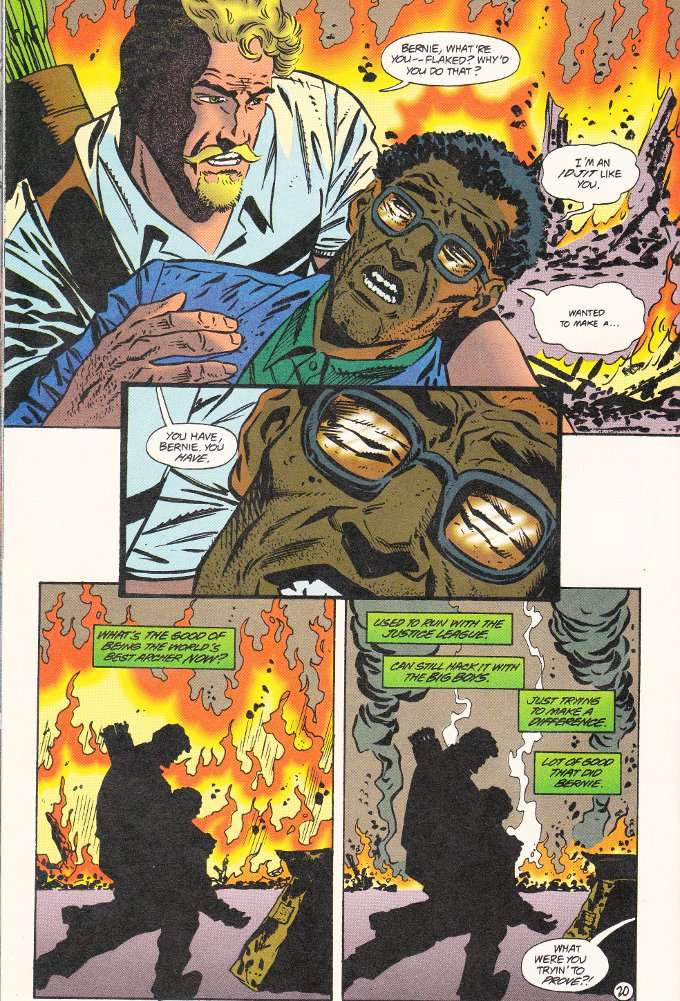
D) Ollie nearly gets shot in the back and is saved only after Bernie throws himself between Ollie and the corrupt cop.  Bernie dies in his arms and Ollie is chewed out for trying to be a hero as the shanty town is completely destroyed and the homeless people are left with nothing.

...

...

...

Pencils down.  Everyone have an answer ready?  Good.
...

...

...


Anyone who didn't say D, smack the back of your hand for not paying attention!


o/` No one knows what it's like... to be the bad man... to be the sad man... o/`

And so our comic ends with Ollie handing an envelope full of money to Ned (apparently, Ollie's Vegas winnings are still in it) and Ollie saying that he lied earlier when he said he wasn't living a life discarded.  Ollie then decides to go to the one place on Earth depressing enough to match his current mood - New Jersey! 

No, really!  He decides to go to Gotham City.  It's in New Jersey!  Look it up in the DC Atlas!   

This may well be the most depressing comic I've ever had the misfortune to read.  This comic holds the idea of heroism down and uses it for a toilet.  Our hero doesn't accomplish one heroic thing in the whole book.  Hell, he doesn't even manage to accomplish his stated basic goal of meeting up with his old friends!

If anyone needs me, I'm going to be doing something more cheerful than reading this comic.  Maybe listen to The Smiths while looking at pictures of abused animals.   

Tuesday, January 15, 2013

Dungeons and Dragons Publisher Recruiting Slave Labor To Produce Adventure About Fighting Slavers!


SOURCE: A-Series Art Contest

So Wizards of The Coast - the current owners of the Dungeons and Dragons name - have elected to publish a new edition of their classic A-Series adventure trilogy Against The Slave Lords.  Fine and dandy.  And they decided that this new edition should have new artwork.  Also fine and dandy.

There is just one problem.  Rather than hire professional artists, WotC has elected to make a contest of it and asked for artists to submit artwork for a contest to be judged on their website.  The prize for the contest?  Publication. No residuals.  No promise of further work.  No contracts.  You just give us something for free and we use it to make ourselves money.

So basically, Wizards of the Coast is hoping to use a bunch of people working without pay to create something that will benefit them financially.  All built around the theme of an adventure that was based around the concept that someone big and powerful bullying someone into serving their interests was wrong.

Irony just died, folks.

Tuesday, January 1, 2013

Off Target: Green Arrow (Vol. 2) #87

Daron Kappauff, who was one of my editors at Comics Nexus, recently asked me if I ever reviewed comics I didn't like anymore.  This comment came on the heels of a run of relatively positive reviews I had just published.  Personally, I think he misses being able to force me to read bad X-Men books and laughing at my torment in having to describe just how bloody awful everything is. :)

Well, let it never be said I don't give the people what they want.  Because this episode of Off-Target focuses on a comic that is so vile you'll be surprised it wasn't a collaboration between Garth Ennis and Mark Millar.  This comic is so morally disgusting, it makes Evil Ernie look like Tiny Toons. In fact, I'd suggest cleaning your bathtub and shower now because by the time we're done with this book you're going to need a lengthy cleansing period.

Hyperbole?  I wish.  Because this issue of Cross Roads was written at a point when the letters of complaint had begun to pour in from the fans.  The readers were upset that Ollie Queen - a hero who had always been defined by his strict morality - had largely been reduced to being The Punisher with a bow, making only token attempts at avoiding killing .  They were also upset that the depth of the character and focus on real-world issues had been reduced from the days when Dennis O'Neil and Mike Grell were writing the character.

How did writer Kevin Dooley respond to these complaints?  Apparently by trying to create a melodramatic villain so unsympathetic that only the most devout pacifist could complain about his being killed by our hero.  He also apparently attempted to ape the styles of both Grell and O'Neil, telling a story that read more like a Men's Adventure pulp magazine than a traditional superhero story.  While there's nothing wrong with that (indeed, one might argue Ollie's roots as a character lay in those same pulps) , it didn't play to Dooley's strengths as a creator and the final product is ham-fisted to say the least.

But I'm getting a little ahead of myself.  So let's take a look at the cover of Green Arrow #87 and - OH MY GOD!
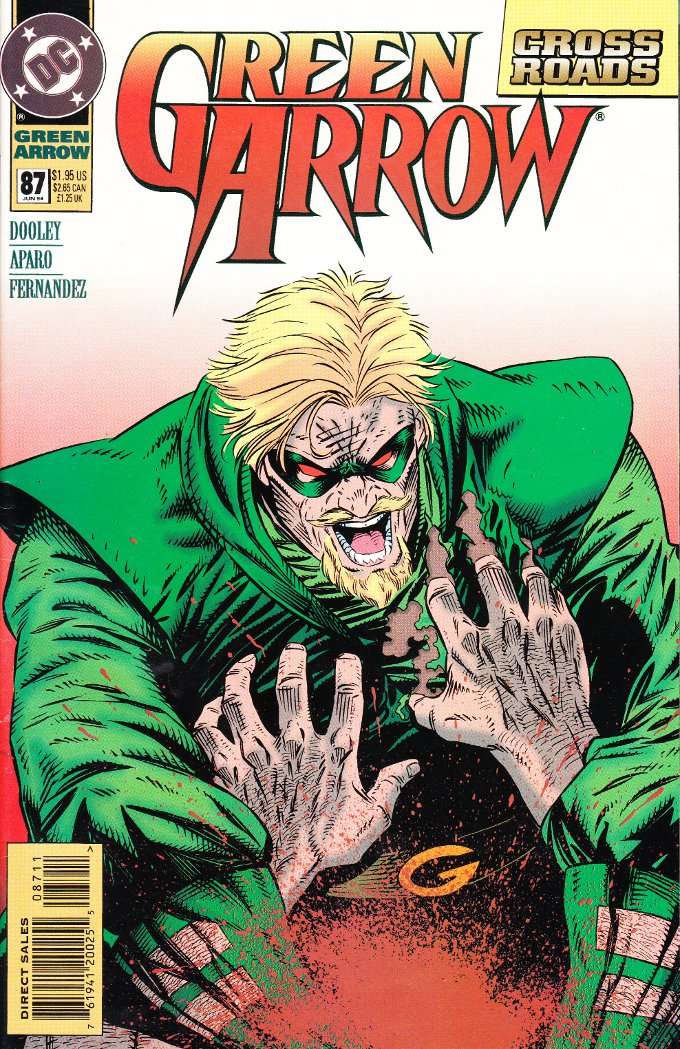


THIS MONTH: Green Arrow - Vampire Lord!

I have no explanation for this.  So let's just press on.

Last time, Ollie was fresh off becoming an accessory to one of Catwoman's thefts and - oh yes - petting the pussy.  Deciding he was bored with Dallas, Ollie decided to head to New Orleans.  Not surprisingly, this issue opens with Ollie on the deck of a New Orleans riverboat casino ship.  Also not surprisingly, Ollie's vacation has been interrupted.  Again.
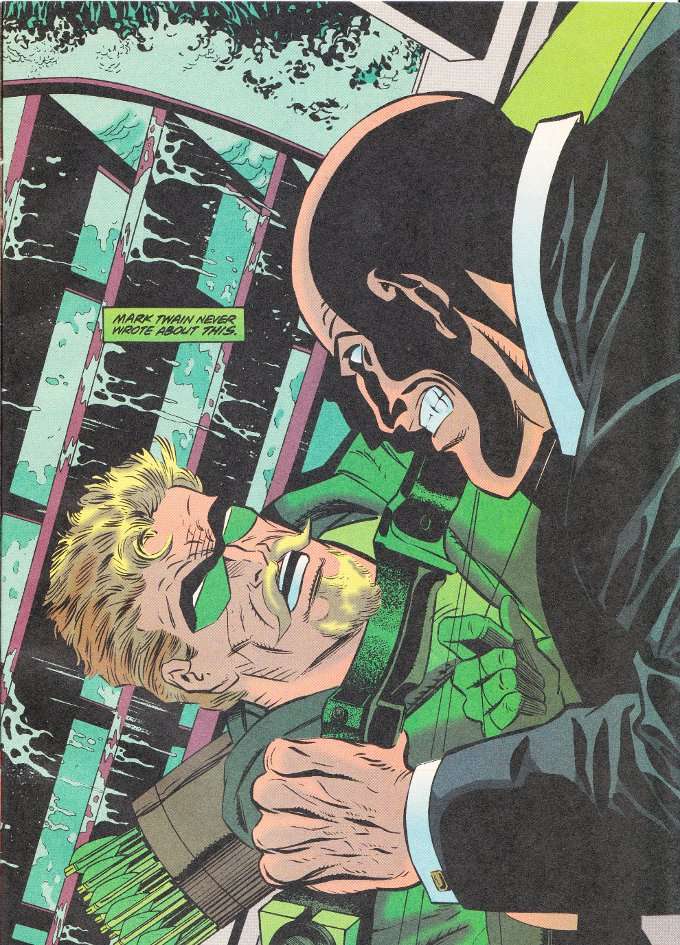

That's because Mark Twain wrote GOOD stories, Ollie.

So how did Ollie wind up in this mess, being strangled by Mr. Clean?  To the surprise of no one, a woman was involved.  Specifically, a gorgeous blonde who was being harassed by a couple of thugs.  Coincidentally, she's the spitting image of Black Canary, save for her mismatched eyes.

Never one to tolerate a lady being bothered - especially one who looks like his lost love - Ollie decided to take action.  Apparently he didn't feel the need to rush taking action, as we see that he took the time to change into his costume.  Luckily, the thugs hadn't dragged the girl away somewhere during that time.  Or was Ollie actually gambling in costume?  I know he stopped giving a damn about his secret identity long before this point but... gah, so many questions over something so stupid!
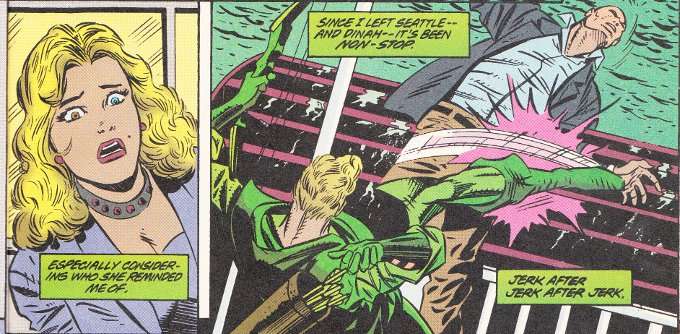

Coincidentally, "jerk after jerk after jerk" is also Ollie's coping mechanism since leaving Dinah.

As the fight continues, we see just how horribly out of character Ollie is under Dooley's pen.  Bad enough that Ollie's kick sends Mr. Clean crashing against a rail and onto the water-wheel of the ship.  Worse that Ollie decides to pin the guy to the wheel with arrows, so he has no chance of swimming to safety now that he's out of the fight.  And Ollie justifies it to himself in his monologue, saying that his recent troubles were all "inevitable".
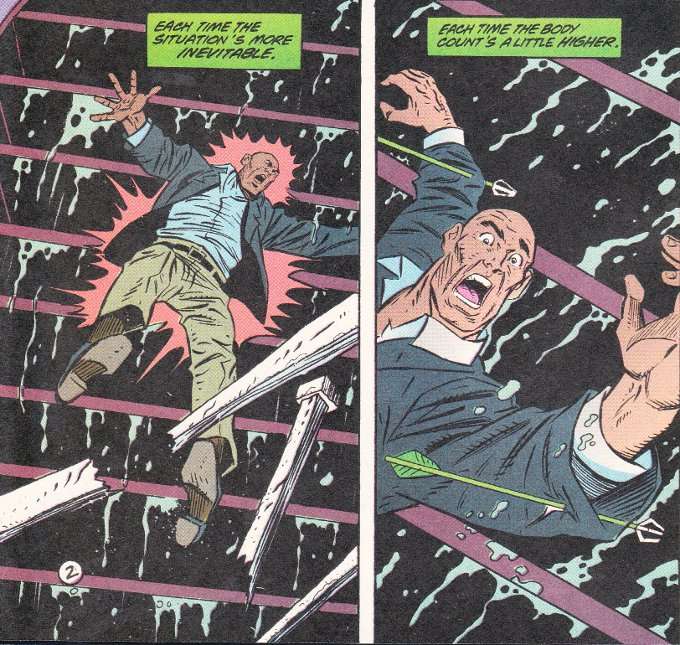

It's not MY fault I keep running into idiot criminals who deserve to die!

Apparently the boat was just coming into dock (it couldn't have been docked, because why would the water wheel be turning if the boat weren't moving?)  and Ollie is quick to chase after the woman for... reasons.  Naturally, Ollie doesn't think that being a masked man and known vigilante fleeing the scene of a crime while chasing after a woman might look bad.  Luckily, the cops don't notice the running woman, the guy dressed like Robin Hood chasing after her or the suicidal behavior of both as they jump in front of trains and knock over a street vendor's cart.
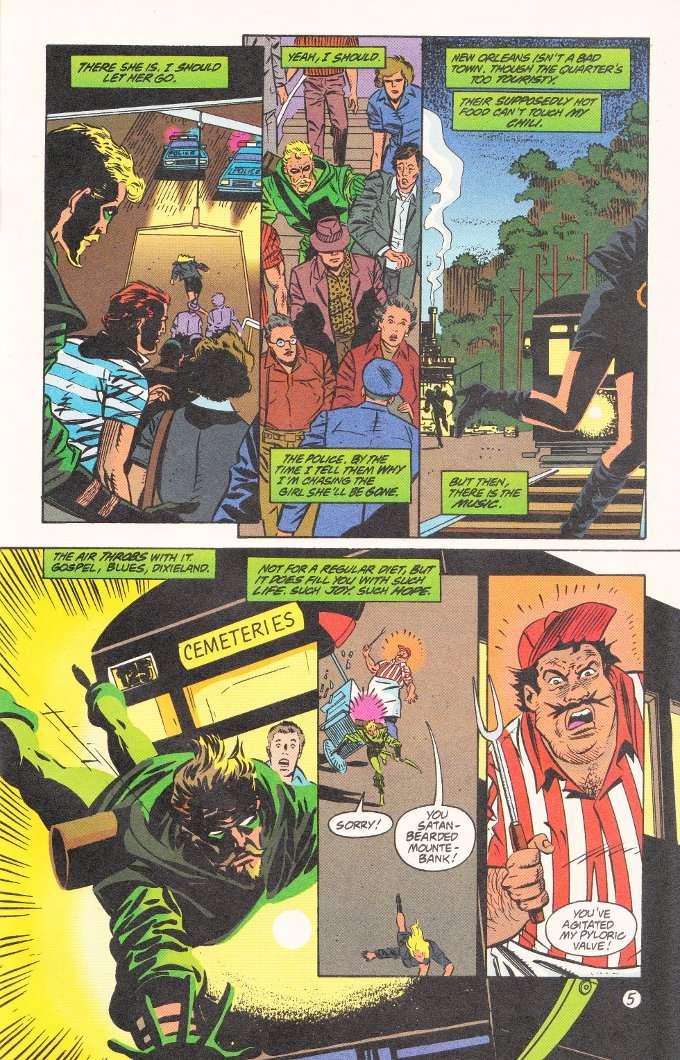

Much as I loathe this comic, I do like the insult "Satan-bearded mounteback".

Ollie finally manages to close the distance on the woman and - being in primal caveman mode - grabs at her hair.  It is then we find out that this woman has one more thing in common with Dinah - she's really a short-haired brunette!  This, coupled with a sudden passing jazz band parade (It's New Orleans - there's ALWAYS a jazz band parading in the streets!), distracts Ollie just long enough to be clubbed across the back of the head by the irate street vendor.  Those of you playing the Green Arrow drinking game at home, do one shot for Ollie sustaining a head injury. 
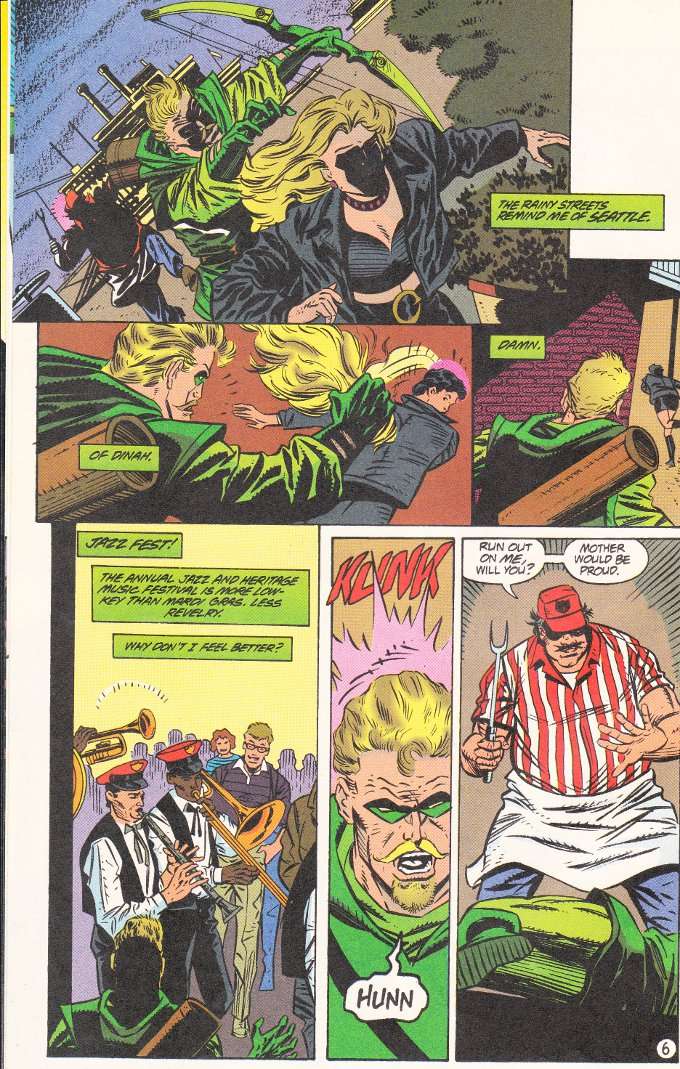

Into da pot with 'im!  He make a mighty fine gumbo.

Surprisingly, Ollie does not wind up becoming long pork gumbo for the tourists.  When he comes to, he is in a strange cabin being watched over by a strange old woman.  Curiously, he's also been changed out of his costume and into his street clothes, yet is tied up.  The old woman turns out to be the mother of the Black Canary look alike.  Rather than thanking him for saving her daughter, she lays into Ollie about trying to help others with violence, even going so far as to compare him to Mussolini.  I think she's meant to be a proxy for the readers complaining about Ollie's unrestrained blood-lust.  But like Kevin Dooley, Ollie has no good explanation or defense for his behavior.
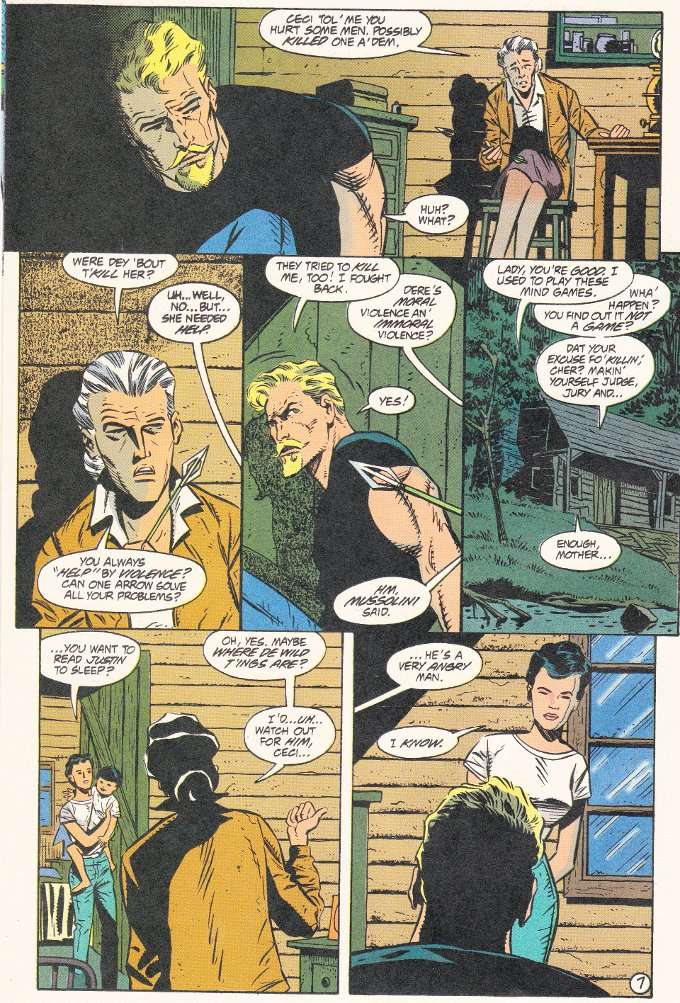

You'd be angry too if you were starring in this piece of crap book!

The woman's name turns out to be Ceci and she explains that she was able to get Ollie's gear off the boat.  What her relation is to the street chef who brained Ollie is never clearly explained, nor why they felt the need to change Ollie's clothes.  She further explains that she works as a whore for local factory owner/gangster Simon "Daddy" Lamoreaux and that the thugs Ollie took care of work for him.  And - prepare to be sickened - she's 15 years old and apparently one of Daddy Lamoreaux's more experienced girls.
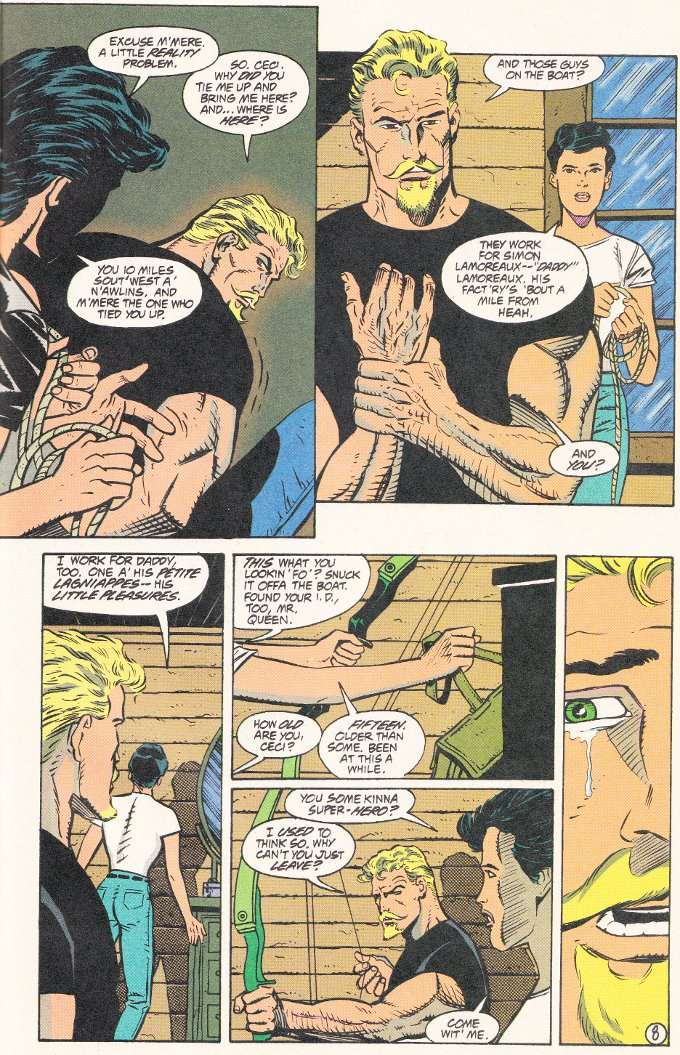

Uh-oh.  This must be really bad for a hardened crime-fighter like Oliver Queen to be tearing up so quickly.  What is it that has so touched the heart of this cynical hero?  Toothless old men crawling in the gutters, begging for change?  Children playing in an open sewer?  The new Taylor Swift single?   
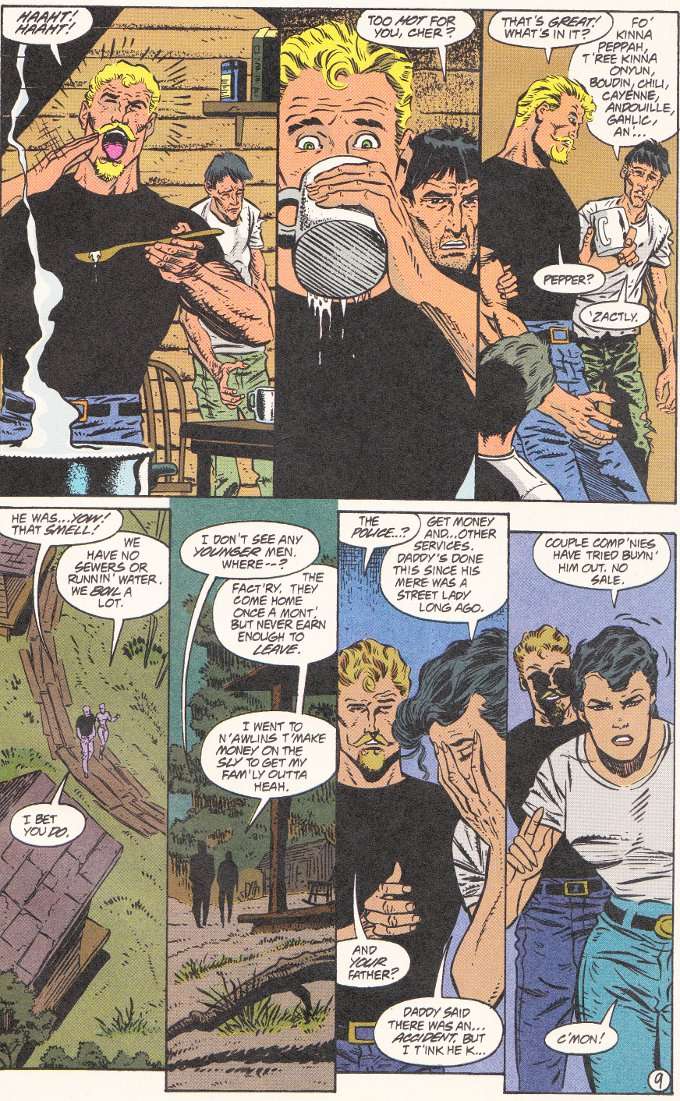

No, it's chilli.  Five alarm Cajun chilli. 

This scene highlights the biggest problem with Dooley's script - the tone changes on the turn of a dime.  You cannot drop a gag involving spicy food just a few panels after a seriously revelation regarding child prostitution.  It just doesn't work!  It also doesn't help matters when we spin back around to total seriousness a few panels later as we get to the part of the story where Dooley decides to emulate Dennis O'Neil. 

For those of you who don't know, Dennis O'Neil was the writer who was largely responsible for transmuting Green Arrow from just another Batman knock-off into the real-world issue tackling, modern-day Robin Hood we all know and love.  O'Neil used his Green Lantern/Green Arrow book to examine serious issues such as urban poverty, overpopulation and drug-use among other things.  Though many of his scripts seem heavy-handed and over-dramatic by today's standards,  they were still groundbreaking for the time and are rightly acknowledged as such today.

I mention this because Dooley's work here is equally heavy-handed but lacks the excuse of being forced to make it abundantly clear how cruel and unusual "Daddy" Lamoreaux is by the CCA guidelines which required any authority figure to be shown as being irredeemably corrupt before the heroes could go after them.  It was not enough for Dennis O'Neil to show the owners of a factory exploiting their workers - the owners also had to be Nazis raising gold for the Fourth Reich!  Writing this in the 1990s, Dooley had no such excuse.
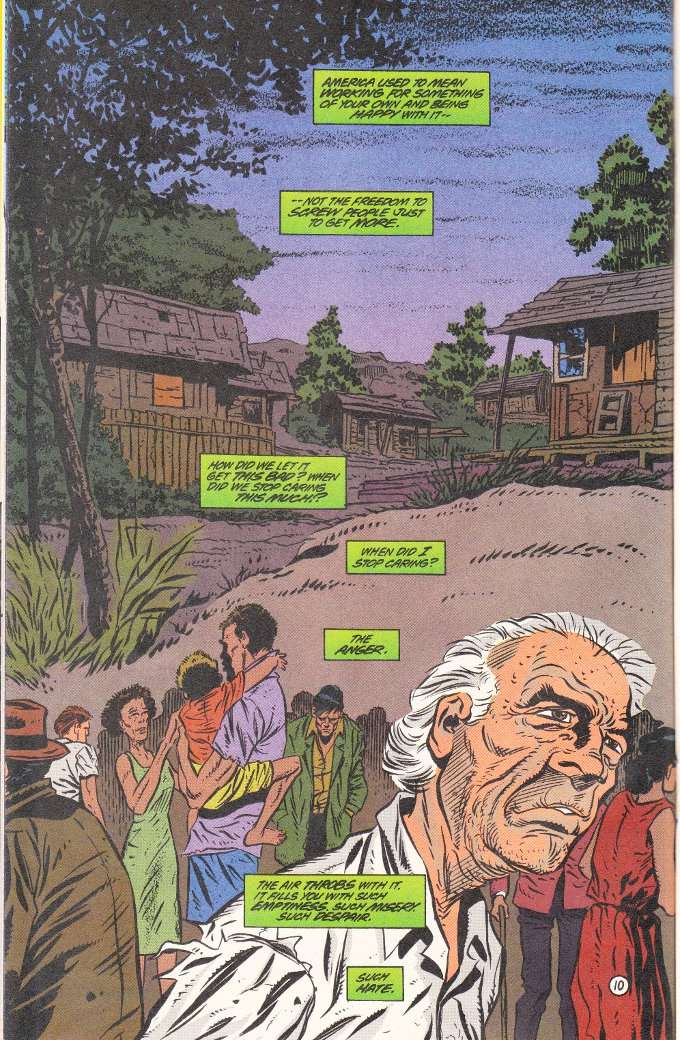

They don't even have a Starbucks, the poor bastards!

The two head back to Ceci's place and Ollie - ever the White Knight - offers to give Ceci and her mother and brother the money they need to escape the swamp.  Ceci corrects Ollie, saying the boy she was holding earlier wasn't her brother - he was her son!  This further enrages Ollie, who swears to put an arrow through "Daddy" for this.  Ceci says she doesn't want anyone risking themselves over her but does offer to "thank" Ollie for his saving her earlier.  Ollie refuses, because contrary to popular belief, Ollie does have standards about who he'll sleep with.  I'll credit Kevin Dooley with at least getting that much right.

This leaves Ollie on the living room couch when Daddy Lamoreaux his goons show up.  Holding Ceci's mom at bay with a threat about arranging a reunion with her husband, Daddy takes Ollie for an up close and personal tour of the local swamp.  And by up-close and personal, I mean they tie him to a tree in waist-deep water out where the gators roam.  And then we get another shocking revelation - "Daddy" Lamoreaux is Ceci's father and shares her unique eyes!   
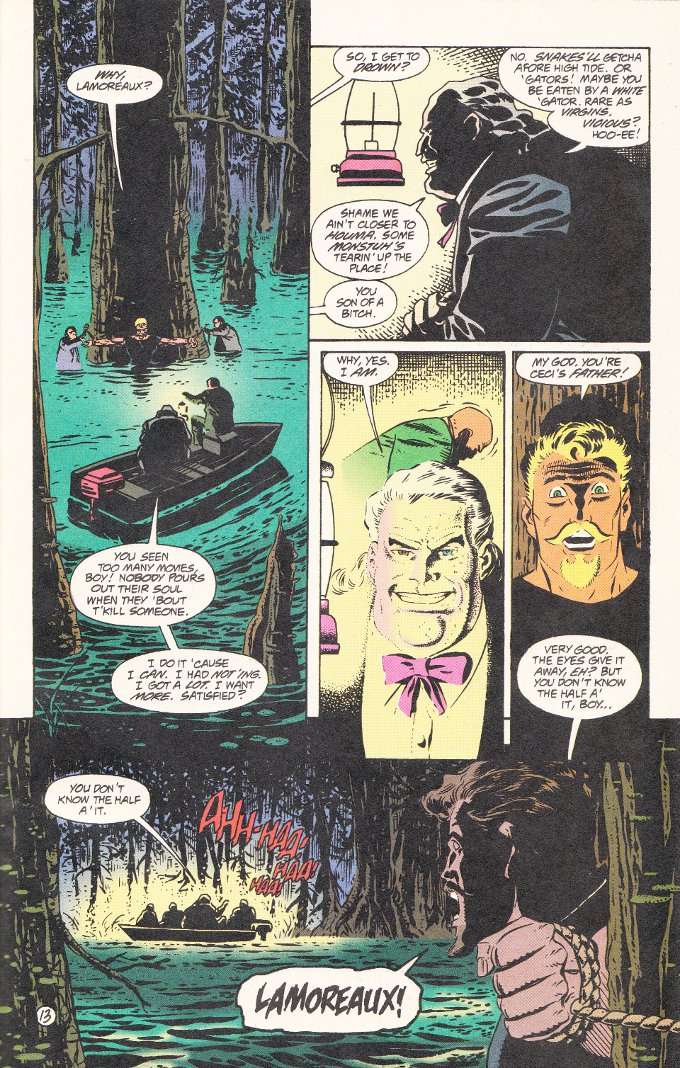

And now we get into Men's Adventure magazine territory.  As I mentioned earlier, Mike Grell wrote a lot of stories in this vein, with Ollie living off the land in a hostile terrain and pitting himself against wild animals.  The problem is that Grell kept his stories firmly in reality and... oh, just watch.
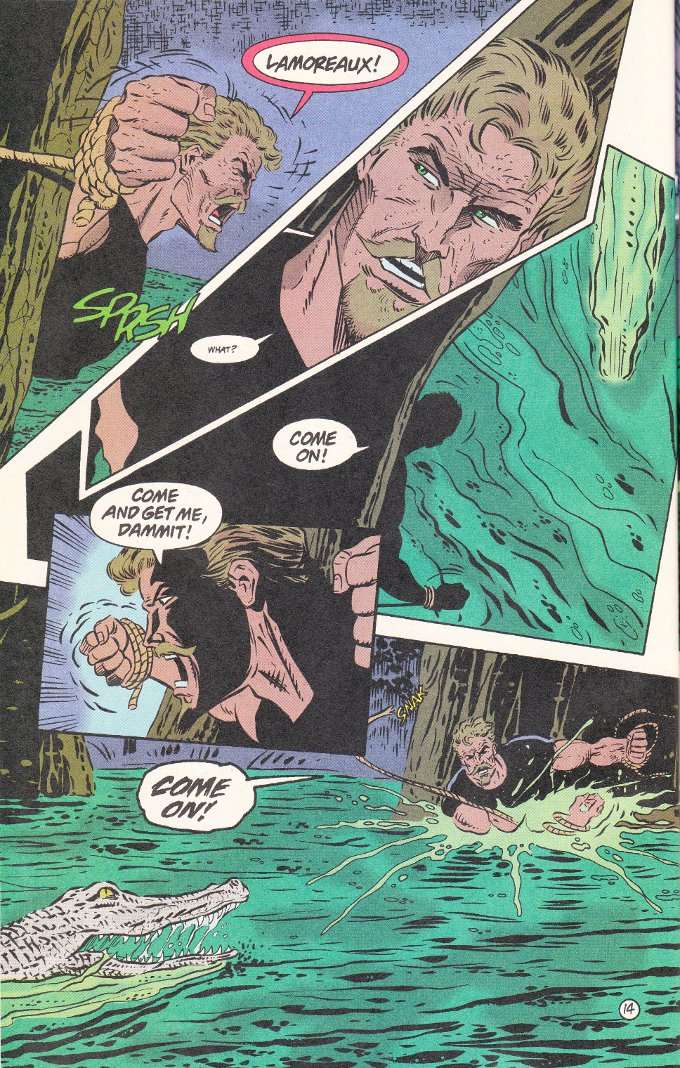

Okay.  I'll grant that Ollie MIGHT be strong enough to break a rope.  Maybe Daddy and his henchmen used old rope or half-assed the knots, figuring the snakes or gators would get there before Ollie had a chance to escape.  I'm willing to grant this story that much leeway.  However, I'm not willing to believe that Ollie is straight-up capable of killing an alligator with his bare-hands, without sustaining any injuries!
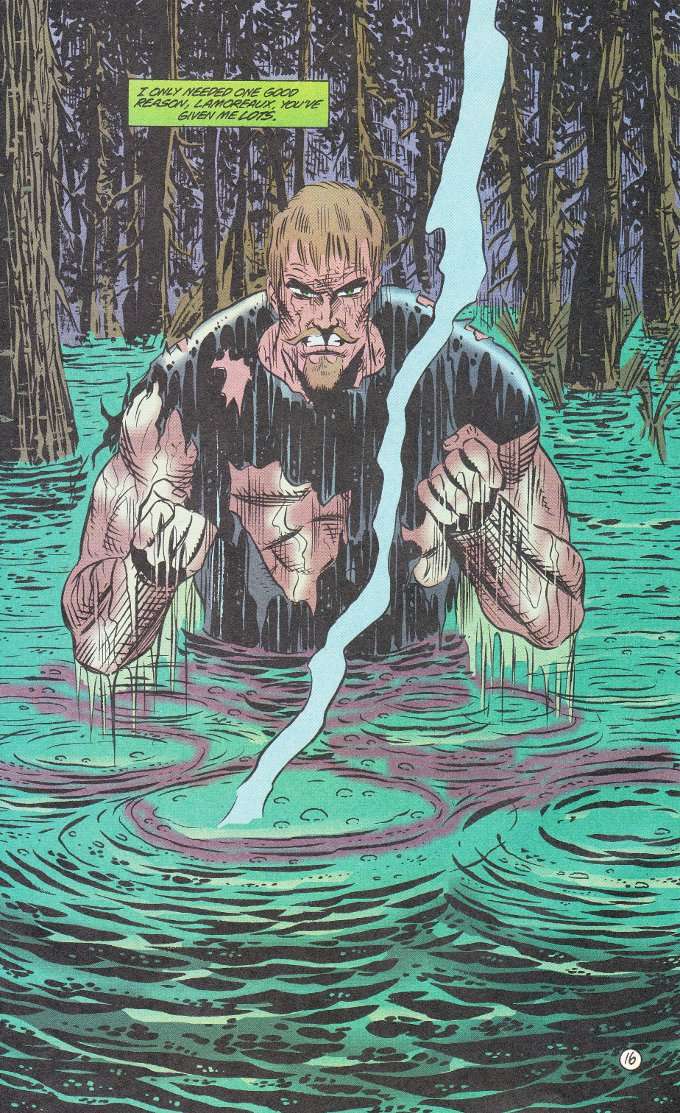

Ruining my shirt, forcing me to kill a rare animal... 

No, Ollie actually has a lot better reasons than that.  He runs through all of them as he wanders through the swamp, biting a snake in half for no reason as he gathers what he needs to make a bow and arrows.  Maybe he needed the snake skin for his bow grip?  Ollie also runs through the reasons why he can't go to the authorities - Daddy has the judges, sheriff and police in his pocket.
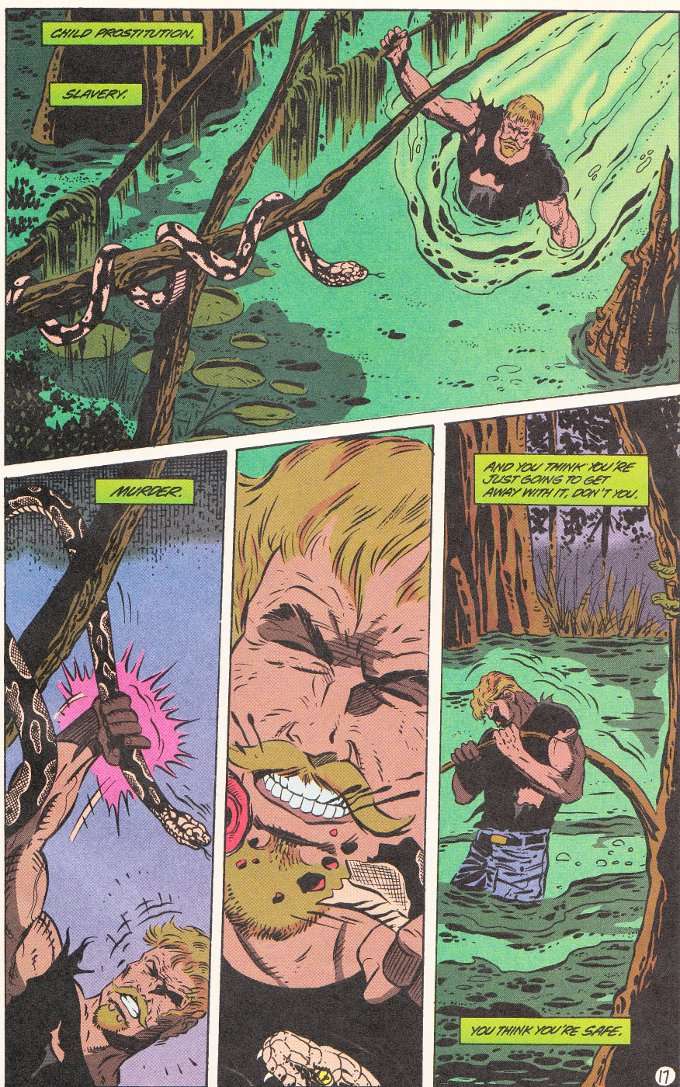


At this point, it may have occurred to you all that all of this internal monologuing exists just to silence the critics of the direction this book has taken.  You may believe Ollie is running through a list of all of Daddy Lamoreaux's crimes so we can see that he is irredeemably evil.  You might be thinking that Ollie is running through the list of all the authority figures Daddy Lamoreaux has bought off so we can see there is no solution other than for Ollie to kill Daddy Lamoreaux.

You'd be right.

But lest we had any doubts that Ollie is completely justified in lethal force this time around, after killing one security guard gaining entrance to Daddy's factory, Ollie walks in on Daddy in the midst of raping Ceci.  So not only is he a sleazy, double-dealing factory owner/pimp who lies, cheats and swindles for the sheer love of doing so while condemning his workers to virtual slavery.  He's an incestuous, sleazy, double-dealing factory owner/pimp who lies, cheats and swindles for the sheer love of doing so while condemning his workers to virtual slavery!

But wait - there's more!
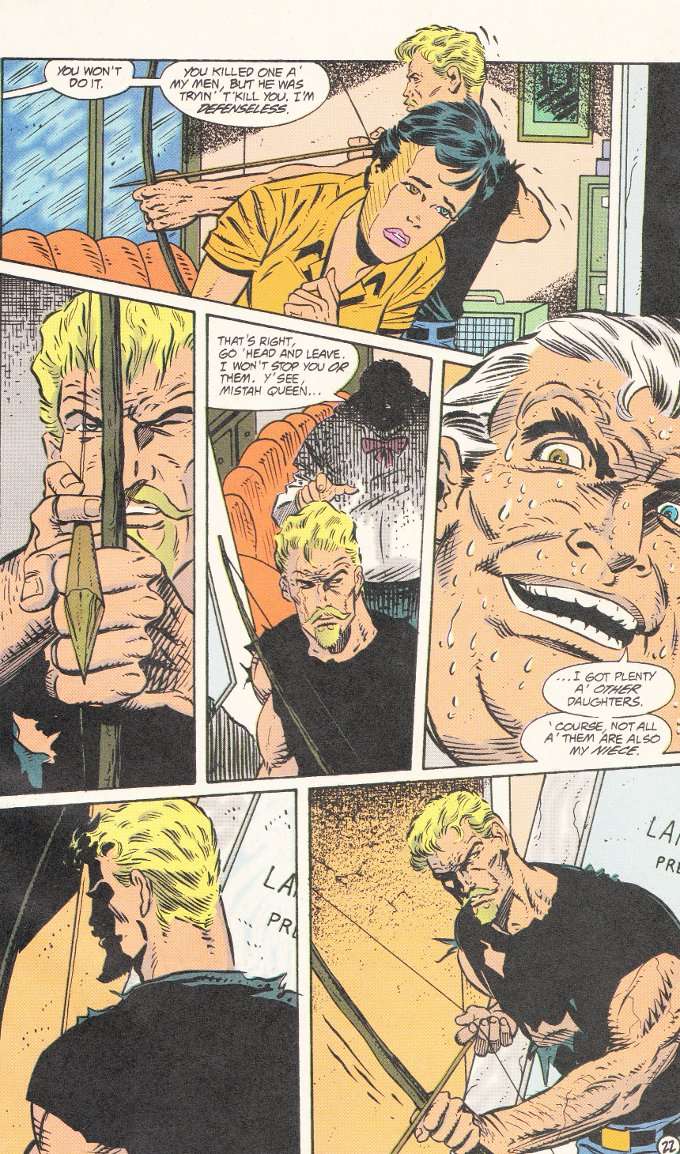


Ollie hates incestuous, sleazy, double-dealing factory owner/pimp who lie, cheat and swindle for the sheer love of doing so while condemning his workers to virtual slavery.  But he REALLY hates incestuous, sleazy, double-dealing factory owner/pimp who lie, cheat and swindle for the sheer love of doing so while condemning his workers to virtual slavery who also killed their own brother-in-law, had sex with their widowed sister and have double-incestuous relationships with their own daughter/niece.  And so our comic ends with Ollie putting an arrow through Daddy's big fat gut and walking out of the factory without a word.  That's it.  End comic.

This comic is stupid and ugly.  The only way to justify Ollie's actions in this story are to set up a totally implausible melodramatic situation where there is no solution other than the one the writer has set up to prove his point - i.e. killing the bad guys is awesome because bad guys deserve to die.  What's really confusing to me is that this story was written at a time when they were trying to get Ollie out of the Vertigoesque place his book had been for the better part of a decade and were trying to bring him in-line with the happier, more hopeful mainstream DC Universe.  How does this story do that?

Thankfully, the next issue of Cross Roads will do a far better job of bringing Ollie back into the DC Universe.  Unfortunately, it will be just about as depressing as this issue, though far less icky.  Now if you'll excuse me, I need a shower....