Showing posts with label Adam Strange. Show all posts

Sunday, November 16, 2014

Justice League United #6 - A Review

The one saving grace of Justice League United #6 is Jeff Lemire's ability to bring little moments of character into what is essentially one gigantic fight scene. It is these moments that have defined the series so far. And it is these moments with all the little interactions between the regular cast that make the book so interesting.


Alas, most of this book is taken up with the sort of Claremontian battles that have come to define any story involving The Legion of Superheroes.  There are no characters here - merely a loose collection of bodies attached to various superpowers.

These scenes consist of various characters standing around, explaining the action to the reader (Quickly, Ass-Kicking Lad!  Kick the ass of that big guy while I hold him in the grasp of my Magnetic Mind Grip!) while clumsily letting us know their codenames.  It's a shame because Jeff Lemire is capable of so much better than this and the scenes in which his Justice League speak to themselves showcase the difference between the two teams.


As before, the artwork is erratically mixed.  Neil Edwards is a clearly skilled penciler, but too many of his figures seem artificially posed. The best aspect of the artwork is the energetic colors added by Jeromy Cox.

Sunday, November 2, 2014

Justice League United Annual #1 - A Review

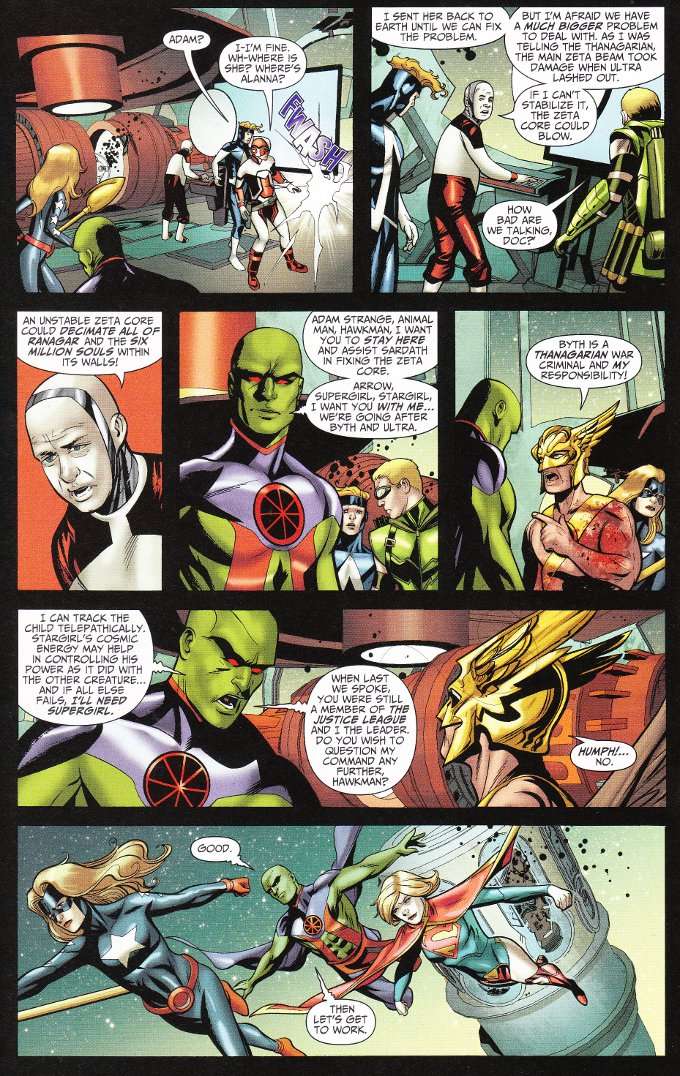
The biggest problem with Justice League United's crossover with The Legion of Superheroes is that it is a Legion of Superheroes crossover.  The good news is that thanks to The New 52, readers will not have to worry about any of the cumbersome continuity problems that beset the classic LOSH comics.  The bad news is that the LOSH are still a collective of bland characters largely defined by their individual super-powers, with only Brainiac Five and Mon-El possessing any kind of personality. And those personalities are "know-it-all jerk" and "hot-headed douche-bag" respectively.


Writer Jef Lemire does what he can, but even he can't battle the inherent inertia of an storyline involving The Legion of Superheroes.  Too much time has to be devoted  to explaining who they are and listing off the individual members of the team. It also doesn't help the plot is strictly standard, with The Legion having come back in time to kill Ultra (Jonn J'onzz's adopted multi-ethnic alien son) before he becomes a world-destroying monster known as Infinitus in the future.

The subplot involving the rest of The Justice League trying to track down the body of a deceased Hawkman is far more interesting for a number of reasons.  Chief among these are the interplay between the team members and the little character touches that Lemire excels at. My personal favorite was the interplay between Supergirl and Green Arrow, with the inherently rebellious Oliver Queen struggling in a position of authority as he tries to reign in the equally rebellious Supergirl.  


The artwork this time is a bit of a mixed bag.  Neil Edwards is a skillful penciler and there are a number of Kirbyesque splash pages throughout the book.  The problem is that many of the poses of Edwards' figures seem overly forced and artificial, up to and including two women pointing their posteriors directly at the reader while curving their backs so we can see the profile of their chests!   The inks by Jay Leisten are competent but not particularly noteworthy. The best aspect of the artwork is the coloring, with Jeromy Cox using a vibrant, heroic palette that makes everything jump off the page in just the right way.

Thursday, October 16, 2014

Justice League United #5 - A Review

I've spoken before about how Jeff Lemire is one of the few modern writers who seems to follow the classic rule that every comic should be written as if it were someone's first exposure to the characters.  It is for that reason - and perhaps because of the delay between issues caused by the Future's End specials - that this issue opens with a recap of just how the new Justice League came together and why Martian Manhunter has now taken on guardianship of a genetically engineered being born of multiple alien species known as Ultra.


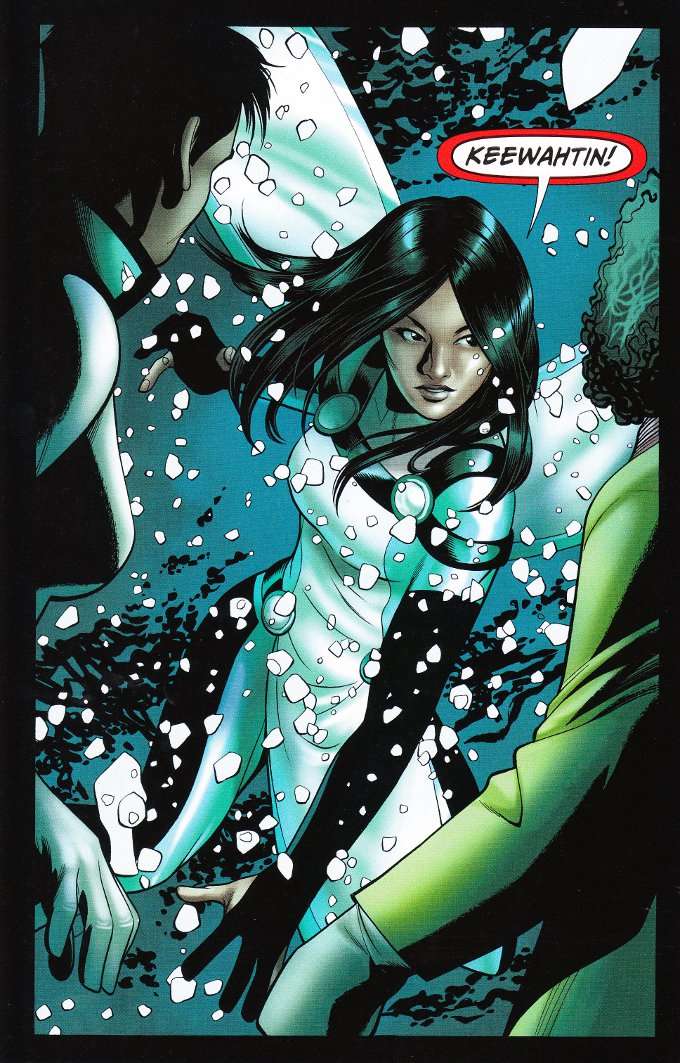
This story - as well as the majority of the team going to investigate the sudden activation of the distress beacon of a recently deceased Hawkman - take a backseat to the main focus of the issue, which develops two heroines who haven't been seen in the book much so far and indeed haven't really defined themselves as heroines yet.  One is Alanna Strange, who despite having a space-suit, a brave heart and a ray gun, still isn't quite sure what to make of the destiny that has been thrust upon her and her husband, Adam.  The other is Miyahbin - a young woman who is about to discover her own special powers and her family's legacy as protectors and guardians.


The artwork of Timothy Green II and Joe Silver proves the equal of Jeff Lemire's amazing script.  Green is a grand visual storyteller and he has a gift for drawing interesting inhuman figures, such as J'onn J'onzz or the monstrous Whitago. Joe Silver is a soft touch with the ink pen, but that suits this bright, largely hopeful story just fine.

All in all, if you haven't been reading Justice League United, this is a good issue to start with.

Sunday, September 7, 2014

Justice League United #3 & #4 - A Review

Through no fault of my comic shop, I somehow neglected to pick up the last two issues of Justice League United until this past week.  And I find myself wondering how I could ever have forgotten this book, even with my busy schedule.  Granting that it has been slow in finding its footing and in bringing its cast together, these two issues finally see our new Justice League united, including Jeff Lemire's creation Equinox and Alanna Strange - no longer a passive romantic figure but now a hero in her own right.


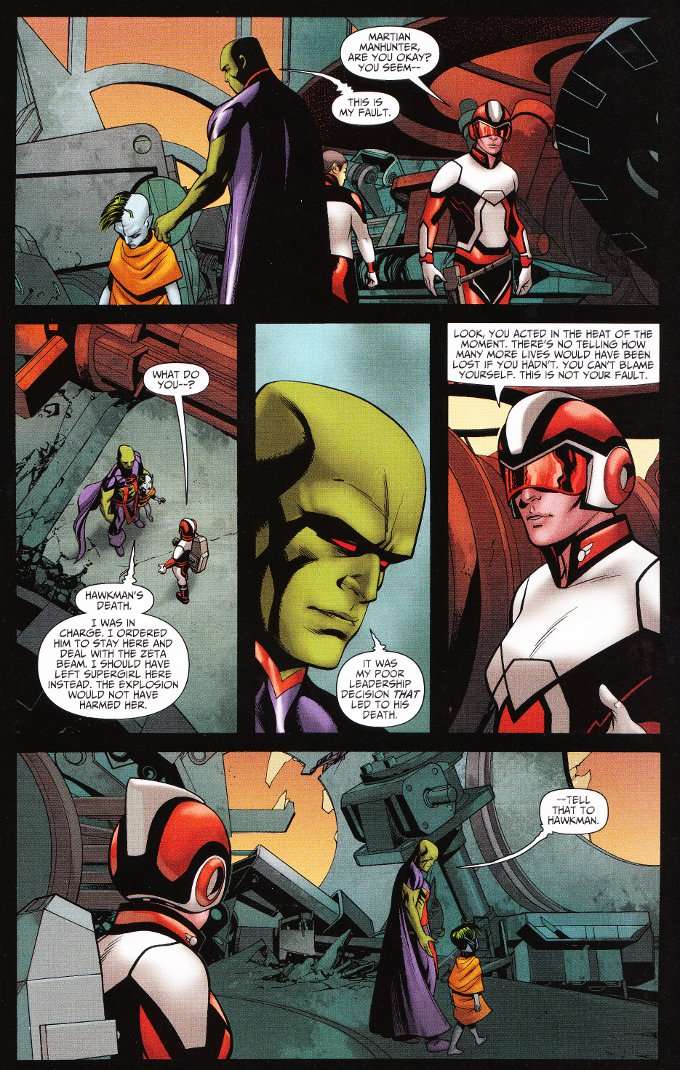
As always, the best parts of these issues are Jeff Lemire's grasp of these characters and his development of their personalities and the relationships between them.  The key sequence of Issue 4 sees these characters - working together but not yet a team - paired off and made to play off one another.  Green Arrow reaches out to Animal Man only to try and shrug off his olive branch with a joke.  Supergirl proves as cool and and jagged as Kryptonian crystal when Stargirl tries - and fails - to make a similar gesture of friendship only to stick her foot in her mouth.  And for the first time in a long while, we see the paternal side of J'onn J'onzz as he takes it upon himself to take charge of the newborn Ultra The Multi-Alien (long story) as well as the responsibility for failing to save an ally's life.


The book's weak point continues to be its artwork. Mike McKone is a competent penciler but the rotating team of inkers on this series do his work a disservice - particularly when multiple inkers are employed on a single issue and all hope of a consistent look is ruined.  I've noted before that McKone also seems guilty of recycling his panels but these two issues bring us a new problem - that of the artwork not matching up with the script. Consider this panel in which J'onn asks for Green Arrow to accompany him, Stargirl and Supergirl only for Ollie not to be included in the away team. For the rest of the issue, Ollie is seen standing in the background with the other half of the team, not saying anything or doing anything.  I blame the editor more for not noticing this problem before the book was printed but it is still a vexing point that takes the reader out of the story.


Despite this, the scripts are good enough that I can forgive the missteps in the art.  And it is gratifying to see so many characters that I enjoy in their New 52 incarnations being given a chance to shine.  So I shall be sticking with this book for a while longer.

Saturday, June 14, 2014

Justice League United #2 - A Review

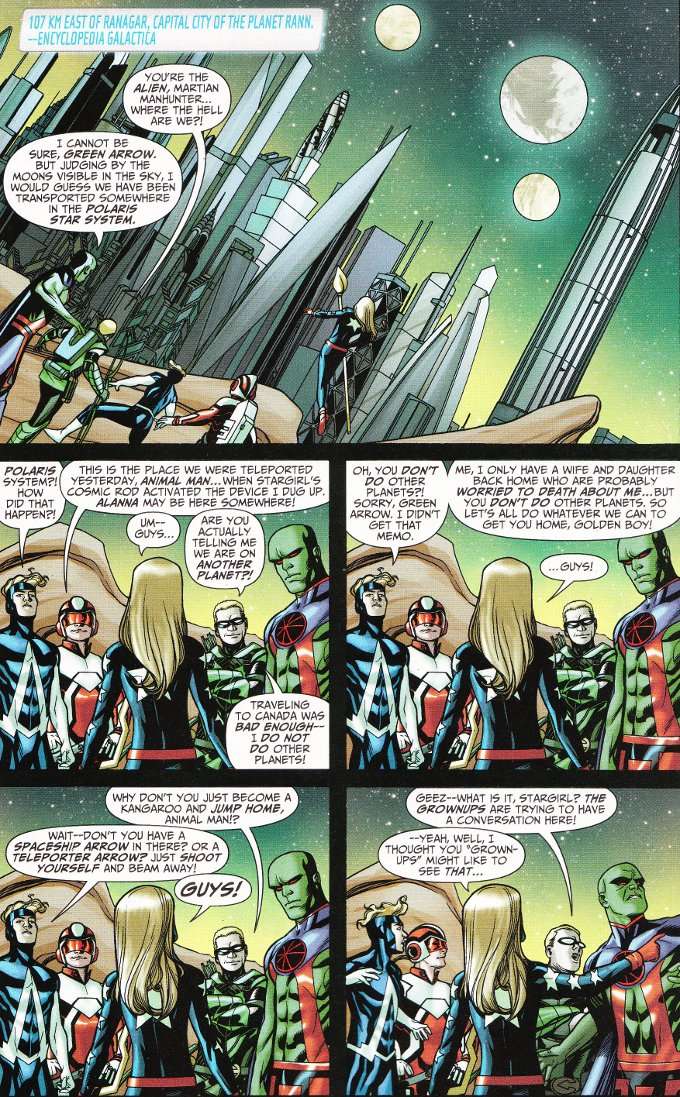
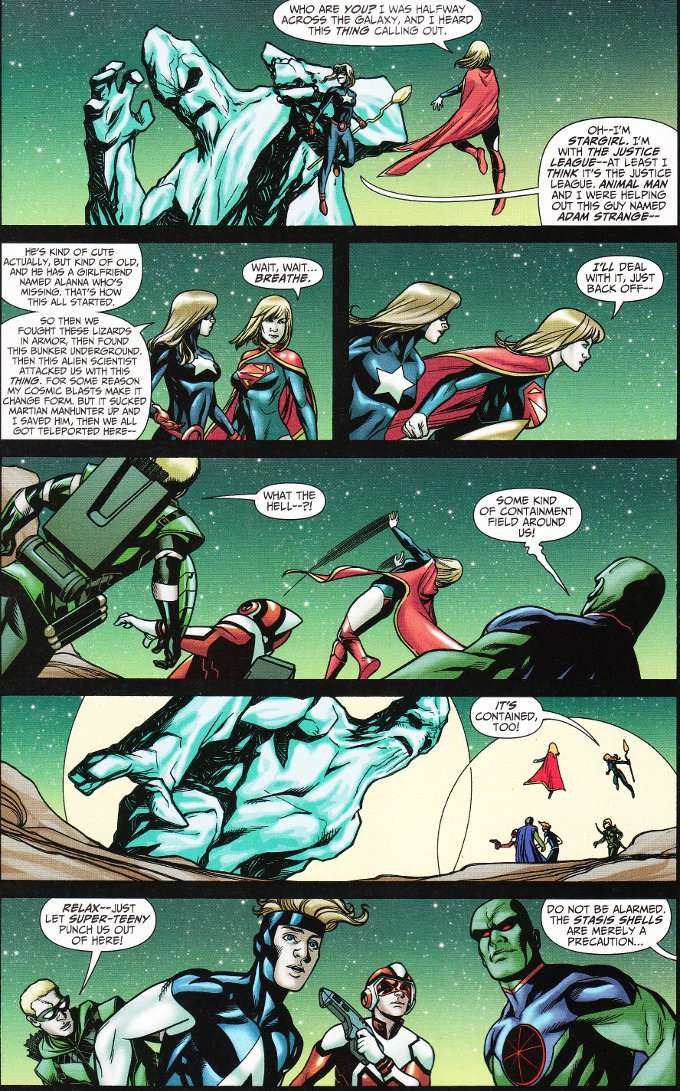
A madman named Blyth is kidnapping the beings of a thousand star systems for nefarious purposes and has hired the bounty hunter Lobo to keep his captives subdued.  The good news is that a new Justice League is aware of the situation.  The bad news is they're currently stranded on the distant planet Rann.  And even with Supergirl having stumbled across them and Hawkman launching a one-man rebellion from within Blyth's prison, it still seems that the new Justice League's tenure is over before it truly began.


I love this book so much.  And it is almost entirely due to how Jeff Lemire writes my favorite heroes.  Specifically, how he can portray them as being competent in a fight but still let the humor of their personalities conflicting with one another come through in a believable fashion.  This is most apparent in the snarking between Green Arrow and Animal Man, but it also comes through in Stargirl's first encounter with Supergirl.  And there is one glorious but amusing sequence where Martian Manhunter  gets a laugh-inspiring moment as he deals with a group of Rannians who have threatened to imprison him indefinitely.  


Unfortunately, I don't think the artwork is quite up to par with Lemire's story.  Mike McKone's artwork isn't bad but - as in the first issue - he is not above recycling panels.  A larger problem with this issue is the inking, which was overseen by three different inkers including McKone.  As a result, there are noticeable and distracting differences in the individual pages, with some seeming to have barely gotten any inking besides a black outline around individual characters!


Tuesday, May 20, 2014

Justice League United #1 - A Review

I love this book.  I love how it is funny and makes fun of the characters without being mean-spirited or making the heroes seem less than competent.  It reminds me of the good old days of the Giffen/DeMatties Justice League, save that the heroes here are actually good at their jobs.


What Jeff Lemire is doing here shouldn't seem so revolutionary.  And yet, it is.  We see superheroes who act like real teammates - not allies of convenience who tolerate each other, at best, because they need someone to watch their back during the next epic brawl.  This new Justice League truly is United and the team spirit lacking in other recent supergroup books by DC Comics is very strong here.


The artwork by Mike McKone is as enjoyable as Lemire's story.  McKones figures are big and bold and his action sequences well choreographed.  Really, the only flaw with the artwork is the palette used by colorist Marcelo Maiolo, who  uses an off-white for Caucasian skin that is not far removed from the same white color used for snow.  

Tuesday, April 29, 2014

Justice League United #0 - A Review

I'd abandoned all the Justice League titles several months ago when it became clear during Trinity War that I would be expected to read them all if I were to make heads or tails of just one.  Throw in the fact that the entire line became part of the much-lamented Forever Evil mini-series and I felt little need to keep going.  Given the mess that story-line has made of the New 52 universe, it would take a lot to get me to wade back into that swamp again. "A lot", in this case, equaling one of my favorite writers working with some of my favorite characters to create Justice League United.


After an opening flash-forward showcasing the titular team in action, we cut to three days earlier.  The story truly begins with anthropologist Adam Strange approaching Stargirl and Animal Man (during a personal appearance at a comic convention) with evidence that aliens are abducting people - including his research assistant Alanna.  The two are eager to help but prove out-classed and out-gunned when armed aliens show up with homicide on their mind.  Thankfully, Green Arrow and Martian Manhunter respond to Stargirl's request for back-up.  Two interludes round out the issue - one giving us our first glimpse of new heroine Equinox and another revealing the fate of the alien's captives and how Hawkman is among them.

Jeff Lemire's grasp of the characters and gift for drama dresses up an otherwise drab premise for a superhero team's formation.  We've seen this scenario before - a big crisis forces a group of otherwise unrelated heroes together, uniting them when they realize how badly said alliance is needed - but Lemire makes it seem new by playing the characters off one another masterfully.  Green Arrow and Animal Man keep the proceedings from getting too dark and this new take on Adam Strange is a gripping one.  What little we see of Equinox seems promising as well.    


The artwork is more problematic.  Mike McKone is not a bad artist but he does a poor job of hiding his shortcuts.  There are a few obviously recycled panels and the thick inking on some of the character outlines leaves them looking like they should be in a coloring book rather than a comic book.  Even the usually stellar colorist Marcelo Maiolo seems to be off his game, with the Caucasian members of the cast being as white as the snow they are walking through.  Despite this, Justice League United looks to be an enjoyable series worth picking up.

Sunday, March 13, 2005

Looking To The Stars: Strange Daze

Yet another slow comic week in Starmanland. I was actually worried about having something to write about this week. And then Johnny Babos had to go shoot his mouth off about a character very near and dear to my heart…

I’m surprisingly leaning towards getting this. While I am a huge Star Trek fan, I’ve never been a comic sci-fi fan. The possibility of learning more about Thanagar and Rann appeals to me.

Seeing Hawkman in this foreign sci-fi environment (I say foreign b/c in his revamp he really is all human not Thanagarian as I understand) also is appealing. I wonder how/if he’ll be accepted by Thanagar. I’d love to see Darkwing show up too.

I’m also intrigued about Kyle Rayner’s new role in the DCU – and hopefully a costume change is in the works for Kyle.

Adam Strange? The weak link of the bunch IMHO. What’s the appeal of this character? None.

Adam Strange? Weak link? No appeal? Blasphemer!

So who, I hear some of you ask… who is this Adam Strange guy? Doctor Strange’s cousin? Hugo Strange’s nephew? Hardly…

Adam Strange was an ordinary Earth archeologist who had discovered the legendary Inca city of Caramanga, where the Indians had hidden their vast treasure of gold during the Spanish conquest of Peru. The Incas, not quite as dead a tribe as was believed, did not appreciate Adam’s discovery of their secret. Adam ran from the restless natives until he came to a large chasm.

Having no other choice, Adam ran and threw himself across the pit. Midway through his leap, he was struck by a ray of light. The next thing he knew, he was facing a strange predatory animal in an even stranger world. He was rescued by a beautiful brunette in a large flying machine and taken to her city, Ranagar. It was there he was taught the language of this world by the use of a “menticizer” and found that his 25-foot leap had become a leap of 25 trillion miles to the planet Rann of the star system Alpha Centauri.

The girl was named Alanna and her father was Ranagar’s head scientist, Sardath. It was Sardath who was responsible for Adam’s teleportation, having hit him with a “Zeta Beam”. Originally built as a means of communication with Earth, the beam had been warped by cosmic radiation and had become a teleportation beam. It turned out later that Sardath was lying and that he was hoping to use the beam to find a mate for his daughter, one of the few Rannians who had not been made sterile by the radioactive wars.

Rann, once populated by a society obsessed with science, was a world destroyed by atomic war. Most of the planet’s population turned to barbarism, forming vast city-states that were in a constant state of war with each other. At the time of Adam’s arrival, some of the city-states (like Ranagar) were regaining the scientific progress of their ancestors and were learning to get along with each other. The Zeta beam’s effects would prove to be temporary and Adam would be teleported back to Earth. But Sardath would send out subsequent beams to return Adam to Rann. Equipped with a fire-proof uniform, a rocket-pack and a ray-gun, Adam would go on to be Ranagar and Rann’s greatest defender.

Adam Strange first appeared in 1958. It was shortly after the creation of the Comics Code and just two years after the creation of Barry Allen, The Silver Age Flash. He made his debut appearance in Showcase 17, written by Gardner Fox. Adam’s creation owed itself to a sudden need for more science-fiction stories in comics. With Sputnik launched and stories involving space travel showing increased sale. But like many characters created because of market forces, Adam would evolve into something more.
Adam got a regular feature following his appearances in Showcase. He took over Mysteries in Space as his personal title with No 52 in the August of 1959. Adam’s early stories were admittedly formulized, following the same standard pattern. Adam would rush to the spot where the Zeta beam would hit Earth, travel to Rann, deal with some kind of menace, and return to Earth when the Zeta beam wore off. In his defense, Fox was only allowed 10 pages per story and variations on the same basic concept was all he really had space to work with. It is a credit to Fox’s brilliance as a writer that despite this handicap he was able to make Adam Strange a success, gradually moving up to 15 and 25-page stories within a few years.

One such example of how he varied what might have become a quickly tired premise can be seen in how he would devote a whole page to showing Adam deal with the difficulties in getting to the exact spot of a beam hitting. He once bought ice cream for two boys who were sitting on the park bench he needed to sit on. One issue even showed Adam dealing with the problem of getting inside a mountain sitting on the contact point. It was little touches like this, added into the larger 15 and 25 page stories, which made Adam Strange DC’s premiere science fiction character and one of the most popular characters of the Silver Age revival. At that time, Adam was as widely recognized among comic fans as the Barry Allen Flash and the Hal Jordan Green Lantern.

Admittedly, Adam Strange has suffered from being “out-dated” according to many modern comics readers. They see some guy in a jet pack with a ray gun and dismiss him as dull and boring. And on that level, yes. Yes, the science and idea behind the character is silly. Yes, the whole tragedy of his being separated by the love of his life could easily be solved by Green Lantern giving him a ride to Rann. Yes, it is rather questionable that he would be able to breed with a Rannian woman in the first place. Yes, pretty much anyone could strap on his flight-suit and fire a ray gun and it’s a mystery why no Rannian man, sterile or no couldn’t protect the city of Ranagar. Yes, Adam Strange is just one more bit of nostalgia to be tossed on the trash heap with Buck Rogers and Flash Gordon.

Except for one thing. The thing that separates Adam Strange from all the other space-heroes. The thing which endeared him to me as a character. The one trait that, when written properly, makes him a character the equal of any other in the DC Universe. His mind.

Despite having a handy arsenal of sci-fi weaponry and equipment, Adam truly did believe that his brain was his best weapon and that he could use his smarts to defeat any enemy. Of course there is a chance that there is no place in the DC Universe for a hero who wins his fights not through power, but through smarts. Someone who, with careful planning, could take on any threat and survive. Maybe even fight the gods themselves…

Batman? Who is that?

John Constantine? Never hoid of him.

Many stories showed Adam doing the same things Batman does on a regular basis. But none captured the spirit of the character quite so well as what is considered to be the best Adam Strange story of all time; “The Planet that Came to a Standstill” (Mystery in Space No. 75).

In this story, a Justice League villain named Kanjar Ro comes to Rann, believing that the planet’s triple sun will give him powers akin to Superman. He is right and begins single-handedly defeating the Justice League members who had followed him to Rann. Even while they are having their butts handed to them, the League members comment about feeling sorry for “poor Adam Strange” who must stand by helplessly because he has no super powers.

We soon find, however, that Adam was not standing idle, but thinking. He reasons that if Superman can be weakened by pieces of his native Krypton, Kanjar Ro might be similarly weakened by metal from his home planet of Dhor. Adam threw a rod of Dhorite at him, and Kanjar Ro fell down, weakened by the presence of the metal. Where the pure power of the JLA had failed, Adam Strange’s quick thinking had saved the day. Admittedly, this is a rather Silver-Aged bit of logic. But by the logic of his world, it works.

Adam had many more adventures in the pages of Mysteries in Space, until Hawkman’s solo book was canceled and Mysteries in Space began to hold the adventures of both heroes. Gradually, Adam’s space began to shrink as more and more pages were allotted to the more popular Hawkman. Eventually, Hawkman was given his own book again and Fox as well as the artists and editor of Mysteries in Space left the title to do the new Hawk book. Adam was left in the hands of writer Lee Ellis and editor Jack Schiff, neither of whom cared for the hero of Rann as Gardner Fox did. After 10 more issues, Adam Strange was dropped from the title. Not wanting to see his creation die off, Fox put Adam Strange in a guest spot in Hawkman, thus tying up the loose ends left in the storyline by Schiff and Elli’s abrupt dropping of Adam from their book.

Many attempts were made to revive Adam Strange. The first attempt came after Strange Adventures, recently canceled after a disastrous Deadman run, was reformatted to feature science fiction stories. The lead feature of the revived Strange Tales, was appropriately enough given the title, reprinted Adam Strange stories. The reprints proved successful and the famed team of Denny O’Neil, Gil Kane and Murphy Anderson was given permission to start a new series. Sadly, while O’Neil, Kane and Anderson had breathed new life into Batman and received critical acclaim for their Green Lantern/Green Arrow run, they did not have the same love for Adam Strange. O’Neil wrote Adam out of character and Kane’s pencils were said to be too loose and sloppy. A later attempt was made in a “picture book” style. It too did poorly.

Some measure of closure was finally brought to Adam Strange’s story in 1975 when, in a two part JLA story, he finally married Alanna. But the character was ignored for the most-part during the 1980s, save for a few cameos during major events and an appearance in Alan Moore’s Swamp Thing where it was revealed that Alanna was pregnant. The 1990 mini-series, recently collected in trade-paperback format for reasons nobody understands, is best ignored. Not only because of its poor quality but because everything in it (the death of Alanna, the madness of Sardath, Ranagar being launched into space, Adam being hated by the people he protects) has been undone by other, better writers since then. And oddly enough, all the stories that show the value of Adam Strange in a character in a modern DC Universe have all been collected in one trade-paperback or another.

Green Lantern #74-75 – Reprinted in Green Lantern: Baptism By Fire

Adam is one of several heroes on-hand for a last-stand effort by the Darkstars to stop the rampage of Grayven. While the highlight of the issue is Kyle Rayner single-handedly stopping the destruction of the city of Ranagar, this issue serves as an excellent primer to the character and world of Adam Strange.

JLA #21 – Reprinted in JLA: Strength in Numbers

In two issues, Mark Waid managed to turn-around most of the problems with Adam Strange and restore it to what it was before. It turned out that Alanna was not dead, but in a deep coma-like state that Rannian medicine was unfamiliar with. Sardath took Alanna to the En’Tarans; a telepathic race of conquerors well known for being skilled physicians. They were able to cure Alanna but tricked Adam into teleporting an invasion party of the aliens onto Rann on Sardath’s orders. With his wife and father-in-law held hostage, Adam quickly promised to deliver the En’Taran’s more than just Rann. Setting the people of the city to work “rebuilding its’ former glory” (a legitimate concern following the battle with Grayven), Adam used the Zeta Beam to kidnap the JLA and set them to work aiding in the construction. Held in check by the En’Taran’s telepathic might, the JLA was powerless to fight back.

Thankfully, it turned their old ally had not crossed over completely to the side of darkness. He had instead embarked upon a bold plan, using the landmarks of Ranagar to create the largest Zeta Beam ever; large enough to send the En’Tarans entire fleet far away. But his salvation of his homeworld came at a high price; for the ray to work, it needed a source of Zeta radiation… and the only ready source available was Adam Strange’s own body. When the ray fired, his body was cleansed of the Zeta energy and he teleported immediately back to Earth, once again dependent on running to catch the next beam. One of the best moments during Waid’s tenure on JLA came at the end of this issue, with a saddened Adam Strange looking up to the stars with tears in his eyes. And then being joined by a silent Martian Manhunter; another hero who well knows what it is to lose a daughter and a wife and how it feels to be apart from his own world.

Starman #52-53- Reprinted in Starman: A Starry Knight

The first Adam Strange story since Waid’s retcon of the past 20 years, James Robinson laid the groundwork for the portrayal of Adam Strange currently used by Andy Diggle in the current Adam Strange mini-series. Adam was now written as a man of action in the Indian Jones vein of adventurer; an intelligent man who could turn to violence if needed, but who always preferred battles of wits to battles of fists.

As you can see, Adam has a lot of potential as a character and can inspired some great stories when properly written. With the upcoming Rann/Thanagar mini-series, we can only hope that Adam will finally get some much deserved respect from the fandom community that has ignored or insulted him for so long.

Tune in next week. Same Matt time. Same Matt website.

Saturday, May 1, 1999

The Salvation of Adam Strange

Three writers helped to restore Adam Strange to his former glory.

The first was Ron Marz, who in Green Lantern 75 of the current run, had the Darkstars and Green Lantern Kyle Rayner trying to save Ranagar from the attacks of Darkseid's illegitimate son, Grayven. What had protected Ranagar from the attacks of the other city-states, its elevated position, ironically made it the first target of Grayven's attacks. During the battle, the machines keeping the city elevated were destroyed. Green Lantern was able to hold the whole city in a giant snowglobe and safely lower it to the planet's surface. This took care of the whole floating city problem.

The second was Mark Waid, who deserves the lion's share of the credit for helping to restore Adam Strange's reputation. During a two-part story in JLA (No 20-21), Rann was invaded by the En'Tarans, a telepathic race of conquerors, who hoped to gain Rann's Zeta Beam technology. It turned out that Alanna's death had been greatly exaggerated, the doctor making the declaration of death being an Earth doctor with no experience with the Rannian physiology. She was merely in a coma-like state, but even Sardath could not revive her. Sardath had taken Alanna to the En'Tarans, hoping their advanced medical technology could save Alanna. It did, and through Sardath they learned of the advanced Zeta teleporter. Using Alanna, the En'Tarans tricked Adam Strange into teleporting an invasion group onto Rann. However, the resourceful Strange tricked them into thinking he'd deliver them the entire world in addition to the technology. Using the Rannian population and the JLA as slave labor, Adam set to work rebuilding Rann in its former glory, under the guise of readying it for his dear wife's return. In reality, Adam was secretly moving monuments and statues into the right positions, turning the whole of Rann into a planet-sized Mega-Zeta Beam large enough to teleport the En'Taran invasion force far away. Superman was able to get Alanna and Sardath off the invasion force's ships and return them safely to Rann. However, there was one drawback to the plan. In order to get the ray to work in the time left, Adam had to use his body as the focal point for the Zeta beam. Doing so, Adam Strange lost the Mega-Zeta radiation in his body (which was what kept him on Rann) and was soon teleported back to Earth, away from his reunited family. He barely had time to introduce his wife to the daughter she'd never seen. The issue ended, in one of the best scenes in comicdom in the last year, with Adam wistfully looking up at stars and J'onn J'onzz (who also knows the heartbreak of being separated from one's family) clasping his shoulder. It is thanks to Waid that we now have Adam back to his roots; a thinking-man who outsmarts the bad guys and does it all in the name of love.

The third writer who has helped restore the glory of Adam Strange, while not having made many world shattering changes, has given us a vision of what future Adam Strange stories might look like. This man, James Robinson, has already done a lot to restore forgotten DC Heroes, having started the excellent Starman series and having penned "The Golden Age", probably the best JSA story ever written. Recently (in Starman #52-53), Adam played a guest role in the current storyline, when Jack Knight paid a visit to Rann.

We got a chance to see Adam in his new role as a hero, father and husband simultaneously. We also got a surprisingly touching moment when, while on a mission to save Adam's daughter, Adam starts to fade away and he asks Jack to promise to save his daughter. Jack in turn asks Adam to go to Opal City and let his family know he is safe. This two-parter showed a lot of potential for what might be done with Adam Strange now. Hopefully DC will see that and find a new writer and artist who can bring a new life to the Thinking Man's Hero.

The Rise Of Adam Strange

One of the things that kept me away from comics in my teens was this. Every time I went to the local comics shop, I would scan the covers and even flip through a few issues, but not see anything special. Some of what I saw impressed me, but most of what I saw showed an amazing amount of sameness. Dozens of covers featuring women whose proportions would have Dolly Parton asking "How does she walk?". Countless gun-toting "heroes" whose philosophy of dealing with criminals is "shoot first and then shoot some more". Even Green Lantern, my favorite hero from Superfriends as a kid, seemed lackluster. I couldn't help but wonder… what ever happened to superheroes thinking around problems and outsmarting the villains? That was back in the late 80's, what we now call the Modern or Dark Age and it wasn't until sometime later, just barely a year ago that I found out about a man called Adam Strange.

Strange first appeared in the dark days after the creation of the Comics Code. Adam Strange made his debut in three issues of Showcase (17, 18, 19) in 1958, just two years after the first original Silver Age hero- The Flash was created. Adam was at first created as a quick way to make some money. It was just a scant few months after the launch of Sputnik, and stories having to do with outer space tended to sell very well.

Adam Strange was an ordinary Earth archeologist who had discovered the legendary Inca city of Caramanga, where the Indians had hidden their vast treasure of gold during the Spanish conquest of Peru. The Incas, not quite as dead a tribe as was believed, did not appreciate Adam's discovery of their secret, and set out to kill him. Adam ran until he came to a large chasm. Having no other choice, Adam ran and threw himself across the pit. Midway through his leap, he was struck by a bright flash of light, and the next thing he knew, he was facing a strange predatory animal in an even stranger world. He was rescued by a beautiful brunette in a large flying machine, and taken to her city, Ranagar. There he was taught the language of this world by the use of a "menticizer". It was then that Adam found that is 25-foot leap had become a leap of 25 trillion miles to the planet Rann of the star system Alpha Centauri.

The girl was named Alanna and her father was Ranagar's head scientist, Sardath. It was Sardath who was responsible for Adam's teleportation., having hit him with a "Zeta beam". Originally built as a means of communication with Earth, the beam had been warped by cosmic radiation and had become a teleportation beam. It turned out later that Sardath was lying and that he was hoping to use the beam to find a mate for his daughter, one of the few Rannians who had not been made sterile by the wars. Rann, once populated by a society obsessed with science, was a world destroyed by atomic war. Most of the planet's population turned to barbarism, forming vast city-states that were in a constant state of war with each other. At the time of Adam's arrival, some of the city-states (like Ranagar) were regaining the scientific progress of their ancestors and were learning to get along with each other.

The Zeta beam's effects would prove to be temporary and Adam would be teleported back to Earth. But Sardath would send out subsequent beams to return Adam to Rann. Equipped with a fire-proof uniform, a rocket-pack and a ray-gun, Adam would go on to be Ranagar and Rann's greatest defender.

Written by Gardner Fox, Adam eventually got a regular feature, taking over Mysteries in Space with No 52 in the August of 1959. Adam's early stories were admittedly formalized, following the same standard pattern. Adam would rush to the spot where the Zeta beam would hit Earth, travel to Rann, deal with some kind of menace, and return to Earth when the Zeta beam wore off.In his defense, Fox was only allowed 10 pages per story and variations on the same basic concept was all he had really had space to work with. It is a credit to Fox's brilliance as a writer that despite this handicap he was able to make Adam Strange a success, gradually moving up to 15 and 25 page stories within a few years. One such example of how he varied what might have become a quickly tired premise can be seen in how he would devote a whole page to showing Adam deal with the difficulties in getting to the exact spot of a beam hitting. He once bought ice cream for two boys who were sitting on the park bench he needed to sit on. One issue even showed Adam dealing with the problem of getting inside a mountain sitting on the contact point.

It was little touches like this, added into the larger 15 and 25 page stories, that made Adam Strange DC's premiere science fiction character and one of the most popular characters of the Silver Age revival. At one point, Adam was as widely recognized as the Barry Allen Flash and the Hal Jordan Green Lantern. Still, while having a deep appreciation of a good science fiction epic what really appealed to me most about Adam Strange was his method of dealing with problems. Adam truly did believe that his brain was his best weapon and that he could use his smarts to defeat any enemy. Many stories showed Adam doing just that, but none quite so well as what is now considered to be the best Adam Strange story of all time; "The Planet that Came to a Standstill" (Mystery in Space No. 75).

In this story, a Justice League villain named Kanjar Ro comes to Rann, hoping that the planet's triple sun will give him powers akin to Superman. He succeeds and begins single-handedly defeating the Justice League members who had followed him to Rann. Even while they are having their butts handed to them, the League members comment about feeling sorry for "poor Adam Strange" who must stand by helplessly because he has no super powers.

We soon find, however, that Adam was not standing idle, but thinking. Reasoning that if Superman was weakened by metal from his native Krypton, Kanjar Ro might be similarly weakened by metal from his home planet of Dhor. Adam threw a rod of Dhorite at him, and Kanjar Ro fell down, weakened by the metal. Where the pure power of the JLA had failed, Adam Strange's quick thinking had saved the day. From then on, Adam Strange was not only referred to as Earth's first spaceman and Hero of Rann, but also as the Thinking Man's Hero.

Adam had many more adventures in the pages of Mysteries in Space, until Hawkman's solo book was canceled and Mysteries in Space began to hold the adventures of both heroes. Gradually, Adam's space began to shrink as more and more pages were allotted to the more popular Hawkman. Eventually, Hawkman was given his own book again and Fox as well as the artists and editor of Mysteries in Space left the title to do the new Hawk book. Adam was left in the hands of writer Lee Ellis and editor Jack Schiff, neither of whom cared for the hero of Rann as Gardner Fox did. After 10 more issues, Adam Strange was dropped from the title. Not wanting to see his creation die off, Fox put Adam Strange in a guest spot in Hawkman, thus tying up the loose ends left in the storyline by Schiff and Elli's abrupt dropping of Adam from their book.

Many attempts were made to revive Adam Strange. The first attempt came after Strange Adventures, recently canceled after a disastrous Deadman run, was reformatted to feature science fiction stories. The lead feature of the revived Strange Tales, was appropriately enough, reprinted Adam Strange stories. The reprints proved successful and the famed team of Denny O'Neil, Gil Kane and Murphy Anderson was given permission to start a new series. Sadly, while O'Neil, Kane and Anderson had breathed new life into Batman and received critical acclaim for their Green Lantern/Green Arrow run they did not have the same love for Adam Strange. O'Neil wrote Adam out of character and Kane's pencils were said to be too loose and sloppy. A later attempt was made in a "picture book" style. It too did poorly.

Some measure of closure was finally brought to Adam Strange's story in 1975 when, in a two part JLA story, he finally married Alanna.