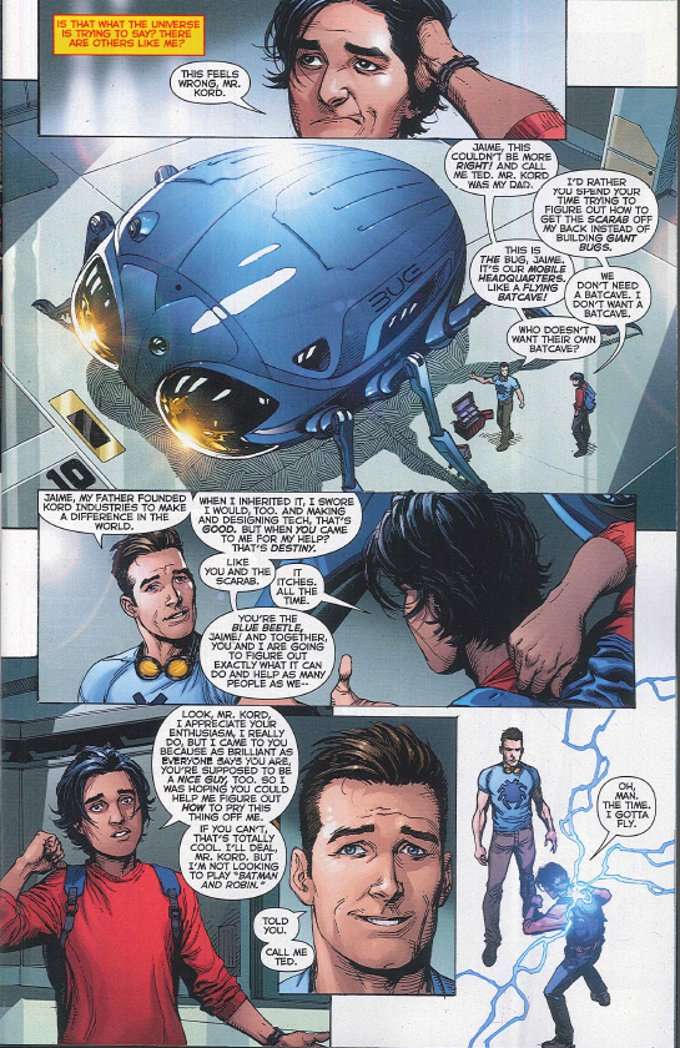
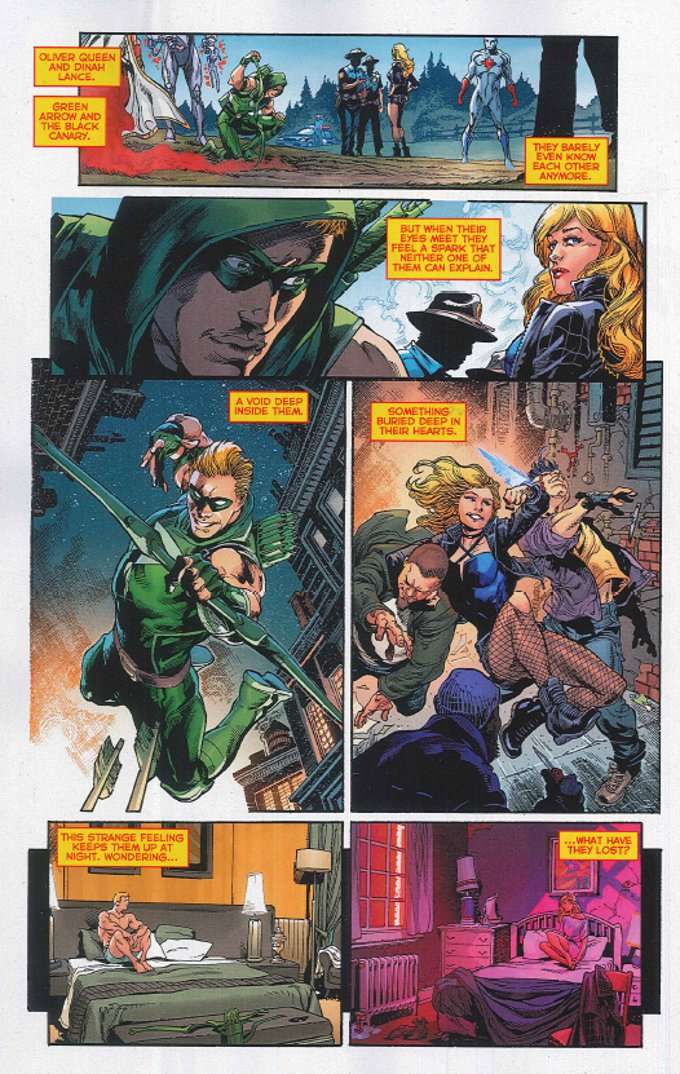
Showing posts with label Gary Frank. Show all posts

Thursday, December 28, 2017

Doomsday Clock #2 - A Review

Desperately seeking Doctor Manhattan, who he thinks may be the only person capable of saving his world, Ozymandias has devised a mean of tracking his former ally. With the new Rorschach in tow, along with the criminal duo of Mime and Marionette, Ozymandias makes the journey into another universe - one that is foreign to him but well-known to us... 


"Nostalgia. They don't make this anymore."

That sentence, more than anything, seems to sum up Doomsday Clock to date. Thus far the story seems to be little more than the mechanism through which Geoff Johns can get a paycheck for his Watchmen fan fiction. It's well-written, as far as fan fiction goes, but there doesn't seem to be any finer artistic point behind the story so far - all theories regarding how this ties into the foundation of the current DC Comics timeline aside.

It must be said that Gary Frank and Brad Anderson do put on a fantastic show illustrating it all. Though very little seems to be happening in terms of an overall plot, what action exists in this issue is well-handled and laid out well in the classic nine-box grid pattern utilized so well by Dave Gibbons. All in all, the execution of this issue is competent but one still wonders if there's any higher purpose other than giving Alan Moore one more reason to lay a death curse upon the management of DC  Comics.

 The Final Analysis: 6 out of 10. Fantastic artwork but the story seems rudderless so far.

Wednesday, May 25, 2016

DC Universe Rebirth #1 - A Spoiler-Free Review

The cynic in me chuckled at the first page of DC Rebirth #1. First page of a new book meant to revamp the whole of the DC Comics Universe (again!) and - in theory - bring in new readers looking for an entry point, and what do we start with? An editorial note saying we should read Justice League #50 and Superman #52 before reading this issue.

 After that, the cynic didn't laugh once.


This book is good. Damn good. An all-star line-up of artists make every page poster-worthy. Textually and metatextually, the conceit at the center of this issue's story is brilliant. It is a great story, told by the perfect narrator to explain just what went wrong with the DC Universe as it is now.

Once the dust is settled I will do a more in-depth review, discussing what worked about this issue in detail. Right here, right now, I will say only this. Rebirth is the shot in the arm that DC Comics needed and the future is looking bright indeed.


I still have some reservations about what is to come. And the cynic does wonder if the various editorial teams will manage to hold to the vision of love and legacy that Geoff Johns put forth in this issue. But I have hope after reading this book that things will improve. And that is something new.

DC Rebirth #1, as a single story, is a good one. It's a love letter to everything I love about DC Comics and a renewal of many of the things we've been missing. And even if you're not a DC fan... in fact, especially if you're not a DC fan...you should check this issue out to get a sample of what we've all been missing.

Monday, July 1, 2013

Justice League #21 - A Review

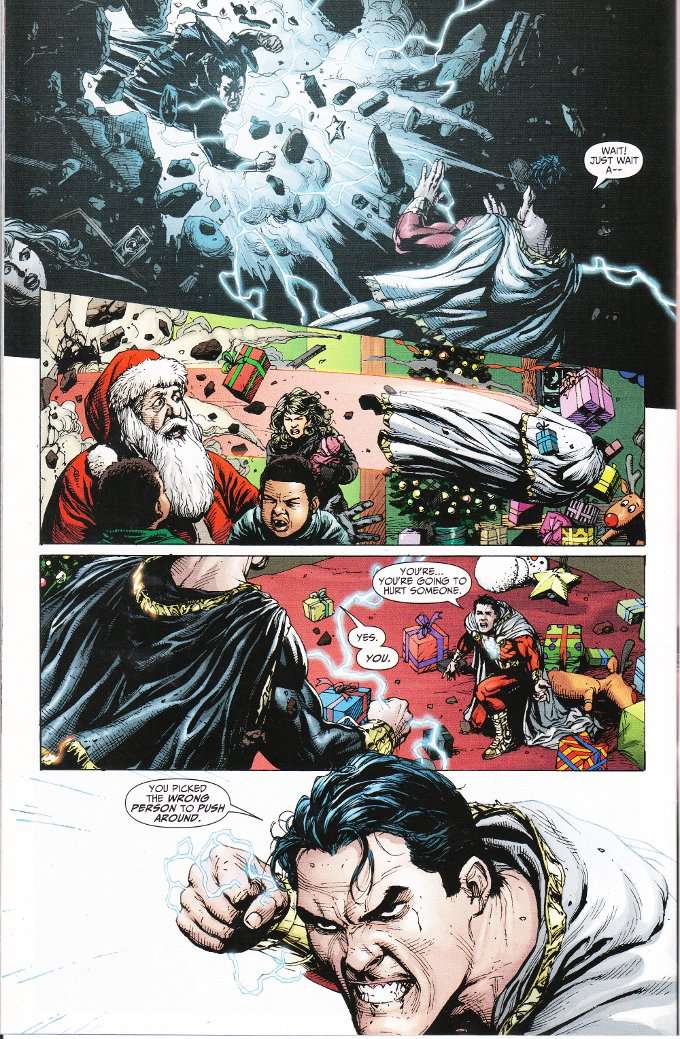
Justice League #21 is entirely devoted towards Shazam, wrapping up the origin story for Billy Batson in the New 52 Universe.  There is little I can say about this issue without spoiling it - and one of the biggest surprises in recent memory.  Suffice it to say my attitude towards this revamp has done a 180 and I would gladly buy a monthly Shazam series if Geoff Johns and Gary Frank were the creative team.


What prompted this change?  Oddly enough, it was a combination of one inspiring moment in this book and my thoughts on the Man of Steel movie and what characters mean to different people.  I had always associated the character of Captain Marvel and Billy Batson with the honesty and innocence seen in stories such as Kingdom Come and the Clash episode of Justice League Unlimited. Yet on reflection, I found that all of the appearances of Billy Batson in the comics that I liked (chief among them Geoff Johns' JSA) depicted a character who was idealistic despite lacking any illusions of the world being a fair place!  Looking at this issue, I realized that the defining characteristic of Billy Batson isn't innocence - it's optimism.  And there's a world of difference between the two.

Likewise, Billy's role is not that of the wide-eyed innocent.  He is the dream come true of every little guy held down by someone bigger.  He is every person who was ever bullied and wished, if only for a second, that they could turn the tables.  Curious then that so many of his enemies (indeed, all but one in this story) are victims of bullying who ally themselves against Billy due to their jealousy of what he is.  Dr. Sivana is a geeky scientist who longs for the magical power Billy inherited.  Black Adam is an ex-slave who fears losing what power he has now that Billy has replaced him as a magical champion.  Even Mister Mind is a victim of size-discrimination in a way.


I think now that restraining this story as the back-up to Justice League hampered it unfairly.  Given an entire issue to shine, it does just that.  The artwork is as amazing as one would expect from Gary Frank.  Geoff Johns' script inspires and entertains.  Hopefully the whole story will be collected in one volume by itself without The Justice League getting in the way. 

Friday, June 14, 2013

Superman: Secret Origin - A No Flying, No Tights Review


Over the past decade, many comics-reading pundits have cracked-wise about DC Comics retelling Superman’s origin story every year, like clockwork. Surprisingly, this is only a slight exaggeration and somewhat ironic given that Superman is one of the most widely recognized characters in all of fiction with an equally well known origin. What possible benefit could there be to retelling a story everyone already knows? Ah, but storytellers do like to put their own spin on things and Geoff Johns certainly does make the story of Superman his own in the ironically titled Superman: Secret Origins.

There are no sweeping changes made in this tale. There’s no revelation that the people of Krypton resembled giant glowing donuts and that a young Kal-El was surgically altered to resemble the people of Earth. Kal-El is still raised as Clark Kent in Smallville, finds his first love with a red-haired Lana Lang, grows up to become pals with Jimmy Olsen, develops a friendly rivalry with Lois Lane, and works at the Daily Planet in Metropolis. Where Johns changes things is by getting to the heart of the characters and looking at the familiar established events from a new perspective.

For instance, the analogy between Clark Kent discovering his powers and undergoing puberty has been made before (Indeed, Johns has Clark discovering his heat vision after his first kiss from Lana Lang) but this is the first Superman origin story I’m aware of which effectively conveyed the angst a teenage Clark Kent must have experienced upon discovering his alien heritage. It stands to reason that Clark Kent would feel even more awkward than the average teenager, doesn’t it? As teens, nearly all of us felt like a freaks who didn’t fit in, so imagine finding out that the way you felt was the literal truth?

Imagine finding out that you aren’t human? That you really are different than everyone else? How would you react? How could you react? Johns answers this question perfectly and gives Jonathan Kent an equally perfect response as Clark howls to the heavens that all he wants is to be plain ol’ Clark Kent.

This scene is also referred to by David S. Goyer in his introduction to this book. A frequent collaborator of Johns’ and no mean writer himself, Goyer is perhaps most famous as the writer of all three of Christopher Nolan’s Batman movies. Goyer claims he never thought it possible to tell a truly modern Superman story until he read this one, citing the aforementioned scene in specific as the “aha” moment. One wonders how the upcoming Man of Steel movie – which Goyer wrote – will compare to this graphic novel and how much direct inspiration it may have offered.

Johns’ excellent script is matched by the equally excellent artwork of another frequent collaborator – artist Gary Frank. Frank’s design of Superman borrows heavily from the appearance of Christopher Reeve, capturing not only the general look of Reeve’s face when he smiled, but also the many subtle aside expressions Reeve made when the Clark mask was dropped and Superman shined through for a second. Frank’s designs for the other characters are equally insightful, but Frank is more than just a good caricaturist. He’s also a wonderful visual storyteller with an amazing aptitude for conveying motion and action.

DC Comics rated this series T for Teens 13 and Up and I believe that rating to be a fair one. There’s no language apart from the very occasional ‘damn’ or ‘hell’ and no sexual content apart from some passionate kissing, a little innuendo, and Lois Lane pulling a pink lacy bra out of her desk – much to Clark’s embarrassment. There is a fair bit of violence and blood, particularly as Lex Luthor performs the surgery to turn soldier John Corben into a living weapon against Superman, but nothing inappropriate to a teen audience.

Superman: Secret Origin
by Geoff Johns
Art by Gary Frank
ISBN: 9781401226978
DC Comics, 2010
Publisher Age Rating: T (13+)

Monday, May 27, 2013

Justice League #20 - A Review

 Justice League #20 is something of a mess, in terms of both story and artwork.  Reportedly, the main story was laid out by one man and then illustrated by three different pencilers and three different inkers.  Art by committee works even less often than writing by committee and it really doesn't work here.  Even accounting for the differing styles at work, everything looks horribly uneven.


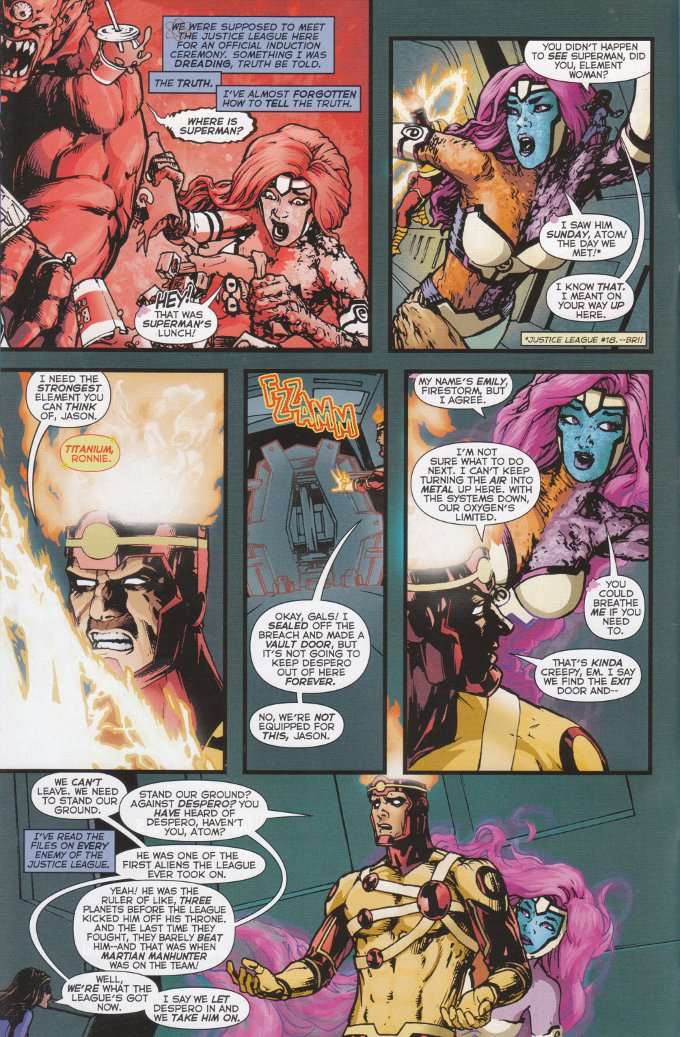
The story by Geoff Johns, focusing primarily upon the newest members of The Justice League as they fight the telepathic powerhouse Despero, isn't much better.  Johns does his best but the underdogs fighting outside of their weight class story has been done to death.  Not helping matters is that much of the "charm" of this issue depends upon your enjoyment of the flighty bimbo that is Element Woman or the continual squabbling of the two teenagers who make up Firestorm.  And given that Fury of Firestorm was cancelled this month, it appears that the vast majority of comics fandom find the antics of Ronnie Raymond as tiresome as I did when they played this exact same conflict out during Brightest Day

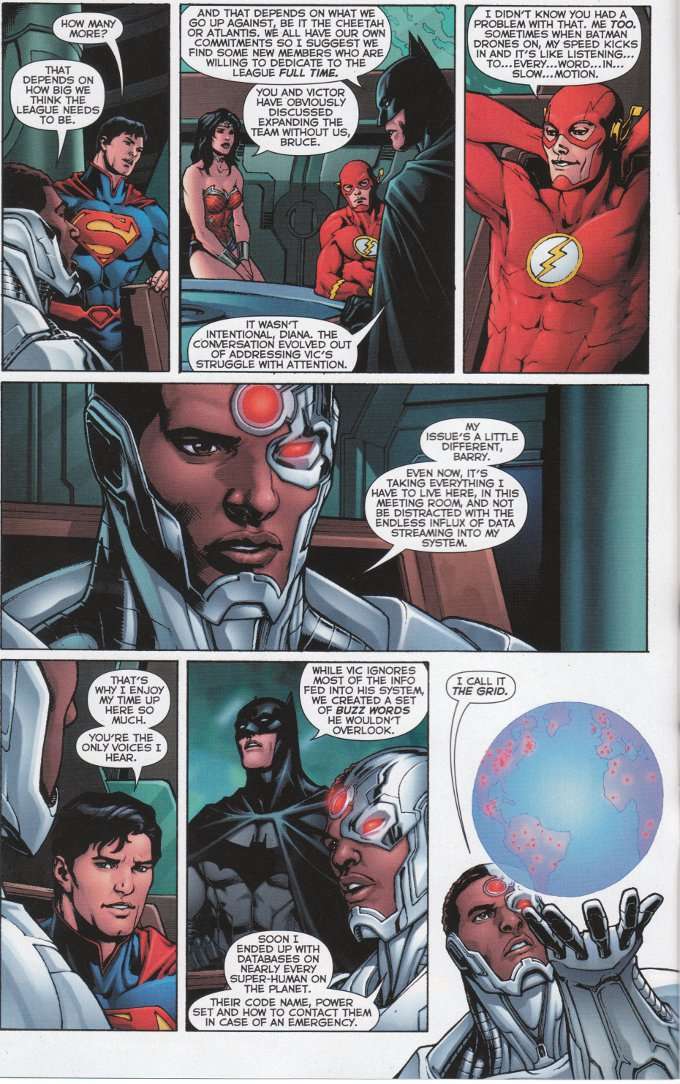
There's only two things that save this comic at all.  The first is the Shazam back-up story, which finally seems to be gaining some legs or maybe I'm just viewing it more sympathetically now that Billy Batson is beginning to act like the hero he should be.  The other bright side in all this is a scene involving several of the Justice League founders and Superman having a talk with Batman about his creation of protocols to take down every other member of the Justice League... including himself. 


This book seriously needs one artist, one inker and one person deciding its' look.  The multiple teams working on the main story this time around do not work well together.  And Johns would do better to develop his new characters alongside the established crew for a time rather than throwing them all into a spotlight that none of them deserve yet. 

Wednesday, April 24, 2013

Justice League #19 - A Review

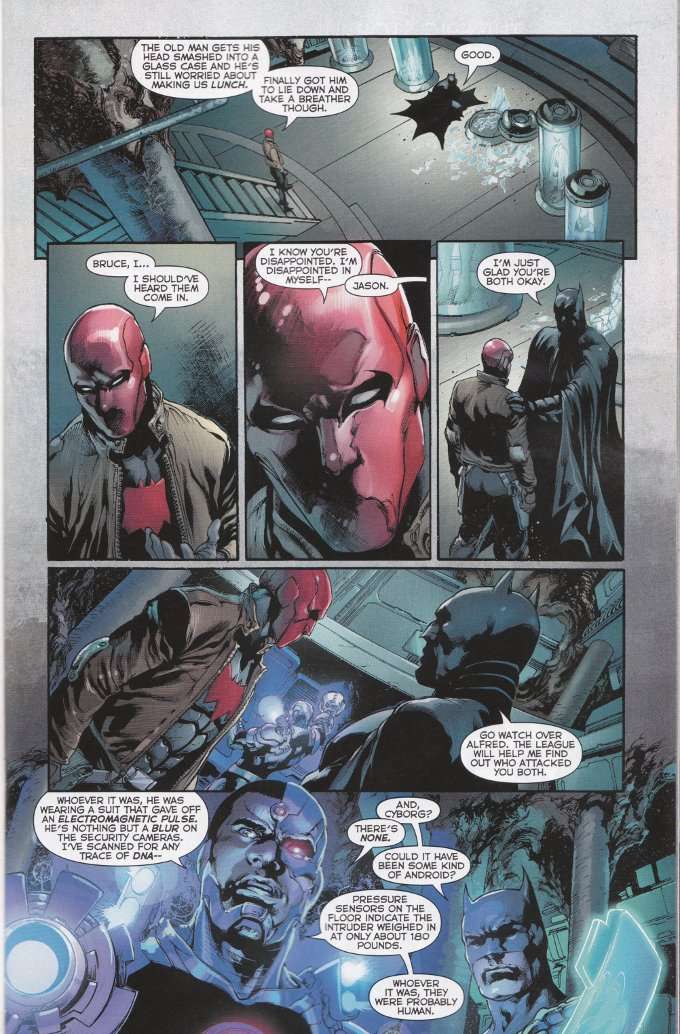
It is a credit to Geoff Johns' skill as a writer that he manages to do in two pages what Scott Lobdell and Judd Winick failed to do in two years - make Jason Todd into a sympathetic figure.  This is perhaps the most minor of the subplots we see in Justice League #19 yet it is perhaps the most compelling.  It's certainly more interesting than watching Ronnie Raymond and Jason Rusch arguing with one another (honestly, didn't we get enough of this in Brightest Day?) or the revelation that the new Atom can use her powers to play her favorite MMORPG from the inside... I think.  That sequence isn't particularly clear, though it is a nice nod to the old Sword of The Atom series.


The actual meat of the issue is more enjoyable, with Batman coping with a burglary in the Batcave that bodes ill for the entire team and Wonder Woman encouraging Superman towards a more proactive approach to crime-fighting.  There's a lot going on here and Johns is no doubt setting things up for the upcoming Trinity War storyline.  Thankfully, he does a good job keeping his ducks in a row.  I just wish he hadn't bothered with some of the story-lines that do little to develop the already well-established characters.

Ivan Reis continues to flourish as the series' new penciler, despite being somewhat crippled by a team of three inkers.  Does the book look bad?  No, but you can tell that three different artists were handling the inking duties.  There's little sense of continuity and cohesion visually.  Any who doubt the power of an inker to completely change the feeling of a penciler's work would do well to check out this issue.


I shan't bother offering my two cents on the Shazam back-up anymore.  You all know what I'm going to say at this point and I'm sick of saying it, over and over and over again..  Johns' script is good, but I loathe the new take on Billy Batson, who doesn't feel at all like he should.  Gary Frank's art is far better than the story deserves.  They had to call this Shazam because this mess sure isn't Captain Marvel.  Blah blah yakkity smackity. 

Tuesday, March 26, 2013

Justice League #18 - A Review

It is an odd thing that Justice League #18's greatest strength is also its' greatest weakness.  The early scenes where the core members of the Justice League are discussing recent events and their need to expand the team in the wake of some extensive disasters are well-paced character-building moments.  Yet the later scenes - where the potential recruits are brought in to mix and mingle with the team - seem rushed and forced in comparison.  There are too many players on the stage in this moment and it proves beyond even Geoff Johns' ability to balance a large ensemble to manage these moments. 


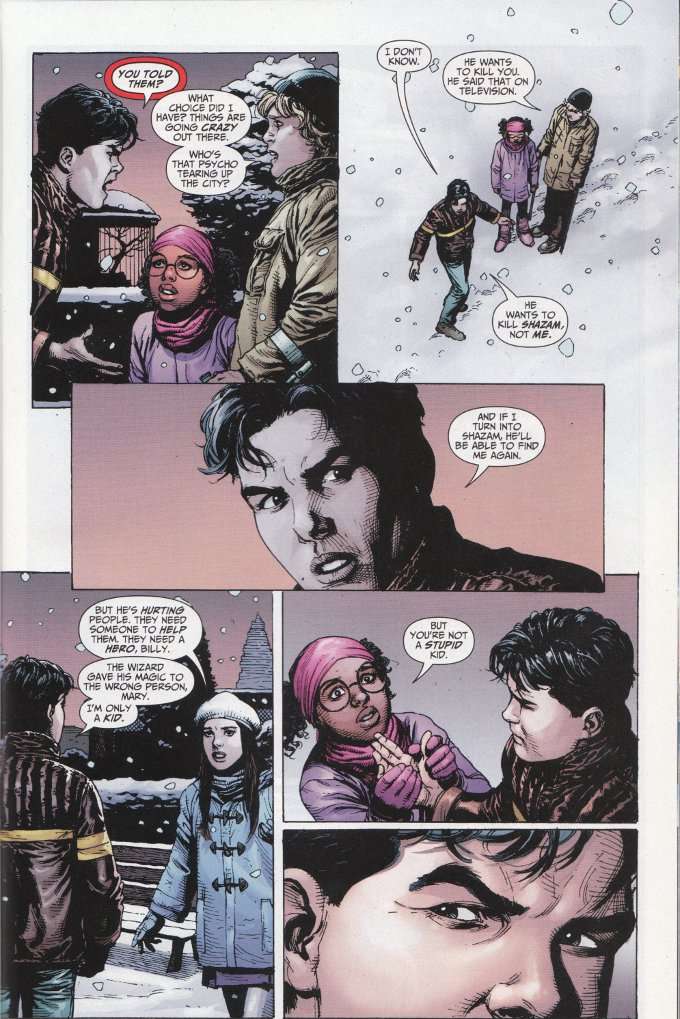
The back-up story involving the origin of Shazam continues to limp along.  I'm still not fond of this revamp of the classic Captain Marvel concept but there are some good moments here - chief among them the scene where Billy's foster brothers and sisters go searching for him to offer an encouraging word.  I wish Johns would decided on a tone for the series at large, as the opening scenes with the villainous rich man Mr. Bryer are far too melodramatic to be taken seriously in anything other than a classic Captain Marvel comic yet the general tone of the series has been darker and grittier. 


While I may grouse about the stories, I cannot complain about the artwork.  Everything here looks gorgeous.  Gary Frank makes Shazam appear far better than it has any right to.  And Jesus Saiz, who illustrates the Justice League section of the book, deserves to be assigned to one title rather than doing fill-in jobs on a variety of books.

Sunday, February 3, 2013

Justic League #16 - A Review

Ocean Master has always had a rough time of it as a character. It's bad enough being an Aquaman villain to begin with.  Imagine being a bad guy whose sole motivation is being jealous of Aquaman's superpowers.  That was Ocean Master back in the Silver Age.  He was Arthur Curry Sr's son by a human woman.  No powers.  No resources.  Just a burning hatred for the bastard half-brother who got superpowers while you didn't.  Things weren't much better in the Dark and Modern Ages, where he was a thinly-veiled Loki rip-off  with vague magical powers fueled by a demonic trident.

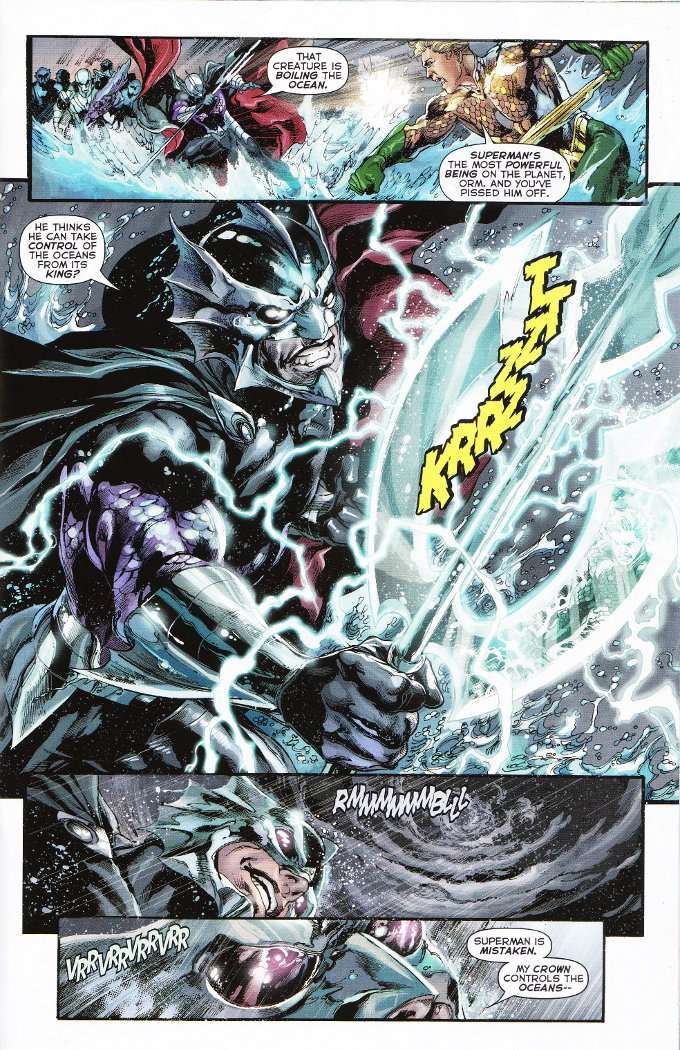
Geoff Johns has changed this all yet again in the New 52 reality but this time he has created an Ocean Master worthy of the name.  No petty criminal or scheming courtier this time!  This Orm, now Aquaman's half brother by the same Atlantean queen, is a credible threat even without the might of the Atlantean army backing him up.  With defined magical powers that let him influence both water and the weather, this Ocean Master proves menacing enough to hold the heaviest hitters of the Justice League at bay single-handed!  We're left with the impression that Aquaman's pleading for an end to the fighting is less out of a desire for peace but more from an honest fear he may not be able to stop his brother if things come to a head.  


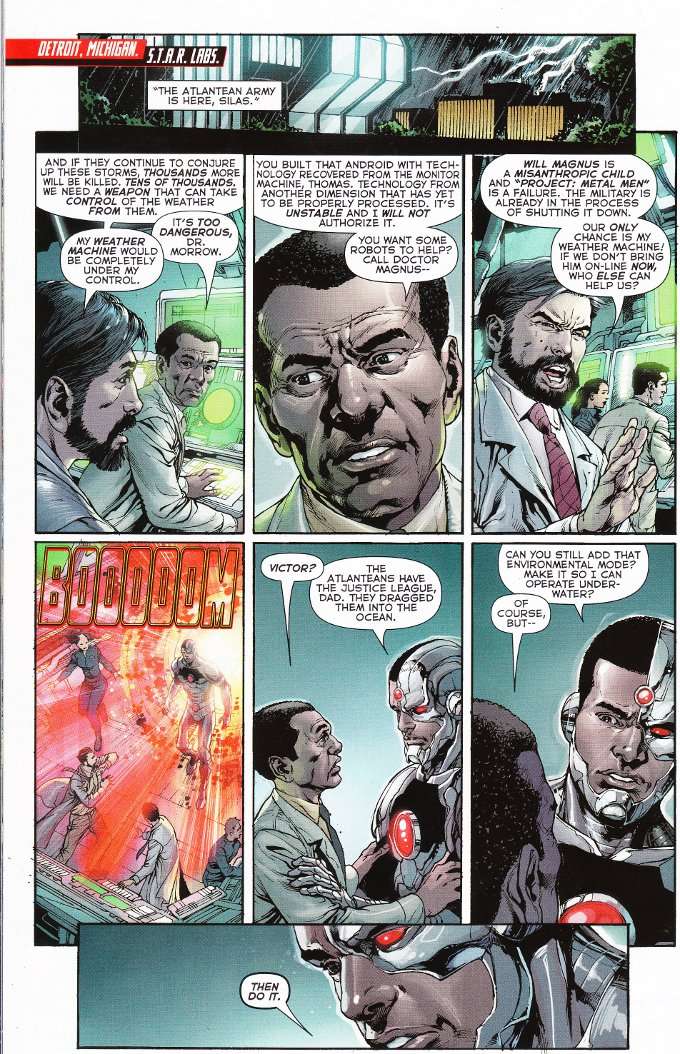
Johns has a gift for taking these classic concepts and redefining them and it's one of the things I find most enjoyable about his writing.  The other thing that makes Johns brilliant as a storyteller is the way he manages to work such wonderful character moments into his stories while hinting at things to come.  A good example of this comes in a brief interlude at S.T.A.R. Labs, where a certain Dr. Morrow is monitoring the Atlantean controlled-weather attacks and asks permission to test a robotic weather-control machine he's been working on. 

Longtime Justice League fans will appreciate the reference but everyone will appreciate the scene in which Victor Stone a.k.a. Cyborg confronts his father about upgrading his body to allow him to breathe underwater.  The on-going conflict regarding Vic's fears of losing his humanity as more and more of his body is replaced with mechanical parts has barely been touched upon in recent issues, save for occasional scenes of Cyborg refusing to discuss a newly developed upgrade.  It says volumes in this moment, when his superhero colleagues are in need, that Vic is willing to put all his fears and objections aside for the sake of his friends.  THAT is heroism in a nutshell as well as why Geoff Johns is one of my favorite writers.    


The artwork in this issue is excellent, as always.  Ivan Reis offers up the same breath-taking pencils that made his recent run on the main Aquaman book so memorable.  Everything is beautiful and this is one of the best-looking books on the shelves today.  Gary Frank is equally amazing in the Shazam back-up story.


The Shazam back-up story - long the millstone around this book's metaphorical neck - didn't bother me as much this time around.  I suspect it's because Billy, for all of his petty acts of crime in the past issues, finally began to act like the hero I expect him to be in this issue.  I think I'll be able to live with this new take on (not) Captain Marvel if things continue in this manner, with Billy taking his power more seriously and realizing what he can do to help people besides himself.

Sunday, December 30, 2012

Justice League #15 - A Review

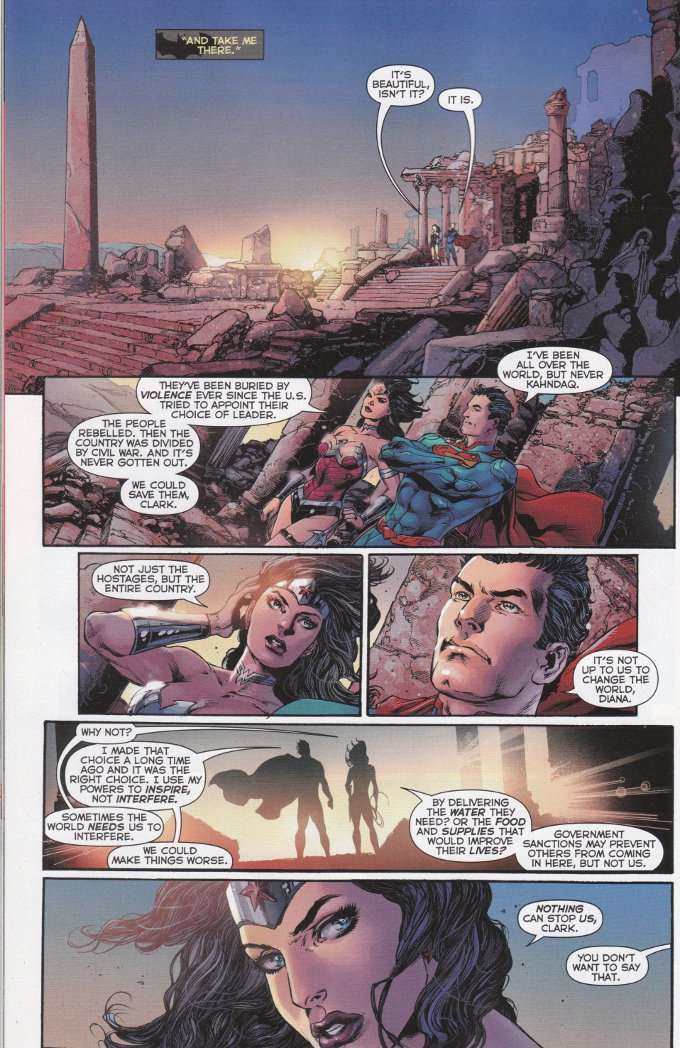
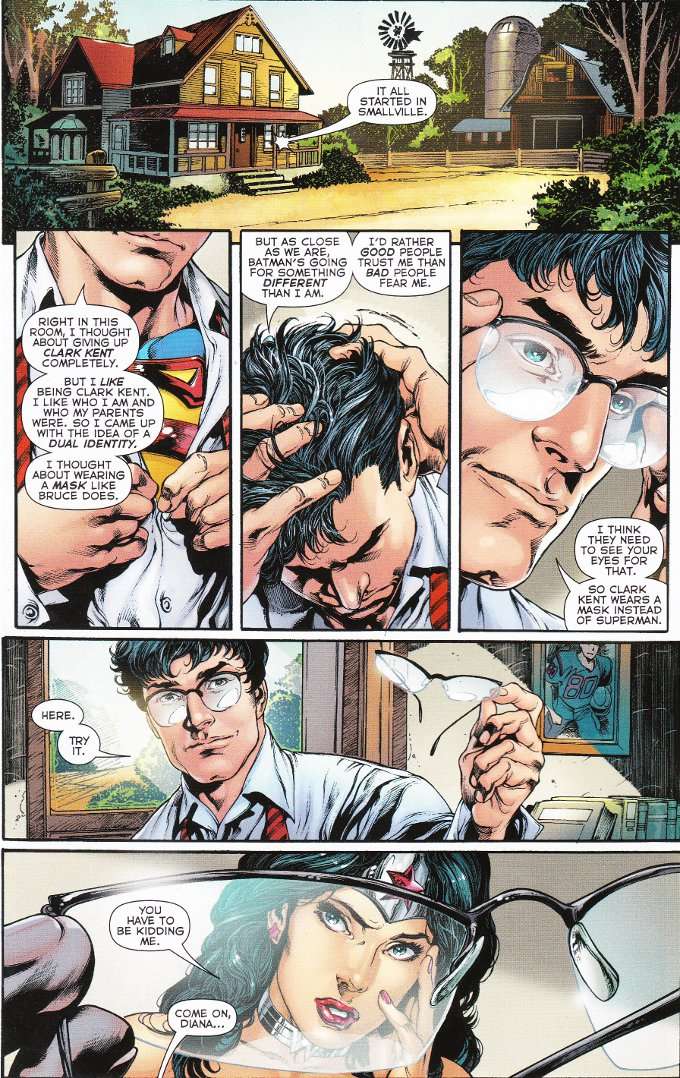
Justice League #15 kicks off the long-awaited Throne of Atlantis crossover between the Aquaman and Justice League titles.  Yet for my money, the best parts of the book have little to do with the crossover and everything to do with the people behind the costumes and superpowers.  Take for instance the page below, which has done far more to define Clark Kent as a character than anything I think I've seen in any other book in the New 52 so far.


It's the little moments like this that have made author Geoff Johns beloved as a writer and made this title worth reading, though it was far slower to get going than many would have liked.  The backbone of the issue is found in scenes such as this, the scene where Cyborg talks with his father and even the scene where Aquaman and Batman team up to take on several of The Scarecrow's minions.  But don't think for a second that doesn't mean the action-packed moments aren't good too.  Far from it!  And Johns' plot involving an Atlantean invasion of the surface world offers excitement aplenty to go with the fine character scenes.


The artwork by Ivan Reis and Joe Prado - most recently seen on Aquaman - can be summed up in only one word.  Phenomenal.  Reis has an amazing eye for detail  and Prado knows when to merely outline Reis' pencils and when to shade them heavily.  Reis is also a good visual storyteller, whose panels flow naturally and easily even on the two-page spreads.

I wish I could praise the Shazam back-up story as highly.  The artwork by Gary Frank is as wonderful as Reis's work but the base concept of Billy Batson as a juvenile delinquent leaves me cold.  It doesn't add anything to Billy as a character to make him a smart-ass punk.  Indeed, his basic decency and inherent nobility was one of the things that set him apart from other teen heroes in the past.


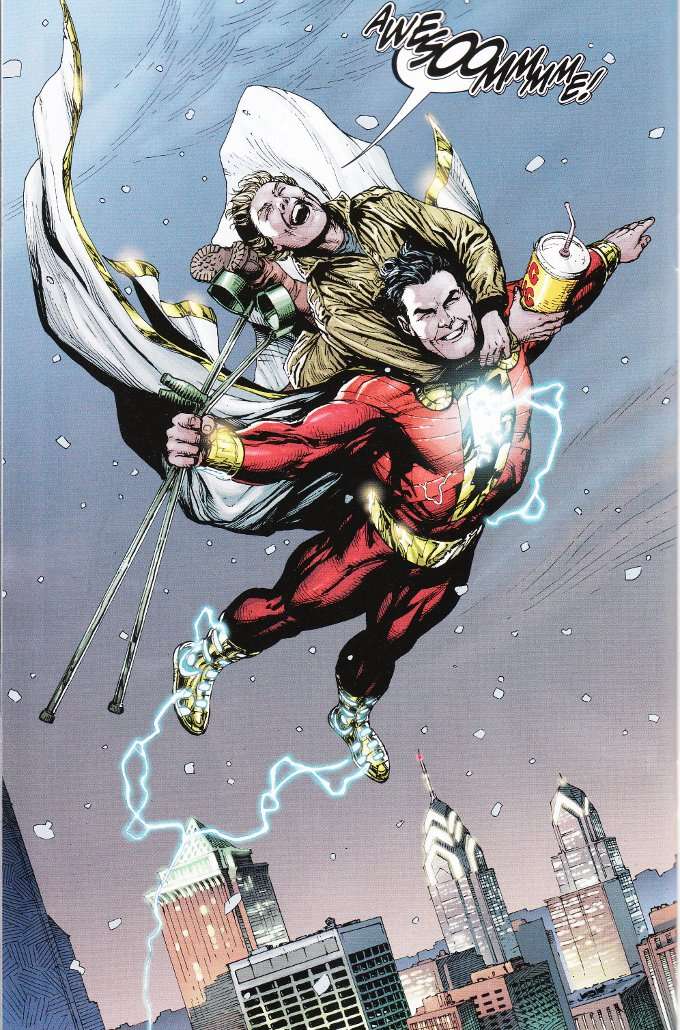
Incidentally,  whatever happened to The Wisdom of Solomon that's supposed to warn Billy away from being dishonest or foolish?  I can't help but think it must have gone the way of Wally West and Donna Troy, since the plot of this story is dependent on the "hilarity" that ensues after Billy uses his powers to hack an ATM so he can get the money to buy beer.  There are some brief moments worthy of the Captain Marvel legacy, such as Billy and Freddy's joy at discovering that Billy can fly but these moments are too brief and too few in number.

This issue is worth picking up if you haven't given Justice League a shot before now.  But do yourself a favor and skip the back-up story.

Monday, November 26, 2012

Justice League #14 - A Review

First, a correction.  In my review of the last issue of Justice League, I took issue with a part of the new origin for the villain The Cheetah.  Specifically, I took issue with how the comic said that she was empowered after cutting herself on a knife recovered from a tribe in the Amazon Jungle and became possessed by a goddess of the hunt.  I asked why, if she had been empowered by a South American goddess, she had taken the name of an African predatory cat. 

What I missed was that the jungle the team journeyed to at the end of the comic was in The Congo - not The Amazon.  Further, this issue does explain how this knife - dubbed The Godslayer - had been used in Africa to bind one hunter goddess/cheetah spirit and made its' way to South America, where it wound up in the possession of the aforementioned Amazon tribe.  My apologies to Geoff Johns for the error.

Now that that's said, on with THIS issue... 
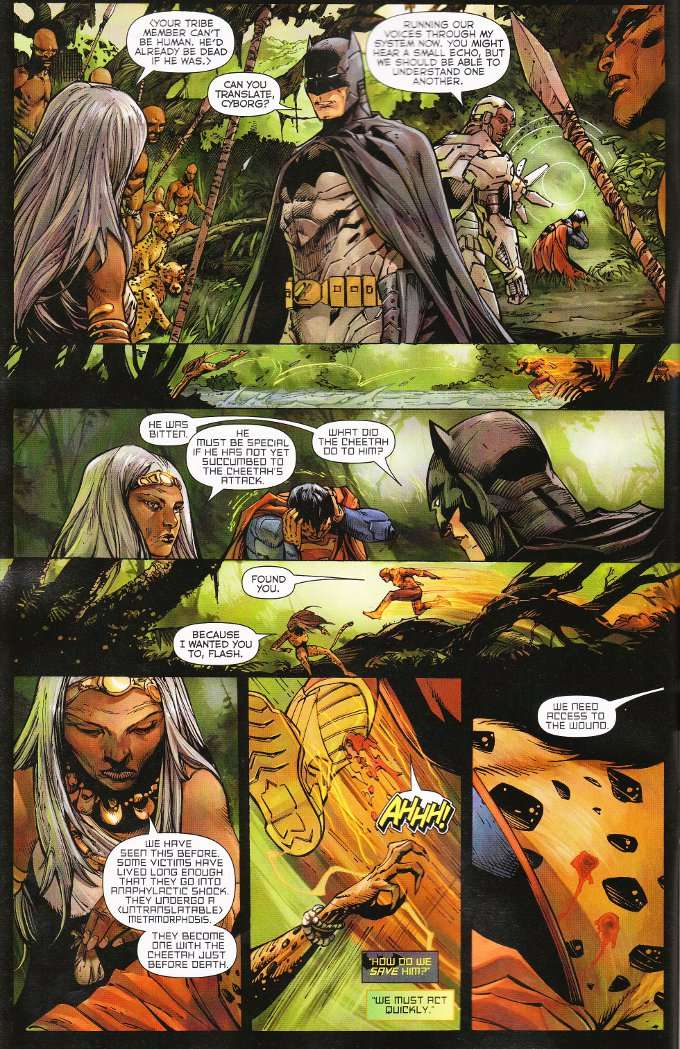


Justice League #14 offers a lot of material I wish we'd seen in this title sooner.  Still, there's no point in crying over what should have been done earlier.  The fact of the matter is that, for the first time in a long time, this book did more right than it did wrong.

The first half of the book focuses upon our team as they have to cope with the dual threat of The Cheetah running loose and a magically poisoned Superman growing ever-closer to death.  There's a lot of nice little touches here, but three stand out for me in particular.  First, the conceit of having Superman be the teammate placed in danger and - for once - through means other than a piece of Kryptonite is a novel one and really helps to sell the drama.  The second is Johns' use of Cyborg, whose powers are used in a uniquely creative fashion.  (At least I've never seen Cyborg act as a universal translator before!)  Finally, there is Aquaman's brief, wordless moment of awesome in which Johns once again showcases how Aquaman's powers are far from useless.

I think I like Tony S. Daniel more as an illustrator than I do as a writer.  His depiction of The Cheetah and her jungle realm is appropriatlye savage and would not look out of place in a Tarzan story.  He also does well with the more mundane scenes later in the second half of the book when we get to the other major subplot in need of resolution.
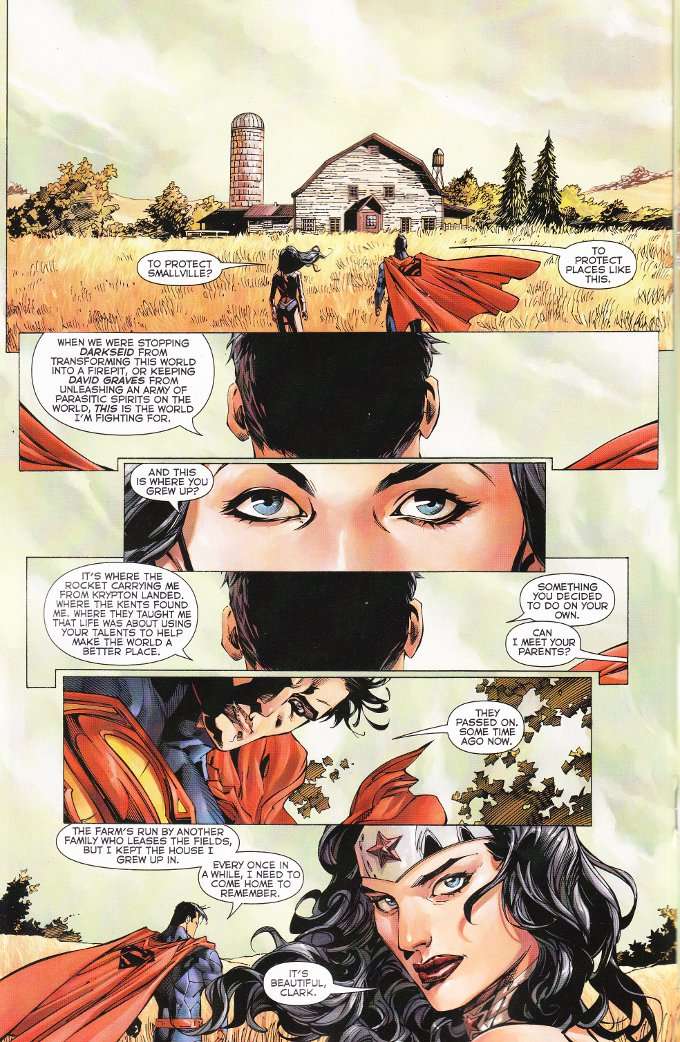


One big complaint that many DC Comics fans had about the declaration that Superman and Wonder Woman were now a couple lay in how sudden the declaration was made.  There was no build-up in Justice League to suggest such a thing was happening - no hint of romance or even a suggestion that the two viewed one another as anything but teammates.  While it may be too little, too late, the second half of this book is  a step in the right direction.  It focuses upon Superman attempting to show Wonder Woman who he really is - not in the sense of his secret identity but by showing her places that are important to him and taking her to do things that remind him of the people they are protecting.  This is something that the Amazon Princess has never spent much time doing and it helps to emphasize the main difference between the two heroes.  Wonder Woman, first and foremost, is a warrior.  Superman, first and foremost, is a protector.  Both characters get some much needed development and the idea of a romance between the two seems a little less forced as a result.

Less enjoyable, however, is the back-up story featuring Shazam.  Or, as I'm quickly thinking of him in my own head, Sham-zam.  I had hoped we were done with these back-up stories after last month's excellent story involving Green Arrow and Steve Trevor teaming-up.  But it was not to be.

Thankfully, we see very little of Billy Batson this time around, save for a scene in which he and his cohort Freddy buy Billy a trenchcoat to cover up his costume and ponder how to spend the rest of the $20 they were given for saving a woman from a mugger.  Most of the story focuses upon Black Adam, learning something of how the world has changed since he last walked upon it and further learning that some things have not changed.  Namely, the powerful still stomp upon the weak for their own glory, though the pharaohs now call themselves CEOs. 
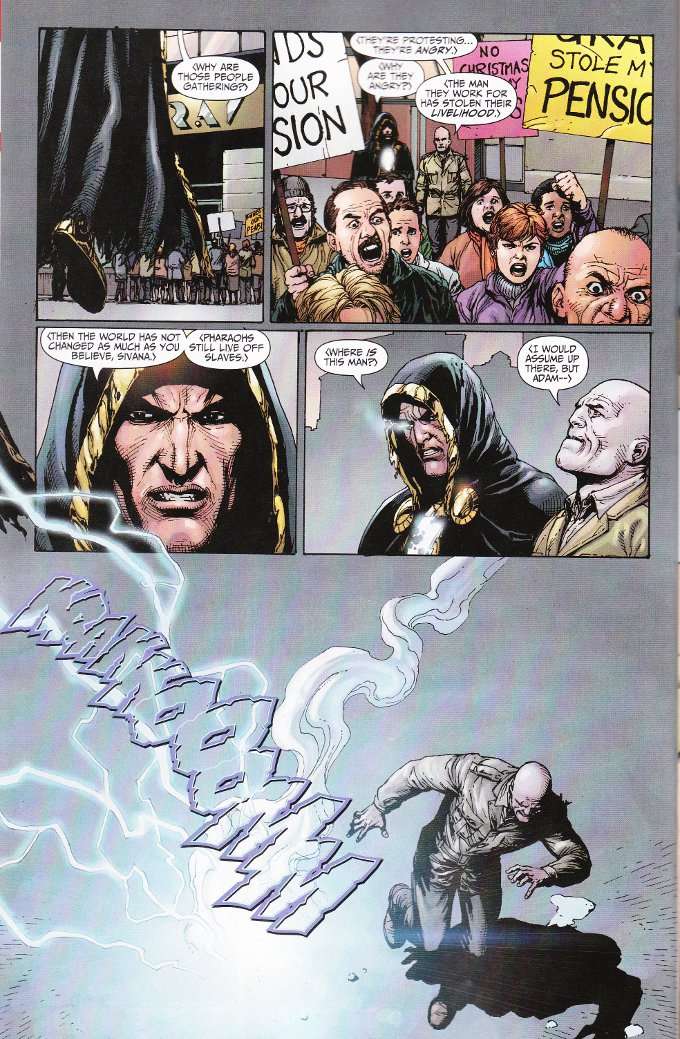

Is it wrong that I find myself cheering Black Adam in this story?   Should I NOT be rooting for him to slap some sense into Billy?  Because Johns' take on Black Adam so far seems to be exactly the same as how he wrote the character back in JSA and so far Black Adam has been the most heroic person in this book ignoring - you know - the whole dropping a pension-stealing CEO to his death thing.

Gary Frank's artwork is still uniformly excellent.  Indeed, I'd argue it's far better than this story deserves.  I'm hard pressed of a way to describe precisely why I find Frank's work so good.  Like the old saying says, I don't know much about art but I know what I like.  Well, I do know a bit about art and I like this.  So take that for what it's worth.

All in all, this book is definitely worth your four bucks.  I had been on the fence about it for a while but for now I'm in, if only to see what Johns does with his upcoming crossover with Aquaman.

Saturday, October 13, 2012

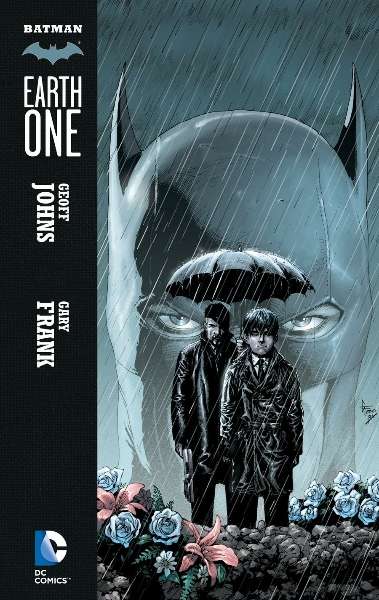
Batman: Earth One - A No Flying, No Tights Review

SOURCE: Batman: Earth One


The back cover of Batman: Earth One proclaims “YOU ONLY THINK YOU KNOW HIS STORY.” Surely, this is simple advertising hyperbole?! The origin of Batman is one of the most well-known superhero stories in the world. Indeed, it may be the most well-known superhero origin story ever. Certainly it is one of the most retold superhero tales, having been explored in graphic novels by Len Wein (The Untold Legend of Batman) and Frank Miller (Batman: Year One) as well as in films by Tim Burton and Christopher Nolan.

Riddle me this — who could possibly put a unique spin on the Batman mythos at this point? Why, none other than Geoff Johns, the same writer who revitalized the Justice Society of America for a new generation of comic readers and rebuilt the Green Lantern mythology from the ground up. The story Johns tells in Batman: Earth One is unique, not because of The Batman himself, but because of the personalities around him.

By way of a for instance, let us consider the character of Alfred Pennyworth – Bruce Wayne’s loyal butler and chief cohort in the fight against crime. Some Bat-fans my age may vaguely remember that, in an episode of Batman: The Animated Series, Alfred was suggested to be a former spy.  The truly dedicated may remember his origin from the comics, depicting Alfred as an aspiring actor who agreed to become a butler due to a deathbed request.

Johns borrows a bit from both of these ideas, creating something that is paradoxically original. The usually paternal Alfred Pennyworth is gone, replaced by a soldier who has little inclination or aptitude for raising a child. Johns’ Alfred is a former Royal Marine, security expert, and old army buddy of Thomas Wayne, who is surprised to find himself called to duty, first as head of security for his old friend’s mayoral campaign and then as a guardian for Bruce in the event of Thomas Wayne’s death.

Alfred is far from alone in being presented as a completely different person. Jim Gordon, Harvey Bullock, and Oswald Cobblepot are also among the many characters long-time Bat-fans may expect to see and be utterly surprised by. Barbara Gordon is also a part of this tale, but, Batgirl fans will be pleased to note, she is far from being a background character and there are hints of the hellraiser she is to become.

The art by Gary Frank is excellent, but his Batman design deserves special attention. This is the first Batman story in any comic in recent memory where I can recall Batman’s eyes being visible underneath his mask, rather than being whited-out or obscured by some type of lens. This may seem like a small detail but it makes all the difference – nearly as much as Johns’ script, which depicts Bruce Wayne as a competent fighter, but one utterly unequipped for precisely what this crusade will require. We get to see every bit of annoyance as his equipment fails, every bit of righteous anger as he confronts an evil doer, and even the brief moments of terror when he realizes he may be in over his head. This helps to do one thing that too few Batman artists or authors bother to do: humanize the hero.

Batman: Earth One is a must-read for all Bat-fans and a must-own for all libraries. There is some graphic content involving a serial killer who preys on young girls, but the artwork suggests far more than it actually shows. There is nothing in this book that would be inappropriate for the teenage audience it is written for.

Batman: Earth One
by Geoff Johns
Art by Gary Frank
ISBN: 9781401232085
DC Comics, 2012
Publisher Age Rating: T (13 )

Tuesday, September 25, 2012

Justice League #0 - A Review

I'd say that Justice League #0 is the greatest collection of false advertising and empty promises I've seen all year except for one thing - it's an election year in America.  But in all seriousness, this issue was an all-around disappointment.  There is no Justice League to be found here.  Instead we get the continuing misadventures of Billy Batson - #2 on the list of children I most want to see repeatedly slapped, just behind Joffrey Baratheon of A Game Of Thrones.


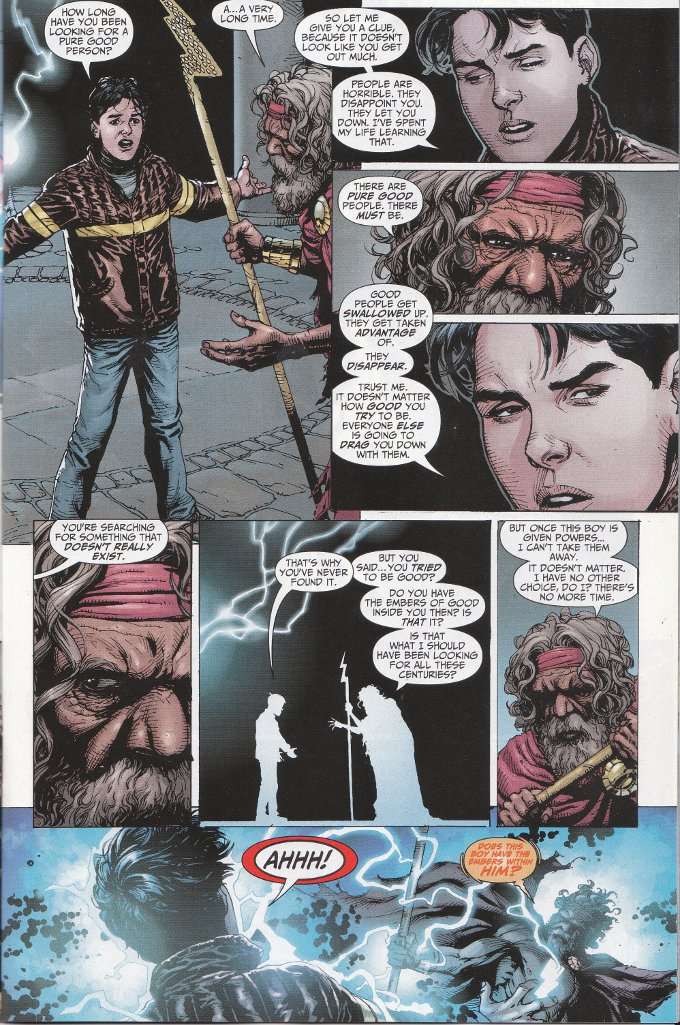
This issue finally brings us the moment we've been waiting for six months - when bratty Billy meets s wizard, who grants him magic powers by saying the word Shazam.  As hinted before, the wizard - like Diogenes - has been seeking a purely good and honest soul for quite some time.  But unlike Diogenes, he thought he actually had a chance of success.  Not surprisingly, being a mouthy jerk and petty crook, Billy fails to past the purity test.  But being a mouthy jerk, Billy points out that nobody is purely honesty and good - a fact that has somehow been missed by one of the wisest men on the planet for several thousand years.  This leads the wizard to test Billy to see if he has the potential to be good, decide "What the heck?" and give Billy his power just before dropping dead. 

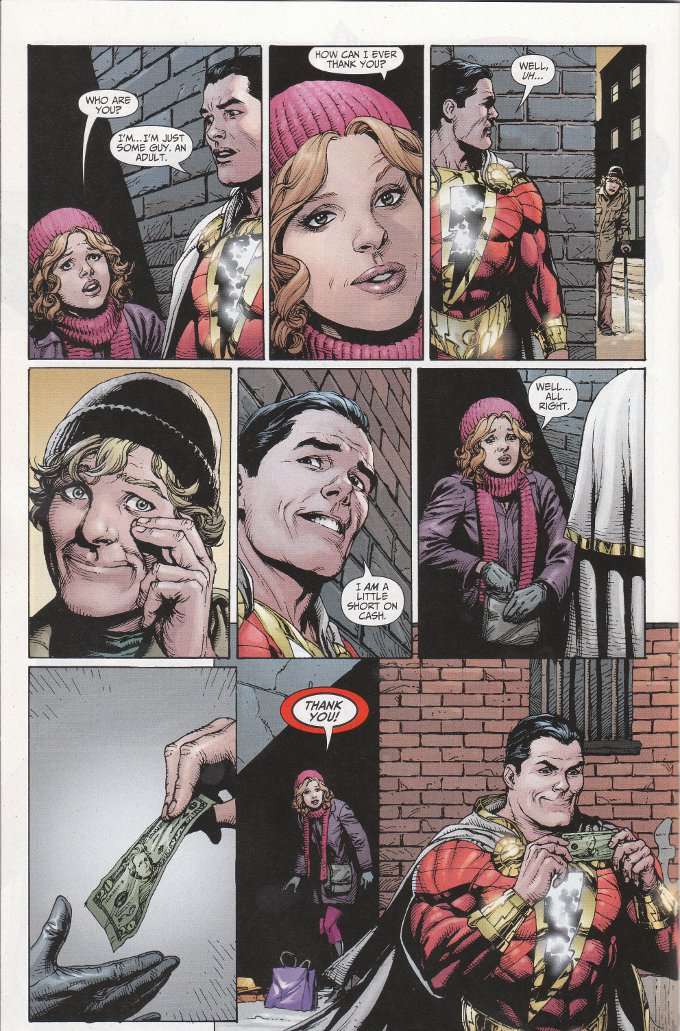
It takes Billy about three minutes to start abusing the holy gift he's been given.  He destroys the car of the local rich jerk and contemplates stealing a fancy new suit that is less conspicuous than his hooded cape and tights.  Thankfully, Billy does have scruples enough to step in after he and his foster-brother stumble across a mugger at work.  Unfortunately, those scruples stop just short of accepting payment from the woman he just saved.


To say that this story defiles everything Billy Batson & Captain Marvel represent would be an epic understatement.  I don't think they decided to have Billy go by the name Shazam because that's what most people outside of comics call the character anyway or because of the continual legal battles with Marvel Comics over the Captain Marvel name.  I think The Powers That Be at DC Comics decided to call this character Shazam because they knew there was no way in Heck that they could ever get away with trying to sell this character to Captain Marvel fans under the name Captain Marvel.

The only justification for Billy's retconned personality I can think of is the misguided belief that an idealistic young man granted power because of his pure spirit has no place in the modern DCU.  To see Billy acting the way he does in this issue is painful.  And to see Geoff Johns writing this story doubles that pain - partly because Johns put the idea that Billy Batson needs to be modernized and made more cynical to bed during his excellent JSA run and partly because - ignoring that Shazam is a betrayal of everything Billy Batson should be - Johns does pace the story well and deliver some good dialogue. 

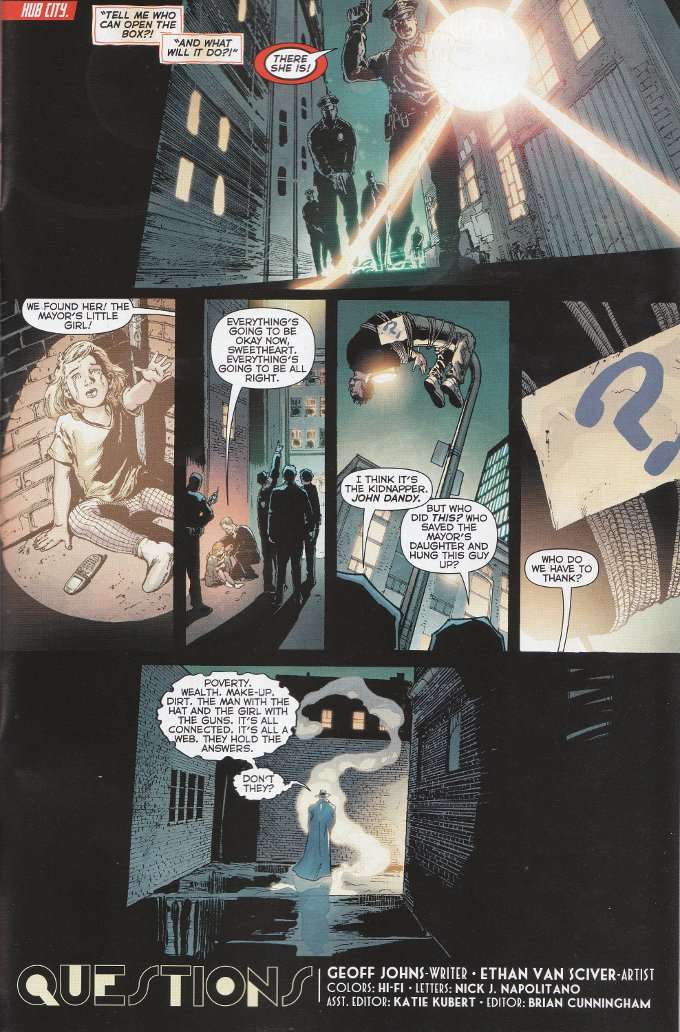
Thankfully, regardless of what I think of the story, the artwork is amazing throughout.  Gary Frank does a good job illustrating the Shazam story while Johns' frequent Green Lantern collaborator Ethan Van Sciver lends his talents to the back-up story.  This brief tale finally introduces us to the mysterious pink-cloaked woman who has been popping up around the New 52 universe as well as another classic hero we haven't seen before now.


Still, no amount of fine artwork can make this book palatable.  What matter that the face be pretty when the heart is cold and dead?

Billy Batson is supposed to be a decent kid in spite of his hard-luck life.  His positive attitude in the face of all the evils of the world is what leads to his being rewarded with the power to help others.  The character is all about the innocence of youth and the power of idealism.  Even Frank Miller understood that and didn't try to force Captain Marvel into a darker, grittier role when he wrote The Dark Knight Strikes Back.  And it was Billy who took Superman to task for being blinded by his hatred of Lex Luthor in the excellent Justice League Unlimited episode Clash Of The Titans


Let's end this review with some Wisdom of Solomon, shall we?

"I believe in fair play. I believe in taking people at their word, and giving them that benefit of the doubt. Back home, I've come up against my share of pretty nasty bad guys, but I never had to act the way they did to win a fight. I always found another way. I... I guess I'm saying I like being a hero, a symbol, and that's why I'm quitting the Justice League. You don't act like heroes anymore."

That's why I think I'll be quitting Justice League, too.  Nobody in it acts like a hero anymore.

Wednesday, July 4, 2012

Justice League #10 - A Review

I think, at times, there are two Geoff Johns writing at DC Comics and Justice League #10 lets us see them both at work.


Half of this issue reminds me of the Geoff Johns writing Green Lantern.  The Geoff Johns I remember from JSA and Hawkman.  This Geoff Johns was a master of characterization - a comic geek made good.  He knew the characters and loved to play them off one another, exploring the relationships between them. 

We see this Geoff Johns in the scene where The Justice League - still relative strangers after five years working together - discuss a new villain who is apparently fighting their greatest foes and attempting to learn their weaknesses.  The conversation winds up turning to how little they know about one another and how little trust there is between them.   This is, at the same time, hilarious and troubling.  Hilarious because of Johns' knowledge of the essential core of the characters and troubling because it is hard to believe that any version of The Justice League should be this unfamiliar with one another after five years.


This leads us to the other half of the issue and the writing of the other Geoff Johns.  The Geoff Johns writing Aquaman.  The Geoff Johns who, I am sad to say, we have seen a lot more of in recent months.  The Geoff Johns who is so busy trying to tell more than one story that he makes a muddle of things.  Ironically, it is in repressing his usual tendencies to write great dialogue and cater to the strengths of his artist Jim Lee that Johns turns the last few pages of this issue into an unreadable mess. 


Jim Lee is a good artist when it comes to detailed covers and action-packed splash pages but he's not - at least in this issue - a greatest visual storyteller.  Compounding this is the palette used by the coloring team of four artists, which does little to make the panels that are meant to be a flashback to the origins of new villain Graves and the panels that are set in the here and now distinct.

The back-up story involving the new Shazam continues to plod along.  Strangely, we see signs of the first Geoff Johns here in his dialogue between Billy and Freddie.  Sadly, even the finest Geoff Johns dialogue cannot hide the fact that - thus far - the new Shazam comic is sadly lacking in magic, both literally and figuratively. 

There are no superheroic exploits to be found here - only the tales of a bratty teenager who has been hurt too much by the world and the totally unrelated story of an obsessed mad scientist trying to open a door.  There is no correlation between the two halves of the story and it is, to be frank, dull as dishwater.  The artwork by Gary Frank is quite good, but I think - on the whole - DC Comics would be better served handing the whole Shazam franchise over to Mike Kunkel or Art Balthazar and letting them restart the series as the kid-friendly power-fantasy it was meant to be.

Thursday, May 24, 2012

Shazam #1-3 (A Justice League #7-9 Back-Up Review)


Since Issue #7, the Justice League title has been pulling double-duty, offering us not only the adventures of the JLA but also introducing us to the DCnU version of Shazam (a.k.a. The Hero Formerly Known As Captain Marvel).  At least, that was the theory.  In practice, the entire back-up storyline thus far has read like a parody of a typical young adult fantasy series, but with all of the humor and magic stripped from it.

For those of you who aren't familiar with the original concept, let me sum up.  Billy Batson was a homeless orphan, who was still noble of heart despite his rough circumstances.  It was for this reason that Billy was chosen by the wizard Shazam to be empowered as a champion of good.  Shazam appeared to Billy, and told the young man that he could summon forth a magical bolt of lightning by saying the wizard's name.  This magical bolt would temporarily give Billy the attributes of several legendary figures - the wisdom of Solomon; the strength of Hercules; the stamina of Atlas; the power of Zeus; the courage of Achilles; and the speed of Mercury - allowing him to fight evil as Captain Marvel.

At one time, the adventures of Captain Marvel outsold Superman.  Even today, after years of erratic publishing, The Big Red Cheese still has a small but loyal following - a devout fandom who have rejected most of the attempts to modernize the core concept of the character or make it "relevant".  And personally, I can't blame them.  True, some of the aspects of Billy's background are a little dated, like his after-school job as a radio news reporter.  But that doesn't change the fact that the core of Billy's character concept - a virtuous young man who proves worthy of magical powers that turn him into a protector of justice - is a solid one.

This brings us to the main problem with this new Shazam series.  The new Billy Batson is neither pure, nor noble nor good-hearted.  Indeed, he is rightly described as the most unpleasant boy in the world.  He seems nice enough as we are first introduced to him, as a kindly old social-worker supervises a meeting between Billy and a potential adoptive family.  Billy describes himself as being neat, tidy, an avid reader and a pod-caster.  But after one page, once the potential parents are out of ear-shot, the mask is dropped and both Billy and the social worker are exposed as being... well.. the sort of people who should never be in a Shazam story except as the villains.


It seems to be a disturbing trend at DC Comics of late that every single teen superhero has to have some kind of dark, disturbed background and a snarky personality..  Now, I love snarky anti-heroes as much as the next fellow... but what's wrong with having a teen protagonist who is basically a good kid?  Too boring?  Not extreme enough?  Billy Batson doesn't have enough attitude for the kids today who are reading Harry Potter or Percy Jackson?

Bull!  Billy Batson can be written as an idealistic young man in the modern day without coming off as being cheesy or artificial.  Geoff Johns did a damn fine job doing just that during his legendary run on JSA.  Which makes it all the more frustrating that Johns is writing Billy Batson as a spoiled brat.  And what is worse, three issues into this storyline, and Billy STILL hasn't been exposed to anything magical or shown any heroic traits apart from hating bullies and being willing to stand up to them... even as he acts like a jerk to everyone who is trying to help him.  There's no magic or wonder or marvels here.  Just a melodramatic slice-of-life comic that reads like Lemony Snicket sans whimsy.

The artwork by Gary Frank is decent enough but it can' t disguise the heartless shell lying at the core of this title.  I can't help but cynically reflect that the reason this title is being published as a back-up in Justice League is because there's no other way it could sell.  The Captain Marvel fans of old won't buy a book where Billy Batson is a juvenile delinquent and many modern readers won't give a "classic" character like Shazam a fair shake.  And it's a crying shame, because whether he's Captain Marvel or Shazam, Billy Batson deserves a lot better than this dull book.