Showing posts with label No Flying No Tights. Show all posts

Tuesday, July 16, 2013

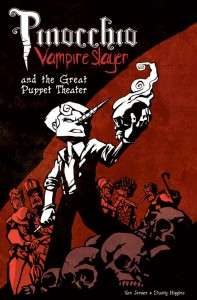
Pinocchio: Vampire Slayer and the Great Puppet Theater - A No Flying, No Tights Review


For the benefit of those readers who had not had the good fortune to read the first volume of Pinocchio: Vampire Slayer (or those, like me, who hadn’t read the original book in a while) this second volume begins with a performance, staged by the titular Great Puppet Theater. They tell us the real story of Pinocchio and how he never became a real boy but did live happily ever after with his father, Gepetto. At least, he lived happily ever after until the night when vampires came to their home and killed the old toymaker. Thankfully, as a bloodless wooden puppet, Pinocchio was uniquely suited for the life of a vampire hunter. Aided by The Blue Fairy and Master Cherry (the carpenter who originally found the magic wood that Gepetto later shaped into a puppet), Pinocchio protects his home village from the vampire menace.

We soon meet The Great Puppet Theater in the flesh – er, wood – as the story begins in earnest. Made up of the other puppets made of living wood whom Pinocchio encountered in his original journeys, the troupe of wooden players have been seeking their lost brother since they, too, had had an encounter with vampires and since their master, the showman Fire-Eater, was killed. The troupe happens upon Carlotta, Pinocchio’s only friend, who has also been looking for Pinocchio ever since he and his entourage left their village in search of a mysterious Master Vampire that – legend has it – rules over all of the blood-sucking undead. Eventually family and friends are reunited and the quest continues, leading up to a stunning cliffhanger.

Fans of the first volume hoping for more of the same will not be disappointed, as this sequel features more of what makes this series so amusing – slapstick and sarcasm in equal measure, as Pinocchio throws out increasingly insulting lies in order to make his nose grow so he can break it off into a stake. Yet Van Jensen’s scripts continue to build beautifully upon the original premise, further fleshing out the world with the addition of The Great Puppet Theater and its colorful cast of characters. Based off the archetypes of both the Commedia dell’arte and classic Neapolitan puppetry, the stock personalities of the troupe’s members do not make their antics and arguments any less entertaining.

Dusty Higgins’ artwork has evolved along with Jensen’s scripts. I noted in my review of the first Pinocchio: Vampire Slayer that Higgins’ work resembled that of Jhonen Vasquez of Johnny The Homicidal Maniac fame. The puppets and vampires still sport a similarly stylized look, but there’s a subtle softness to Higgins’ human characters this time around. Indeed some of the panels featuring Caroltta are downright mangaesque.
If you own the first Pinocchio: Vampire Slayer book, you owe it to yourself to pick up this equally excellent sequel. And if you don’t own the first book, you should get it immediately along with the rest of this series. I consider this series a must-have for any serious Young Adult Graphic Novel collection.

Pinocchio: Vampire Slayer, vol. 2 — Pinocchio: Vampire Slayer and the Great Puppet Theater
by Van Jensen
Art by Dusty Higgins
ISBN: 9781593622039
SLG Publishing, 2010
Publisher Age Rating: (13+)

Friday, July 12, 2013

Van Von Hunter, vol. 1-3 - A No Flying, No Tights Review


And so it was in ancient times (or maybe it was three years ago) that an evil prince of distant lands did threaten the once-peaceful Kingdom of Dikay. But in the darkest hour, when all seemed hopeless, a hero emerged – a bold champion who hunted all things evil and slew them in the name of goodness and decency. With his beautiful companion by his side, he destroyed the evil prince’s cursed artifact, drove back the assembled armies of darkness, and forever banished the dreaded demons back to the hells from which they’d come.

Now, the twice-peaceful Kingdom of Dikay is safe. Apart from an epidemic of amnesia that has clouded the minds of most of the citizens of Dikay as to precisely what happened during this epic battle between good and evil, most of the people are healthy, happy, and content. Yet even now their savior stands ever watchful for signs of evil’s return…mainly because it’s really difficult being a hero in a twice-peaceful kingdom and he’s incredibly bored. Then one day he happens to notice that his next door neighbor – a barmaid whose amnesia is so severe she can’t remember her name or anything of her life three years ago – looks an awful lot like the beautiful companion he lost three years earlier…

So begins the tale of Van Von Hunter – one of the funniest American manga I’ve ever read and one of the best parodies of the fantasy genre I’ve seen in any medium. Imagine Slayers as written by Mel Brooks and you might just be able to grasp the sheer hilarity of Van Von Hunter. There’s a lot of referential humor, with several characters who are obvious parodies of established characters and archetypes from other fantasy manga and Japanese role playing games as well as a lot of gags about the fantasy genre in general.

For instance, The Evil Prince is quite clearly mocking every effeminate ineffectual villain in manga history – think Sephiroth from Final Fantasy VII as played by James from Pokemon. There are also numerous jokes about such staples of the fantasy genre as impractically large (but cool-looking) weapons, a group of elves corrupted by dark magic who now use their magical baking powers for evil, and impractical armor like plate-mail bikinis.

Thankfully, the humor isn’t limited to gags that only fans of the fantasy and manga/anime genres will appreciate. The situational humor and characters are amusing enough on their own terms. From the wizened old man who is determined to narrate the action of his surroundings no matter what the facts are or who is listening to the crazed king of Dikay (who laughs at his advisors and seeks advice from his jester), this series is full of memorable characters whose antics will leave you laughing out-loud.

Long out-of-print, all three volumes of this hilarious series are once again available through Tokyopop’s website. It is rated T for teens 13 and up, due to some mild cursing, excessive comedic violence, and sexy sorceresses in scanty armor.

Van Von Hunter, vol. 1-3
by Ron Kaulfersch
Art by Mike Schwark
Vol. 1 ISBN: 9781595326928
Vol. 2 ISBN: 9781595326935
Vol. 3 ISBN: 9781595326942
Tokyo Pop, 2005-2006
Publisher Age Rating: T (13+)

Wednesday, July 10, 2013

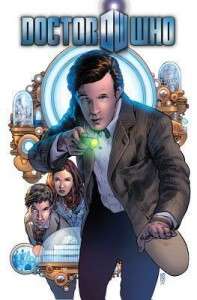
Doctor Who, Series 3, Vol 1: The Hypothetical Gentlemen - A No Flying, No Tights Review


There’s this bloke called The Doctor. He’s smart and good and occasionally nice. He looks human, but he’s really an alien. He lives in a big blue box called The TARDIS. It can travel anywhere in space and time and, while it rarely takes The Doctor where he wants to go, it always takes him where he needs to be. He wanders the cosmos showing off the wonders of the universe to the various companions he picks up along the way and quite frequently saves the day, the night, the world, and the entire universe.

Doctor Who has been around for nearly five decades and there’s a fine tradition of Doctor Who comics stretching back nearly as long as the history of the show itself. It’s no surprise, then, that with the reemergence of the Doctor Who television series back in 2005 there would be new comic books, as well. IDW Publishing currently holds the license and has printed a number of mini-series and specials depicting the exploits of the enigmatic Doctor and his companions, as well as a monthly series that restarts every year or so.

This first collection of the third IDW series collects four issues and two whole stories. The first story, “The Hypothetical Gentleman,” centers upon The Doctor and his current companions (the husband and wife team of aspiring-model Amy Pond and nurse Rory Williams) as they travel to Victorian London. It is here they meet another young couple – Charles and Emily – who make a living putting on fake séances in order to capitalize on the growing belief in Spiritualism. While their shows are fake, Emily’s telepathic gifts are quite real, making her into a conduit for a disturbing intelligence. Naturally, this is just the sort of mystery to get The Doctor’s attention.

The second story, “The Doctor and The Nurse,” centers upon The Doctor and Rory reluctantly agreeing to have a “Boys Day Out” after Amy concludes that the two need some time to bond without her getting in the way. This is the only thing The Doctor and Rory agree upon, apart from the fact that neither of them is particularly interested in doing any male bonding. So while Amy wanders off for an hour to see the sights of London in 1814, The Doctor and Rory decide to “cheat” and take The TARDIS forward one hour so they can meet up with Amy later. Naturally The TARDIS winds up taking them elsewhere and elsewhen, while Amy has an adventure of her own fighting an unexpected alien menace.

Like the television series, the Doctor Who comic has attracted some of the best and brightest creators in its respective industry. This particular volume features writing by acclaimed author Andy Diggle, best known as the creator of the Vertigo series The Losers, and Brandon Seifert, creator of the independent horror series Witchdoctor. The art team is no less impressive, with Mark Buckingham of Fables fame and Phillip Bond – most famous for his work on Vertigo Comics’ The Invisibles and Tank Girl – lending their considerable talents to the proceedings.

In my professional opinion as a critic and my personal opinion as a Whovian, this volume would make a fine addition for any graphic novel collection. Like the show itself, there’s little here that would be unsuitable for younger audiences, but the language and ideas are complex enough that it might be best if an adult were on hand to assist younger readers. Place it in the Teen section as a compromise.

Doctor Who: Series 3, Volume 1: The Hypothetical Gentleman
by Andy Diggle, Brandon Seifert
Art by Mark Buckingham , Philip Bond
ISBN: 9781613775790
IDW Publishing, 2013
Publisher Age Rating: (13+)

Thursday, June 27, 2013

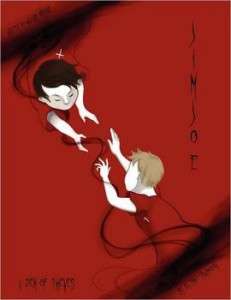
Jim Joe, Den Of Thieves - A No Flying, No Tights Review


Full Dislosure: JimJoe – Den of Thieves was published by Dog Ear Publishing – a vanity publishing house. This note is included as a courtesy to those libraries that have a policy against adding such materials to their collections.

In order to off-set some of the negativity that is to follow in this review, I’ll say this much for JimJoe – Den of Thieves at the start: with a six-year-old dropping the F-dash-dash-dash word on Page Three and the most prominent female character in the story being introduced to us through a gratuitous nude scene, JimJoe – Den of Thieves makes it abundantly clear from the beginning that it is not suitable reading material for children. Unfortunately, it’s not suitable reading material for adults either.

The story opens on six-year-old Arrow Brown (or Harrow Brown, depending on the page) fleeing for his life from an unseen assailant. This is JimJoe – Arrow’s imaginary friend, who is quite real and pushing Arrow to do bad and/or dangerous things. JimJoe disappears shortly after Arrow is hospitalized after being hit by a bus while fleeing JimJoe.

Twenty years later, Arrow runs his own car-customization business and is married with a six-year-old son of his own – a son named Aspen, who has started talking to an imaginary friend named JimJoe. In short order, Aspen is using curse words, the family dog is almost strangled to death, and Arrow himself is nearly killed after Aspen plays with the buttons at Arrow’s garage,  nearly dropping a car on top of him because JimJoe told him to. In order to save their family and their sanity, father and son will team-up with an understanding psychiatrist and an old priest who may be the only one who recognizes JimJoe for what he truly is…

The script of this book is made up of the worst horror movie clichés imaginable. It offers no unique spin on the done and overdone idea of a child’s imaginary friend turning out to be a real monster. The characters are all cardboard cut-outs that conform to the usual stereotypes, with the old priest being an alcoholic with an ever-ready hip flask. Of course Arrow’s wife of eight years doesn’t believe a word of his crazy story about a murderous imaginary friend and immediately starts treating him like a crazed lunatic killer who is only just now showing signs of being a psychopath who will drag their son down with him. Yet Dr. Ziggy, a psychiatrist client of Arrow’s who promised him a favor after Arrow pimped out his car, completely believes Arrow’s story despite only having met him once before!

The artwork of the book is equally amateurish. The entire book is rendered in a series of uninked pencil sketches. This becomes problematic during the night scenes, which are rendered on a solid gray background. The box-placement is awkward on several pages, with the story flow difficult to follow. Worst of all, the artwork has as many continuity problems as the writing, with the pregnant Rachel’s enlarged stomach disappearing completely in some panels!

Even the book’s back-cover speaks to the poor workmanship that went into crafting this graphic novel. You know it’s a bad sign when the author’s biography spends more time talking about his work as a business consultant and entrepreneur than his work as a writer. The blurb describing the plot is filled with misspellings, grammatical errors, and a seemingly random placement of commas. ‘Is’ is used in place of “His” and “as the climax of the battle between Arrow and JimJoe approach” rather than “approaches”. One also wonders how the reader is meant to be surprised by the astonishing twist “as the climax… approach” when the blurb ends with the promise of “an astonishing twist.”

JimJoe – Den of Thieves
by William Marquis
Art by Emiko Sawanobori
ISBN: 9781457509322
Dog Ear Publishing, 2013
Publisher Age Rating: (18+)

Friday, June 14, 2013

Superman: Secret Origin - A No Flying, No Tights Review


Over the past decade, many comics-reading pundits have cracked-wise about DC Comics retelling Superman’s origin story every year, like clockwork. Surprisingly, this is only a slight exaggeration and somewhat ironic given that Superman is one of the most widely recognized characters in all of fiction with an equally well known origin. What possible benefit could there be to retelling a story everyone already knows? Ah, but storytellers do like to put their own spin on things and Geoff Johns certainly does make the story of Superman his own in the ironically titled Superman: Secret Origins.

There are no sweeping changes made in this tale. There’s no revelation that the people of Krypton resembled giant glowing donuts and that a young Kal-El was surgically altered to resemble the people of Earth. Kal-El is still raised as Clark Kent in Smallville, finds his first love with a red-haired Lana Lang, grows up to become pals with Jimmy Olsen, develops a friendly rivalry with Lois Lane, and works at the Daily Planet in Metropolis. Where Johns changes things is by getting to the heart of the characters and looking at the familiar established events from a new perspective.

For instance, the analogy between Clark Kent discovering his powers and undergoing puberty has been made before (Indeed, Johns has Clark discovering his heat vision after his first kiss from Lana Lang) but this is the first Superman origin story I’m aware of which effectively conveyed the angst a teenage Clark Kent must have experienced upon discovering his alien heritage. It stands to reason that Clark Kent would feel even more awkward than the average teenager, doesn’t it? As teens, nearly all of us felt like a freaks who didn’t fit in, so imagine finding out that the way you felt was the literal truth?

Imagine finding out that you aren’t human? That you really are different than everyone else? How would you react? How could you react? Johns answers this question perfectly and gives Jonathan Kent an equally perfect response as Clark howls to the heavens that all he wants is to be plain ol’ Clark Kent.

This scene is also referred to by David S. Goyer in his introduction to this book. A frequent collaborator of Johns’ and no mean writer himself, Goyer is perhaps most famous as the writer of all three of Christopher Nolan’s Batman movies. Goyer claims he never thought it possible to tell a truly modern Superman story until he read this one, citing the aforementioned scene in specific as the “aha” moment. One wonders how the upcoming Man of Steel movie – which Goyer wrote – will compare to this graphic novel and how much direct inspiration it may have offered.

Johns’ excellent script is matched by the equally excellent artwork of another frequent collaborator – artist Gary Frank. Frank’s design of Superman borrows heavily from the appearance of Christopher Reeve, capturing not only the general look of Reeve’s face when he smiled, but also the many subtle aside expressions Reeve made when the Clark mask was dropped and Superman shined through for a second. Frank’s designs for the other characters are equally insightful, but Frank is more than just a good caricaturist. He’s also a wonderful visual storyteller with an amazing aptitude for conveying motion and action.

DC Comics rated this series T for Teens 13 and Up and I believe that rating to be a fair one. There’s no language apart from the very occasional ‘damn’ or ‘hell’ and no sexual content apart from some passionate kissing, a little innuendo, and Lois Lane pulling a pink lacy bra out of her desk – much to Clark’s embarrassment. There is a fair bit of violence and blood, particularly as Lex Luthor performs the surgery to turn soldier John Corben into a living weapon against Superman, but nothing inappropriate to a teen audience.

Superman: Secret Origin
by Geoff Johns
Art by Gary Frank
ISBN: 9781401226978
DC Comics, 2010
Publisher Age Rating: T (13+)

Wednesday, May 29, 2013

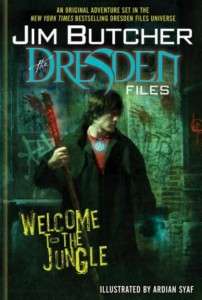
The Dresden Files: Welcome to the Jungle - A No Flying, No Tights Review


For over a dozen novels and a goodly number of short stories and novellas, Jim Butcher’s Dresden Files have delighted millions of readers around the world. It’s fair to say that Harry Dresden may be the most famous supernatural detective in modern fiction. A fully ordained Wizard of The White Council, Dresden is also an accredited private investigator and the Chicago Police Department’s go-to guy for any supernatural weirdness that the cops can’t explain away as business-as-usual.

The series is full of comic book references, such as Harry’s car, an oft-destroyed and oft-rebuilt Volkswagen Beetle, being named after the superhero “The Blue Beetle.” As a character, Dresden himself seems to be a mix of Marvel Comics influences – think “What If Peter Parker Had Become The Sorcerer Supreme Instead Of Doctor Strange?” It’s no surprise, then, that Jim Butcher recalls his love of comics as a kid and their influence on his writing in the introduction to this volume, the first original graphic novel starring Harry Dresden.

The plot centers upon a murder at the Lincoln Park Zoo. Harry is brought in to investigate the death of a night watchman who was beaten to death by something much stronger than he was. The best theory the police have is that one of the gorillas somehow escaped its locked enclosure and turned savage. It’s a flimsy theory, but it’s enough to make the city demand the accused gorilla be put to death, despite the protest of the zoo’s primate experts that gorillas are docile and attack only if threatened. In order to save Moe the Gorilla’s life – to say nothing of the lives of any future victims – Harry must put all his skills as a detective and a wizard to the test.

This story is set in the early days of Dresden’s career, so comic readers unfamiliar with the novels don’t need to worry about references to the books that they won’t understand. Indeed, Butcher does a masterful job of introducing all the established players besides Harry himself. These include Lieutenant Karrin Murphy (Harry’s main contact with the Chicago PD), her skeptical partner Carmichael, and Bob The Skull – a spirit of knowledge bound in a human skull who acts as Harry’s research assistant and comedic foil. On the other side of the fence, fans of the Dresden Files who aren’t regular comic readers will be glad to know this graphic novel reads just like one of Butcher’s regular novels, despite the inclusion of some pretty pictures.

The pretty pictures are provided by the always excellent Ardian Syaf. Syaf’s character designs perfectly capture the look and spirit of each of the established characters. Harry is a tall, lanky man who resembles an unshaven Peter Parker. Karrin Murphy is a short but powerful-looking woman with hard eyes that don’t seem to fit the rest of her pretty face. And Bob – well, he looks like a skull with glowing orange eyes. More importantly, Syaf is an excellent visual storyteller who can match Butcher’s scripts for tone and pacing. The action scenes are laid out well and flow naturally from panel to panel.

If this is your first exposure to the world of the Dresden Files, you are in for a treat. If you’re a long-time Jim Butcher fan who has never read a comic before, I think you’ll see the appeal of the medium by story’s end. And it should be obvious to all why this story was nominated for a Hugo Award and why it made the ALA’s Great Graphic Novels For Teens list in 2010. This novel is wholly appropriate for teenage audiences, containing nothing worse than a few curse words and some mild violence. Despite this, I would still recommend librarians place this series in their adult fiction collections (assuming you don’t have a separate adult graphic novels section), where it may be more easily discovered by Dresden Files fans who don’t usually read comics.

The Dresden Files: Welcome to the Jungle
by Jim Butcher
Art by Ardian Syaf
ISBN: 9780345507464
Del Rey/Dabel Brothers, 2008
Publisher Age Rating: (13+)

Saturday, May 25, 2013

Star Trek: The Next Generation / Doctor Who: Assimilation Squared - A No Flying, No Tights Review


The cross-over has been a speculative fiction tradition since at least the time of the first pulp novels and magazines. The Green Hornet radio show established that The Lone Ranger was the great uncle of The Green Hornet and had a hand in inspiring the younger hero to take up the role of an outlaw hero. Robert E. Howard and H.P. Lovecraft worked elements of one another’s stories into their own work, with Lovecraft outright saying that Howard’s Hyboria was the long distant past of the Earth where his stories took place. And of course the idea of shared universes and inter-company crossovers – rare as they are now – is part and parcel of the superhero genre and comic books as a medium.

That brings us to this series: Star Trek: The Next Generation / Doctor Who – Assimilation Squared. The longest running American science-fiction franchise and Britain’s longest-running science-fiction franchise, together for the first time. An unlikely pairing? To put it mildly. Trekkers and Whovians tend to be very different breeds of fan, though both are equal in their fanaticism. Trekkers tend to be obsessive about details and realism and knowing how everything in the universe works. Whovians, by contrast, are generally more concerned with a ripping yarn and will gladly accept a hand-wave that something is caused by time going wibbly-wobbly so long as there’s a good story at the heart of it.

However you may feel about one franchise or the other, it cannot be denied that Assimilation Squared is a good story and that Trekkers and Whovians alike will find it enjoyable. Astonishingly, so will casual readers who might not be familiar with one series or the other. The script by Scott and David Tipton takes great pains to establish the settings of both worlds before colliding them and thrusting both sets of heroes together against a common (and uncommon) enemy. Indeed, the entire first chapter of the first volume of this mini-series depicts a typical adventure of both Captain Picard and his crew and The Doctor and his current companions. The cast is fleshed out and we get a number of good character moments for all involved, allowing new readers the chance to get to know The Enterprise Crew as well as The Doctor, Amy Pond, and Rory Williams before we are thrust into the action.

And what action! The plot concerns an alliance between The Borg and The Cybermen – both technology-based species (the former from Star Trek, the later from Doctor Who) who depend upon the assimilation of organic life in order to propagate their species as they work toward their goal of universal domination. Thankfully, the Doctor’s transport – The TARDIS – manifests on-board The Enterprise as Captain Picard becomes aware of the new threat. It will fall to both teams of heroes to work together to save not only their own dimensions but perhaps all dimensions!

Fans of both series will no doubt love the interplay between the characters. The meeting between The Doctor and Guinan – The Enterprise’s mysterious, seemingly all-knowing but rarely all-explaining bartender – is quite a treat. So is trained nurse Rory discussing advancements in medical technology with Dr. Crusher. For my money though, nothing quite tops Rory’s response to Worf’s recitation of the classic Klingon saying “Today is a good day to die!”

The artwork is equally impressive, with J.K. Woodward having painted nearly every panel of the entire eight-part mini-series in a photo-realistic fashion that perfectly captures the likenesses of all the actors involved. The one exception to this is a brief flashback sequence in Chapter Five, rendered in a more traditional sixties comic-book style by The Sharp Brothers. This scene depicts an earlier story, just discovered among the Enterprise’s records, where the crew of Star Trek: The Original Series once encountered the Cybermen and a smiling, long-scarf wearing man who called himself The Doctor.

In the end, Star Trek: The Next Generation / Doctor Who – Assimilation Squared is that rarest of all crossovers – one that will please everybody. Trekkers and Whovians alike will appreciate how their respective franchises have been handled and the story, while steeped in the mythology of both series, will prove accessible to those unfamiliar with Star Trek or Doctor Who. I dare say this mini-series could create a number of new Whovains and Trekkers.

Star Trek: The Next Generation / Doctor Who: Assimilation Squared, vol. 1 & 2
by Scott Tipton, David Tipton
Art by J.K. Woodward, The Sharp Brothers
Volume 1 ISBN: 9781613774038
Volume 2 ISBN: 9781613775516
IDW Publishing, 2013
Publisher Age Rating: (13+)

Tuesday, May 21, 2013

Classic Fantastic: Starman - A No Flying, No Tights Review


My first exposure to Starman came about when I was first getting into comics.  As I recall I was in my local comic book store fishing through The Quarter Bins.  Primarily the final resting place of whatever Bad-Girl books with a dozen variant covers the owner had over-ordered the previous year, The Quarter Bins still yielded the occasional treasure.

It was here, digging through several dozen copies of Danger Girl, where I stumbled across a copy of Starman #29.  With a cover painted – yes, painted! – by Tony Harris, it was unlike anything I’d ever seen before in a comic and the interior work was just as impressive.  I must have starred at it for quite some time, broken from my reverie by the scornful snort of one of the shop employees – the one whose tastes were diametrically opposed to my own.

“You WOULD like that one.  The main guy?  He sounds like you.”

His disdain was all the invitation I needed to spend 25 cents.  Thankfully, Starman #29 turned out to be a prefect jumping-on issue, aimed at bringing new readers up to speed on The Story So Far.  And as promised the main character, Jack Knight, did indeed sound like me.

Jack was a self-proclaimed geek, “more in love with yesterday than tomorrow.”  Jack’s humor tilted in favor of heavy sarcasm and obscure pop-culture references that went over most people’s heads.  He was verbose, inclined to using a dozen words when one would do.  He was also, I realized sometime later, a bit of a jerk.  That revelation helped me to recognize my own character flaws and inspired me to correct them.

Even without that, I can honestly say without any hyperbole that Starman changed my life.  While other series brought me into comics, Starman kept me in them.  It gave me a penname and a nickname.  Jack Knight was my first cosplay.  And after a decade of reading comics and writing about comics, it’s still my favorite series of all time.

What’s it about?

Our story begins in the gloriously Art Deco town of Opal City.  We’re introduced to Jack Knight – a Bohemian artist and collectibles shop-owner who never got along with his scientist father, Ted Knight, or his athletic older brother, David Knight.  Jack was just as happy to stay out of the family business of protecting Opal City using his father’s starlight-fueled inventions as David was happy to take up their father’s mantle as the superhero Starman.  But when David is killed and Ted left hospitalized as a result of a crime spree orchestrated by The Mist – Starman’s arch-enemy – Jack reluctantly assumes his father’s role as Opal City’s protector.
Aiding Jack in his new job are The O’Dares – a quintet of cops, all the children of legendary local beat-cop Billy O’Dare, who was the closest thing Ted Knight had to a partner.  Guiding Jack in his assumption of the hero’s mantle is The Shade – a mysterious immortal and sometimes super-villain, who makes his home in Opal City and wishes to see it well protected… so long as nobody expects him to do the protecting.  As the series progresses, Jack will grow into his father’s shoes, become a true hero, find the love of his life, meet the other heroes who bore the name Starman, journey into space, travel back in time and even become a better person.

Notable Notes

There are many reasons why Starman is notable but I’m going to focus upon three of them – the colorful cast of characters, the wonderful creative teams and the theme of transformation.
I’ve already spoken a bit about how unique Jack Knight was as a protagonist but that difference extends to the rest of the supporting cast.  Jack’s mentor The Shade is an unapologetic villain yet he aids Jack in protecting Opal City because of his personal vow to commit no crime there and see to the peace of his own home – presumably even super-criminals want a nice neighborhood to live in!  Each of the five O’Dare cops have a unique personality.  And that’s just the main cast.  I could write for pages about all the interesting incidental characters like the ghost pirate John Valor or Rat-Pack loving bank robber Jake “Bobo” Benetti.  Even the random thugs break the mold, arguing over which Sondheim musical was the best instead of the more usual sports-related minion chatter.

Artistically, Starman has a unique aesthetic, thanks to the efforts of some truly legendary creators.  Like Metropolis and Gotham City, Opal City has a unique feel to it that makes it as much a character as the people who inhabit it.  This is due to the Art Deco designs of artist Tony Harris.  Harris also painted the covers for most of the issues of the original comics as well as crafting original paintings for most of the soft-cover and all of the hard-cover collections of the series.  Though he only penciled the interiors of a little over half the series, Starman is as much Harris’ child as it is James Robinson’s.  Tribute must also be paid to David S. Goyer, who assisted Robinson with writing several issues.  Goyer is most famous today for his work as a screenwriter on various superhero movies, including Christopher Nolan’s Batman trilogy and Man of Steel.

Thematically, the book is all about the ability we all have to change ourselves for the better.  This is virtually unheard of in superhero comics, where most of the characters are static and their personalities unchanging.  The series is primarily about Jack’s transformation from a self-absorbed fanboy into a hero and a decent human being.  And yes, there is a difference between the two.  As one of Jack’s ex-girlfriends notes, “You may be a hero, Jack Knight, but that still doesn’t make you a nice person.” This theme also extends to most of the series’ main characters, who change for the better as the story progresses.
I’m hard pressed to think of one story arc out of dozens to hold up as the best or most memorable.  But if I had to pick one, I’d say Sand And Stars – an arc collected in The Starman Omnibus: Volume 2.  I picked this one for two reasons.  The first is that this is the arc that won Robinson and Harris an Eisner Award for Best Serialized Story.  The second is that this story contains a line, thought by retired superhero Wesley Dodds (a.k.a. The Sandman) as he watches Jack Knight fly into battle, that I think sums up the appeal of adventure fiction in three short sentences.  “He’s in danger.  He may die.  And I envy him the thrill of it.”

Significance

Starman came about because writer James Robinson wanted to establish a common mythology for every character published by DC Comics who ever used the codename Starman.  When the series started in 1994, there had been six separate heroes who had used the name and only two of them had any link to one another.  Starman was meant to create those missing connections.
Starman was also significant for promoting the glorious past of DC Comics at a time when the American comics industry seemed to be abandoning their roots in favor of books centered upon violent anti-heroes.  As part of the series, James Robinson penned a number of flashback stories known as Times Past, which told epic tales in a modern style using the characters and trappings of yesteryear.  This proved the value of the early superheroes and the relevance of their morality to the modern world.
In many ways, Starman predated Kingdom Come in rejecting the values of The Dark Age and introducing the storytelling techniques common to The Modern Age.  If it hadn’t been for Starman, it’s unlikely we would have had a revival of the Justice Society of America and the heroes affiliated with that group in the pages of JSA.  There’s also a chance that Geoff Johns – DC Comics current Chief Creative Officer – would have had a markedly different career path as his first professional comics work – Stars and S.T.R.I.P.E. – was created with input from James Robinson and spun out of Starman.

Appeal

It’s difficult to suggest an ready-made audience for Starman as the people I know who enjoy the series besides myself are as eclectic as the series itself and defy easy classification.  It’s a superhero book but it’s unlike any other superhero series I can think of and I can’t see your average X-Men fan seeing the appeal.  Fans of Golden Age comics will find a lot to enjoy, though.  There are elements of the series that will likely appeal to fans of science-fiction (particularly the Stars My Destination arc) but it isn’t entirely a science-fiction series, being closer to classic Doctor Who in tone than Star Trek.
I would instead recommend this series to fans of quirky dialogue and unusual characters in general.  If you enjoy Jerry Seinfeld’s talking about nothing, Christopher Moore novels, Mystery Science Theater 3000, Michael Stipe’s music or Chuck Klosterman’s essays, there’s a fair chance you’ll enjoy Jack’s dialogue and adventures.  I’d also recommend the series to anyone who is a collector, whether it be of comics, tin signs, baseball cards, Barbie dolls or anything that anyone might consider cool and put on a shelf.  You’re likely to find a kindred spirit in Jack Knight as I did.
I consider this series a must-read for all graphic novel enthusiasts 16 and up.  That age restriction is due less to the content (though there are a few graphic deaths, a fair bit of innuendo and suggested nudity) and more to the fact that a certain level of maturity is needed to appreciate the growth of the characters as well as some of the dramatic situations and most teenagers lack the patience to muddle through the talky bits between the action scenes.

Why should you own this?

Historically, Starman is an important series for students of the genre to study.  It’s an award-winner, frequently held up as a source of inspiration by many of today’s most popular graphic novel writers and artists.  It’s also a damn fine read on its own terms.  With the recent Omnibus collection of the series – currently available in its entirety in Hardcover with paperback editions on the way – there’s no excuse for a library NOT to have this series in their adult graphic novel collection, in my professional opinion.
Starman Omnibus (hardcover)
  • Volume 1 – 9781401216993
  • Volume 2 – 9781401221942
  • Volume 3 – 9781401222840
  • Volume 4 – 9781401225964
  • Volume 5 – 9781401228897
  • Volume 6 – 9781401230449
Saturday, May 11, 2013

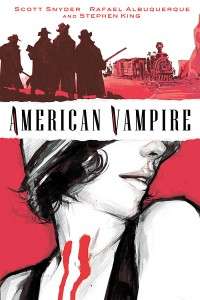
American Vampire, Vol. 1 - A No Flying, No Tights Review


The introduction to this book informs us that Stephen King was so impressed by the idea behind American Vampire that when Scott Snyder approached him about writing a promotional blurb for the series King asked if he might write for the series instead. Reading this book, it is not hard to understand King’s enthusiasm. At a time when the vampire mythos has been played out and (pardon the pun) revamped into every conceivable genre, American Vampire offers a fresh new take on the classic formula.

The vampires of Snyder’s universe — and there are, as we eventually discover, many different varieties of vampire — are not nice people. Many of them don’t even qualify as people by the most liberal standard of what constitutes humanity. There are no brooding Byronic figures, pining away for a lost love of centuries past. There are no tormented ex-soldiers seeking redemption by using their dark powers to protect humanity from their own kind. And there are certainly no sparkly-skinned immortal teenagers seeking a perfect little swan to help them tame the beast within. These vampires are undoubtedly monsters and most of them are bastards.

Skinner Sweet is a bastard, too, and was something of a monster even before he became a vampire back in 1880. A bandit by trade, Sweet is on his way to stand trial when he is fed upon by the vampire railroad tycoon whose trains and banks he’d robbed. Left for dead, Sweet awakes days later with a powerful hunger for something besides his ever-present peppermint stick — revenge! And blood, too, of course. Sweet’s victims quickly realize he’s come back as something beyond human, beyond vampire: a new breed of American vampire, immune to the touch of sunlight or wooden stakes.

It is this tale of Skinner Sweet’s fall and rise that Stephen King spins across five chapters of this volume. These chapters alternate with Scott Snyder’s story, which is set in Hollywood, California, in 1925. It is here that Sweet creates his first “child,” Pearl Jones. Pearl is an aspiring actress who runs afoul of the very Old Boy network that runs Hollywood, literally chewing up and spitting out beautiful young women. Not that Sweet really cares, save that the vampire studio moguls on are on his hit-list and another one like him could only help make things in town more chaotic, just the way Sweet likes it.

Rafael Albuquerque illustrates both stories with a vitality to match the scripts by both King and Snyder. Forgive me another pun when I say that Albuquerque’s artwork has real bite. Describing it as visceral, while accurate, may not be much better. Regardless, this graphic novel looks as good as it reads.

In case this being a Vertigo title, and Stephen King being one of the two authors, isn’t a big enough warning sign, let me state this clearly: “This Book Is Suggested For Mature Readers” for a reason. There’s a lot of ultra-violence, bad language, uncovered naughty bits, and a fair bit of disturbing imagery, such as our first look at Pearl Jones as she wakes up in a charnel pit. Keep this book firmly in your adult fiction section.

American Vampire, vol. 1
by Stephen King, Scott Snyder
Art by Rafael Albuquerque
ISBN: 9781401229740
Vertigo Comics, 2011
Publisher Age Rating: Suggested For Mature Readers (18+)

Tuesday, April 30, 2013

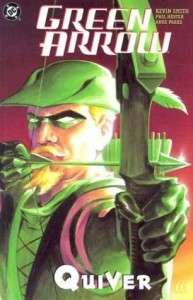
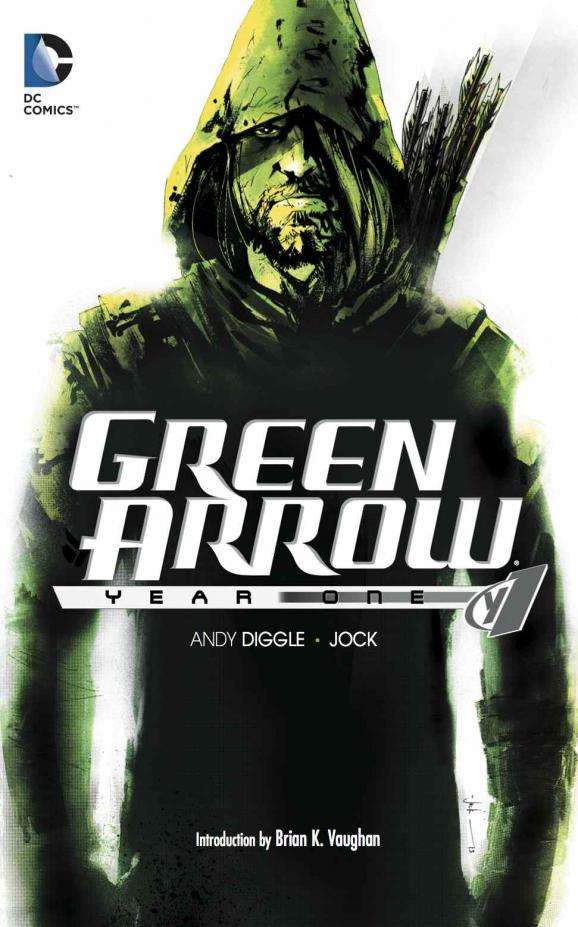
Classic Fantastic: Kevin Smith's Green Arrow - A No Flying, No Tights Review


There’s one question I’ve been getting a lot recently, both as a librarian and as a comic book historian – where should I start if I want to read some good Green Arrow comics?  It’s a fair question but it’s also a difficult one for me to answer fairly.  Despite being around for over seventy years, Green Arrow never had a solo comic book series until the late 1980s and most of those comics have never been collected in a trade paperback edition.  Many of the stories which have been collected haven’t aged particularly well, with the Dennis O’Neil penned Green Lantern/Green Arrow comics of the 1970s being particularly cringe-worthy with their groovy dialogue.

For this reason, I usually recommend Green Arrow: Quiver and Green Arrow: The Sounds of Violence.  These two trade paperbacks collect all the stories written by the man who brought Green Arrow into the Modern Age of Comics – Kevin Smith.  Better known for his work as a filmmaker, Smith was a rather prolific comic book writer at the turn of the century best known for his inability to meet deadlines and his outspoken personality.  Love him or hate him, one can’t deny the impact that Smith had on Green Arrow.

What’s it about?

As Quiver opens, we are introduced to Oliver Queen – the man behind the mask who fought corporate criminals and corrupt civil servants as The Green Arrow.  This introduction comes through the eyes of his loved ones as they reminisce upon the impact he had on their lives before his untimely but heroic death.  Death?  Yes, as this story opens Oliver Queen is dead.  Or is he?  There’s a familiar green-clad figure running around the roof-tops of Star City who begs to differ and his oldest friends in the Justice League agree this new Green Arrow sure looks and sounds like Oliver Queen did ten years ago.  But even if Green Arrow has come back from the dead, how did he do it and for what purpose?  And why are his memories and personality those of a younger Oliver Queen than everyone remembers?  The search for answers will lead the newly resurrected Green Arrow and his allies on a wild ride through the spiritual side of the DC Comics universe.

The Sounds of Violence continues where Quiver ends, with a newly resurrected Oliver Queen trying to get on with his life.  His new job overseeing the Star City Youth Center has given him purpose beyond his nightly patrols and it’s offered him ample time to bond with Connor Hawke – the illegitimate son he never knew he had.  But Ollie worries that with the world having moved on there may not be a place for him anymore.  At the very least, he worries there’s no place for him in the life of the lady he most wants to be with – long-time girlfriend Dinah Lance, a.k.a. The Black Canary.  And even as Ollie seeks to rebuild, a new villain plans to end Ollie’s crime-fighting career before he can truly restart it.

Notable Notes

Two things stick out above all others in Kevin Smith’s scripts – his love and knowledge of the DC Comics universe and his twisted sense of humor.  From the very first scene, we know we’re in for something special as we see Superman and Batman – not as the Big Blue Boy Scout and the dour Dark Knight but as two friends snarking about their first memories of feeling cold (Batman’s involves a sleigh ride and Superman asks if the sled was named ‘Rosebud’).  Despite this story being built upon some rich history, it is easily accessible to anyone who has never read a comic book before, much less a Green Arrow comic.  Long-time comic readers may get more out of reading this series, spotting references to Neil Gaiman’s The Sandman among other things, but one needn’t have a copy of Who’s Who in The DCU on standby to get through it.

The artwork is all-around amazing.  Penciler Phil Hester, who collaborated with Smith previously on a comic based on Smith’s film Clerks, proves an unorthodox but credible choice to bring Smith’s characters to life.  Hester’s previous works tilted heavily in favor of the horror genre, which proves fitting given the direction Smith’s story takes toward the end of Quiver.  Inker Ande Parks further adds to the dark and spooky feeling with some atmospheric inks.  Writer/Artist Matt Wagner, who painted the covers for each of the monthly comics and the cover of the TP collections, also deserves high praise.

Significance

This series catapulted Green Arrow into the spotlight and kept him there for the better part of a decade.  The monthly series began to wane after Smith’s departure but Green Arrow’s newfound popularity extended into other media, particularly the various animated adaptations of the Justice League and Batman comics.  This eventually led to Ollie becoming a series regular on the Smallville TV show and probably had a hand in inspiring the current Arrow TV series.

Appeal

Fans of Smith’s movies will love these books for their humor.  Fans of superheroes looking for an easily-accessible entryway into the DCU will also find this series enjoyable.  It’s also the first thing I’d recommend to fans of the new Arrow show, who want to know more about the comics that inspired the show and how different the two worlds are.

I would offer a brief word of warning regarding the series’ content.  While there’s nothing in this series that would make experienced comics readers blush, the fact remains that this is a Kevin Smith story.  Those of you familiar with his films will know what to expect.  For the rest of you, let me say that there are several depictions of extreme violence, references to drug use, an attempted rape and a far more frank depiction of Oliver Queen and Dinah Lance’s sex life than some may be comfortable with.  Suffice it to say there is much innuendo and while nothing is shown, Oliver Queen is depicted giving oral sex to his girlfriend twice over the course of the series.  Taken all together, I’d rate this series as being a T+ (16 and up).

Why should you own this?

Strictly speaking, these are among the few Green Arrow comics that are easily accessible to a new reader.  Sadly, they are out of print and even used copies are going for five-times the original price on-line.  Hopefully the success of the Arrow TV show will inspire DC Comics to put these stories back in print, despite their lacking relevance to the New 52 universe.

Wednesday, April 10, 2013

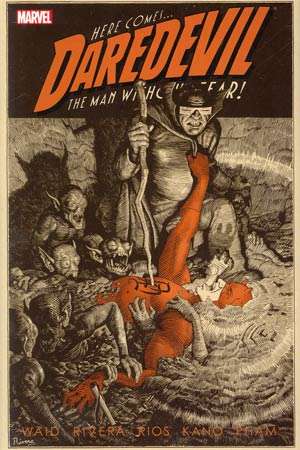
Daredevil, Vol. 2 - A No Flying, No Tights Review


The second volume of Daredevil continues the trend set when Mark Waid first took over the book and made it his own. Sick of the increasing amount of melodrama and tragedy in the life of lawyer/vigilante Matt Murdock, Waid only agreed to take over writing duties on the title if he was allowed to do the unthinkable: make Marvel Comics’ darkest superhero lighten-up, restoring the swashbuckling Man Without Fear that Stan Lee had envisioned fifty years ago.

The first chapter of this volume, which won the Eisner Award for Best Single Issue Story in 2012, illustrates just how much Waid has done to turn this title around. The usually dour Matt Murdock arrives at his law firm’s holiday party in grand style, wearing plastic devil’s horns and a red sweatshirt that reads “I’M NOT DAREDEVIL” in white print. His regular cane is replaced with an oversized red-and-white-striped candy cane with a bit of mistletoe tied on the handle. Even the cover of this chapter depicts Daredevil making a snow angel on the rooftops upon which he usually lurks menacingly. And all this occurs before the main plot begins, which involves Matt Murdock’s struggle for survival following a bus crash that leaves him and several blind children stranded in the wintery wilderness. Truly, this volume is worth the purchase just for that one story!

Before any long-time Daredevil fans get all huffy about this change in tone, let me reassure you that, while Matt Murdock may be sick of being miserable and the comedy quotient of the book has increased since Waid’s revamp started, the book still contains a good deal of drama. The main portion of the book is devoted to a team-up between Spider-Man, Daredevil, and the semi-reformed burglar turned hero, Black Cat, who must track down the crooks who framed Black Cat for the theft of a highly advanced holographic projector. The final chapters pit Daredevil against a blind supervillain – frequent Fantastic Four foe Mole Man – who has extended his criminal activities to grave-robbing and whose latest caper gives Matt Murdock a personal reason to see justice done.

Most of this collection is ably illustrated by the series’ regular art team of artist Paolo River and inker Joe Rivera. Their style is as fun as Waid’s script, being clearly penciled without seeming overly cartoonish in design. The inks are perfectly appropriate to each panel, with Joe Rivera seeming to know when to make the shadows thick or when to leave just enough light for the color to poke through the darkness. The Spider-Man/Daredevil/Black Cat team-up features artwork by artist Emma Rios and the artist Kano. There is also a brief story illustrated by Khoi Pham. All of it is good, though some of the poses Kano puts Black Cat in make my spine ache in sympathy.

In terms of content, there’s little to make parents or librarians nervous about this series. There are several moments of passionate kissing leading into something more intense between Daredevil and Black Cat, but there’s no nudity. Likewise, while the eventual reasons for Mole Man’s grave robbing are quite disturbing (i.e. finding the one woman who was ever nice to him and saying goodbye), Waid’s script keeps his intentions purely platonic and there’s no hint of anything else happening. The whole scenario is gross enough without THAT implication!

Daredevil, vol. 2
by Mark Waid
Art by Paolo Rivera, Joe Rivera, Emma Rios, Kano, and Khoi Pham
ISBN: 9780785152392
Marvel Comics, 2012
Publisher Age Rating: T+ (12 and Up)

Tuesday, April 9, 2013

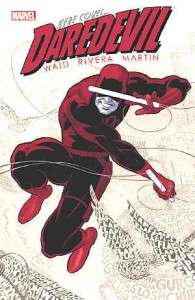
Daredevil: Vol. 1 - A No Flying, No Tights Review


Even before Frank Miller put his personal stamp on Daredevil in the late 1970s and introduced many of the elements that made Daredevil one of the darkest books in mainstream superhero history, Daredevil was a character born of tragedy. His radar-sense superpowers were born of the accident that took his sight. He was abandoned by his mother and lost his father to violence. Some of his love interests were killed by costumed super-villains. Some of his love interests WERE costumed super-villains. His secret identity was exposed to the public on three separate occasions, requiring that he deal with it by creating a fake twin brother, fabricating a second separate legal identity, and then by simply denying everything and threatening libel suits. At one point or another he’s lost his job, his home, his mind – even his soul after a brief stint being demonically possessed. Yet despite it all, Matt Murdock perseveres.

When approached about creating a new Daredevil series for Marvel Comics, veteran writer Mark Waid reportedly had one condition. He did not want to start the book over by introducing a new girlfriend for Matt Murdock who would turn out to be a ninja assassin with a hereto untold tale of woe seeking revenge. He would not bring back The Kingpin with an entirely new scheme to ruin Matt Murdock’s life. He refused to add to the festering dung heap of tragedy that has been Matt Murdock’s life for the past three decades.
What he would do, instead, is make the book fun again.

From the opening chapter of this book, we know that this is a Daredevil not seen since the days of Stan Lee. Crashing a Mafia princess’s wedding to thwart a kidnapping, dodging bullets even as he steals a kiss from the bride – this Daredevil is a hero from the same school as Douglas Fairbanks and Errol Flynn. He is bold. He is gleeful. He laughs in the face of danger. And under Waid’s pen he is glorious and truly worthy of the title The Man Without Fear.

Waid quickly establishes the world of Matt Murdock for those new to the characters. A brilliant lawyer by day and vigilante by night, Matt Murdock and his best friend and legal partner Franklin “Foggy” Nelson have recently revamped their law firm into a legal-aid clinic where they advise their clients on how to best represent themselves in court. This step proved necessary since Matt’s alleged superhero identity, while not publicly proven to anyone’s satisfaction, has caused enough mistrials to make it impossible for him to directly represent anyone in court. Waid also introduces a new foe/love interest in the form of Assistant District Attorney Kirsten McDuffie, who is determined to prove Matt Murdock and Daredevil are one and the same even as she finds herself falling for the idealistic lawyer.

Waid’s scripts are backed by some equally excellent artwork, provided by two separate creative teams with very different ways of showing us the world through Matt Murdock’s eyes. The first three chapters are illustrated by penciler Paolo Rivera and inker Joe Rivera. They show us the world from Matt’s viewpoint through a series of black backgrounds overlain with red lines highlighting the objects as Matt “sees” them. The last three chapters are illustrated by Marcos Martin, who takes a more minimalist approach to depicting Matt Murdock’s radar sight. Concentric circles overlay single-color silhouettes of the objects and people around Daredevil. Both methods are effective and the normal artwork is laid out with equal skill and detail.

Daredevil is one of those rare books that proves capable of pleasing both long-time fans and newbies alike. There’s nothing in the book that would be objectionable for the book’s target audience of 12 and up. Indeed, this series should be considered a must-have for any superhero fan’s comic collection or young adult library collection.

Daredevil, vol. 1
by Mark Waid
Art by Paolo Rivera and Marcos Martin
ISBN: 9780785152378
Marvel Comics, 2012
Publisher Age Rating: T+ (12 and Up)

Sunday, April 7, 2013

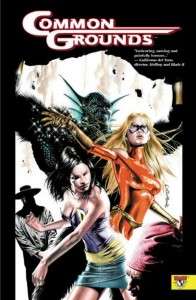
Common Grounds - A No Flying, No Tights Review


Common Grounds is a lost treasure of the Modern Age of Comics. (That’s not hyperbole. I literally lost my copies of the original six-issue mini-series somewhere along the line and only recently rediscovered the series after chancing upon the trade paperback collection in a used book store.)

There is no over-riding plot or main character in Common Grounds. Instead, writer Troy Hickman presents a series of thirteen vignettes built around the titular chain of coffee shops. Founded by a retired superhero named Big Money, the goal of the chain was to give costumed crime-fighters a place to relax in their masked personas while they were off duty. In an effort to foster understanding and peace, costumed criminals are also welcomed provided they leave their grudges at the door.

These interludes run the gamut from low comedy to high drama, occasionally playing with both comedic and dramatic elements at the same time. The opening story, “Beyond the Speed of Life,” sets this balanced tone perfectly. It tells the story of a reporter interviewing his favorite superhero, The Speeding Bullet, at a nearby Common Grounds location. The Speeding Bullet is a speedster who is widely beloved by the public and acknowledged as one of the greatest heroes in the world. He is also, to the surprise of the reporter, largely unsatisfied with his life outside of heroism. While he loves helping people and is thankful for the opportunities his powers give him, “SB” does express his wish for the ability to slow down on occasion and his desire to live a normal life.

It would be easy to play the problems of a man with super-speed off for laughs or for Speeding Bullet to come off as a bit of a whiner, but Hickman seriously examines how super-speed with the heightened perceptions to match your reflexes would make everyday life a bit more difficult. For instance, being able to eat whatever you want due to a heightened metabolism that burns off excess calories in minutes sounds great in theory, but the fact of the matter is you have to spend more time in the bathroom than a normal person. Why? Well, there are some things you can’t do at super speed. Such is Hickman’s gift as a writer that he can play up the comedy such situations while simultaneously exploring the dramatic elements of the superhero genre.

The book’s cast features a host of other such memorable characters, but my favorite is probably Moshe Chomsky. Moshe is a devout Hasidic Rabbi who somehow developed the power to melt anything he touches. Moshe is an honestly good person who prays for guidance and struggles to find constructive uses for a destructive ability, all while trying to tolerate “the smart-alecks in the media” who dubbed him “The Acidic Jew,” with good humor. There’s no small amount of irony that such a potentially deadly power should wind up in the hands of someone so ill-disposed toward violence and hurting people and it is fun to watch Hickman play off the clichés of comics (which demand that anyone with fire powers have a temper or anyone with cold powers be emotionally distant) in this way.

This is one of the best-looking comics series I’ve ever had the pleasure of reading, featuring an all-star roster of artists. Dan Jurgens does the lion’s share of the work, having drawn six of the thirteen vignettes but there’s not a single scrub in the line-up. Michael Avon Oeming. Ethan Van Sciver. Chris Bachalo. Carlos Pacheco. Angel Medina. Sam Kieth. The legendary George Perez. You’d be hard pressed to get one artist of this caliber for a mini-series, let alone all of these fine artists!

Common Grounds is a must read for any fan of the superhero genre, as well as those who typically dismiss superhero stories as childish fantasies. There are some truly complex stories here, with none of the gore or overt sexuality one usually expects in a Top Cow graphic novel. Indeed, apart from some frank discussions about superhero sexuality ala the Man of Steel/Woman of Kleenex debate, there’s no material in this collection I would consider objectionable for a teenage audience.

Common Grounds
by Troy Hickman
Art by Dan Jurgens, Michael Avon Oeming, Ethan Van Sciver, Chris Bachalo, Carlos Pacheco, Angel Medina, Sam Kieth and George Perez
ISBN: 9781582408415
Top Cow Productions, 2007
Publisher Age Rating: (13+)

Saturday, March 9, 2013

Kill Shakespeare, Vol. 1 & 2 - A No Flying, No Tights Review


SOURCE: Kill Shakespeare Vol. 1 & 2

Hamlet, Prince of Denmark, has been convicted of the murder of Lord Polonius. Sentenced to exile by his uncle, King Claudius, Hamlet’s closest school-friends have been given orders to escort Hamlet to England and see to his execution. But good Rosencrantz and Guildenstern decided to defy their king and stand by their friend as he plots a rebellion. Sadly, their alliance is short-lived and an attack by pirates sees Hamlet fall overboard as his friends die.

Hamlet washes ashore and is discovered by soldiers who escort him to their liege lord – King Richard the Third of England! Luckily for Hamlet, King Richard has as little love for King Claudius as Hamlet does. Indeed, Richard has need of Hamlet, or at least believes he does. For Richard has formed an alliance with King Macbeth of Scotland and the witches who serve the Scottish lord’s good lady wife have put forth a prophecy that speaks of a young man like Hamlet. They further speak of a Shadow King who can find the lost god-king creator of their realm – The Great God Shakespeare. Richard sends Hamlet forth with his best man, the honest and ever-loyal Iago, to find Shakespeare and kill him.

So begins Kill Shakespeare – a series which does for The Bard of Avon what the original League of Extraordinary Gentlemen series did for Victorian-era Literature. Such a comparison is unfair but inevitable. Kill Shakespeare defies easy categorization past its base concept of,  “All of Shakespeare’s most famous characters live in one fantasy realm at the same time.”

Note that I say “most famous” characters and not “best,” for therein lies one of the odd paradoxes of Kill Shakespeare. We meet several of Shakespeare’s more obscure characters as the story progresses and the reader must be familiar with the whole of The Bard’s catalog of works to appreciate all the references. And yet, the most prominent parts are given to those characters a layman is most likely to know, to mixed effect. While recasting Othello as the general of the rebel army and Falstaff as the heart of the prodigal rebellion are inspired choices on the part of the writers, it strains credibility to turn Juliet Capulet into a warrior princess when there are so many other Shakespearean heroines better suited to a combat role.

The artwork is skillful enough, at least. Andy Belanger uses a broad, cartoonish style that befits both the high drama and comedy of the piece. Everything is exaggerated in a fashion fit for the stage or a 17th century woodcut of a Shakespeare play.

Kill Shakespeare is an amusing diversion for theater fans who like comics, but little more than that. The book has no official rating but could be read (if not necessarily understood or enjoyed) by teenagers without fear of warping their minds. They have a far better chance of finding excessive sex and violence in a local stage production of Titus Andronicus than in this book.

Kill Shakespeare, vol. 1 & 2
by Conor Mccreery and Anthony Del Col
Art by Andy Belanger
ISBN Vol 1 – 9781600107818
ISBN Vol 2 – 9781613770252
IDW, 2011
Publisher Age Rating: (13+)

Sunday, February 3, 2013

FAME:Taylor Swift - A No Flying, No Tights Review


SOURCE: FAME: Taylor Swift

I had no illusions of quality or even basic competence as I began to read FAME: Taylor Swift. I’ve read too many comics by Bluewater Productions to expect anything but the worst. What else could one expect from a publishing company that has no editors or – at the very least – does not credit them in their books? (Perhaps the editors of Bluewater Productions have pulled a collective Alan Smithe and refused credit for their work?) In any case, Bluewater Productions has a reputation for dirty-dealing with freelancers and for hiring anyone willing to draw in exchange for a “professional” credit. Note the quotes around the word professional and that I am using a definition of the word so loosely as to be inappropriate.

In my previous review of the FAME: The Cast of Glee (unauthorized) biography comic, I said that the artwork looked as if it had been created by taking photos from a Google Image search and running them several times through a Photoshop filter, or had been traced over a printed photograph. Judging by other reviews I’ve read, I am not alone in this assessment and this is a frequent complaint regarding other Bluewater Productions illustrated biographies. Thankfully, I can make no such accusation regarding the artwork of Erick Adrian Marquez. Traced images or Photoshopped pictures would look far better.

Marquez’s penciling is, in a word, awful. There is no craft, no character and no design at all in Marquez’s scribbling. The people depicted are all misshapen and deformed. There are whole panels of this comic that appear to have gone uninked, save for a black outline around the individual characters. This outline, it should be noted, appears to have been applied with either a Crayola black marker or the largest paintbrush setting in MS Paint. To describe the artwork in this book as amateurish would be to insult every amateur artist in the world. Indeed, to call the graphics in this book artwork may be an insult to Art itself. For that, I apologize.

The script for this book was written by C.W. Cooke and P.R. McCormack – the same team behind The Cast of Glee (unauthorized). I mention this only so that I can relate that I discovered – while confirming that the same team wrote both books –that McCormack’s last name is misspelled on the title page of the Glee comic. As in that book, there are numerous other spelling errors and tense-troubles in the language of FAME: Taylor Swift, along with several awkward, run-on sentences. (“She became a member of a kid’s comedy group where her comedy blossomed and shined through, something the world would get to see later on when she hosts Saturday Night Live.”)

FAME: Taylor Swift has no place in any quality library collection. The artwork transcends mere putridness to become something truly anathema. The script, while teaching me far more about Taylor Swift’s life than I ever wanted to know, is rife with grammatical mistakes and I keep wanting to pull out a red marker to start making corrections. If you must have a Taylor Swift biography for your collection, please, find something else.

FAME: Taylor Swift
by CW Cooke, PR McCormack
Art by Erick Adrian Marquez
ISBN: 9781450749176
Bluewater Productions, 2012
Publisher Age Rating: All Ages

Friday, February 1, 2013

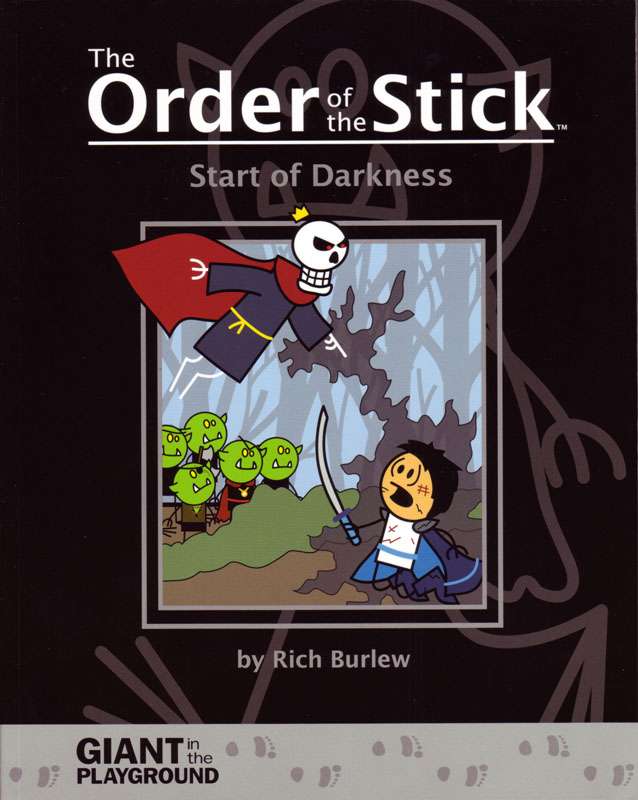
The Order Of The Stick: Start of Darkness - A No Flying No Tights Review


SOURCE: The Order of the Stick - Start of Darkness

It is said that everyone is the hero of their own story. Even the vilest villains in history did not consider themselves to be bad people. Yet fiction is filled with villains who lack any further motivation than being evil for evil’s sake. Even Shakespeare had characters like Don John the Bastard, who refused to give any reason for his villainy save “…it better fits my blood to be disdained…”

There is a reason for this. Villains need to be villainous in order to be dramatically effective. Delve too deeply into a bad guy’s past or motivations and the writer runs the risk of making him more sympathetic than the hero. And while some writers have had success in telling the villain’s side of the story (Wicked comes to mind immediately) it is generally a bad idea for a writer of genre fiction to try and buck that trend. Somehow, artist Rich Burlew was able to overcome this difficulty and tell a tale that expands the backgrounds of his two main villains while simultaneously exploring the nature of evil, both philosophically and within the confines of a narrative structure. Not bad for a stick-figure comic, eh?

Start of Darkness is the second original graphic novel based on Burlew’s immensely popular web comic, The Order of the Stick. Originally a simple comic that poked fun at the rules of Dungeons and Dragons and how they would play out in a real fantasy world, OOTS has blossomed into a fully-fledged epic in its own right. Now the strip features more humor based on its characters and the conventions of the fantasy genre than it does jokes about the difficulty in figuring out the mechanical difference between a charge and a bull-rush.

Our story focuses primarily upon Redcloak, a goblin cleric who is elevated to the position of High Priest of his religion after his mentor and his tribe are killed by rampaging knights out to “cleanse the land of evil.” Granted the knowledge of his predecessors, Redcloak goes into hiding with his younger brother and begins work upon a sacred (or is that profane?) quest. The (un)holy plan? Join forces with a sorcerer of equal power and use a ritual devised by their deity to unmake the world and create something more equitable for all the monstrous humanoids currently eking out sad lives lurking in swamps and living in caves, waiting to become a footnote on some human hero’s path to glory.

Enter Xykon, a down-on-his-luck evil overlord/necromancer who is long in the tooth and short on ethics. He seems the perfect pawn for Redcloak’s plans, except he’s not much for planning and gets bored quite easily. And when Xykon gets bored, he tends to start killing minions. After all, it’s not like he can’t bring them back as zombies if he needs them for something besides target practice later, right? Still, Redcloak will try to persevere even as he finds himself becoming more of a minion than a partner to the power-mad sorcerer, thinking it will all be worth it in the end.

Burlew’s stick-figure art won’t win any awards, but it’s amazing how he can tell such a complex story with such simple figures. The artwork may be simplistic but this is an emotionally and structurally deep story, despite the series’ usual comedic tone. One can’t help but feel some sympathy for Redcloak as he sinks deeper and deeper into depravity, crossing line after line in his righteous crusade against human superiority.

Despite being the first story in The Order of the Stick saga chronologically, this is a bad book for readers to start with. Check out the original web comic from the beginning and then come back to this volume after the first 300 strips or so. You’ll appreciate it a lot more. Like the Dungeons and Dragons game, this book is appropriate for teenage audiences and older, provided you have no objections to cartoonish depictions of children being killed, souls being trapped, and gratuitous breaking of the fourth wall by demonic, genre-savvy roaches.

The Order Of The Stick: Start of Darkness
by Rich Burlew
ISBN: 9780976658047
Giant in the Playground, 2008
Publisher Age Rating: (13+)

Tuesday, January 22, 2013

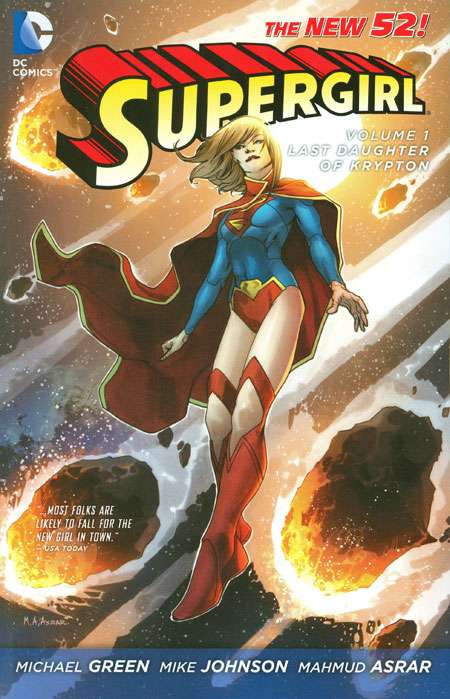
Supergirl, Vol. 1: Last Daughter of Krypton - A No Flying No Tights Review


SOURCE: Supergirl, Vol.1 - Last Daughter of Krypton

The greatest problem with Supergirl as a character has always been establishing her as a separate entity from Superman and developing her into something more than “Superman’s cousin”. This proved a daunting task for most writers, given the impetus behind Kara Zor-El’s creation was a desire to get more girls to read comics. For the longest time, that’s all Supergirl was – a girl with Superman’s powers. Over the years, many writers have tried to differentiate Supergirl from Superman by giving her different powers and a different background, to varying degrees of success.

Thankfully, the New 52 revamp of 2011 gave DC Comics a chance to create a Supergirl that was free of all this baggage and authors Michael Green and Mike Johnson rose to the occasion. Though the background of this Supergirl may be familiar to long-time comic fans, Green & Johnson’s Supergirl is an entirely new character. They accomplish this through an angle I don’t think any writer has considered in the five decades since Supergirl’s creation – culture shock.

Attacked by Russian soldiers shortly after her awakening from suspended animation after her ship crashes in the Siberian wilderness, this Kara Zor-El is quickly established as both an intelligent, logical young woman and a typical teenage girl. Her intelligence is established in how she deduces that she is truly on an alien world and not just dreaming. Her nature as a realistic teenager is established later on, when she finally meets her cousin Kal-El. Or rather, a man dressed in the seal of their house who claims to be her infant cousin Kal-El, grown to maturity while she was asleep.

To say that Kara is skeptical of Superman’s story would be an understatement. To say that she is stunned at his apparent apathy over the destruction of their world would be a greater understatement. To say that she is angered by his suggestion that she should forget about her life before and join him in protecting the relatively primitive people of Earth who view her as either a potential test subject or a monster is so great an understatement as to require the use of an entirely different word than understatement.

This is a brilliant conceit and it makes Kara all the more realistic and, oddly, more sympathetic as a character. After all, how many teenagers do you know who would cope at all well with having to move just before the start of their senior year? How would you have coped with that? Now throw in the “everyone you know is dead” and “everyone here hates you and wants you dead” angles and you’ve got the recipe for some high drama, even ignoring the other superheroic elements of the story as Kara finds her footing, copes with her loss and – eventually – finds her own path to heroism.

Artist Mahmud Asrar deserves an award for his work on this book. Not only does he present the action well, with the story following naturally from panel to panel, he avoids the trap so many previous Supergirl artists have fallen into by indulging in fan service. There’s nary a cheesecake pose to be found and Asrar’s Supergirl looks like a real teenage girl who hasn’t quite finished growing into her figure yet.

All in all, Supergirl is one of the best hidden treasures of the New 52 line. I consider it a must-read for anyone who enjoys quality comics and stories with a strong female protagonist. Furthermore, I’d consider it a worthy purchase for any library with a graphic novel collection aimed at young adults.

Supergirl, vol. 1: Last Daughter of Krypton
by Michael Green, Mike Johnson
Art by Mahmud Asrar
ISBN: 9781401236809
DC Comics, 2012
Publisher Age Rating: 13+

Sunday, January 20, 2013

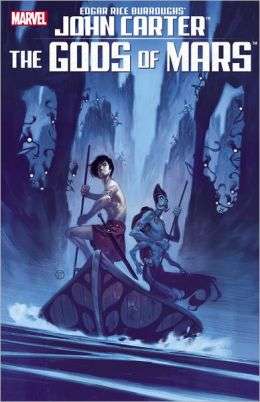
John Carter: The Gods Of Mars - A No Flying No Tights Review


SOURCE: John Carter- The Gods of Mars

I stand as one of the few who seems to have appreciated the 2012 movie John Carter. I firmly believe it to be a good film that was destroyed by bad marketing. Originally titled A Princess of Mars after the pulp novel that inspired it, the film that became known as John Carter had its title changed repeatedly.  Reportedly, various executives worried that fathers and sons wouldn’t pay to see an action movie with the word “Princess” in the title. Never mind that the plot of the story focuses on a soldier traveling to another planet and gaining superpowers! Then they demanded all reference to Mars be removed from the title and the advertising in the belief that – since no movie with the word Mars in the title had ever been a blockbuster hit – people hated Mars.
 
Throw in an ad campaign that emphasized generic CGI desert landscapes over any of the truly alien wonders of Edgar Rice Burrough’s Barsoom and you can see why John Carter may have been doomed from the start, cinematically. To my mind this is a crying shame, because it had the potential to be so much more. The script had a perfect blend of action, comedy, drama, and romance. You had a strong, likeable hero. You had an equally powerful heroine. Heck, you even had the boy and his dog angle in the form of John Carter’s loyal companion Woola the calot! What more could a franchise ask for?

I mention all this because John Carter: The Gods of Mars is a direct sequel to said film, presented in comic book form. I also mention this because this graphic novel is similarly troubled in its presentation. The artwork on the front and back cover bears no resemblance to the interior artwork by artist Ramon Perez. Perez’s artwork is competent enough, though his panel-flow is confusing at times and his character designs leave much to be desired. Far too many characters resemble one another and it is fortunate that the story keeps John Carter’s true love – the warrior princess Dejah Thoris – out of the action for most of the book, as there is no way of distinguishing her from Thuvia, another Red Martian warrior woman, who teams with John Carter for most of the story.

A larger problem is the book’s coloring which, according to the credits page, was handled by no less than four individual colorists/coloring companies! The palette changes wildly from chapter to chapter, with the coloring used for John Carter’s skin changing frequently. Why is this a problem? Because coupled with so many characters looking alike, it is hard to keep some of the characters straight when Carter’s skin is as red as the Red Martians in some panels or as white as the White Martians in others. Things become even stranger in the flashback sequences, where Green Martians are yellow and the Earthman is the same shade of blue as the Black Martians.

The story, at least, is action packed and a fair adaptation of the original Gods of Mars story by Edgar Rice Burroughs. In fact, I dare say it’s a good enough adaptation that anyone who hadn’t read the original A Princess of Mars or seen the film John Carter will be completely lost as to who is fighting whom, and why. Sam Humphries’s script could have benefited from a recap at the start.

Another eyebrow raiser is this book’s all ages rating. Considering that the John Carter film was rated PG-13 and the language used in this adaptation is at a higher level than what I’d consider fitting for the “under 8” audience Marvel’s all ages works are aimed at, I’d recommend this book for Young Adult collections if I were inclined to recommend it at all… which I’m not. Give this a miss and consider the excellent Warlord of Mars series published by Dynamite Entertainment instead.

John Carter: The Gods Of Mars
by Edgar Rice Burroughs, Sam Humphries
Art by Ramon Perez
ISBN: 9780785165132
Marvel Comics, 2012
Publisher Age Rating: All Ages

Sunday, January 6, 2013

Star Trek: Khan - Ruling In Hell - A No Flying No Tights Review


SOURCE: Khan - Ruling in Hell

The character of Khan Noonien Singh (or simply Khan) has become famous even to those who are not familiar with Star Trek in specific or science fiction in general. Played by the charismatic Ricardo Montalban on both the small screen and silver screen, Khan proved to be far more than a simple villain-of-the-week. Indeed, despite his background as a genetically engineered super-soldier and attempted dictator, Khan was a surprisingly sympathetic figure. Though his means were cruel, he was a product of his creation and he struggled against his nature to be something greater, becoming a man of honor who honestly did wish to provide for his followers. Small wonder then that Captain James Kirk chose to give Khan and his followers the chance to colonize a hostile but habitable world rather than punish them for attempting to usurp his command.

Most of us know where the story went from there. How the planet Khan and his followers settled on was ravaged by natural disasters shortly after they began their colonization efforts. How neither Starfleet Command nor Captain Kirk himself ever checked-up on the colony to monitor their progress or see if they needed help. How Khan’s wife and many of his followers died in the decades that followed, leaving Khan bitter, disillusioned, and desperate for revenge.

Khan — Ruling In Hell tells the story of the time between where Star Trek: The Original Series left off and where the film Star Trek II: The Wrath of Khan began. Unsurprisingly, given the popularity of the character, this is not the first time this tale has been told. Author Greg Cox wrote a Star Trek novel detailing the same period of time – the similarly named To Reign in Hell. This book, however, is an entirely original work and the first time Khan’s exile has been detailed in a graphic novel format.

One might rightly think it difficult, if not impossible, to tell a gripping, action-packed story where one already knows the ultimate ending. However, writers Scott Tiption and David Tipton meet this challenge handily, largely focusing the story not upon the disasters but on the people. Much of the plot details Khan dealing with treacherous underlings who lack his faith that Captain Kirk will treat them fairly. Khan’s romance with Lt. Marla McGivers – the Starfleet historian who aided him in his attempted coup of the S.S. Enterprise – also offers readers an interesting subplot, showcasing Khan’s nature as a man, not a leader or warrior.

The artwork by Fabio Mantovani proves impressive. Mantovani perfectly caricatures the actors from the original Star Trek show and does a good job of slowly and subtly aging them as the story progresses. The use of color and shadow is particularly impressive, with some fine detail blending the colors in such a way as to make the light of fires seem to glow upon the page!

IDW did not offer an official rating for this book. I would personally rate it as being fit for most teenage audiences. There’s a fair bit of violence but no blood is shown and there’s no outright nudity, though Lt. McGivers does trade her Starfleet uniform for a skin-tight bodysuit that leaves little to the imagination.

Star Trek: Khan – Ruling In Hell
by Scott Tipton and David Tipton
Art by Fabio Mantovani
ISBN: 9781600109096
IDW Publishing, 2011

Saturday, January 5, 2013

Green Arrow: Year One - A No Flying No Tights Review


SOURCE: Green Arrow: Year One

With the possible exception of Tony “Iron Man” Stark, I don’t think any superhero has suffered from mischaracterization in the Modern Age of Comics more frequently than Oliver Queen. The Green Arrow I was a fan of growing up was chivalric to a fault and his most frequent point of argument with long-time girlfriend Dinah Lance (a.k.a. Black Canary) lay in how possessive and over-protective he was. Granting that at one time he was a womanizing billionaire playboy (more Bruce Wayne than Bruce Wayne), his taking on the role of a hero changed that. That was what I always admired most about Oliver Queen as a character – the idea that a man could recognize his faults and honestly change for the better.

Unfortunately, this idea got lost somewhere along the way due to sloppy research. As a result, Oliver Queen was routinely portrayed as a flirtatious buffoon, even after becoming a superhero, for the better part of a decade. This idea of Green Arrow as a womanizer became so prominent that his rape at the hands of the assassin Shado was held up as an example of his “chronic” cheating on Dinah Lance by several writers!

I mention all of this to provide historical context as to what a breath of fresh air Green Arrow: Year One was at the time of its’ release. Here was the Green Arrow I’d loved as a kid, though somewhat rougher as a result of author Andy Diggle’s attempt to modernize Oliver Queen’s origins. Amazingly, Diggle’s modernization of the character only helped to make Oliver Queen’s transformation from idle-rich lay-about into a defender of the weak more plausible.

One way in which Diggle did this was by subtly addressing the main problem with Green Arrow’s backstory in a realistic universe. Namely, how does a billionaire playboy with no experience as an outdoorsman survive being shipwrecked on a deserted island? Diggle neatly explains this away with a scene before the infamous shipwreck occurs in which we learn that Oliver Queen is an extreme sports enthusiast, who base-jumped the Grand Canyon and dived the Titanic wreckage before leading an expedition to the North Pole.

Other scenes showcase Oliver’s hatred of hypocrisy and social injustice, his love of Robin Hood myths as a child, and – in a nice nod to the Mike Grell Green Arrow series – his training in archery as a child with real-world stunt-man and master archer Howard Hill. Given all of that, Oliver’s survival in a hostile environment does not seem at all implausible. Nor does his transformation into a real Robin Hood figure after he learns that a drug cartel has enslaved the local natives and put them to work on a poppy farm seem contrived.

The artwork by Jock perfectly captures the exotic appeal and primal energy of Diggle’s script. Famed for his use of shadows and heavy inks to establish mood, Jock alternates his usual style with more traditional, lighter panels. The effect is not unlike viewing stills of an action movie in sequence, the entire book having a cinematic aura to it.

If you’re a fan of the new Arrow television series and looking for a good place to start in learning about the character of Oliver Queen from the comics or are just a lover of good survival-based suspense, I recommend this book highly. The book is rated 12+ by DC Comics, but I would recommend it to slightly older audiences merely because I don’t think most middle-school students are worldly enough to appreciate this story fully. Content wise, there’s a fair bit of violence and drug use, including one scene where Ollie’s drunkenness is played for laughs and a more intense sequence in which Ollie is forced to take opium as a pain-killer after being severely injured. Both scenes are realistic in their portrayal of drug use, however and do nothing to glamorize it.

Green Arrow: Year One
by Andy Diggle
Art by Jock
ISBN: 9781401217433
DC Comics, 2008
Publisher Age Rating: 12+