Showing posts with label Grant Morrison. Show all posts

Monday, July 21, 2014

Five Reasons Oliver Queen Is Awesome

Despite the popularity of the show Arrow, fans of Oliver Queen still get a lot of guff about our favorite hero being a half-hearted Batman rip-off.  While it may be true that Green Arrow spent a goodly portion of The Silver Age following in Bruce Wayne's footsteps, later comics turned Oliver Queen into his own man.

So what is it that separates Oliver Queen from all of the other billionaire playboy superheroes and all of the other archery-based superheroes?  Besides epic facial hair, of course.  Well, the man said it best himself in JLA #123.

"...I can't leap tall buildings in a single bound and I don't wear any fancy power rings. Hell, I'm not even the world's second greatest detective, whatever THAT means. But I am a guy with a hell of a lot of chatzpah. And that's got to count for something in a crisis, right?"

More than anything, Oliver Queen is defined by that word - chatzpah.  Call it guts, nerve, boldness, balls or just plain audacity if you want to use a ten-dollar word.  Oliver Queen is a man who will say the unthinkable, attempt the impossible and just plain refuse to back down no matter how badly the deck is stacked against him.

To that end, I've put together a list of five deeds that I think exemplify Green Arrow's awesomeness.  And to make it fair, I've eliminated all of the stories where he dies a heroic death in the name of his principals.  Because that is its own Top Five list.


5. Oliver Queen - The One Man Justice League. 
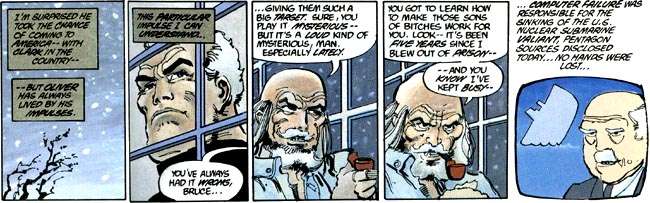


As Seen In: The Dark Knight Returns & The Dark Knight Strikes Back

I'll admit this one is implied more than it is stated.  But the facts are there on the page.  For those who haven't read The Dark Knight Returns, it's a classic Batman story set in an alternate future where superheroes were made illegal in the United States and a middle-aged Bruce Wayne comes out of retirement to become Batman one last time.  The sequel, The Dark Knight Strikes Back, is not as well regarded but it continues the story of DKR and shows what happened to all of the other Justice League members.

Apart from Superman, Green Arrow is the only Justice League member who appears in The Dark Knight Returns.  We don't get the full details of his story but we do get enough to paint a vivid picture.  Oliver Queen was in prison for a while, escaping five years previously.  He spent that time on the run, striking against the corrupt American government as best he could from overseas.  And at some point before Ollie was imprisoned, Superman was responsible for him losing an arm.

The Dark Knight Strikes Back reveals the fates of the other JLA members.  Wonder Woman and Captain Marvel joined Superman in working for the American government, which we find out is secretly being run by Lex Luthor and Brainiac.  The rest of the team either went into hiding in remote locations or were captured and imprisoned by Luthor and Brainiac.

Logically, that means that for a time, both before being imprisoned and afterward, Oliver Queen was The Justice League.  He was the one hero who didn't back down or give up or agree to fade into the shadows in a world that was going to Hell.  And he did that while single-handedly facing two of the world's most dangerous villains and three of the most powerful superheroes on the planet.

And when I say single-handedly, I mean that in the literal sense as well.  Yet despite that disadvantage, he could still use a bow with Olympic-level accuracy.  Even though he had to pull the bow-string back with his teeth!


4. Oliver Queen Holds His Own Against The Forces Of Apokolips.


As Seen In: Final Crisis #4

At the time of this story, Black Canary was the leader of The Justice League.  And as Apokolips once-again tried to invade the Earth in the name of Darkseid, The JLA Watchtower was attacked.  Knowing the importance his wife held in planning a retaliation against the invaders, Oliver Queen stayed behind to hold off the pursuit as the rest of the team teleported to safety.  

One man with a quiver full of arrows against a horde of soldiers with the strength and endurance of Superman, riding giant hunting hounds and a few brainwashed superheroes as well?  Doesn't sound like much of a fight.  And it isn't.  Ollie tears them apart.

He brings down the hounds and the soldiers with them.  And if Ollie hadn't stopped to try and talk some sense into a brainwashed Black Lightning, he might well have won.  But he didn't and one good shock to the system was all it took to bring Oliver Queen down long enough for a mind-control helmet to be slapped down on his head.

This battle would rank higher, but this fight was a loss for Oliver Queen.  And yet it was a victory, because Ollie did accomplish his goal of buying enough time to let the love of his life and the rest of his teammates get to safety.  And while the villains may have technically won the fight,  it was a hard-won victory that shouldn't have been nearly as difficult as Oliver Queen made it.


3. Oliver Queen Overcomes The Black Mercy
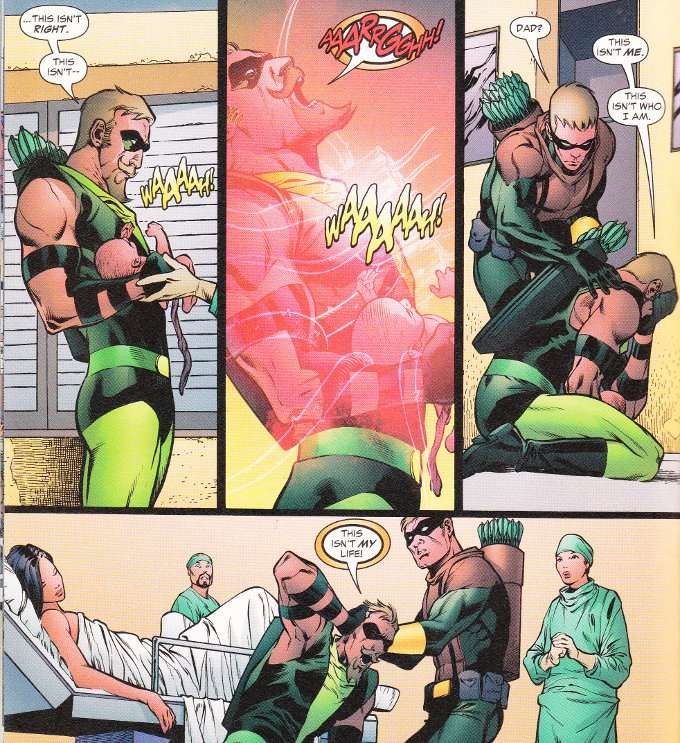


As Seen In: Green Lantern (Vol. 4) #8

Created by Alan Moore for his Superman story For The Man Who Has Everything, The Black Mercy is a sentient alien plant with telepathic abilities.  Parasitic in nature, the plant latches on to a host, to whom it broadcasts a hallucination of an ideal life.  The host slowly wastes away, blissfully unaware that its body is being sucked dry by The Black Mercy in the real world as their every fantasy is seemingly brought to life.

So how strong is a Black Mercy plant?  Strong enough that even Superman couldn't break free of its control without Batman pulling it off of him by force.  And then when it latched on to Batman, Robin had to pull the plant off of Batman for him to be freed of its influence.  Even Hal Jordan was unable to resist the lure of the perfect world that The Black Mercy created for him.

And yet... Oliver Queen did.  He resisted.  He saw through the illusion and dragged himself and Hal back to reality after a single Black Mercy plant latched on to them both.

After the fact, Hal Jordan guessed that the plant had chosen to focus on him since his will was stronger and that instead of giving Ollie a vision of what really would be his ideal world, it had given him what Hal thought would be Ollie's perfect world within the context of Hal's perfect life.  Fine and dandy.  Except that does nothing to explain why Hal Jordan thought to set-up Oliver with Connor Hawke's mom (a woman Ollie hadn't seen in decades and whom Hal had never met) and why there was no place for Dinah Lance or Roy Harper in Ollie's "perfect life".

I think Hal is kidding himself.  I think the truth is that The Black Mercy may be strong enough to cloud the mind of Superman, subvert the fortitude of Batman and even overcome the willpower of a Green Lantern.  But that's nothing compared to Oliver Queen's ability to question everything around him.


2. Oliver Queen Resists Poison Ivy


As Seen In: Batman/Green Arrow: The Poison Tomorrow

Dennis O'Neil earned his place in comics as a living legend with his work in the 1970s on both Batman and Green Arrow.  It was he who developed Green Arrow into the modern-day Robin Hood we know and love and turned Batman into a Dark Knight Detective once more.  He teamed the heroes together in The Brave and The Bold and a few more times besides!  And yet, I think O'Neil's 1992 graphic novel The Poison Tomorrow may be the best thing he ever did with both of these heroes together.

The Poison Tomorrow sees Batman and Green Arrow joining forces after they discover they are working the same case from different angles, with Oliver Queen racing time to save Black Canary's life.  The trail leads from a diseased scientist to Poison Ivy and a plot to use toxic baby food to make a fortune selling an antidote.  In the exciting climax of the story, Batman moves to stop the first shipment of the tainted food as Green Arrow retrieves the antidote from Poison Ivy, who is currently hiding out in a housing development that was built on a toxic landfill!

To his credit, Ollie does try to go in protected.  But he didn't count on how hard it was to draw a bow while wearing a Hazmat suit.  Or on Ivy having a muscle-bound henchman who shared her immunity to toxic waste.  Deciding he can risk the poisoned environment for long enough to hand out a beating, Ollie slips out of the suit and beats down the henchman only to be confronted by Ivy herself.

Ivy, being Ivy, pours on the charm along with the pheromones.  The full "oh my brave hero, let me take care of you" act.  And for a moment, Ollie is tempted.  He's taken a few good lumps from the henchman and he's starting to feel the effects of the toxins around him.  And a little voice tells him he's as good as dead anyway - what harm could one kiss do?  But Oliver Queen's love for Dinah Lance is too strong to be overcome by such cheap tricks.  And with one open-handed strike to the face, Green Arrow shuts Poison Ivy down.

A few years ago, I achieved a modicum of fame for taking Judd Winick to task for his depiction of Oliver Queen as an unrepentant womanizer who cheated on Dinah Lance continually.  This story was largely responsible for my attitude.  Because while a lot of stories show how passionate Oliver Queen is in his love of Dinah Lance, I don't think any story has ever quite so well depicted just how strong that love truly is and how love is a more powerful force than lust any day of the week.  That's why I have nothing but contempt for anyone who tries to sum up Oliver Queen as "a horndog who chases skirts and can't stay faithful".


1. Oliver Queen Walks Out Of Heaven.
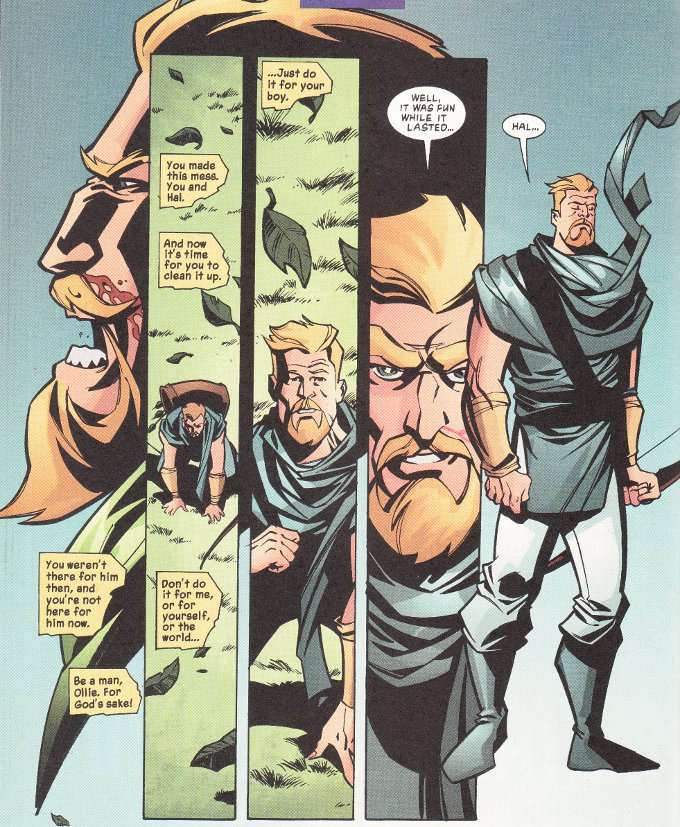

As Seen In: Green Arrow (Vol. 2) #10

Oliver Queen was dead.  Astonishingly, to him at least, he went to Heaven.  Or some kind of paradise where he had found the peace that was denied him in life.  As such, when his best friend Hal Jordan (who, at the time, possessed the power of all but one of the Guardians of the Universe) breached the boundaries between worlds to offer him a second chance at life, Oliver Queen turned it down.  But he did agree to let Hal bring him back after a fashion, creating a soulless clone that would possess all of Oliver Queen's memories up to a certain point.

This "hollow Ollie" would go on to reestablish the name of Green Arrow in Star City in Kevin Smith's Quiver and become a target for all manner of supernatural evil.  When that evil threatened Connor Hawke - Oliver Queen's illegitimate son - the hollow Ollie was somehow able to breach the boundaries of Space and Time to deliver his older, wiser self a much-needed dressing down.  That and the knowledge that his son needed him was enough to stir Oliver Queen into action and demand to be returned to Earth.

Oliver Queen defied his enemies.  He defied his friends.  He defied his government and alien invaders.  He overcame a mind-controlling parasite and the most powerful seductress on Earth.  And all of that is awesome.  But for sheer awesomeness, I don't think anything can top Oliver Queen finding the strength of will to walk out of paradise.


Agree?  Disagree?  I await your comments.

Monday, March 25, 2013

Action Comics #18 - A Review

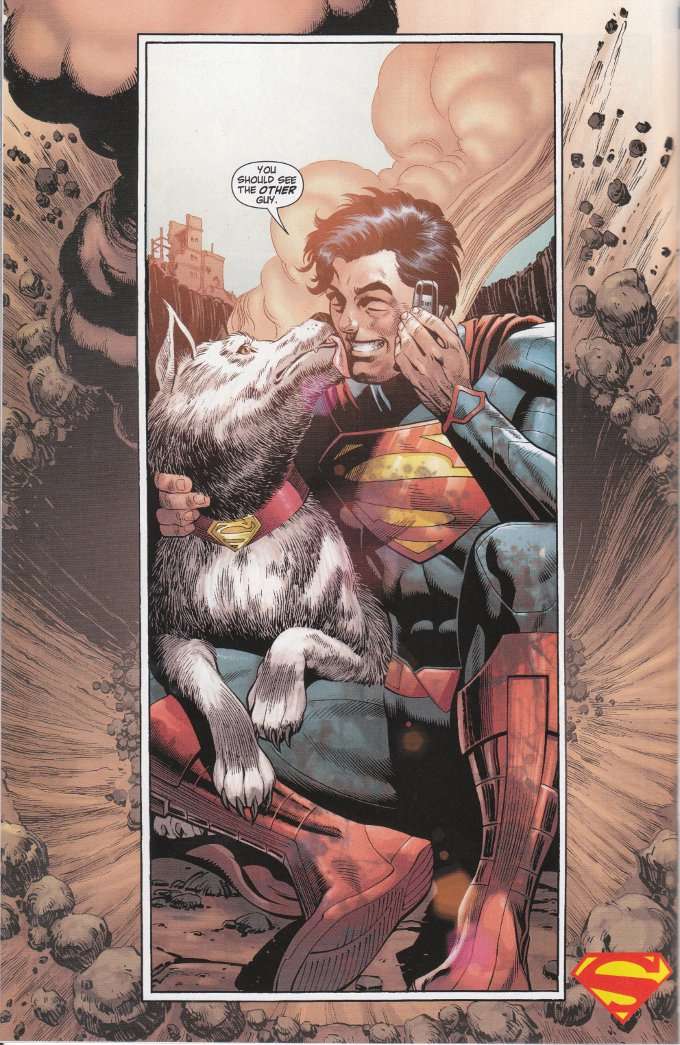
There is little I can say about this issue - or indeed the entirety of Grant Morrison's Action Comics run - that I have not said before in part or in whole.  As before, Rags Morales, Brad Walker and their respective inkers do a fine job of capturing and displaying the action of Morrison's script, which is a fitting summation to the whole series with a callback to every major storyline.   While Morrison's conceit of a battle to destroy Superman fought across five dimensions is a complex bit of writing, it is the simplest images - like a Superboy and his dog victorious - that hit the reader the hardest. 


Simplicity is also the rule of Never-Ending Battle - the back-up story by Sholly Fisch. Told entirely without spoken dialogue (but not without words), this story set in the 23rd century shows how Superman's example continues to inspire heroism in the most unlikely of places years after his passing.  Fisch's subtlety is welcome here, given that social issue comics on subjects like bullying tend to be anything but.  The lack of dialogue only adds to the power of the images put forth by Chris Sprouse and Karl Story.   


This last story alone makes this comic a must-read, even if the larger part of the issue is largely inaccessible to those who haven't been reading Action Comics since the first issue.  Never-Ending Battle is Eisner-worthy for how well it captures spirit of heroism - not just in superhero stories, but in the human spirit itself.  I'd encourage any comic fan to buy this book.  Even if you're not a Superman fan.  Especially if you're not a Superman fan. 

Saturday, February 23, 2013

Action Comics #17 - A Review

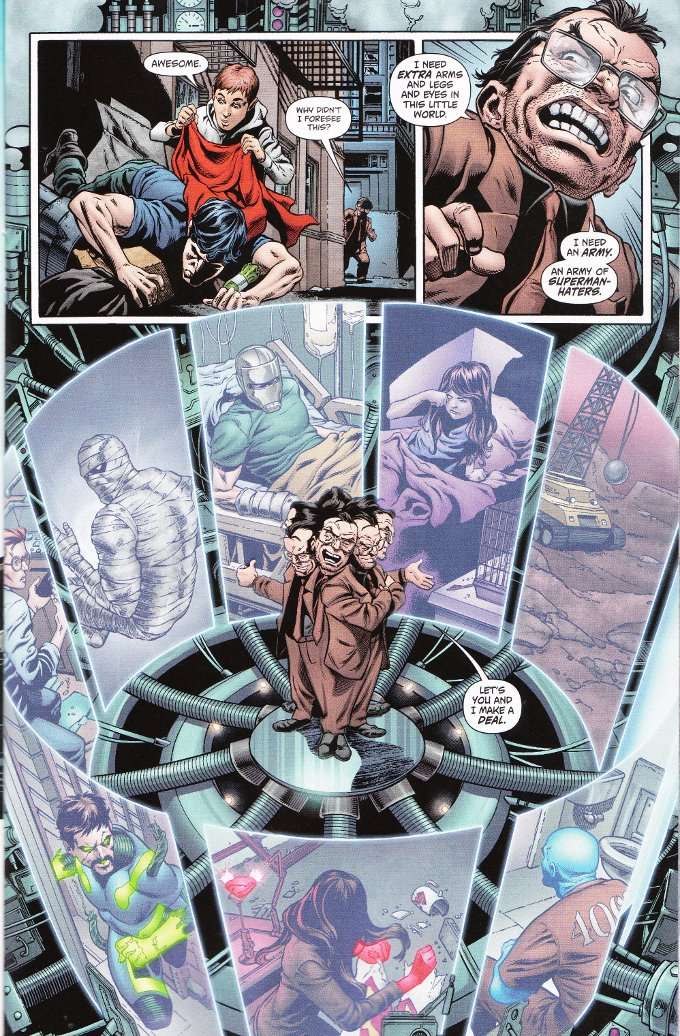
With Action Comics #17, the phrase "never-ending battle" has taken on another meaning.  It seems like Grant Morrison's final storyline for this series has been going on forever and the novelty of Morrison's conceit for this story - an assassination attempt executed through multiple points in space, time and probability - has begun to wear thin.  This entire issue feels like filler up until the final pages, where Superman finds himself with a most unlikely ally in his darkest moment leading into next issue's conclusion.


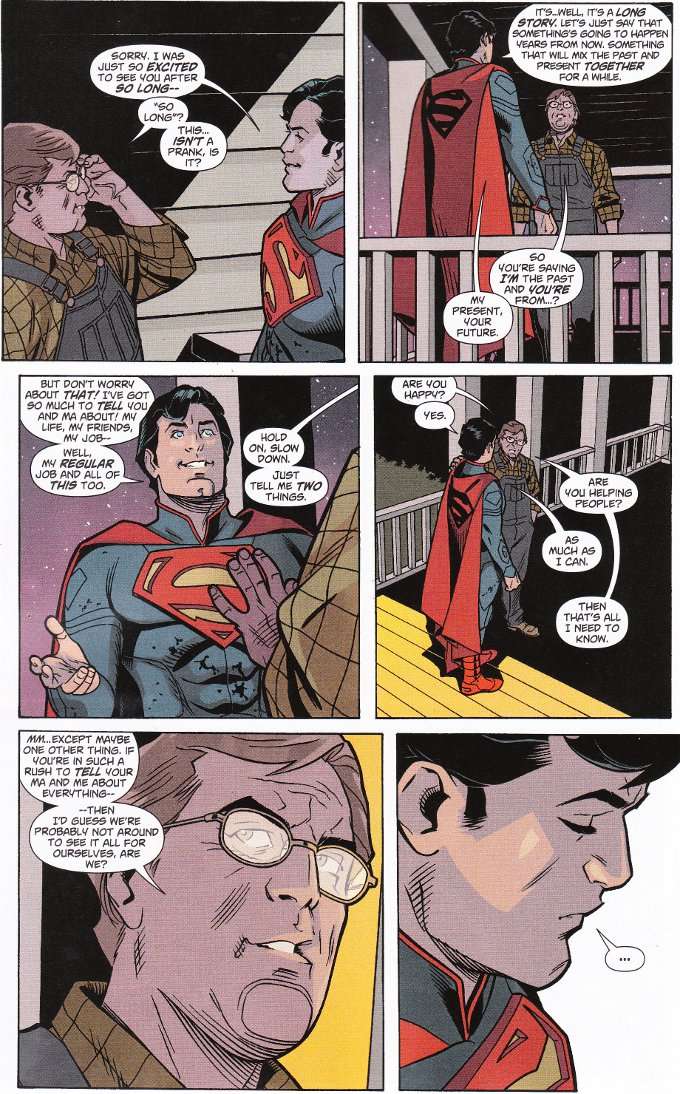
The back-up story by Sholly Fisch is far more enjoyable.  Indeed, I'd recommend this issue just for this story alone.  Stories about Clark and Pa Kent having a good father/son chat are hardly new but Fisch's story here - centering on a time-displaced Superman being given a chance to talk to the dad who never got the chance to see what he did with his life - seems both brand-new and touching.  It reminded me of a similar story that J. Michael Straczynski penned for Amazing Spider-Man #500 yet it still comes off as it's own unique tale.


This book continues to be blessed with top-notch artists across the board.  Brad Walker?  Rags Morales?  Chris Sprouse?  You'd be lucky to have one of these artist's illustrating a story, never mind all three of the working in concert!  While I may grow annoyed with Morrison dragging his feet, I cannot complain about how this book looks even as it seems we are treading water in terms of the plot.

Saturday, January 12, 2013

Action Comics #16 - A Review

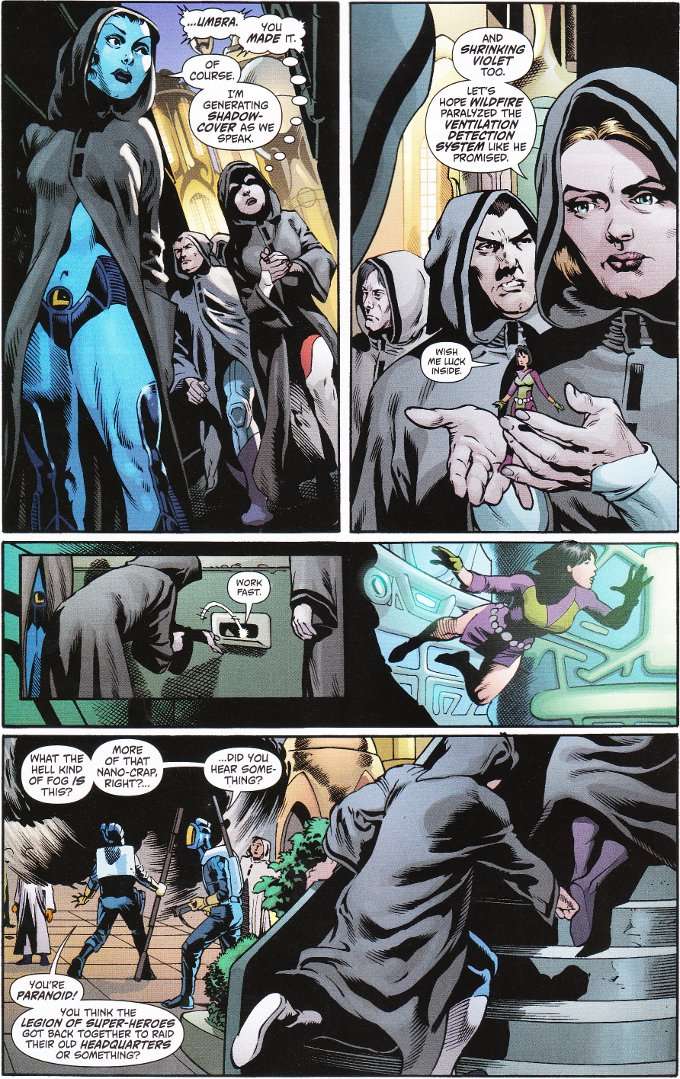
It's folly for me to attempt to describe the story of Action Comics #16 beyond what I already explained in my review of last month's issue.  Reality has begun to break down as Superman faces attacks at multiple points in space and time, all thanks to the plotting of a Fifth Dimensional being.  Thankfully, Superman is not without allies even in futures just born into existence which should not be.  A new addition to the morass this month includes a version of the Legion of Superheroes from a future where a tyrannical government born of a villain from the past now threatens of all creation and their only hope is a desperate trip back in time to aid Superman in his greatest battle!


It's a damning statement on the condition of the New 52 Legion of Superheroes books that - despite Morrison not focusing on their characters - the vision of The Legion we see here is far more accessible and far more likeable than any of the characters I saw in Legion of Superheroes or Legion Lost.  Let that thought sink in for a moment - a story by Grant Morrison about reality collapsing and the text of the story reflecting that is more lucid and easier to follow that Legion Lost.  That statement goes double for the enjoyable back-up story by Scholly Fisch, in which we see the LOSH at a point in their past where they accidentally set their dark future into motion by stopping a political assassination.  


The art teams for both sections of this series continue to excel.  Walker and Morales continue to paint vivid pictures of reality running together as Superman's enemies begin to attack time itself.  Chris Sprouse's stylized pencils show us a Legion as fun and as colorful as the team at the height of their popularity.  High quality, all around.

Friday, December 14, 2012

Action Comics #15 - A Review

If there is any writer in comics capable of telling a story in five dimensions, it's Grant Morrison.  Okay, maybe it's a bit of an exaggeration to say that he tells the main story of Action Comics #15 in five dimensions.  Yet he does tell a story that is multifaceted, taking place at several points and several perspectives in time. 

The main portion of this tale is told by Superman's landlady, who it seems is actually a princess from The Fifth Dimension and is/was/will be aware of everything Clark Kent is/was/will be.  Meanwhile - or perhaps 'Previously' or even 'In The Future', a group of Superman's greatest enemies hunt him through multiple points in history.  And that's ignoring the greater cosmic threat that even now threatens multiple worlds at multiple points in space and time, including Krypton!

Confusing?  No more than your average Doctor Who episode and this is just as enjoyable to those with the right mindset.


Easier to comprehend but no less enjoyable is the back-up story by Sholly Fisch.  This story tells the tale of one of the villains now hunting Superman.  More importantly, it tells the story of the hero who stopped him once before and even in death seems to be setting up the means for Superman to survive.  The hero?  Mister Mxyzptlk.

Fisch spins off of Morrison's conceit, keeping in line with the original portrayal of the character, that Mister Mxyzptlk isn't malicious.  He may annoy Superman with his antics but ultimately likes the Big Blue Boy Scout.  There's a bit of a retcon here, recasting Mister Mxyzptlk as a court wizard/jester for the King of the Fifth Dimension, who did what he did to Superman as a way of amusing his bored king and whose antics wound up winning him the heart of a princess.  It's a marvelous conceit and though the idea is a throwaway, it's one I'd love to see explored in a regular series. 

The artwork, as always, is top-notch.  Brad Walker and Rags Morales are formidable creators on their own.  Together, their work blends into a wonderful artistic alloy.  Chris Sprouse's cartoonishly stylized work in the back-up story is gleefully glorious and a joy to behold.  All in all, Action Comics continues to be one of the best values on the market and a darn good dead.

Sunday, November 18, 2012

Action Comics #14 - A Review

Action Comics #14 tells two different stories drawn from today's science news headlines.  One story is set on Mars and centers upon the themes or exploration and wonder invoked by our recent landing of a rover on Mars.  The other story goes further afield than our solar system yet hits much closer to home.


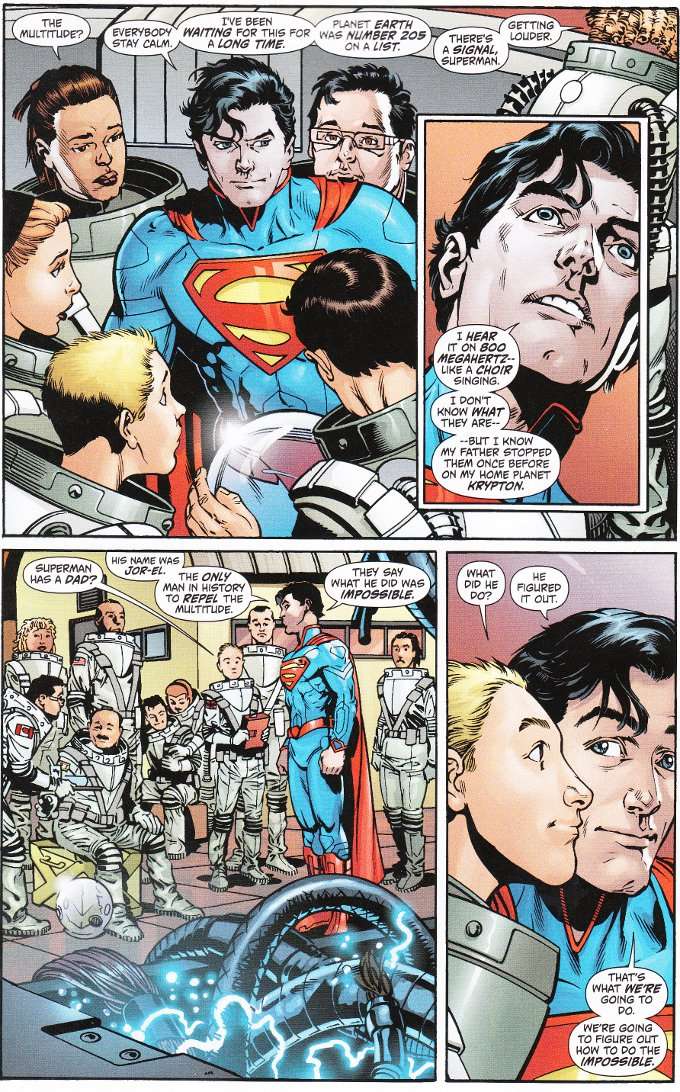
The first story centers upon Superman making a journey to Mars to help protect Earth's first colony there from an invasion of The Metaleks - the all-consuming mechanical creatures we first saw several issues ago.  It turns out that they are the least of it and that the Metaleks are on the run from an even more insidious threat known as The Multitude.  Since they appear on the cover, it spoils nothing to say that The Multitude have the appearance of angels with fangs and claws. 

Grant Morrison's story seems well-paced enough but at the same time seems awfully derivative of his previous work.  Morrison famously explored the base idea of Superman fighting angels during his now-legendary JLA run and one can't help but think of that story hereAnd even with Morrison's take on Superman being more of a thinker than a puncher, I still can't help but think this story would be more appropriate to Doctor Who than Superman.  Rags Morales injects his usual energy into the proceedings with his excellent artwork but that doesn't change the fact that we've seen this story done before and done better.

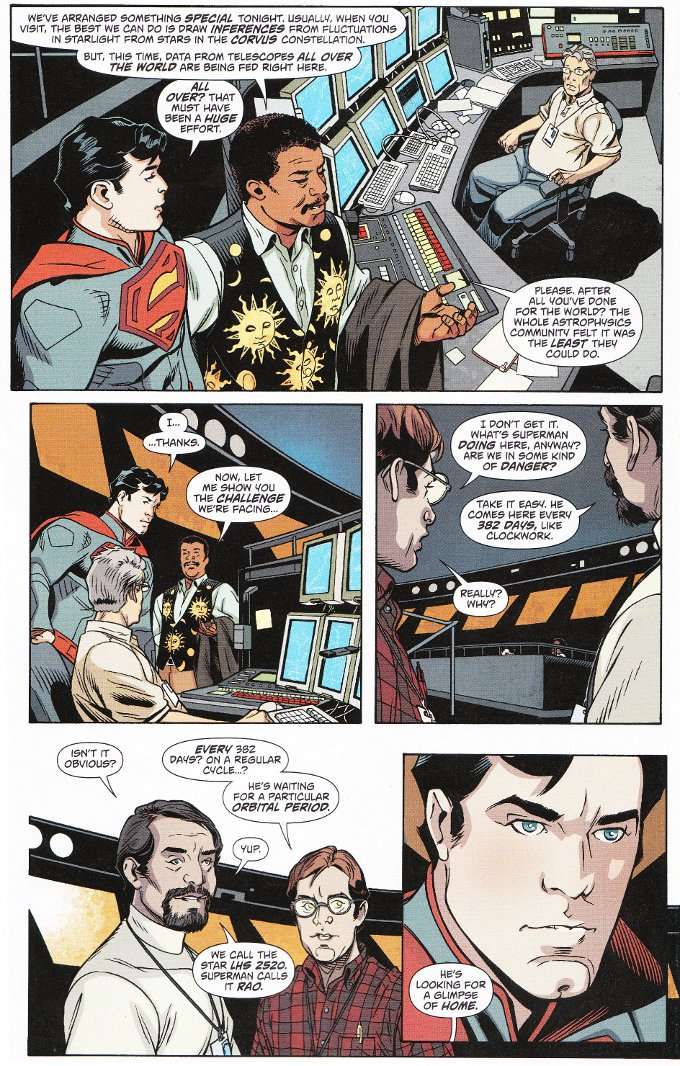
The second story, guest-starring famed astronomer Dr. Neil deGrasse Tyson, has less action yet hits the reader much harder.  DC Comics made the headlines recently when they asked Dr. Tyson to try and find a real-world place where Superman's homeworld of Krypton might have existed.  Tyson obliged and this story details his efforts to give Superman a glimpse of home as thanks for everything he's done to help the Earth.  Injecting real world figures into a superhero comic is always a risky affair but Sholly Fisch - ironically enough - manages to keep things down to earth.  The artwork by Chris Sprouse is crisp and clean, yet oddly stiff and posed.  In a more action-packed story, this might be problematic but it fits this story well enough.   

Saturday, October 6, 2012

Action Comics #13 - A Review

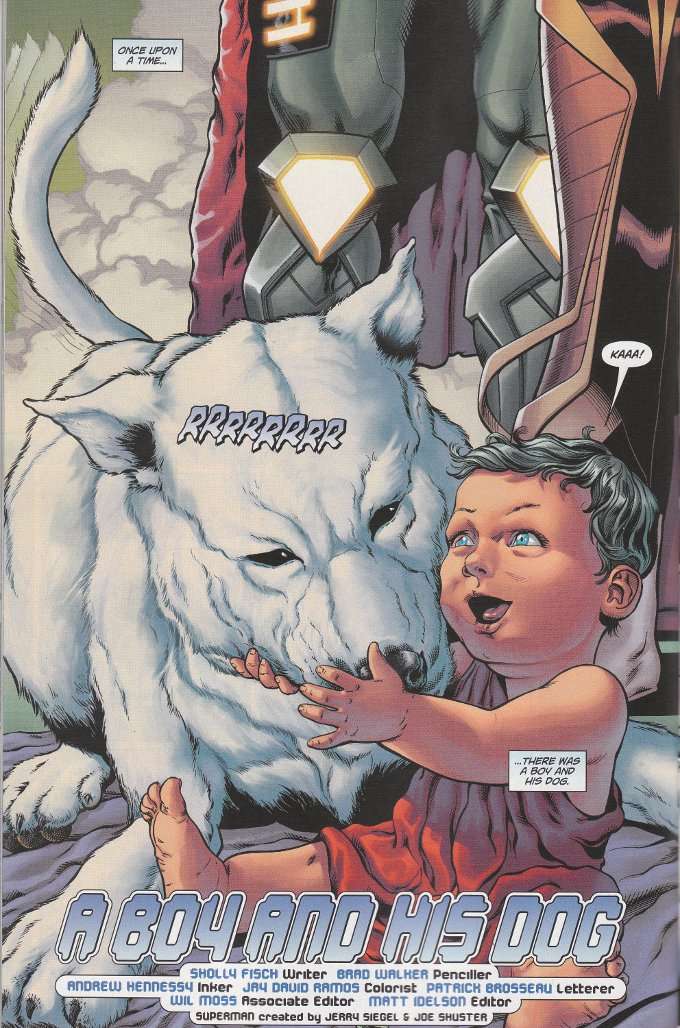
Action Comics #13 is many things.  A tale of revenge.  A ghost story.  A Halloween tie-in comic  A tribute to the writings of Ray Bradbury. A parable about the power of faith and the inevitable triumph of good over evil.  And yes, it is even a story about a boy and his dog..


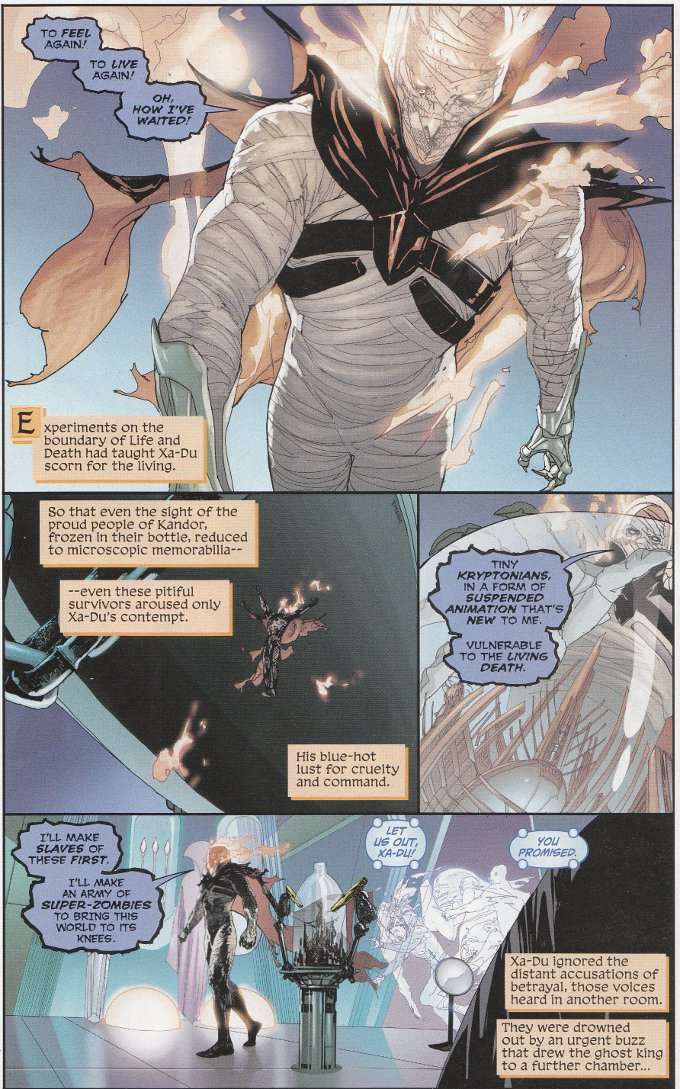
Our plot centers upon Dr. Xa-Du - the first criminal to be sent into The Phantom Zone.  Sentenced to "total physical dematerialization" for his experiments in suspended animation which "unleashed the horror of living death" on Krypton, Xa-Du is quick to swear revenge on his accusers.  In particular he singles out the scientist who discovered The Phantom Zone and suggested it as an more humane alternative to the previous methods of criminal punishment on Krypton - Jor-El a.k.a. Superman's dad.

Does this seem a bit familiar?  A bit.  The trial scene and subsequent scenes in the Phantom Zone are totally cribbed from the Superman movies, with Non and Ursa being among the other criminals eventually sentenced to The Phantom Zone and one figure says "Kneel Before - " before getting cut off.  But Grant Morrison has proven his ability to take classic superhero cliches and make them seem new and exciting time and time again and does it again here.


How does he do it?  By emphasizing the horrific elements of Xa-Du's experiments and confirming that he almost caused the Zombie Apocalypse on Krypton.  Some Kryptonian criminal escaping from the Phantom Zone and trapping Superman inside it?  Not that new.  A Kryptonian criminal escaping from the Phantom Zone using an "ecto-suit" that makes him look like a mummy, who traps Superman inside it so that he can begin a new reign of terror backed by an army of super-zombies?  NOW we're cooking with super-gas!

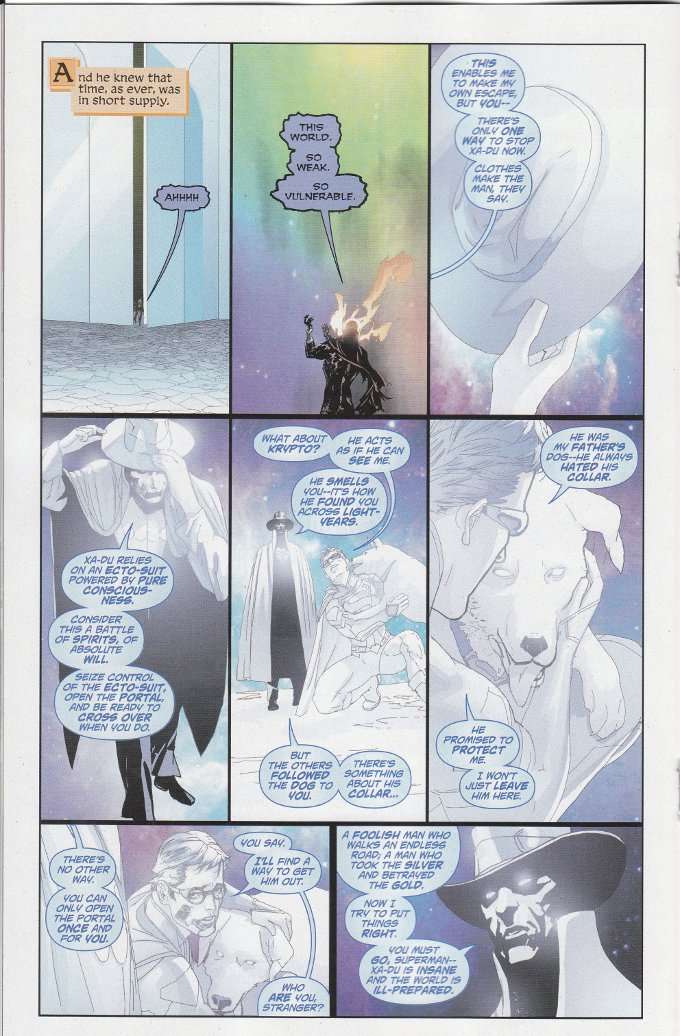
Truly, this story is so awesome that not even the inclusion of Wandering Judas (I refuse to call this character The Phantom Stranger as he isn't a stranger and outright tells Superman who he is!) can weaken it.  Not in the face of the concentrated furry ball of awesome that is Krypto The Super Dog.

Yes, Krypto - the family hound of the House of El - is still alive.  Trapped in the Phantom Zone while protecting a young Ka-El from an inter dimensional attack, he has been there for many years, watching and waiting for his young master to return to him after apparently tracking him part way across the universe by smelling him.  Does this make a lick of sense?  No.  Do we care?  Not really.  Because the idea of a ghost dog that can track someone across the whole of space and across the dimensional divide is just awesome. And the concept becomes even more awesome in the back-up story by Sholly Fisch, where we see that Krypto has been watching over young Kal-El for quite a while.


The artwork for the issue is generally as impressive as the story.  Travel Foreman, who penciled the main story, does a fine job with The Phantom Zone sequences, using light inks on the ghostly figures trapped in the Zone while heavily shadowing Xa-Du in the far-shots to visually emphasize his own dark corruption.  The color palette by Brad Anderson also helps emphasize the three levels the art plays upon.  The only problem I can see is that  Foreman's design for Krypto seems inconsistent, with Krypto largely resembling a husky or short-eared wolf-hound in most panels but suddenly having longer, floppier ears in some panels as above.  The artwork in the back-up story, by Brad Walker and Andrew Hennessy is more consistent, with Krypto clearly defined as a more wolfish breed as opposed to the Beagle-like breed we're used to seeing.

This issue is a wonderful jumping on point for those of you who have resisted the draw of Action Comics up until now.  It would also make a fine gift for any dog lovers you might know or anyone looking for an unusual ghost story this Halloween.

Wednesday, September 12, 2012

Action Comics #0 - A Review

The origins of Superman are one of the most well-known stories in modern American culture. DC Comics has already told and retold this story several times in the last decade alone (Birthright, Secret Origins, Earth One). Just a year ago, Grant Morrison gave us a picture perfect introduction to everything Superman is in the New 52 universe with the first issue of the new Action Comics. One wonders then - what more needs to be said about how Superman became Superman? What CAN be said that hasn't already been said?

It is, perhaps, in answer to this question that Action Comics #0 breaks away from the standard template we've seen thus far in DC Comics's Zero Month issues. Morrison's focus in this issue is less upon the man himself and more upon the people he touches. More, it is an exploration of the idea of Superman and his greatest power - the power to inspire.
Italic


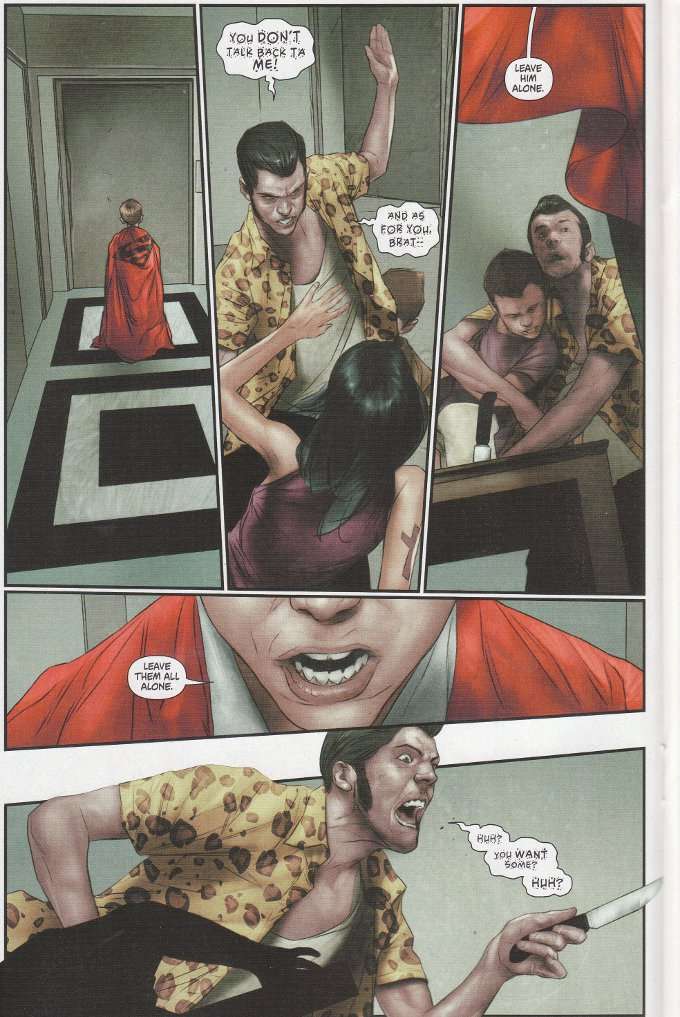
The Boy Who Stole Superman's Cape centers upon a young boy who, having witnessed Superman's first unsuccessful attempt at crime fighting and seen him survive close-range contact with an RPG, steals his cape. Why? Because he has an abusive step-father at home and he knows that cape can protect him and his family.

As with so many Morrison ideas, the conceit is brilliant in its' simplicity - take the conceit of so many children playing superheroes and make it into a practical reality. What comic fan didn't tie a blanket around our shoulders and pretend we could fly while stretched out across a bed or stand up to a hail of gunfire, fists firmly planted on our hips at some point in our childhood? Precious few, I'd think.

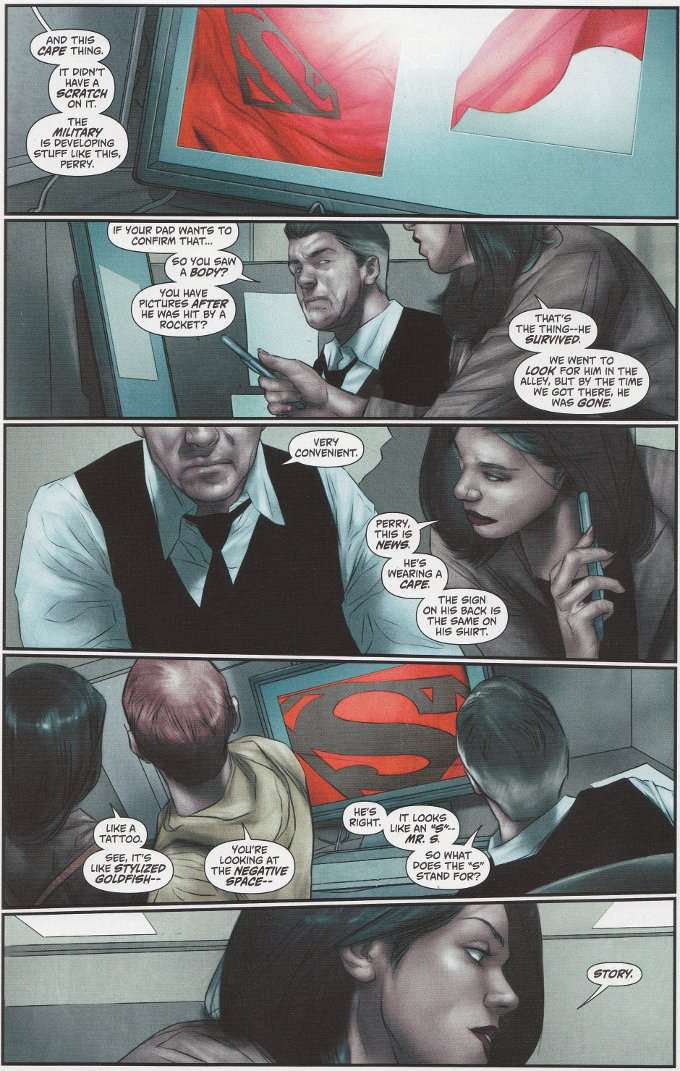
Morrison also adds a little polish to his development of the supporting cast. Jimmy Olsen's role as Clark Kent's "pal" (i.e. ex-roommate and only real friend in Metropolis) is expanded upon. Perry White is given a far larger role than I think he's had in the series until now (no surprise as he isn't Clark's boss yet). And Lois Lane - dear Lois Lane, I have missed seeing you be written to be this awesome.


Ben Oliver & Brian Reber - the regular art/coloring team on Batwing - deliver what is easily the best work I've ever seen from their partnership and that is saying something. Oliver's crisp pencils are perfectly painted and brought to life by Reber. Letterer Steve Wands also deserves high praise for his unique method of demonstrating drunken, slurred speech.

If this issue has a downside, it's that the back-up story seems like something of an add-on to the meat of the main part of the issue. Origin of the Species details the creation of this universe's version of Captain Comet. It's not a bad story. Sholly Fisch is as great a storyteller as ever and Cafu's art is grand. There's just little emotional investment in an origin story for a character who is supposed to be a superbeing developed far beyond humanity's ability to comprehend or relate to.

Overall, this is a damn fine comic and a good jumping-on point if you haven't gotten into Action Comics yet. Give it a try. You'll be glad you did.

Wednesday, August 8, 2012

Action Comics #12 - A Review

How is it possible that the best bits of a book called Action Comics have nothing to do with action, much less the action of the main story? Such is the magic of Grant Morrison, whose run on Action Comics has delivered plenty of what the title has promised. But as in so much of his earlier work, it is Morrison's unique ideas that capture the hearts and minds of the readers rather than the standard superheroics.


Case in point: the main thrust of this issue sees Superman attempting to protect Lois Lane's niece from alien abductors and what is apparently the New 52 version of Captain Comet. Little Susie Lane is apparently a Neo Sapien - an evolutionary flash-forward with powers atypical of what humanity will eventually evolve into. This may seem like fairly standard stuff for a Superman story but you'd be wrong. Morrison drew great acclaim for playing with the powers of Superman and everything they might encompass during his All Star Superman mini-series and he does much the same here, as Superman finds a way to out-think an enemy he cannot possibly outwit. Morrison also pays tribute to the Superman stories of yesteryear, restoring an old chestnut I don't think has been used since the Silver Age - Superman's infinite capacity for knowledge and ability to read at super-speed.


It is the moments such as these that make Action Comics one of the best books on the market today and the best Superman title to come out of the New 52 revamp. With the precision penciling of Rags Morales backing Grant Morrison's splendid scripts, this is one to keep on your pull list!

Tuesday, July 10, 2012

Action Comics #11 - A Review

I don't know how Grant Morrison manages to cram so much information and wonder into a single issue of Action Comics. I'm just glad he does it.

With Clark Kent having "died" in the last issue after a professional assassin discovered the connection between Clark Kent and Superman, Superman has adopted a new secret identity - a fire-fighter named Johnny Clark, who is a complete blank apart from his day job. The good news is the job does give him plenty of opportunity to help people apart from being Superman. The bad news is... well, he feels out of touch with people he's helping, having traded Clark Kent's cheap apartment for the satellite which once housed Brainiac. Of all people, he vents about this to Batman in what is a surprisingly effective character-building scene for both heroes and the first time I've really seen the two acting like the World's Finest heroes since the reboot.


Oddly enough, this has nothing to do with the main plot of the issue, which involves Lois Lane's niece turning out to be a nutant - a delightful Morrisonian term for a human who is evolved far in advance of modern-man by 100,000 years. The build-up is surprisingly understated but promises some exciting action in the next issue. The back-up story by Sholly Fisch is another amusing slice-of-life story, depicting a Metropolis T-Shirt shop which claims to be the place where Superman buys his t-shirts. Of course our POV characters - a tourist and his friend, the local - are skeptical, even as the owner tells the story of how Superman saved him from a robber and earned himself a discount.


I've written before about my love of Rags Morales art and my joy that he is back on a monthly book. His work on Geoff Johns' Hawkman was seriously underrated and it is good to see him on a prominent, monthly book like Action Comics again. The back-up story art by Cafu is also of high quality.

Action Comics is something DC Comics has needed for a long time - a Superman book that shows why Superman was the inspiration for an entire genre. It is a must-read for all fans of superhero fiction.

Friday, June 15, 2012

Action Comics #10 - A Review

Grant Morrison's scripts are usually chock-full of ideas but for the first time since he started on Action Comics, this is not to the benefit of his script.  Don't misunderstand me - I loved this issue as I've loved the entirety of the series since the start of the new DC Universe.  Morrison is one of the few writers I feel truly gets the heart of Superman and has made a true effort to do something new with the character. 

The problem is this issue does so much to play with the ideas of who Superman and Clark Kent are while setting up various future plot points that it winds up devoting very little time to its' nominal plot - a hunter named Nimrod attempting to track down and assassinate Superman.  Compared with the spectacle of Superman confronting a child killer the cops won't touch, Superman attempting to find a pair of hamsters a new home (don't ask) and a Justice League meeting where Superman all but outs Batman's secret identity completely by accident while nagging the team about becoming a greater force for social justice (Superman/Green Arrow team-up soon?  Please?), the more mundane plot involving Nimrod can't compete... even when his job is blown following the apparent death of Clark Kent.

I've said before that I always felt Rags Morales was one of the most underrated pencilers that DC Comics employed and that it was a fine thing to see him on a monthly book.  At the risk of being repetitive, I'm saying it again here.  Really, I cannot stress strongly enough how much I like Morales' work on this book.


The back-up story by Solly Fisch is as enjoyable as ever, depicting a number of Clark Kent's associates and friends paying tribute to their colleague after his apparent death.  I can't say a lot about this story without revealing some substantial spoilers.  I will say that if it weren't for the mid-book credits, you'd never have known this was a separate story, so seamlessly does it blend into Morrison's narrative style.  Cafu's artwork on this section is also complementary of Rags Morales' style, offering a shadowy and more detailed look at the characters that is fitting of the introspective tone of the tale.  


This is a lackluster issue of Action Comics but even a mediocre issue of this book is better than the best days of most other comics.  If you aren't reading this book, you should be.  Even if you aren't a Super-Fan, you owe it to yourself to give this book a shot as Grant Morrison isn't writing your daddy's Superman.  Heck, he's not even wriitng your older brother's Superman.  This is Superman done right, for the 21st Century..

Monday, May 7, 2012

Action Comics #9 - A Review


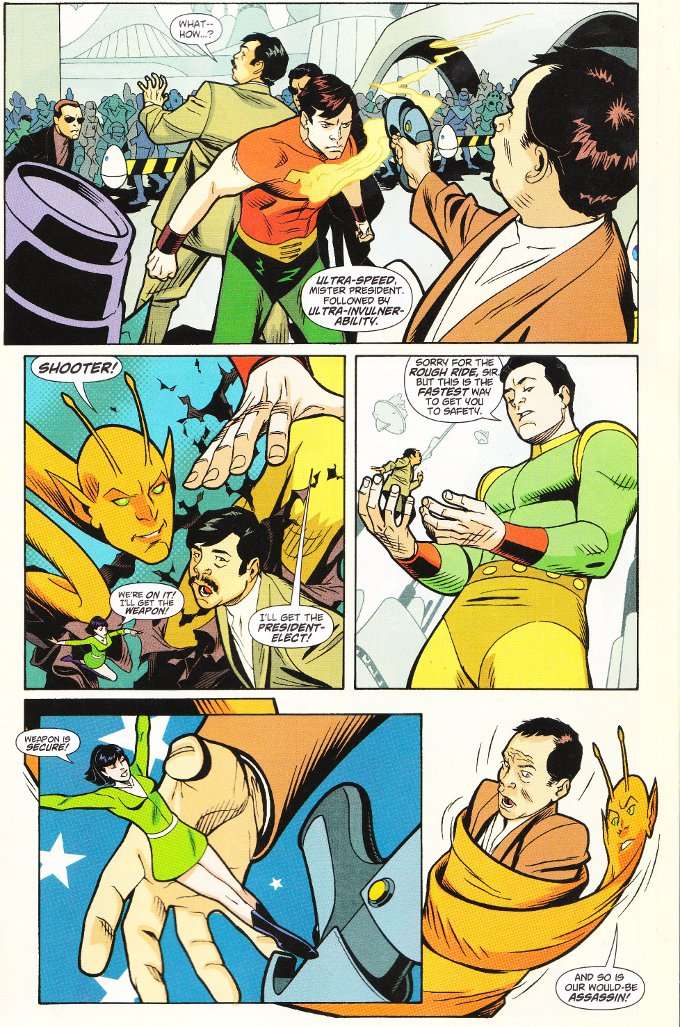
Returning to a concept first introduced in his Final Crisis series, this issue of Action Comics reintroduces us to Calvin Ellis.  He appears to be an ordinary African American man but is secretly the Superman of Earth 23.  Ellis balances his duties as Superman with those of his day job - President of the United States of America. 


Fresh off a victory against his arch enemy, Calvin confronts a mysterious trio who appear suddenly from a portal.  The two male figures are badly burned and the one female figure is missing an eye.  She explains to Calvin that they created a device that enabled them to make thoughts real as solid sound-waves and that they attempted to sell the device in order to promote their idea for an idealized guardian of good - a Superman.  But the Superman concept was diminished in an effort to commercialize it to the masses until a new Superman - a brutal, pitiless monster - was turned loose upon its' creators.  A monster traveling to Earth 23 even as they speak...


There is no reason for a story like this to work nearly as well as it does, as it can be read several different ways. Straight comic book story?   A parable about creators' rights? A warning about the dangers of corporate culture controlling the creative process?  It works on every conceivable level.  This isn't the first time Morrison has merged elements of the textual and metatextual made manifest into a script but the spin here is a unique and interesting one.

Gene Ha pulls the art duties this time, filling in for Rags Morales.   Ha proves an able replacement, offering a grittier, darker style than Morales but one that fits this darker, stranger story perfectly.  Credit must also be given to colorist Art Lyon, whose prefect palettes further define Ha's pencils and inks.

No less enjoyable is the back-up story by Sholly Fisch, which details a day in the life of Calvin Ellis as he attempts to balance both his duties as a member of Earth 23's Justice League and President of the USA, negotiating with the leader of a terrorist nation over the phone even as the JLA is destroying the secret labs where said leader is building weapons of mass destruction.  The story raises some interesting ethical questions and I'd love to see more stories done with the Justice League we see here.  The art by Cully Hammer (most recently of The Shade mini-series) and colorist Dave McCaig is top-notch.

Action Comics is one of the best values for your comic-buying dollar for sheer variety, if nothing else.  It is superhero comics done right and a must-read for any fan of the genre.

Thursday, April 26, 2012

Action Comics #7-8

I usually start my reviews by talking about the writing.  This time, I'd like to start with the artwork.  Consider if you would this silent page.


I've been a Rags Morales fan since his days on JSA and Hawkman and while it may be hyperbolic for me to say that this is the best work of his career, I'll stand behind the statement.  Morales is a highly underrated storyteller and it's amazing how much action and character he can put into a single page.  Here we see Clark Kent, pushing himself past limits he's never dared consider, attempting to leap off of the Earth itself in pursuit of the alien menace that just stole an entire part of the city of Metrpolis.  Does he stop to marvel at the sheer wonder of what he's just done?  Does he pause to gaze at the astonishing beauty around him?

No.  His focus remains upon his target and finding the foothold he needs to get  there.  Without a single word of dialogue to assist him, Rags Morales has conveyed the essence of Superman as a character and showcased his greatest power in one page.  It isn't flight or super strength or heat vision - it's his selflessness.

This core idea - that Superman's greatest power is his truly selfless nature - was at the core of another great Superman series, All-Star Superman.  Not surprisingly, both that mini-series and this book are written by Grant Morrison, who has a fair bit of experience writing Superman and being an amazing writer in general.  What is surprising, however, is that despite his time and experience writing Superman, Morrison still finds new things to say with the character and new ways of looking at the classic mythos.

As I noted in my earlier review of the Action Comics series, Morrison has managed the amazing trick of retelling the Superman origin story while still making it seem entirely new and exciting, despite working with the exact same props and characters.  For instance, it was not much of a surprise that the electronic alien menace that stole part of Metropolis was the classic Superman baddie Braniac.  What was a surprise (and a very amusing one, in my opinion) was Morrison's depiction of this robotic A.I. as less of a super-intelligent genius and more of an obsessive collector - a personality I'm sure most comic readers are familiar with.


That is but one surprise of many that has been sprung upon we readers within the past two issues.  I shan't tell you of exactly how Brainiac came to Earth, the origins of Superman's new costume or the identity of Clark Kent's mysterious informant.  Why?  Because I want you to have the treat of discovering these mysteries and more for yourself.  The collected edition isn't due out until August, so if you can't wait for a nicely bound edition, I'd suggest checking the on-line stores for a digital copy..  You'll be glad you did.

Friday, February 17, 2012

52 Catch-Up: Action Comics #1-6

If Action Comics can be said to have a constant in the New 52, it is that one never knows quite what to expect. This should, paradoxically, be expected given that Grant Morrison's writing - particularly his writing of Superman - usually encourages us to expect the unexpected yet leaves us gaping slack-jawed at the wonders on every page. Exceptionalism has become the norm. Thankfully though we expect much we're rarely disappointed. How could we be with the likes of Rags Morales and Andy Kubert lending their pencils to Morrison's prose?


The first issue serves as a prime example of the paradoxes Morrison frequently puts into his writing. In taking Superman back to his Great Depression era roots as a rabble-rousing champion of the common man, Morrison has given us the perfect hero for the era of the Occupy Movement and the 99%ers. No more The Big Blue Boy Scout, this Superman will gleefully dangle a corrupt businessman over a ledge to put the fear of God into a worshiper of Mammon. Despite this, he is still recognizable as our Superman - faster than a speeding bullet, more powerful than a locomotive and able to leap reasonably tall buildings in a single bound.


It is said that a great storyteller can tell you the same story more than once but make it just as enthralling as the first time you heard it. Morrison accomplishes this feat with apparent ease. All the elements of the Superman origin we've heard time and time again are contained with these opening issues. But with a tweak here and a stitch there, Morrison manages to make this classic tale seem new again. And yet, Morrison still finds the time to throw in his own little additions to the Superman mythos.

Case in point - in Issue 2, Superman is captured by Lex Luthor - a scientific genius and freelancer who is currently in the employ of the US Government. For reasons that are explained hilariously later, they believe that Superman is a shape-shifting alien and that the body of a deformed calf is a deceased member of Superman's species in its' true form.


This is a moment of high comedy but it also reveals something of the characters involved. Namely...

1) Lex Luthor does not like being laughed at or being made to look the fool.
2) Superman has brains to match his strength, proving to be no mean tactician and to be knowledgeable enough about science to figure out how his various vision powers work.

I also have to give Morrison props for his logical expansion of Superman's powers here. Morrison did a lot to improve Aquaman's stock during his run on JLA, postulating that anyone capable of controlling fish brains would also be capable of wrecking havoc on the parts of the human brain responsible for controlling balance. Here, if we can assume Superman's heat vision is based on focused microwave emissions, he should also be able to scramble electronics the same way a radio jammer does.

This trend continues into Issue 3, where Morrison looks a bit more closely into the life of Clark Kent. Here we find that Clark is just as much the altruistic hero as Superman, using his limited power as a journalist and blogger to try and expose corruption in the local government and big business to the point where he's harassed by the police on a regular basis.


Issue 3 also gives us a closer look at Clark's friendship with Jimmy Olsen, who works for a rival paper along with Lois Lane. Oddly, out of all of the supporting cast, it is Lois and Jimmy who get the least development time. Then again, as the most well developed members of the supporting cast (and, arguably, the best known supporting comic book characters of all time) one could argue they need the least amount of page time. Suffice it to say, Lois is as ornery, independent and all-around awesome as ever. And Jimmy? Still everyone's pal.


Issue 4 gives us the greatest number of cast expansions, providing us our first glimpse of John Henry Irons as Steel, John Corben's transformation into a heartless robot man (he has yet to take the name Metallo) and an oddly familiar alien robot stealing away part of Metropolis for his collection of bottled cities. The issue also brings us our first back-up story, written by Sholly Fisch who gives us an in-depth look at John Henry Irons even as he depicts, in detail, the battle in which "Steel" saves Superman from John Corben.


If this seems somewhat familiar, you may be thinking of the episode of Superman: The Animated Series, in which Steel premiere episode pitted him against Metallo to save Superman's life. There are some differences here, though, as John Henry Irons didn't originally work for Lex Luthor, though his strong ethics do cause him to resign his job and to use the technology he designed to help undo the damage he caused.

Issue 5 shifts gears completely, giving us another retelling of just how a young Kal-El was sent from Krypton to Earth. Little seems to have changed from the recent retelling of this story in Geoff Johns' Superman: Secret Origin, save that The Kents were just barely able to get away from the spaceship crash-site with the baby, never mind carry the rocket off unnoticed.


This sets up a call back to issue 3 and a tangential storyline, where we learn the history of the rocket after it was discovered by Clark Kent, who had no idea as to his alien origins until then. This issue also gives us another Sholly Fisch back-up story, in which we see the early life of Jonathan and Martha Kent and learn of their struggles to have a baby up until their one-in-a-million-encounter with a child from the stars. This is another story that has been told before, but Fisch manages to make it fresh, making Martha and Jonathan into realistic and sympathetic people. Of particulate note is a scene in which they visit their pastor, who tells them that he is certain that God would not deny two loving people like them a child and that He must have big plans for them.


Issue 6 continues right on from where Issue 5 left off, as we jump forward a little bit in time. And yet, we don't. The action here focuses upon a future Superman, who has traveled back to his first year as Superman with some of his friends from the Legion of Superheroes in tow, in order to stop the Anti-Superman Army of his time from traveling back in time to steal the Kryptonite-powered core of the spaceship that brought him to Earth.

Yeah. You can tell Grant Morrison used to be a Doctor Who writer, can't you?


Fisch's back-up story this time is another fine character piece, this time centering on Clark Kent examining the house he grew up in one last time before leaving Smallville for college. There's a few details here that will be of note to Superman scholars who like to know how every incarnation of Superman is different, like the fact that Pete Ross is aware of Clark's "special gifts" in this reality.


Action Comics is a must-read title for all fans of comics in general and Superman in particular. Though there's nothing really new here, Morrison and Fisch have found a way to make these stories seem new in the telling. And the artwork is amazing, with top-notch teams working on both parts of the book every month. Rags Morales, Andy Kubert, Brad Walker & ChrissCross are all masters of the genre. If you aren't reading this one already, you are missing out.

Thursday, October 20, 2011

52 Pick-Up - Week One

Since my recent Internet outage has left me somewhat behind, I've opted to do something akin to the old Fast Thoughts reviews from my old blog regarding all of the new DC Universe books I was trying again after the first month of 52 new #1s.

Welcome to the first installment of 52 Pick-Up.


ACTION COMICS #2 -
Captured by Lex Luthor and General Lane, Superman must endure some horrific tortures as he bides his time waiting for an opportunity to escape. Morrison and Morales continue give us the best Superman comic in recent memory as they reestablish the key elements of the Superman mythos. We see our first appearance of John Henry Irons and John Corben (a.k.a. The Man Who Will Be Metallo) and what I think is the first appearance of Brainiac in this new reality. But Morrison still finds ways to bring something new into the mix, not only giving us a plausable-sounding scientific explanation for how Superman's heat vision would work (i.e. focused microwaves) but finding new uses for Superman's powers, such as using his microwave vision to scramble electronics. Highly recommended.


GREEN ARROW #2 -
Concerned about Green Arrow's success in taking out their party pals, a group of celebrity supervillains make plans to draw out the Emerald Archer. We get a lot character scenes this time around, watching Ollie go through a typical workday. Not surprisingly this involves as little "work" as possible, opening with him playing basketball with the local star athlete, meeting with his personal assistant briefly to bump back as many appointments as possible and then heading to the lab to test-drive the new trick arrows. Still an enjoyable book, with plenty of action in the beginning and end. And bonus - the last page promises we'll see Black Canary next issue!


STATIC SHOCK #2 -
Recovered from his apparent injury at the end of last issue, Virgil is as shocked that his powers apparently let him reattach a severed limb as we are, figuring that the only thing that saved him was his attacker using an atom-thick blade that cut so neatly his electrical powers automatically fused the flesh back together. While this is a cool explanation that cements just how powerful Virgil is, it still seems like a total cheat. There's still no explanation for why Static has two sisters now, though we do find out that one of them is a clone of the other and that Virgil feels responsible for it... somehow. This book is stumbling a bit but the action scenes are still great, though McDaniel's pencils are getting a little sloppy on the long-shots. I may give this one another issue but this may be moving to "Wait For The Trade" status.


Saturday, September 10, 2011

Action Comics #1 - A Review

We’ve all heard the complaints. Superman is boring. Superman is too powerful. Superman is too much of a goody-goody. Superman is irrelevant today. Such is the perception, not only of the public at large, but most of the comic-buying community. Small wonder then that Grant Morrison would seemingly choose to directly tackle these complaints in his revamp of The Man Of Tomorrow.

Indeed, I heard a new batch of wholly new complaints about this issue before I had a chance to read it. Superman confronts a corrupt executive without any proof of wrong-doing! Superman is on the run from the police! Superman isn’t wearing his red underwear on the outside of his tights! Superman isn’t even wearing tights! And perhaps most shocking of all… Superman Doesn’t Fly!


I don’t know why people are so surprised. Grant Morrison is renowned for his ability to distill the complicated continuity of comics into its’ most basic elements and turning the world on its’ ear while doing so. He did it to the JLA with the simple idea of having DC Comics greatest heroes teaming up to face threats no one hero could face alone, just like in the original Silver Age comics or the Superfriends cartoons. He did it to X-Men by expanding upon the idea of what a growing mutant population would realistic entail by treating mutants like any other oppressed minority group, developing their own culture in response to the society that hated and feared them. And now he has revamped Superman for the modern world by taking him back to his roots as a hero of The Great Depression.

Does that sound a bit contradictory? Time for a quick history lesson, kids.

While the Superman of today is synonymous with the phrase over-powered, the Superman of 1938 – as originally created by Joe Shuster and Jerry Siegel was a relative weakling by comparison. No juggling planets this hero! The Golden Age Superman could barely lift a car over his head and – while far faster than a normal man – lacked the speed to travel back in time. Perhaps the introduction to the Superman radio show at the time said it best.

Faster Than A Speeding Bullet!

More Powerful Than A Locomotive!

Able To Leap Tall Buildings In A Single Bound!

Most fans don’t know the source of the above quote but it is probably the best summary of Superman’s powers and their limits in popular culture. As such, it is only natural that Morrison used these exact standards to test the new Superman.


Faster Than A Speeding Bullet? Definitely. When he bothers to dodge them.

More Powerful Than A Locomotive? Probably. He’s called to test it by issue’s end.

Able To Leap Tall Buildings In A Single Bound? Depends on how tall it is.

Morrison has returned Superman to his Depression-Era roots in another less obvious respect. While the Superman of today is widely seen as a duty-bound, law-abiding Boy Scout, the Golden Age Superman had a much looser moral code. He still acted to preserve life above all else but was not above terrorizing the wicked in order to see justice done. The Golden Age Superman was a liberal activist, focusing his crime-fighting efforts upon greedy businessmen and corrupt politicians (i.e. those responsible for The Great Depression) rather than bank robbers and muggers. Indeed, comics scholar Roger Sabin described Superman as the embodiment of "the liberal idealism of Franklin Roosevelt's New Deal", with Shuster and Siegel originally designing Superman as a champion of social reform as well as a crime-fighter.

Much of this first issue is taken up by two extended action sequences, with Superman fleeing the police after forcing a confrontation with sleazy businessman Mr. Glenmorgan. Monitoring the pursuit are General Sam Lane and independent contractor Lex Luthor – both charged by the US Government with bringing the so-called Superman to heel by any means necessary. This opens up the third act, where Luthor’s plan to draw Superman into the open unknowingly puts Clark Kent’s best friend Jimmy Olsen and rival reporter Lois Lane in harms way…


The plot is fairly standard stuff for those familiar with Superman, yet Morrison makes it all seem new again. Ironically, he does this by bringing back the classic elements of an older Superman into play. It is also ironic that while Luthor and Lane do their best to dehumanize Superman verbally (referring to Superman as “The Creature” and “It” rather than “He”), their actions only serve to humanize Superman all the more, as he risks his life and freedom to save the tenement-dwellers endangered by Luthor’s plan.

Of Rags Morales’ artwork, I can say little. I think the accompanying scans speak to the skill and craft of Morales’ work far better than I ever could. I can’t really think of any way to describe Morales’ style except to say that it is active. You’ll rarely see a posed panel in a book drawn by Rags Morales. Everything is always in motion, to the point where you swear you can see the wind rustling people’s clothes in the panel. In fact, there are some points where the panels CAN NOT contain the action!

Morales has been creating fine quality work for DC Comics for quite a while now, yet hasn’t seem to have gotten the name recognition of other artists. Perhaps this is because, apart from a run on the highly underrated Hawkman with Geoff Johns, Morales has mostly worked on mini-series and limited series. With any luck, this book will finally give him the recognition that he deserves as one of the finest illustrators in the business.


Think Superman is dull? Think Superman is boring? Think again. Morrison and Morales have crafted a masterpiece of modern comics while giving a nod and salute to what came before. This issue is a Must Read and you can bet this book will be on my pull list from now on.

Friday, July 22, 2011

DC Comics News From SDCC: Day Two

High Res Art From Supergirl, Superboy, Action Comics, and Superman Revealed!

New Supergirl costume to end complaints about up-skirt shots by eliminating skirt completely!


High Res Art From First 8 Pages of Johns/Lee Justice League of America Released!

Looks suspiciously like eight pages from unreleased All-Star Batman and Robin issues.


Grant Morrison on the new Superman costume: A 17 year old wouldn’t want to wear a suit his mother knitted

Morrison then notes new costume is better than original design, which featured ripped jeans and $30 T-shirt from American Apparel.


JMS says Superman: Earth One sequel will reveal that Clark Kent cannot have sex.

Much like your average Babylon 5 fanboy.


Mike Johnson says Supergirl is largely about the character figuring out her own origin.

Because the previous stories where she had no idea who she was or what she was doing on Earth were SO well-received...


Grant Morrison: "You can’t pierce Superman’s skin, but you can pierce his heart."

Later adds, Okay, you COULD pierce his nipples with a Kryptonite needle. But that costume was rejected too."

Thursday, June 10, 2010

One Good Thing And One Bad Thing About Batman #700


BAD THING: If you don't like Grant Morrison mind-frag stories with a lot of random weirdness... well, a mystery told across time through the investigations of three different Batmen is far from the strangest thing Grant Morrison has ever written, but his mystery stories can be an acquired taste for those more used to traditional detective tales.


GOOD THING: There's quite a lot of sight gags and nods to the glorious history of The Dark Knight throughout the book. Here's one of the easier ones - check out this gang that Batman and Robin fight together and note that they are later identified as "The Mutants". Ringing any bells?


The Final Verdict: The wonderful artwork and pin-up gallery do not make up for a $4.99 price tag and a surprisingly mundane story that seems more interested in throwing out ideas than in giving us a detective story we have a hope of solving. Only for the most die-hard of collectors, I was more excited by the wordless preview of the upcoming Neal Adams Batman story than I was by this over-priced title.