Showing posts with label GLBT issues. Show all posts

Friday, June 20, 2014

All I Really Need To Know I Learned Watching Cheesy Movies With Puppets


All I Really Need To Know I Learned Watching Cheesy Movies With Puppets 
Or: Five Ways Mystery Science Theater 3000 Got Me Through Middle School
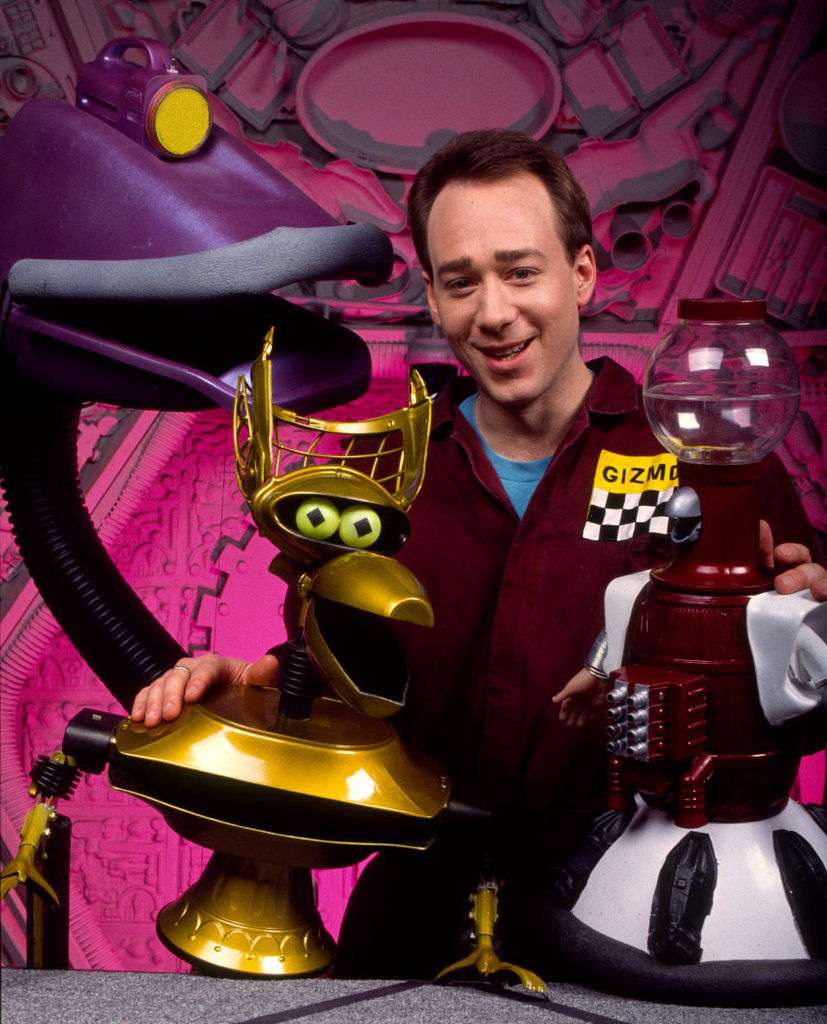


You wouldn't think it from my writing output, but my first fandom wasn't science-fiction or fantasy.  And the first publication I wrote for – a fanzine called Brainfood - had nothing to do with comic books.  No, the first thing that drove me head-first into the deep-end of the geek pool was a little show called Mystery Science Theater 3000. 

A quick bit of background for those of you unfortunate enough to have not stumbled across this fine little program.  Mystery Science Theater 3000 (hereafter MST3K) was the brainchild of comedian/magician/spy Joel Hodgson.  It started out on a local UHF station in the Twin Cities before running for ten years across three cable networks from 1989 to 1999.

Set in “the not too distant future”, MST3K centered upon a janitor named Joel who was shot into space by mad scientists for the purpose of acting as a test subject for their twisted experiments.  Their ultimate goal?  Find a movie so bad that they could drive the populace of Earth insane by forcing them to watch it and then take over the world in the ensuing chaos.  Funny stuff, but this plot was just dressing for the core of the show – Joel and two robot friends watching some of the worst movies ever made and making fun of them with the wit of The Algonquin Roundtable and the abandon of a theater full of teenagers.

Packed full of sarcasm and referential humor, the show was a perfect stepping stone for a smartass lad like me who had cut his teeth on what few Mel Brooks and Monty Python movies his parents would let him watch.  MST3K definitely had an influence on my sense of humor.  But looking back, I think Joel Hodgson actually taught me a few things about life in between the riffs and wisecracks. 


1.  You can use comedy as a weapon.

Every other comedy nerd out there probably just thought “Well, duh!  Of course comedy is a weapon!”  All the great comedians from Groucho Marx to George Carlin used comedy to attack the ills of society as they saw them.  Heck, Mel Brooks once said “The only weapon I've got is comedy”.   And that’s just modern comedy.  I’m sure there are 17th century French satirists I've never heard of who wrote whole novels about the power of comedy as a weapon.

And yet, with the possible exception of Eddie Valiant’s battle with a gang of cartoon weasels, I don’t think any piece of entertainment has made the idea of comedy as a weapon more literal than MST3K.  Every Saturday morning Joel, Tom Servo and Crow faced their tormentors with the only weapon available to them – pure snark.  And the idea that I could do the same thing helped make middle-school a bit more tolerable… even if most of my classmates didn't get my jokes.


2.  Don’t worry about making yourself understood. The right people will understand you.


Isolation is a problem for a lot of teens and a lot of us still haven’t fully left that awkward loner phase as adults.  We felt alone because nobody understands us – not our parents, not our teachers and certainly not our classmates.  

Maybe you were a brain in a village of idiots.  Maybe you were gay in a small Red State town.  Maybe you were a dreamer who wanted to move beyond a town and see the wide world.  In any case, the need for social bonding was there but you were unlikely to find it in the world of middle-school, which is built upon a foundation of superficiality and conformity.  You were better off not wasting time trying to follow the crowd and just finding someone – anyone – who accepted you for you.

Unlike the other lessons on this list, this wasn't something that was preached directly during the show.  But in a documentary on the show – This is MST3K – Joel Hodgson said some words that came back to me as I was despairing over the fact that most of my classmates didn't get my sense of humor.

“We never say ‘Who is going to get this?’  We always say ‘The right people will get this’. “

That phrase clicked with me and made me realize the futility of trying to change myself for an audience that was never going to accept me anyway.  From that moment on, I decided to please myself instead of my so-called peers.  Eventually, I found my audience and my friends.  But until that happened (after high school, not surprisingly) I was at least happy with myself.


3.   “People don’t mean to be obnoxious.  It’s just that they’re all screwed up inside. “

Empathy comes as naturally to the average teenager as flight does to a walrus.  When I was a lad, I nursed a rather extensive persecution complex and was fairly certain that even if the whole world wasn't out to get me, a considerable chunk of my classmates were united in some grand conspiracy against me.  Even after puberty, a lot of adults still have trouble grasping the idea that the people who annoy them probably aren't doing so out of malice.


In Episode 302 – Gamera, Joel tries to drive this lesson home to Tom Servo and Crow, after they forge a make-shift voodoo doll in order to inflict pain on the movie’s child hero, Kenny.  Is Kenny annoying?  Absolutely!  His voice is grating, he’s kind of a weirdo and he gets away with things that should get him grounded until he is 30 over the course of the movie.  But as Joel points out, ignoring the fact that Kenny is a fictional character, none of that is his fault and he’s got kind of a messed-up home life that fuels some of his more obnoxious traits.

Thinking on that, I started realizing things about my own tormentors.  That one bully’s parents were in the middle of a divorce.  That the guy who kept pushing me into the lockers was being beat up by his own dad.  This didn't excuse their behavior but that knowledge probably did keep me from retaliating in kind or worse.


4.  You don’t have to accept the ending they hand you.


In Episode 509 - The Girl in Lover’s Lane, the robots are filled with rage by the film’s ending.  The heroine – a kind, loving waitress named Carrie – is killed, the hero is blamed for the murder and the whole thing is incredibly bleak and depressing even after he is cleared of any wrong-doing.  Carrie’s death was a fridging before the term was ever coined – a pointless death that did nothing to advance the plot and accomplished nothing save giving “Big Stupid” even more angst.

Joel comforts the bots by pointing out that there’s nothing to stop them from writing a better ending to the movie and that you don’t have to accept the bad things people throw at you.  The same concept applies to life.  There are many people who will try and bully you into accepting things as being the way they say they are.  That you're a loser and a failure and that nothing will ever be better.  But you don’t have to accept it.  You can fight for change, even if all that change is amounts to a fan-fiction that lifts your spirits.


5.  Surviving Is Winning


Episode 323 – The Castle of Fu Manchu was widely held to be the worst movie MST3K had tackled for a time.  Certainly the episode’s host segments billed it as such, with all of the skits ending with one of The Bots having a nervous breakdown and Joel doing his best to try and comfort them before even he is reduced to tears.  By the end of the movie, The Mads are drinking a champagne toast to their victory even as Joel, Crow and Servo wail and lament. 

And then, as Dr. Forester gloats one more time, Joel gives a speech that for my money ranks right up there with the “Anyone can win a fight when the odds are easy…” speech from Amazing Spider-Man #33 for sheer awesome and defiance in the face of certain doom…

"You haven't won, Dr. Forester.  You've lost.  And I feel sorry for you.  You're nothing but a sad little man in a hole in the ground, who can only feel power by hurting others!  Well, we've won!  Because we've survived!"

In recent years, the It Gets Better movement has done a lot to reassure LGBT youth that however bad things are for them in their formative years, things will get better once they become adults and that they just have to hold on a little longer.  Similar movements for geek girls and awkward-looking people have also done a lot of good in preaching the message that I learned from MST3K during my awkward years – that survival itself is a victory condition.


*****

I got bullied a fair bit in middle school.  And there were occasions when my jokes weren’t enough.  When I felt all alone in the world.  When I gave in to the hate.  When I felt like there was nothing I could do.  And on those occasions, I just remembered that this was all temporary.  That eventually I’d be free of that place.  I just had to last a little while longer and eventually I’d get to someplace better.

And I did.

Today, I get paid to write about the books and TV shows I once got made fun of for enjoying.  I’ve gotten to meet some of my favorite creators and even befriended a few of them.  I’m part of a Rocky Horror troupe and I get to make people laugh with my own wisecracks as I riff on the movie.  And all of that is awesome and if you’d told my teenage self about all of that he wouldn't have believed it. 

And yet, the most awesome part of my life is my day job as a teen librarian.  Not just because I’m getting paid to talk about books and comics and computers and all the things I like.  But because I get to create a safe place for those awkward teens like me.  A little Satellite of Love in the back corner of the building where – even if just for a little while – they know they aren't alone.

I had the good fortune to meet Joel Hodgson once after a performance of his show, Riffing Myself.  For those who haven’t seen the show, Joel explores his own past and discusses a lot of his influences - including all the kids show hosts he grew up watching.  Until then I had never really thought about how MST3K was a more mature take on shows like Captain Kangaroo and Peppermint Place.  And I wondered if Joel had ever thought about inspiring another generation of kids who liked magic and ventriloquism and other weird things to be better people in the same way that his idols did.

Well, like it not Mr. Hodgson, you influenced at least one of us.  And I thank you for it.

Saturday, June 16, 2012

Earth 2 #2 - A Review

The second issue of Earth 2 is light on action and heavy on set-up.  This is to be expected given that James Robinson is having to build an entire world from the ground up.  Thankfully, while what few moments of action exist are brief, Robinson does find a way to keep things interesting - particularly for those of us with a little knowledge of the original Earth 2 and the heroes of the JSA.


Case In Point: This issue not only shows us the fate of Michael Holt following Mister Terrific #8 but it also introduces us to Terry Sloan - a.k.a. the original Golden Age Mister Terrific.  Shockingly, he seems to have been expecting Michael Holt.  And, even more shockingly, his intentions seem to be less than benevolent.

Cliche as it may be to say this, "Everything old is new again".  Robinson may be utilizing the same names and gimmicks as he did his classic Golden Age miniseries but the devil is in the details.  Jay Garrick is still the hero known as The Flash but the whys and wherefores are completely different.  Originally, Jay Garrick gained his super-speed through an ill-defined college chemistry experiment involving "hard water".  This time, with a tip of the hat to Grant Morrison's theories that modern day superheroes fill the void left by tales of heroes and gods, Jay Garrick is literally elevated to the status of a living god by a dying Mercury.


And speaking of big changes, I am going to address the elephant in the room.  Yes, Alan Scott - the man who will be Green Lantern - is revealed to be gay in this issue.  And no, it's not really a big deal.  Nor should it be. His sexuality has about as much bearing on this issue as whether or not he is left-handed.   There is no big sex scene.  No shocking revelation.  Just one kiss and a hug.  That's it.   

 
As always, Nicola Scott's artwork is excellent.  I've been a fan of her work for a while now and she's one of the few artists who can get me to buy a book regardless of the writer or the characters involved.  You can only imagine how overjoyed I was when I found out she'd be the monthly artist on this, a title I was looking forward to since it was announced.  I don't think I need to say anything more about her art, other than to point to the above scans and say again that you should all be reading this book.

Tuesday, May 29, 2012

DC's Latest Gay Hero? Earth 2's Green Lantern, Alan Scott.

SOURCE: Yes, America, It’s Alan Scott

I can't say that I'm at all shocked and I can't say that I'm at all pleased. 

Do not misunderstand me.  I think, given my vast body of work, I can safely be said to be a straight supporter and a friend of the GLBT community.  So please don't think that any objections I might have to Alan Scott having been revamped into a gay man are based on homophobia or a general adverse reaction to change. 

No.  No, my objections are far more complex than that, if somewhat tongue in cheek and based on my imagining the worst possible reasons for precisely why Alan Scott was chosen.  So with that in mind, here's five reasons why we should all be a little annoyed and/or worried about Alan Scott being outed.


1.The Far Too Obvious Jokes

How many times have we heard some variant of this gag over the weekend?  "He gets his powers from a magical flame and his weakness is wood.  Of course he's gay!"  Get used to it.  We're going to be hearing that line a lot from now on.


2. The Slightly Less Obvious Jokes


Granting that he may be getting a new costume in Earth 2, expect to hear a lot of jokes about how no straight man would ever dare wear that outfit in public.  Conversely, expect a lot of lines about Alan is breaking stereotypes, as most gay men would have better fashion sense than to dress like that.


3. Where Does This Leave The Molly Mayne Harlequin?


For those of you who aren't big Golden Age fans, let me explain.  The Harlequin was a villainess who fought Green Lantern several times.  Her crimes were strictly small-time and she never intentionally hurt anyone, seemingly being in it for the fun of it.  In truth, she had fallen in love with the flashy Green Lantern but could think of no other way to get his attention and asking for a date than by dressing up in a clown costume and committing crimes.  Eventually she reformed and she and Alan Scott hooked up and got married years later. 

A part of me is deeply suspicious that the move to make Alan Scott gay may be a way for The Powers That Be to eliminate any and all reference to any Harlequin-themed villainesses other than the current Suicide Girl model.  This would be a shame, as I always had a soft spot for Molly Mayne and thought that she and Alan made for an interesting couple.  Granted, her motivations for turning to costumed villainy haven't aged well and may cause some teeth-gritting in some modern readers (i.e. I have a crush and want the hero to notice me!) but there's something whimsical about the concept I find refreshing.

Of course it occurs to me that they could be planning to bring Harlequin back for cheap laughs, having her chasing after a hero whose disinterest in her is less due to her criminal ways and more due to his playing for the other team.  I'd like to think James Robinson is better than that.  And then I remember all the comedy in Starman that made light of various characters' sexuality and I worry some more.


4. Gay Alan Scott = No Children = No Infinity Inc. ?

Granting that it is possible for a gay man to have fathered children in some form or fashion, having Alan Scott be uninterested in women does increase the chances that the DCnU will not ever have a Jade or Obsidian in it.  And if they never existed, then as the most prominent members of the second-generation hero team Infinity Inc. it's likely that the rest of the team never existed either.

Why is that a big deal?  Because most of the Infinity Inc. characters could potentially cause problems if you tried to fit them into the new Earth 2.    Wonder Woman's daughter Fury alone could cause a Crisis...


5. Like Father, Like Son.  Think About It, Won't You?

Going along with the above point, if there's no Obsidian in the DCnU then there's one less gay hero in the DCnU as well.  Having Alan Scott's orientation changed keeps the count even.  Of course the idea that you can replace one character so easily brings up some rather disturbing implications... 

Thursday, July 22, 2010

Hateful Religious Crackpots Outnumbered and Outgunned By Geek Love

SOURCE: Super Heroes vs. the Westboro Baptist Church

There's quite a few photos at the above link, though I see precious few superheroes. I do see Bender & Fry from Futurama as well as The Buddy Christ himself.

Actually, the only superhero I saw was Gail Simone.

Monday, June 21, 2010

One Good Thing And One Bad Thing About Birds of Prey #2


GOOD THING: This issue definitively answers a question that has bothered Black Canary fans for quite some time now: Does Dinah Still Have A Secret Identity?


The surprising answer - given how little attention Dinah seemed to pay to it and considering I think she actually used her real name while "under cover" on missions for Oracle a few times - is that she did. At least until she was outed in this issue.

It is nice to have this point settled once and for all - even if it does make the media of the DCU look particularly incompetent since nobody connected the dots between Dinah Lance and Black Canary after Oliver Queen was recently outed as Green Arrow. Or am I the only one who remembers that Black Canary and Green Arrow had a fairly well publicized wedding which had paparazzi trying to sneak into Green Arrow's bachelor party?

BAD THING: This issue also sees the death of fan-favorites Savant and Creote at the hands of whichever power is trying to shut down The Birds.


While I'm not quite as willing to give into panic as some fans and I'm certain that this is building to something, I will admit that there is no small irony in the woman who created the Women In Refrigerators list writing a story in which two minor male characters (one of them gay) are killed for no apparent reason other than to give angst to a female character.


The Final Verdict: I'll say this for Gail Simone - she doesn't do anything half way. I just hope that the apparently pointless deaths we see here aren't nearly as plot-driven as they seem to be and that something big is on the way. There is a lot of dramatic irony in the set-up, with Dinah apparently being forced onto the same outlaw path as the family she's abandoned in other books in an effort to stay true to her ideals.

Wednesday, July 29, 2009

Gay Gamer PixelPoet Wins Internet For Life

Sam? This one is for you.

SOURCE: Gay Gamer Wins EA Promo, Says No Thanks

In a desperate bit of damage control, EA apparently awarded 2nd place in it's horribly sexist and insulting Sin To Win Contest (i.e. the one which encouraged random men at ComicCon to 'commit acts of lust' with booth babes in order to win a night on the town with two babes and a chest full of booty) to a gay male gamer, PixelPoet, who submitted a picture of himself with a "Booth Bear".


PixelPoet refused the prize ($240's in giftcards good for any EA Games games) and sent EA Games an e-mail, which he also cross-posted on gaygamer.net, explaining just why he was refusing the prize and suggesting other things they might consider doing with the $240.

The full e-mail is up here, for those who would like a good laugh.

Tuesday, September 23, 2008

One More Reason To Boycott Marvel

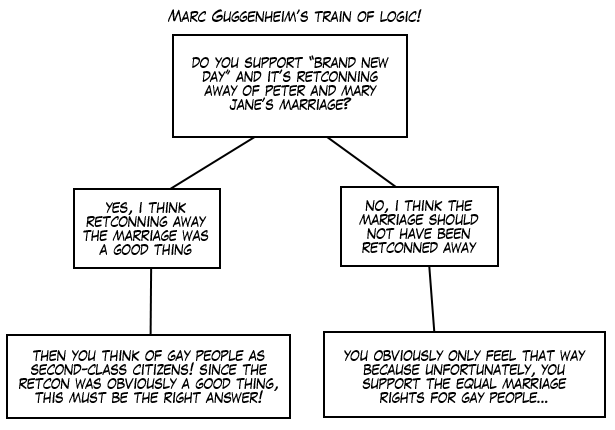
SOURCE: Spider-Man writer equates hating "Brand New Day" to liking Gay Marriage as if both were outright evil.


*sighs*

There's so much wrongness here. Even ignoring the comic book guy angle and pointing out that the Brand New Day pretty much downplayed Peter and Mary Jane ever being serious in the new reality... this is wrongness incarnate.

I think a chart made by sums up the "logic" here best.


I don't have anything else to say. I'm already raged out over the Bail Out. I refuse to get annoyed about a comic book right now past reaffirming by refusal to buy Marvel.

Sunday, July 27, 2008

The Best News All Weekend...

No, not Shia LeBeouf getting arrested for drunk driving after suffering a head injury. This is even better.

SOURCE: Torchwood Star Barrowman Up for Captain America Role

Now for those of you who aren't Doctor Who fans, let me explain. John Barrowman is a very good actor who plays the character Captain Jack Harkness - a time-traveling con-man with a heart of gold. Barrowman has dual UK/US citizenship (born in Scotland, lived in the US during most of his childhood, went back to the UK as an adult) but you'd never know from his accent that he's not a life-long American. And coincidentally, when he first appeared on Doctor Who, it was in a story taking place during World War 2 and Captain Jack was masquerading as an American volunteer fighting Nazis during the Blitz. Captain Jack was so popular after his first appearance in the first series of the new Doctor Who, he was given a regular role in Torchwood - the first new Doctor Who spin-off.

So why do I mention all this? Well, I do think it's a rather inspired and perfect casting choice - Barrowman being a great leading-man figure and a fine action hero who has the right look for Steve Rogers. But I also think it's a very brave casting choice.

Why? Well, casting a semi-Brit to play Captain America is pretty brave. Casting an openly gay semi-Brit who is the poster-boy for the Equal Rights for Homosexuals movement in the UK as Captain America...

Either this is the ultimate in bravery or part of an organized plot to cause every right-wing radio host in America to spontaneously hemorrhage. Either way, I can get behind it.

Sunday, January 14, 2007

Looking To The Stars - Religion, Politics and Chuck Dixon


It is no secret to you, my regular readers, that I am not a big fan of Judd Winick’s work – particularly his run on Green Arrow. However, a recent controversy in the comic book world has led me to a realization about exactly why I do not like Judd Winick’s work.

I’m not going to waste a lot of words on this because I’ve already said enough on the hows and whys in the past. Nevertheless this argument, already well covered by many other writers on the blogesphere - including our own Tim Stevens - has allowed me to reach a personal revelation.

Recently, writer Chuck Dixon was announced as the writer of an upcoming Grifter/Midnighter team-up book. This upset many fans of The Midnighter, whom had concerns about how Dixon – an outspoken conservative who has made statements against portraying homosexual characters in superhero comics in the past – would portray The Midnighter, an openly gay superhero.

Dixon was interviewed about the controversy earlier this week by Newsarama and was given a chance to explain his past statements, including what some perceived as personal attacks on writers Ron Zimmerman and Judd Winick.

Now I admire Dixon as a writer. Nobody today, for my money, can write a good simple action story like Chuck. That being said, while I agree with a lot of what Chuck has to say and think he is very reasonable in how he says it, I still think that there’s a wee bit of hypocrisy in Chuck Dixon being the messenger in the case of some of these messages.

Let us go down the interview, point by point.


1. Regarding his past comments and openly gay comic characters

”I was critical of Marvel’s presentation of Rawhide Kid as a homosexual. I thought that the limited series was done as a stunt and wound up demeaning both the Kid (a childhood favorite of mine) and the homosexual community. I committed some unforgivable sin by suggesting that perhaps a Howard Stern staff writer would not the ideal candidate for a sensitive portrayal of a gay western hero and that it was a mistake to retro-fit an established character rather than create a new one.”

“The Perpetually Outraged instantly labeled me as a homophobe and the label became permanent when I weighed in on Judd Winick’s introduction of an openly gay character in Green Lantern. My suggestion was that superhero comics are, whether die-hard fans like it or not, ostensibly children’s comics and perhaps not the forum to be informing children of homosexuality, heterosexuality, or sexually transmitted diseases. I think I incensed some people by saying that I didn’t want my kids receiving their sex ed from Judd Winick in the pages of a superhero comic book. I still don’t... And the introduction and retro-fitting of gay characters into established series has become an instant clichĂ©. It’s done in a cynical manner strictly for marketing purposes in a way that should offend everyone...”


Now, here’s a little something that may shock all of you, who well know that your kindly Unca Starman is that rarest of all creatures; a fightin’ Texan Liberal.

I agree with 75% of what Chuck Dixon just said.

I agree that Rawhide Kid was an insult to the homosexual community and was as stereotypically offensive to gay men as Stepin Fetchit films are to those of African heritage. (Those who haven’t seen it already can read my original thoughts here.)

I agree it probably would have been better to tell the story used in Rawhide Kid with a new character instead of using an established name, not because I am against the idea of revamping a dead property but simply because the manner in which it was done smacks of cheap sensationalism.

And speaking of sensationalism, I agree that the introduction of gay characters to most recent comic titles has, for the most part, been handled in a less than graceful manner and is usually done more for the purposes of publicity than an honest attempt at inclusion. I point to the outing of Freedom Ring in the pages of Marvel Team-Up as ‘Exhibit A’.

And I certainly don’t want Judd Winick teaching a sex-education class if his portrayal of how he did so in Pedro And Me is at all accurate.

This begs the question of why Chuck chose to single out Judd Winick in particular. After all, Judd isn’t the first writer to introduce a gay character into the pages of Green Lantern. Ron Marz, whom Dixon co-wrote a number of stories with, holds that honor for introducing lesbian couple Lee and Li into the book as Kyle’s neighbors. And James Robinson retro-fitted Mikhal Thomas (aka Starman III) into a homosexual relationship with relatively little fuss as did Greg Rucka when he outted Rene Montoya in Gotham Central.

Perhaps it is because Winick seems to want to make a statement more than he wants to tell a story. As such, he makes himself a target because of his activist approach to writing. Winick specifically created Terry Berg to make a statement. He wrote Pedro and Me to make a statement. And he gave Mia Dearden HIV to make a statement. The problem is that if you keep giving the same speech over and over, people will get sick of it and stop listening.

Okay. I understand. Gay people are people too. Now what?

Of course Dixon’s main concern in all of this seems to be books aimed at younger readers. And with the exception of Marz’s Green Lantern, all these books were aimed at mature audiences. But ignoring all issues on whether or not comic books are still a children’s medium for the moment, I must take issue with the idea that a superhero comic would not be a good medium with which to teach pre-teens about sex, drugs and the other nasty things that we try and protect the innocent from until they become too big for us to pull along behind us.

Why do you think Stan Lee stumbled his way through the now infamous anti-drug issue of Amazing Spider-Man in defiance of The Comics Code Authority? Because someone at the Department of Health, Education and Welfare asked him to do so. And that was such a big hit, that it led to the entire industry following suit in an effort to discuss real issues in the funny books so the kids might learn something.

This begs another question; just what are the kids learning?


2. Regarding the portrayal of sex in comics...

“I’m no more in favor of a frank sexual discussion between Reed and Sue or Lois and Clark than I would be were it Gay Character A and his partner.”

“When I was writing Dick Grayson and Barbara Gordon’s romance I stayed away from stating that they were in any kind of sexual relationship. You could absolutely imply it. But you could just as easily tell yourself they were saving it for marriage. Is this method naĂŻve? In movies made before the 60s it was the norm to present characters as romantically involved and then leave clear indicators that they were getting it on between scenes. Clark Gable and Jon Crawford go into a hot kiss and we fade to black. Cut to next morning and she’s making him breakfast and dressed in a different nightgown.”

“Now they could have kissed one and then played Monopoly until dawn. The audience was left to choose what they wanted to believe and there was no need to explain the facts of life to the kids after a Cary Grant movie. We used to call them “air force” scenes. Whoosh! Right over the kid's heads.”

“So Clark and Lois can be seen kissing and being affectionate and there’s no need to explain it. The sexual aspect of their relationship doesn’t have to be explored. But if Wonder Woman and Supergirl are seen kissing then that does call for an explanation. The sexual aspect of a relationship like that will call forth questions from the kiddies.”

“…There are a million different ways that the issue of sexuality of any kind can be introduced to children. But why can’t some comic creators resist the urge to do so in the pages of a superhero comic? It’s a genre where people wear capes and masks and have magic rings and lift buildings up over their heads. And no matter how much you wish the genre could grow old with you, these are still characters for children. They’re on pajamas and backpacks. They’re Legos, for God’s sake…”


Again, Dixon references children and wanting to protect them from what he sees as something that is not appropriate for young eyes. Now, this is a noble goal and one I know a little bit about from my current and previous positions as a comic book salesman and as a librarian.

Back when I was a comic shop guy, I had a responsibility to let parents know that Spawn was probably not appropriate for their five-year-old. In my current position as a librarian, I have the responsibility of making sure that children’s reading material is age-appropriate – i.e. making sure that Sin City is not filed in the children’s section, despite being an illustrated book. That said Dixon’s point here presumes two things that I know not to be true from personal experience.

First, Dixon seems to think that children are in serious danger of reading Green Lantern or Green Arrow. While Chuck’s concern for children speaks well of him he’s a day late and a dollar short. The new generation has very little use for $3 funny books. Much to my dismay, I can tell you that the number of children who came into my old store looking for something besides Yu-Gi-Oh cards was few and far between. Those few who were there for comics limited their reading material to kiddie-specific fare like Sonic the Hedgehog or the Marvel Adventures or Johnny DC lines. The average comic fan and target market these days is a lot closer to my age than that of Little Billy.

Secondly, Chuck seems to think that without parental guidance, children will be unable to comprehend the idea of boys or girls kissing one another. Now this is a major hornet’s nest and I’m a fool to even go near it. But for one moment, let us put aside all spiritual and religious considerations regarding homosexuality.

Given that, is it truly that more difficult to say "sometimes two people who love each other will kiss one another like that" instead of saying "sometimes a man and a woman who love each other will kiss like that"? To my mind, it isn’t.

To tell another story, I have a friend who has two children from two marriages. The first is almost twenty. The second has just turned seven. The first is a pre-op transsexual. The second is a young girl.

The second has no problem understanding that she used to have a brother but her brother had decided she’s really a sister. To the second one, this is not strange or complicated simply because everything seems strange or complicated at that age and most things adults do don’t make sense to you anyway. All of the younger children I work with are the same way.

Of course it is well within the parents’ rights to decide when such questions are answered and how such questions are answered for their child. This harkens back to Dixon’s earlier comments about not wanting Judd Winick teaching his children sex-ed.

And while I disagree with Dixon on how it is more complicated to explain two people of the same gender kissing or holding hands to young children than it is to explain a man and a woman kissing, I do agree I do not want to hear Reed Richards graphically explaining how he uses his powers to keep his wife happy nor do I want Man of Steel, Woman of Kleenex to ever come into discussion in an actual Superman comic.

That said, I have to wonder – is Chuck’s issue really with all sexual content and politics in the funny books? Or just sex that he himself finds offensive and politics beyond his own?


3. Regarding politics in comics...

“I’ve never backed away from my disdain for agenda-driven comics in what should be the medium’s primary escapist, mass appeal genre. Stand on your soap box all day long. But don’t stand on the shoulders of household-name icons. Write the characters in character and don’t write your world-view through them…”

“…Will the inclusion of gay characters in mainstream comics make homosexuality more acceptable? I haven’t seen a mainstream comic story yet with a gay character that wasn’t loaded with stereotypes and clichĂ©s. A wise editor I used to work with cautioned his writers, “don’t write about human relationships unless you’ve had one.” Most of what I’ve seen of the conscious-raising variety of comics on this subject has been dismal and pandering. Loaded with mock outrage and received wisdom and very little honest human interaction. It’s dealt with an in-your-face issue rather than a story.”


I believe most people do not want to be preached to and will resist any attempt to be told what to do out of general contrariness. I know people who voted for a political candidate simply because the opposition had an annoying advertisement. I’ve joked that many anti-smoking advertisements have made me consider taking the habit up as a form of protest. And I agree with Chuck that nobody wants to hear someone channeling their political opinions through a comic book in a ham-fisted manner.

Of course, Chuck Dixon would never do such a thing himself. Would he?


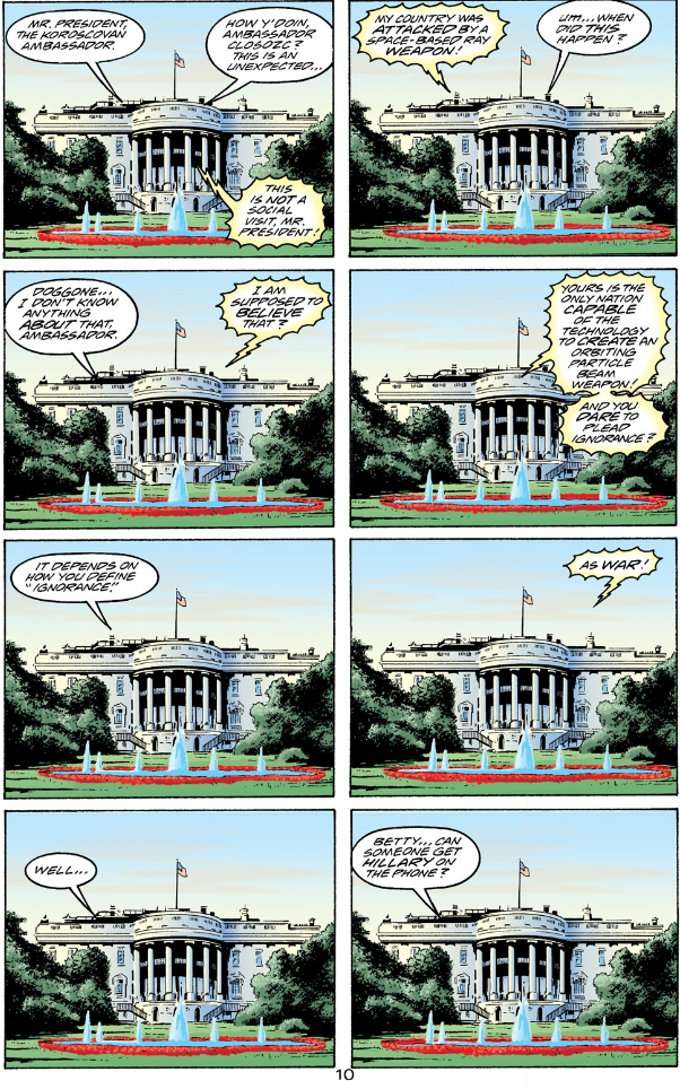
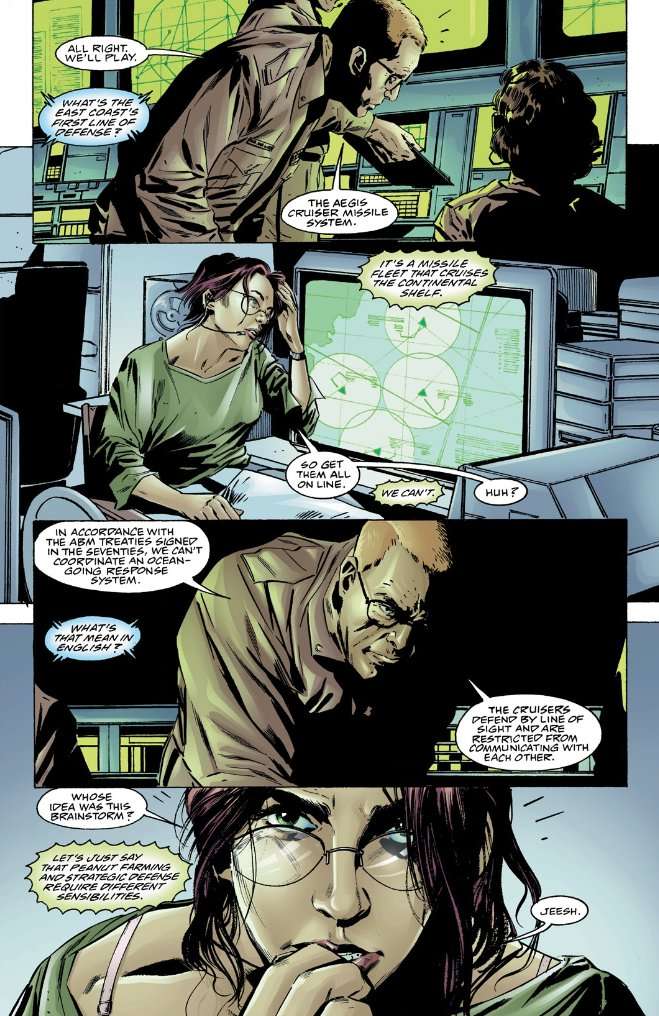
Birds of Prey #10


Birds of Prey #17


Ah. Well, apparently when he would when creating the circumstances for a story that allows him a chance to make a Democrat president look weak-willed and dependent on his wife.

Incidentally, I did some research and I could not find anything on ex-President Jimmy Carter (the peanut farmer in question) agreeing to a weakening of the ABM Treaty much less the addition of the specific, and I must say rather contrived rules, that Dixon refers to in the above panel. If anyone can provide me with proof that the United States is part of an international treaty of some sort that states that cruisers at sea are forbidden radio contact with one another during the time of a missile attack and how Jimmy Carter is responsible for it, I would appreciate it.

In reading some of the other articles about Dixon and his past work in the last week, I’ve seen quite a few stories I read in the past in a new light. I never thought about adult content in the issue of Green Arrow where Connor Hawke lost his virginity to a ghost - at least not in terms of how suggestive the artwork was. I never before thought about how the Planned Parenthood worker Stephanie Brown spoke to while she was pregnant seemed to be trying to push Stephanie toward having an abortion in a comically exaggerated manner much less how Chuck Dixon was tackling the issue of Teen Pregnancy. And thinking on all of this is what led me, ultimately, to my revelation.

This is what has, in the back of my head, made me so angry about Judd Winick. Ultimately, it has nothing to do with continuity or characterization. It is the fact that Winick is so backward as to what a liberal should be and that in turn influences how he writes Green Arrow.

Back in the Dennis O’Neil days, for all of his loud-mouth and reactionary ways, Oliver Queen did one thing that he does not do very well under Winick’s pen. He listened to the other guy and let him speak before letting him have a verbal sucker-punch. How did most of the fights with Hawkman start? The two were discussing politics and Ollie the hothead would start spouting off against “the feathered fascist”. But he always let Hawkman get a chance to say something before throwing out the accusations of how ignorant he was and saying he should be “Caveman” instead of Hawkman.

Not so with Judd Winick’s Green Arrow. Here, there is no room for discussion. Oliver Queen delivers his messages from behind a podium or to a sycophant in his employ with no reaction from the other side of the aisle. The conservative pundit on a talk show is silenced by a shouting liberal and we cut back to the action before any rebuttal can be given, leaving the liberal (and Winick by proxy) with the final word.

As a liberal, this behavior infuriates me even more than conservatives who consider that just because I identify myself as a liberal, that I must believe everything they consider to be a liberal cause. They never think that I might be in favor of the death penalty or that I think PETA goes too far because those aren’t things liberals are supposed to believe in, to their minds. They presume that because there is one liberal like this, than that is what we all must be like.

It’s a sad thing. And liberals do this with conservatives too. I’ve seen quite a few people I know to be of a liberal persuasion dismiss Chuck Dixon’s comments out of hand while banding about words like “Nazi”. They don’t stop to think that, hypocritical though he may be, he might have a few good points.

This happens on both sides of the political fence. It happens with the Bill O’Reillys who tell their liberal guests to shut up and turn their microphones off. It happens with the Al Frankens who would rather tell jokes about George W. Bush stuttering than talk to an intelligent conservative about real issues.

It happens with the Chuck Dixons who write Planned Parenthood counselors indulging in behavior that would get a real counselor fired. It happens with the Judd Winicks who make all their conservative characters cops on the take or amoral C.E.O.s.

And for all of us, if we’re going to solve these problems someplace outside of the funny books, it needs to stop now.

Monday, June 19, 2006

Looking To The Stars - Gaysploitation!


Hello. Happy to see you all here. Been a while for some of you, hasn’t it?

Well, for those of you who are wondering why there’s been no column for two weeks, please read last week’s A-Kon Convention Report, which was mysteriously posted on Wednesday without much fanfare.

There were also some problems with my ISP which have now, thankfully, been worked out.

Still, despite all this, its’ been two weeks without a regular monthly column. Lots of things happened in the comics world in those to weeks though, and there’s a lot of news I have to cover in my own inimitable fashion. But with all the things that happened in the past three weeks since I wrote a regular column, one story stands above all others.


Frank Cho To Write 4-Issue Red Sonja Mini-Series


Now, I know what you’re thinking. Ol’ Unca Starman must have eaten some bad Pocky while at A-KON to think that this is all that important a story. Well, this story is more important than you think when you consider that it is a dark mirror of the attitudes shaping our business today.

Long time fans will remember my taking Mr. Cho to task for his Shanna: The She-Devil mini-series. (Those who don’t remember it can read it here.)

The short version is that Frank took a character who had been created as a feminist and environmentalist hero back in the 70’s and cut all of her character in order to create what would have been a T&A extravaganza had Marvel not wised up and made him put a costume on his creation at the last minute. Indeed, Cho’s exact comments when questioned upon the feminist background of Shanna, according to a recent Wizard Magazine Interview, were...

”When I signed on, Marvel sent me a bunch of those old issues, and let me tell you—I’m not sure what the hell was happening in the ’70s, but all of those damn hippies were smoking crack when they wrote those comics. It was such a B.S., feminist, environmental message! I was so pissed off when I finished reading them. That’s two hours of my life that I’ll never get back. It wasn’t a comic, it was more like a “Green Party” propaganda thing”


Yes. Because Steven Gerber is such a well-known crack-smoker.

In all seriousness, Cho, while being a talented artist, has shown himself to have little to no interest in doing his homework as a writer. He couldn’t write a character properly, so he created something new using the same name. And this attitude, this pandemic is become typical of far too many writers today.

That is why I as a Red Sonja fan, and the boyfriend of a fanatical Red Sonja fan, I am rather worried about Frank Cho getting his hands on everyone’s favorite amazon... metaphorically speaking.

Yes, Cho can draw a beautiful woman. If he were capable of drawing more than one face, he might be one of the greatest artists in the business. But there’s a reason why he mostly sticks to pin-ups and cute animals and that is he just isn’t strong enough to sustain a realistic series. And that’s a problem in a series like Red Sonja which, giant monsters and magic aside, is fairly well grounded in realistic characters and real-world physics.

This is not to say that there is not some creative license with the character. Scanty chainmail is not the warmest of garments but thankfully Sonja’s homeland in the Robert E. Howard world is a fairly large and warm land. And of course her armor doesn’t protect much physically but it serves another purpose.

As Sonja herself put it in one issue, “Men are easily distracted”. Throw in the fact that her speed is her greatest advantage in a fight and it makes sense she’d choose not to be weighed down with full-plate. Still, there is a fine line between showing a hint of exposed buttcheek and the chainmail thong that Cho and artists like him are so fond of drawing.

This creates an interesting problem for those of us in the business of bringing new readers into the comic book game. I know Sonja isn’t an empty-headed bimbo but a strong woman who uses her body as a weapon in more ways than one. But how does it look to the new reader? I can ramble on and on about the feminist underpinnings of the character and how she is a strong, independent woman in a world dominated by evil men and dark sorcery and it won’t do a thing for those who are going “Why does she have ass cleavage?”

And this leads us to consider a larger issue – at what point does cheesecake artwork stop being fun and start becoming exploitation. For that matter, at what point does the existence of beautiful women in comics start being exploitive?

Take the new Batwoman for example. I had several people e-mail to ask me what my opinion was of the fact that the new Batwoman was a lesbian. And my opinion was; why is this news?

Actually, it probably IS news to the readers of the New York Times, which broke the story, so let me rephrase that. WHY IS THIS A BIG DEAL?

There have been lesbian characters in comic books before. Hell, Rene Montoya... one of the main characters of DC’s 52... is a lesbian. Maggie Sawyer, the head cop in Metropolis for years and late of the much missed Gotham Central? Lesbian, who managed to get her life-partner snuck into an episode of Superman: The Animated Series, no less.

Of course, the big deal is that this is a mainstream character... sort of... who is being outed. But as amused as I am that the Batwoman character, who was originally created along with Batgirl in the 50’s to counter charges made in the book Seduction of the Innocent that Batman and Robin were homosexual lovers, is now being used to promote the gay lifestyle, I am more disturbed by the wording used to describe the character.

To quote The New York Times Article Kathy Kane is “…is a wealthy (socialite), buxom lipstick lesbian”. Now, on the odd chance that someone out there is unfamiliar with the term, a lipstick lesbian, at least in popular culture, is a slang term for any lesbian character whose homosexuality exists primarily to titillate heterosexual males. For an in depth example of this, see most of the characters on the Showtime series “The L-Word”, most of the women in a Girls Gone Wild video and indeed any bit of mainstream lesbian pornography.

It’s called the Internet. There’s tons of it out there.

Now, let us think about that for a second. The character is introduced as being a beautiful, rich woman who likes other women. Apart from the fact that she dresses like a flying mouse, how is that really a change from the other attractive lesbian characters that are already occupying the DC Comics Universe?

It doesn’t. And that’s exploitive. It would be one thing if it were just presented as a fact about the characters, rather than being a banner headline in one of the nation’s highest-selling papers. As it is, it just screams of desperation – like DC Comics is trying to court the gay dollar by screaming “Hey! Look at us! We’re diverse and edgy and gay friendly!”

You know what DC would really do if they wanted to be edgy? Put out a Batwoman that is a wealthy, socialite overweight bull-dyke lesbian. Would this be stereotypical? Yes. Would it be a lot closer to the truth than some stunning supermodel? As someone who knows quite a few lesbians who describe themselves as dead butch, I say yes. Would it sell? Probably not.

You go to the other extreme- the not socially acceptable stereotype of gay women – and what would be the interest? Desperate, wanking fanboys wouldn’t buy it for the same reason they wouldn’t buy Liberty Meadows comics if Frank Cho suddenly converted to Islam and started drawing burkas on all his female characters. The gay comic-reading community (and there’s a minority group if ever there was one) would be up in arms over the phrase “bull-dyke”. The die-hard fanboys like me wouldn’t give a toss one way or the other so long as the writing was good. And ultimately, it would all be just as meaningless.

You want to see how to do this kind of thing right? Go read the Villains United TP. Without giving too much away, it gets revealed that two established female characters… both attractive, self-confident women, are both lesbians in a relationship. Did they make a big deal about it? No. Was there a big parade or articles written about it? No. Did it add something to the characters? Yes.

And that ultimate is the problem with the new Batwoman. She is hype for hype’s sake and her homosexuality is nothing more than a Winickian plot device meant to lure in readers. It is just as crass and exploitive as your average Frank Cho cover. And as a fighting liberal and a feminist, I am ashamed as a comic geek and a man that professional publishers can stoop so low in the name of sales.

Still, maybe I’m overreacting. Maybe I’ve unwittingly become part of the censorship army that Erik Larsen claims is trying to rid comic books of big boobies. All I’m trying to say is that you can draw beautiful women but to avoid pushing the cheesecake angle and that you can have all the lesbians you want in a comic – just don’t pretend that having one more attractive women in a skin-tight outfit is something new and exciting.

Comments? The e-mail is down there.

Tune in next week. Same Matt time. Same Matt website.

Wednesday, February 5, 2003

Rawhide Kid #1: A Review

You’ve all probably heard all the hype about this comic already. This is, how it stars the very first gay title character in comic book history. How it a western that, to quote the BBC News, “breaks the mold of traditional macho comic characters.” And how various religious organizations are now boycotting Marvel because of their attacks on family values and how various gay rights organizations are cheering Marvel for this attempt to add diversity to their comics.

What you may not have heard, and what my job as a critic is to tell you, is how the book actually is. Because let’s face it: this book is a historical footnote if nothing else and will probably make Marvel a ton of money on the first issue alone. But all of the above is totally meaningless to me: all I care about is how good the story and art are.

Now those of you who read the Starry Awards in “Looking To The Stars” a few weeks back probably recall that I’m not too big a fan of Ron Zimmerman. In fact, I closed the awards with a tearful plea to Joe Quesada to please stop publishing anything that the Z-Man had penned. You might imagine then, that Unca Stars went into this book with a certain amount of dread.

Give yourself a no-prize on that guess, buckaroo. Cause the writing on this book stinks like a two-day-old cow pie. In fact, I think the wrong organizations are protesting the release of this book and I can only assume that nobody at GLAAD actually read this before they spoke about how great it was to see more homosexual characters being represented in mainstream comics.

Why? Well, the anachronistic dialogue sticks out like a sore thumb, along with various other minor anachronisms. The Rawhide Kid’s sleeping attire, for example. I don’t think they had bikini briefs for men back in the Wild West days.

Then there’s the just plain creepy-crawliness of some scenes… like the scene with The Kid doing a semi-suggestive “can’t see anything” faux strip act with his robe at a group of young boys that must have Dr. Wertham of “Seduction of the Innocent” fame saying “See! See! I was right”, in his seat next to Joe McCarthy in Censors’ Hell.

No, what really sticks in my craw about this comic is that… well, it’s the same thing that makes me avoid watching Will and Grace. This book doesn’t shatter the stereotypes of the macho male main character. It reinforces all the stereotypes of the gay male character.

Reference is made to The Kid’s fine dress sense and accessorizing skills on three separate occasions. The aforementioned crowd of boys start asking him about how he compares to other famous gunmen and The Kid talks about how much he’d love to meet the Lone Ranger and how much he loves his outfit and can “see why that Indian follows him around.” And the dialogue… I can’t bring myself to quote any more of the “Oh fabulous!” dialogue that makes up most of The Kid’s speech.

The real shame of the book though is that John Severin’s artwork is gorgeous and really does a good job of conveying character and scenery. Would that the story and concept could match it in quality. In fact, the only comparison I can make between the two is to ask you to imagine an episode of Robert Smigel’s “The Ambiguously Gay Duo” as painted by Alex Ross.

Personally, I think the best we can hope is that in thirty years, this comic will be viewed like the old Power Man comics featuring jive-talking bad-ass Luke Cage: Offensively stereotypical today, but a big step forward from what had come before.