Showing posts with label Gareth Roberts. Show all posts

Sunday, September 28, 2014

Doctor Who, Series 8 - Episode 6 - The Caretaker

THE QUICK, SPOILER FREE REVIEW

A funny, enjoyable episode that does a better job of defining the cast than any episode so far this Series.


THE PLOT  

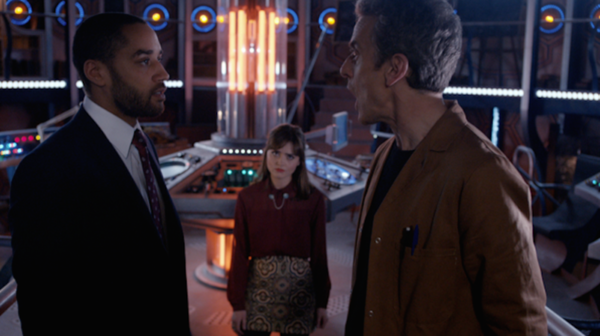
Trying to balance her job as a teacher, her night-work as The Doctor's assistant and her burgeoning romance with fellow teacher Danny Pink is beginning to take its toll on Clara Oswald.  She's actually relieved when The Doctor says he'll have to leave her for a few days as he goes on a deep-cover assignment.  That relief turns to horror when a staff meeting at work the next day ends with the introduction of Coal Hill School's new caretaker - John Smith.  And balancing all the parts of Clara's life becomes very difficult indeed, as The Doctor intrudes on her classes, work gets in the way of her trying to help The Doctor and Danny starts asking too many questions about her relationship with John Smith.


THE GOOD PARTS 

* This honestly is one of the funniest episodes of Doctor Who we've had in a while and very little of that humor is based in the RomCom shtick that Steven Moffat usually indulges in when he goes funny.  But what else might we expect from Gareth Roberts, who is one of the best New Who writers when it comes to presenting comedy and drama in equal measure with equal skill?

* The triangle between The Doctor, Danny and Clara is played off not as a romantic one but more as a disapproving "Space Dad" taking issue with his daughter's new beau.  Apart from The Doctor's muttered remark about making the same mistakes again (a reference to the rivalry between himself and Rory Williams and/or Mickey Smith, perhaps?) there is no suggestion of a pseudo-romance between The Doctor and Clara.

* Danny Pink continues to impress as a character and good on him for pointing out The Doctor's hypocrisy as well as his aristocratic tendencies. ("I'm a soldier but he's an officer!").  His sarcastic "Sir, Yes Sir!" act was particularly delightful.  A lot of play has been made this season of The Doctor's antipathy for soldiers and military thinking which has been somewhat perplexing given The Doctor's history with UNIT and his long-friendships with the career soldiers there (Come to think of it, The Brigadier became a math teacher for a time...) and Pink's assertion here is a brilliant explanation of that contradiction.  Like Jon Pertwee's Doctor, Capaldi's Doctor is a patrician who is only anti-authority when he isn't in the role of the authority.

* Alternatively, Danny takes Clara to task for her attempts to fragment her life by pointing out that - for whatever reason - she doesn't trust him enough to let him know everything about her.  More, this scene offers an analysis of Clara's character that has been sorely lacking until recently.  Clara has been unique among companions with a romantic interest in trying to hide that life from her significant other and Danny's demanding an explanation for why she feels the need to keep that secret is not unreasonable.  Again, this is played not as a suspicion of her cheating on him romantically but a pain born of the idea that she could/would not be honest with him.

* Everything with Courtney Woods aka The Disruptive Influence.  Most of what we see of her suggests a potential companion and The Doctor even notes that he may soon have a vacancy.  But Roberts wisely takes the time to show why Courtney isn't really companion material at the end as we get a scene that shows that, however prickly he may be at times, Capaldi's Doctor really does have one care to give.


THE PROBLEMS

*
While not quite as bad as some of the Series 8 episodes in regards to feeling repetitive, a lot of the bits with The Doctor failing to fit in as he goes under deep cover do come off as a little too close to similar bits of business from Roberts' previous scripts for The Lodger and Closing Time despite the efforts at disguise this time being underplayed by Capaldi's Doctor.

* On that note, some of The Doctor's dialogue does seem to have been written more for Matt Smith's Doctor than Capaladi's, despite the performance.

* The Flip.  Just... The Flip.


THE FINAL VERDICT 

This episode provides high-quality character comedy while being a marvelous character study of both The Doctor and Clara, though one wonders how much influence Moffat had on the final product and how much the episode's few flaws might have been born of his hand.

Saturday, August 18, 2012

REVIEW: Doctor Who: Shada - The Lost Adventure by Douglas Adams


This is the story of Shada, perhaps the most remarkable, certainly the most reworked story ever to come out of the great mind of the late Douglas Adams. What makes Shada so remarkable (or infamous, as some would have it) is precisely how it has been adapted and readapted, often without the permission of the author and - in at least two cases - without his participation. This sort of thing is bound to happen when an author is deceased, although rumors persist that Douglas Adams may have had himself declared legally dead in order to stop his editors calling him about his deadlines.

The story of Shada centers upon The Doctor (currently in his Fourth incarnation, with the long scarf and big smile) and his companion Romana (currently in her Second incarnation, with the blonde hair and haughty aura) as they pay a visit to Professor Chronotis. A retired Time Lord who shared The Doctor's fascination with Earth, Chronotis took up a position as a professor at Cambridge, where presumably an absent-minded old man who horded books and rambled about impossible things would do well or, at the very least, not arouse suspicion.

But Chronotis has somehow aroused the suspicion of Skagra - a would-be tyrant who needs a special Time Lord book that is in the professor's possession. A book that has an odd effect on any equipment used to analyze it and the flow of time around it. A book that is now in the hands of graduate student Chris Parsons, who intends to use it to impress his crush,
Clare Keightley. A book that holds the secret to the mysterious Shada...

Originally scripted as an episode of Doctor Who, a technicians strike at the BBC left Shada largely unfilmed. Though he was largely critical of it at the time and expressed his relief that the episode would never be released, Adams apparently thought enough of Shada as a broad concept to rework the story into the first of his Dirk Gently mysteries. Since that time, Shada has seen life as a direct-to-video special (which Adams claimed to have been tricked into signing away permission for) and an Internet radio play, which was reworked into a story for The Eighth Doctor after Adams' death.

It is no small irony that the main plot of Shada involves the hunt for a book the sends its' reader's mind projecting through time and space. For in turning the first few pages of this book, I found myself transported back through time and space...


It's 1990, I'm 12 years old and taking my first tentative steps into browsing in the "grown-up" parts of the Taylor's Books in Lincoln Square. My mom might debate that, as I'm edging around the Science-Fiction and Fantasy section but she said she'd let me get whatever I wanted so long as it wasn't from the kids section and didn't have a half-naked amazon on the cover. Pressed for time, I decide to start at the beginning and grab the first thing that looks interesting. And that's when I see it.

The Hitchhiker's Guide To The Galaxy By Douglas Adams.

The cover with the green-round thing doesn't inspire confidence but the title is interesting so I flip it over to read the summary on the back. There isn't a summary but there are some names I recognize instantly. John Cleese. Eric Idle. Michael Palin. Terry Jones. Graham Chapman. All members of Monty Python's Flying Circus!

Naturally being 12 years old and a brazen smartarse, I think that Monty Python is the epitome of fine comedy and that anything five of them cared to crack-wise on the back cover of was bound to be something I'd enjoy. I opened the book and was grinning madly as Arthur Dent described how he found the order to demolish his house on display in a filing cabinet in a flooded basement bathroom with no power when my mom finally got tired of waiting and told me to come on.
..

Fans of Adams' work may find themselves similarly overwhelmed by nostalgia as they read this book. Gareth Roberts perfectly replicates Douglas Adams' style from page one onward. It is on the first page that Roberts describes Skagra - a severe and serious man who hordes his smiles as a miser does his coins. We are informed that Skagra came to the conclusion that there is no God at the age of five and that rather than feeling total despair or quiet relief, as most people who come to this conclusion do, Skagra thought "Hang about - that means there's a job opening."

With this first chapter, Roberts - himself a writer on Doctor Who - elevates himself far above the others who have tried (and failed) to write like Douglas Adams. The book largely follows Adams' original scripts and dialogue with Roberts' contributions blended into the narrative seamlessly. Roberts' contributions to the actual story are minimal, primarily concerned with tying the story more strongly into the continuity of the television show, adding in a few references to both the classic and modern Doctor Who series. Roberts also addresses some questions left open in the original script, such as who Skagra is, how Skagra seems to know so much about the Time Lord's history as well as why (apart from sheer stubbornness or paranoia) The Doctor doesn't call The Time Lords for assistance given the threat Skagra poses.

Generally speaking, I'm against one author attempting to ape another author's style or playing with their toys, as it were. I was therefore pleasantly surprised by how well this novel adaptation turned out. This is the closest thing we shall ever have to a new Douglas Adams novel in this world. I would recommend it highly to any fan of Doctor Who, Douglas Adams or science-fiction in general.