Showing posts with label Gene Ha. Show all posts

Monday, May 27, 2013

Justice League #20 - A Review

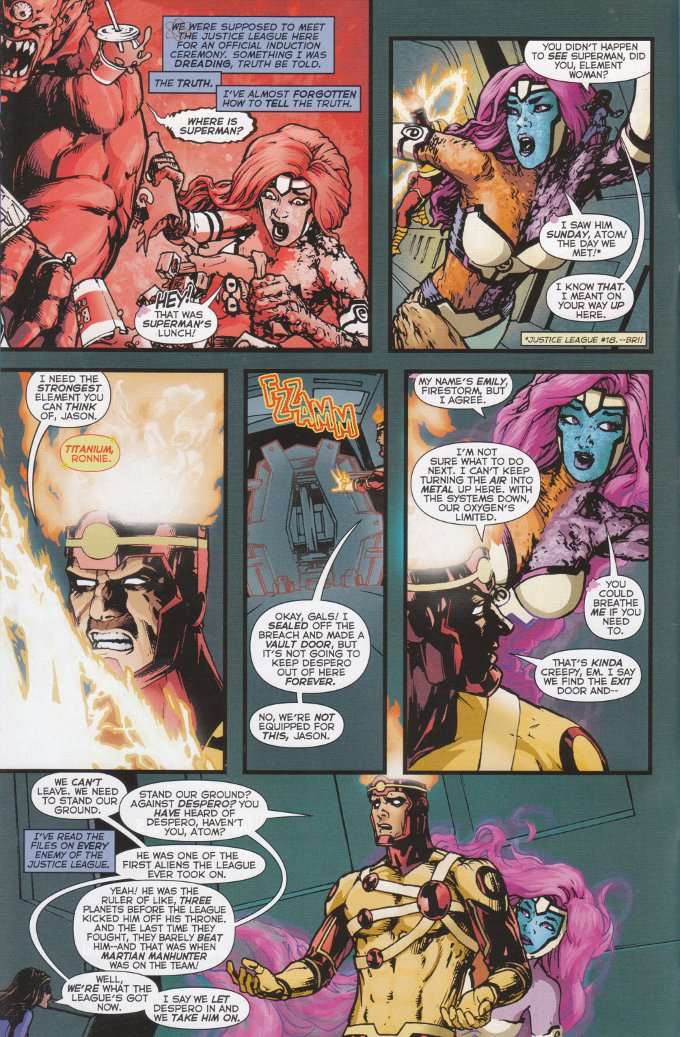
 Justice League #20 is something of a mess, in terms of both story and artwork.  Reportedly, the main story was laid out by one man and then illustrated by three different pencilers and three different inkers.  Art by committee works even less often than writing by committee and it really doesn't work here.  Even accounting for the differing styles at work, everything looks horribly uneven.


The story by Geoff Johns, focusing primarily upon the newest members of The Justice League as they fight the telepathic powerhouse Despero, isn't much better.  Johns does his best but the underdogs fighting outside of their weight class story has been done to death.  Not helping matters is that much of the "charm" of this issue depends upon your enjoyment of the flighty bimbo that is Element Woman or the continual squabbling of the two teenagers who make up Firestorm.  And given that Fury of Firestorm was cancelled this month, it appears that the vast majority of comics fandom find the antics of Ronnie Raymond as tiresome as I did when they played this exact same conflict out during Brightest Day

There's only two things that save this comic at all.  The first is the Shazam back-up story, which finally seems to be gaining some legs or maybe I'm just viewing it more sympathetically now that Billy Batson is beginning to act like the hero he should be.  The other bright side in all this is a scene involving several of the Justice League founders and Superman having a talk with Batman about his creation of protocols to take down every other member of the Justice League... including himself. 


This book seriously needs one artist, one inker and one person deciding its' look.  The multiple teams working on the main story this time around do not work well together.  And Johns would do better to develop his new characters alongside the established crew for a time rather than throwing them all into a spotlight that none of them deserve yet. 

Sunday, September 16, 2012

The Shade #12 - A Review

I've avoided reviewing The Shade 12-issue mini-series since its' first issue because I wanted to consider the whole of the series before passing judgement on the individual parts of it. I've reconsidered that in light of this final issue, simply because I had to share the splendid irony of it all.


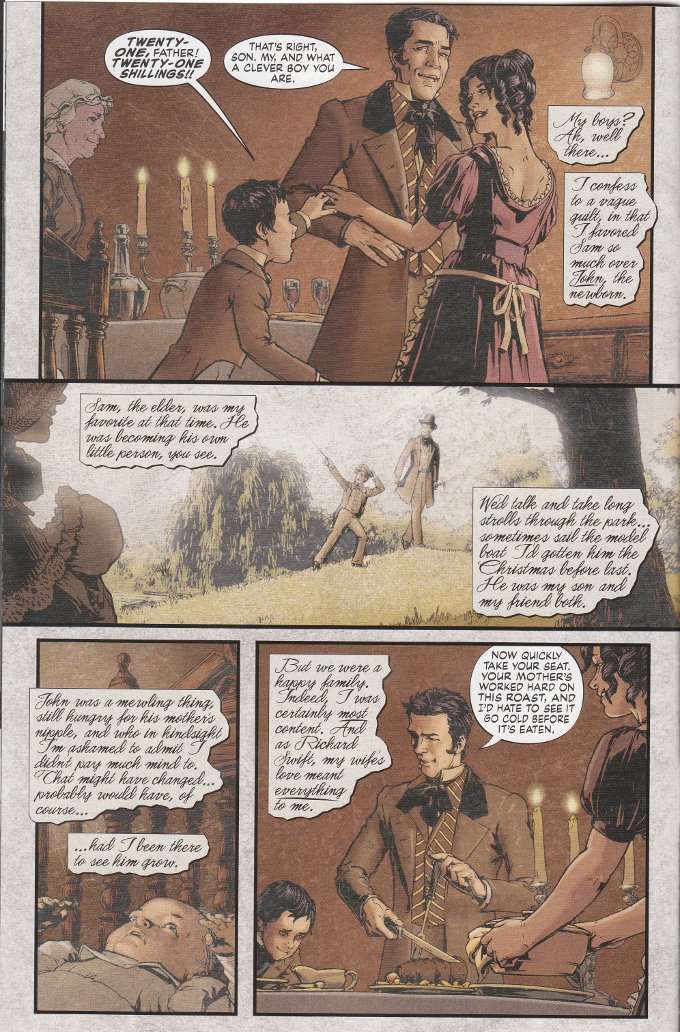
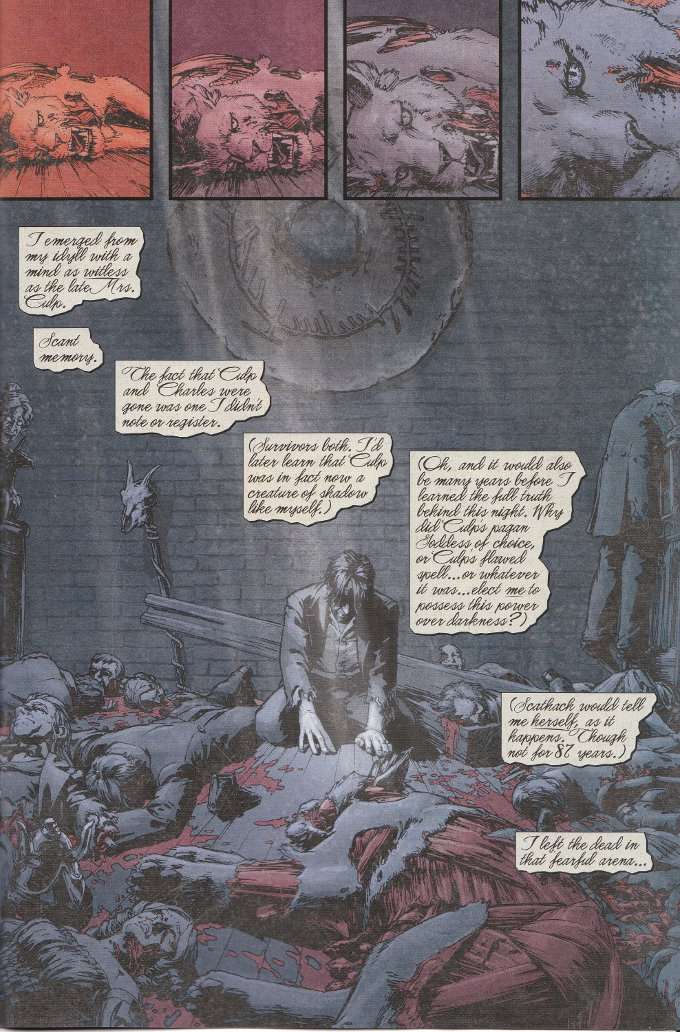
I do not know if it was by fortune or design that this issue - which details the origins of The Shade - should come out now in the middle of DC Comics' Zero Month. I am deeply amused, as I am sure The Shade would be, by the timing if it is a coincidence just as I'm sure everyone's favorite shadowy anti-hero would be amused that a mini-series detailing his life story ends with its' beginning. I think Shade would also be amused how - like the man himself - the story is a mixture of American and British sensibilities, curiously melding the styles of Dickensian drama with Lovecraftian horror.

Fans of the James Robinson's Starman series already know the generalities of how merchant Richard Swift was transformed into a being of living shadow who dubbed himself The Shade. But until now no story has ever gone into the sordid details of precisely how it all happened or described the role that Charles Dickens (one of the rare few who knew The Shade both before and after his transformation) had to play in those events. The grand irony is that while this is an origin story, long-time readers of Robinson's work are the only ones who may fully grasp the greatest of this story.


Robinson's script is once again ably illustrated by Gene Ha, who delivers the work of a lifetime. Ha wisely uses his inks sparingly, limiting his shadows while allowing the original pencils to be emphasized by the color. Colorist Art Lyon, too, deserves a lot of praise. The early pages, depicting the day-to-day life of London in the early 1800s are colored in muted grays (if one can be said to color anything in muted grays) that illustrate the mundane nature of Richard's early life. It also helps to throw the horror of the more colorful later-pages into sharper contrast.

Expect a full review of the entire mini-series at a later date. For now... well done, Mr. Robinson. Well done, indeed.

Tuesday, May 29, 2012

Justice League #7-9 : A Review


I think Justice League would be a better book if it had more of The Justice League in it.

That may seem an odd comment but I stand by it.  Since the opening six-issue story arc, this book - despite having numerous action scenes involving The Justice League - hasn't really felt like it was about The Justice League.  The Justice League is present but there is little depth to that presence.  And up until Issue #9, the main focus of the stories has been on someone other than The Justice League members themselves.

Case In Point; I just did a page count on Justice League #7 and determined that after cutting out the Shazam back-up story, just over half of this comic's pages are devoted to The Justice League fighting a monster created by mad science.  But it doesn't feel like it.  The action sequence is just fluff building up to the real focus of this issue.  And that focus is fixed firmly upon one Colonel Steve Trevor.

In the five years since the Justice League formed, Col. Trevor has become a sort of spokesperson/government liaison for the team.  In theory, this means his job is to field questions from reporters after every incident the Justice League gets involved in and deliver requests from the League to the US Congress and vice-versa.  In practice, Col. Trevor's job is to discourage reporters from openly questioning the efficiency of the U.S.A and convincing various Congressional committees that issuing demands to people who could potentially rip the planet in half is a bad idea.


This could be boring except for the fact that Geoff Johns has developed Steve Trevor far beyond his usual role as Wonder Woman's dude in distress.  Steve Trevor is, in a word, badass.  He's a man of action who chafes at being stuck in a glorified desk job and yet he sticks with it for reasons beyond merely serving his country or protecting the world.  I hesitate to make the obvious comparisons to Nick Fury because Col. Trevor, as written here, is much deeper than that.  

Gene Ha was the guest artist on this issue and he proves to be a fitting choice.  Perhaps most famous for his work with Alan Moore on Top 10, Ha's detail-oriented style is, for my money at any rate, a better fit for this material than Jim Lee's more bombastic pencils would have been.  Ha draws a mean action scene but his ability to put layers into scenes of people merely talking helps to elevate this book. 


Issue #8 may as well have been titled "Everyone Hates Green Arrow".  Again, the Justice League is present for most of the issue but the focus this time is upon a superhero who isn't a League member and his efforts to impress the team into asking him to join.  Again, we don't really get any insight into any of the League members beyond the basic information we've already gleaned in the opening story-arc.  Superman is a  nice guy.  Wonder Woman likes fighting.  Aquaman is a tight-ass.  Batman is a tighter tight-ass.  Hal Jordan is an asshole.  The Flash is a wimp.  And Cyborg... uh, is there.  


This whole issue feels really uneven, being chiefly comprised of a series of interludes where The League confronts some crisis taking up the main story of another DC Comics title (Night of Owls over in Batman, The Cultists from Justice League Dark, etc) and Green Arrow shows up to help out... much to the annoyance of most of the Justice League. Hints are dropped as to Aquaman having some prior dealings with Green Arrow (hints that were also dropped in the Green Arrow book) but no details are given.  Later, Oliver Queen refers to his own dark past and becoming Green Arrow to make amends for his own personal sins but we are not given an inkling just what his past crimes might have been.


What's really vexing to me is that despite so little being said about Green Arrow's backstory, Geoff Johns still gives the character of Oliver Queen more depth and development in this one issue than Ollie's gotten in his entire DCnU series so far.  And I'm uncertain if that's a complement to Johns or a commendation of the current Green Arrow book and all three writers who have worked on it in the past nine months.


The artwork by Carlos D'anda is as uneven as the story.  Consider the shifting size of Green Arrow's mask in the above page scan and how it seems, at times, to go over his hairline.  There's also a continuity error in the earlier pages, where the arrow Green Arrow shot into an Amazo robot is not visible in any far shots of the robot until Green Arrow points it out.


Thankfully, Jim Lee returns to the art duties with Issue #9 and with him returns the Geoff Johns we all know and love from JSA.  This time, the story is focused on The League.  This time, we get a lot of the little character moments Johns is famous for, as most of the team gets brief flashbacks amid the action of the issue that lend further insight into their characters and their backgrounds. 


These scenes give this issue a depth that the previous two issues lacked.  You wouldn't think that a quick panel or two of Clark Kent remembering being the last one picked for teams back in high-school could add so much to the story but it does.  And even though most of these scenes merely highlight what we already know about the characters (i.e. Hal Jordan has authority issues, Barry Allen is a goody-two-shoes, Cyborg has issues with his dad), we do get some new information, such as precisely why Wonder Woman and Steve Tervor's relationship fell apart.

Of course the one thing that everyone picked up on in this issue was one of Bruce's memories involved a letter - a letter that looks suspiciously like it might have been the one that the Batman of the Flashpoint universe, Thomas Wayne, asked Barry Allen to give his son.  What does this mean?  Who can say?  Personally, I'm less interested in the state of the universe and more interested in the state of the characters and this issue does give us more information on that.


In all this talk of character, it occurs to me that I've said little about how this issue sets up a storyline involving a new villain who is out to destroy the Justice League.  But then again, what little we see of the man called Graves is mostly set-up.  No doubt we will be seeing more of him in the coming months.  Yes, I am still reading this book.  For all it's faults and unevenness, it is still a good read.  And if you haven't given it a shot yet, I highly recommend jumping on with Issue #9.


Monday, May 7, 2012

Action Comics #9 - A Review


Returning to a concept first introduced in his Final Crisis series, this issue of Action Comics reintroduces us to Calvin Ellis.  He appears to be an ordinary African American man but is secretly the Superman of Earth 23.  Ellis balances his duties as Superman with those of his day job - President of the United States of America. 


Fresh off a victory against his arch enemy, Calvin confronts a mysterious trio who appear suddenly from a portal.  The two male figures are badly burned and the one female figure is missing an eye.  She explains to Calvin that they created a device that enabled them to make thoughts real as solid sound-waves and that they attempted to sell the device in order to promote their idea for an idealized guardian of good - a Superman.  But the Superman concept was diminished in an effort to commercialize it to the masses until a new Superman - a brutal, pitiless monster - was turned loose upon its' creators.  A monster traveling to Earth 23 even as they speak...


There is no reason for a story like this to work nearly as well as it does, as it can be read several different ways. Straight comic book story?   A parable about creators' rights? A warning about the dangers of corporate culture controlling the creative process?  It works on every conceivable level.  This isn't the first time Morrison has merged elements of the textual and metatextual made manifest into a script but the spin here is a unique and interesting one.

Gene Ha pulls the art duties this time, filling in for Rags Morales.   Ha proves an able replacement, offering a grittier, darker style than Morales but one that fits this darker, stranger story perfectly.  Credit must also be given to colorist Art Lyon, whose prefect palettes further define Ha's pencils and inks.

No less enjoyable is the back-up story by Sholly Fisch, which details a day in the life of Calvin Ellis as he attempts to balance both his duties as a member of Earth 23's Justice League and President of the USA, negotiating with the leader of a terrorist nation over the phone even as the JLA is destroying the secret labs where said leader is building weapons of mass destruction.  The story raises some interesting ethical questions and I'd love to see more stories done with the Justice League we see here.  The art by Cully Hammer (most recently of The Shade mini-series) and colorist Dave McCaig is top-notch.

Action Comics is one of the best values for your comic-buying dollar for sheer variety, if nothing else.  It is superhero comics done right and a must-read for any fan of the genre.