Showing posts with label Doctor Who Series 8. Show all posts

Sunday, November 9, 2014

Doctor Who, Series 8 - Episode 12 - Death In Heaven

THE QUICK, SPOILER FREE REVIEW

Damn near perfect.  One of the best series finales ever, not only for this show but for any show ever in the history of television shows on any planet at any time. Have Kleenex on standby while you watch it, though.


THE PLOT

The Master is returned and building an army of Cybermen, crafted from dead humans.  But what is her game?  And how did she escape Gallifrey?  And for that matter, where in the universe is Gallifrey?!  The Doctor is desperate for answers but, as "Missy" notes, the best part about knowing is "not telling you". And even with all the resources of UNIT and a newly formed emergency world government at his command, The Doctor might not be able to save the world.

Clara Oswald has bigger concerns on her mind. Danny Pink has been converted into one of the tin men and he wants her to be the one to turn off his heart and activate his emotion inhibitor. Can Clara effectively kill the man she loves a second time, even if doing so means saving the world?


THE GOOD PARTS 

* The opening scene and change of the title credits is a brilliant fake out.  And it is a credit to Jenna Coleman's acting chops and the writers' development of Clara over the past series that you honestly do think, for just a moment, that somehow we've been thrown a curve ball and Clara has been another incarnation of The Doctor this whole time.  A female Doctor to match the Mistress.

* As in Dark Water, there's a lot of shout-outs to the classic series and UNIT in particular.

* The Doctor's hatred of soldiers is finally explained in a satisfactory manner.  It is not soldiers themselves but what soldiers represent that angers The Doctor.  Killing without question.  Obeying without thinking.  Given that most of The Doctor's greatest enemies are built around the virtue of unquestioning obedience, his attitude makes a lot of sense. But here, The Doctor realizes that for most people - and Danny Pink and The Brigadier in particular - submission to the soldier's lifestyle is born of love and a promise.  Some must fight the monsters in order for others to remain safe. And that is a sentiment The Doctor can very much agree with.

* Another brilliant Moffat conceit - mixing the traditional vision of Heaven as a city in the clouds and mixing that with the electronic cyber cloud where things are stored electronically.

* The episode is very well directed and well shot.  A particularly nice touch is depicting the Cybermen crawling out of their graves, given that The Cybermen have always basically been electronic zombies.

* One of Moffat's best scripts ever. Great dialogue.  Great exchanges.  Great lines.

* My pick for the best line in the whole thing? "We are the fallen and today we shall rise! The Army of the Dead shall save the Land of the Living!"

* The ending, in which both Clara and The Doctor lie to let the other one think they've got a happy ending.

* Santa Claus himself telling The Doctor that the ending is rubbish and that they can't let things with Clara end this way.


THE PROBLEMS 

* If you're the sort of fan who likes to have everything explained or rolls your eyes at the idea that love and a strong will can conquer all, you're going to hate this episode.  Of course if you're that sort of person, why in the name of Davros' diaper are you watching Doctor Who in the first place?

* As awesome as his appearance is, part of me is still unsure how to feel about a postmortem Brigadier Lethbridge-Stewart flying around defending the earth as an independent Cyberman.  As awesome as it is that the man could defy the Cyber-programming through sheer force of will, one wishes he'd be allowed to rest.


THE FINAL VERDICT

Greatness.  Just plain wonderful.

Sunday, November 2, 2014

Doctor Who, Series 8 - Episode 11 - Dark Water

THE QUICK, SPOILER FREE REVIEW

For good or ill based on the second part, this episode will be one to remember.  The whole may be less than the sum of its parts, but the individual parts are quite good though it remains to be seen how they will all tie together.


THE PLOT

After a tragic accident claims the life of Danny Pink, The Doctor and Clara go off on a journey that The Doctor's always meant to go on but never had a good enough excuse to pursue - the search for an Afterlife.  Surprisingly, The TARDIS manages the journey and the two find themselves in the offices of W3 - a company that claims to see to the comfort of those who have passed on. But The Doctor senses there is far more to things than meets the eye - particularly the mysterious woman named Missy who welcomes them there...


THE GOOD PARTS

* The stand-off between The Doctor and Clara is an amazing scene

* The moment that follows the stand-off, in which The Doctor tells Clara that there is nothing she can do that could make him stop caring about her - is simultaneously the proof we've been waiting for all season that while The Doctor's latest incarnation may play it cool he really does care deep down and the first sign we've had of The Doctor's feelings for Clara being more paternal than anything else.

* The script is full of lots of writing by "the good Steven Moffat" - i.e. lots of random ideas only Doctor Who could get away with like X-Ray water and the general cheek of using The TARDIS to go to What Lies Beyond...

* Michelle Gomez is clearly having a lot of fun as Missy.

* The reveal of the Cybermen is played up well.  The set design of their pods is reminiscent of Tomb Of The Cybermen and a neat clue for eagle-eyed fans of the classic series.

* Another great moment - an honestly panicked Doctor running through the streets of London trying to warn people about the approaching danger.  For all of The Doctor's posturing this year about who he is and how much he has changed, he is still the same man - or god pretending to be a man - when the chips are down. No aloof alien scientist here.  He is, as ever, The Man Who Fights The Monsters.

* The cliff-hanger.  Dear gods, the cliff-hanger!


THE PROBLEMS

* Not a problem with the episode so much as it is with the advertising, but the surprising reveal of The Cybermen was ruined by the poster for the episode.

* Very little is made of Clara's declaration that Danny's death was so "boring".  You'd expect her grandmother to register a little shock at so muted a reaction or for Clara to feel somewhat guilty about it...

* The middle part of the episode - everything between The Doctor and Clara arriving at W3 and the reveal of who Missy is - seems a bit flat.  In fact, one dares to say the subplot with Danny is... boring.

* A question that will hopefully be answered next time - how did The Doctor not sense who Missy was?  Another Chameleon Arch?


THE FINAL VERDICT

As with most Doctor Who two-parters, it's hard to fully judge this episode on its own merits.  That being said, the opening is very powerful and - as with every episode this season - Capaldi and Coleman utilize their great chemistry to sell it.  It's only in the middle sections that things lag a bit as Steven Moffat starts laying out exposition that may may or may not turn out to be completely meaningless based on the finale.  But the cliffhanger is the series' best one since Army of Ghosts, though it remains to be seen if all the build up behind the scenes might turn this episode into this generation of Whovians' Time-Flight.

Monday, October 27, 2014

Doctor Who, Series 8 - Episode 10 - In The Forest Of The Night

THE QUICK, SPOILER FREE REVIEW


A light episode that plays with some interesting ideas but ultimately feels like filler pretending at a deepness it doesn't possess.


THE PLOT 

All around the world, trees have suddenly sprung up in all of the major cities and towns. Trees that don't burn and resist all efforts at being destroyed.  The Doctor is on the case, along with Clara, Danny and some of their students.  But the only lead The Doctor has is an odd little girl who sees things that aren't there, who is now lost in the dark and spooky woods...


THE GOOD PARTS

*
A great premise to start with - what if forests suddenly grew up out of everything?

* A lot of great lines and ideas in the script.  Especially the general idea of The Earth literally saving itself from disaster.

* Good direction and imagery, with the camera shooting things from a down-up perspective emulating a child's view of the world throughout.

* Somehow, the child actors here manage to avoid being annoying and the script allows them to act like real kids - clever, without being wise and still sounding like kids - i.e. getting tired and just wanting to go home after a long day and not being astonished at The TARDIS because they don't have any expectations as to what is impossible after a forest grew up out of nothing.

* Capaldi and Coleman continue to sell even the worst bits of every individual script.  Of particular note is the scene where they both try to save the other one, with Clara trying to convince The Doctor to just give up on The Earth and The Doctor trying to convince Clara to come with him.


THE PROBLEMS

* Even by the loose standards of science in Doctor Who, trees generating extra oxygen to shield Earth from the effects of a solar flare is a bit dodgy.  Expect much grousing from the same fans who complained about the idea of The Moon being a giant egg a few weeks ago.

* Nothing much is done with all the fairy tale references apart from falsely building suspense.

* On that note, society at large seems to take the reforestation of the Earth remarkably well from what we see on the news.


THE FINAL VERDICT

In The Forest Of The Night is unlike any other Doctor Who story ever but that isn't altogether a good thing. While there's some good ideas and imagery throughout, the script pushes its fairy-tale symbolism way too far while making too little of it.  Still, the episode largely succeeds but that's due almost entirely to good direction and good performances on the part of Capaldi and Coleman.

Sunday, October 19, 2014

Doctor Who, Series 8 - Episode 9 - Flatline

THE QUICK, SPOILER FREE REVIEW

One of the best "monster of the week" episodes in the show's long history, there's not one note played wrong.  This may well be the best episode of the series once all is said and done and the final four episodes have a high bar to clear.


THE PLOT

The TARDIS winds up about 100 miles away from Clara's home as The Doctor and Clara return from their latest adventure. That is not so unusual. What is unusual is that The TARDIS is slowly shrinking and people are disappearing from the local neighborhood as strange graffiti resembling the missing people is appearing on walls around town.  And when The Doctor becomes stuck inside a toy-sized TARDIS, it will fall to Clara to step into the role of The Doctor as a menace from another universe touches our world!


THE GOOD PARTS

* The script by Jamie Mathieson is a perfect balance of horror, comedy and action.

* The Boneless are a truly terrifying monster - not only for their instantly lethal touch but because of an alien nature that is Lovecraftian in scope. By the episode's end, we still have no idea precisely what they are or what their intentions and purpose in attacking people are.  We don't even know if they realize what they are doing!

* Many of the episodes this series have focused upon the relationship between The Doctor and Clara but none have done so quite so effectively as this episode. We are shown how Clara views The Doctor in her attempts to be a proxy Doctor - with much banter and snarking, of course.  And it is telling indeed that The Doctor asks if that's what he really sounds like - once in a moment of offense and once in a moment of revelation.

* By that same token, any doubt as to The Doctor's feelings about Clara and humanity in general and his having become nothing more than a mean old man in this incarnation are put to rest as The Doctor praises Clara's performance as The Doctor and her companion, "the florescent pudding brain" Rigsy. This Doctor may have the lowest threshold for suffering fools gladly of any Doctor in history, but he will give credit when credit is due.

* Fenton, the curmudgeonly supervisor, provides an interesting contrast to The Doctor and  a further denial of The Doctor being a mean old man at hearts. Here, we have a truly awful man who views people as expendable and doesn't give a damn about people dying so long as it isn't him that did the dying.  And again we have the theme of The Doctor's trying to be a good man being the thing the redeems him, even as he harbors some monstrous thoughts.

* As before, Capaldi and Coleman play off of each other perfectly.

* It's a nice touch that, despite being inspired by The Doctor's example, Clara's plan for fighting The Boneless is her's and her's alone.  As is her solution for The Doctor escaping when his powerless TARDIS falls onto a train-track with trains approaching.

* Every Doctor has at least one speech that - for better or worse - define their character. I believe that Capaldi has found his with this speech...

"I tried to talk. I want you to remember that. I tried to reach out, I tried to understand you, but I think that you understand us perfectly. And I think that you just don’t care. And I don’t know whether you are here to invade, infiltrate or just replace us. I don’t suppose it really matters now. You are monsters! That is the role you seem determined to play, so it seems that I must play mine – The man that stops the monsters!"


THE PROBLEMS

* The only real problem with the script - and this is not a pun - is that the supporting cast are incredibly two-dimensional.  Fenton exists purely to be an obstacle and a symbol of what The Doctor is not. Rigsy is the standard "hidden layers" one-off companion.  Everyone else - and again, this is not a pun - is just a part of the background.


THE FINAL VERDICT

An instant classic, with a great monster, witty dialogue and a perfect balance of horror and humor. This may be the new Blink - the episode for introducing complete newbies to Doctor Who.

Sunday, October 12, 2014

Doctor Who, Series 8 - Episode 8 - Mummy On The Orient Express

THE QUICK, SPOILER FREE REVIEW

Delightfully original and honestly surprising at times, with a strong supporting guest cast and Capaldi turning in his best performance yet as The Doctor.  This may be my favorite episode of the Series so far and I suspect it may be my favorite still at the end of the season.


THE PLOT

Somehow - after the telling-off she gave him following the incident on the moon -The Doctor has persuaded Clara to go along with him on one-last trip. One last hurrah at a place that will be totally safe with no surprises and no dangers.  In this case, The Doctor has chosen to take Clara for a trip on The Orient Express - one of many trains to bear the name but this one was the only one that traveled through space!

Naturally, things go wrong.  Even before our duo turn up, people are dying mysteriously, claiming to have had visions of a horrific mummy-like monster reaching for them before dropping dead of a sudden heart attack.  Yet there is more to things than meets the eye.  And The Doctor may have to fight more than a legendary monster if he is to save the lives of everyone on-board as well as his relationship with Clara.


THE GOOD PARTS

*
Peter Capaldi has been getting better with every passing episode but some of his best bits of acting come in this episode. The series has played with the idea of The Doctor being wholly unpredictable and how you should never really know which way he will turn when the wind blows. This episode nails that idea, thanks to a strong script by Jamie Matheson. Fans will likely be debating the question raised by this episode - Is he really as callous as he seems or is he just playing at being a jerk to drive Clara away to the safe, secure and happy life he can't give her?  - for some time to come.

* I have my own theories on that idea, which are centered around the perfectly silent performance Capaldi gives at the end of the episode as Clara is on the phone with Danny Pink. Clara tells Danny "I love you" and there is a moment - just a moment - when you can see both The Doctor's hearts breaking. Logically, he knows he can't keep Clara with him forever. And as he said in the first episode, the idea of them being boyfriend/girlfriend was his conceit, not hers. The whole affair is reminiscent of Jon Pertwee's performance in the final scene of The Green Death, in which he quietly steps outside to leave companion Jo Grant to her new life with her new beau as the rest of the UNIT team celebrate her engagement.

* The Foretold is one of the best and most original monsters we've seen in some time. While it may look like just an ordinary mummy, it is still a well-crafted and frightening mummy even outside of its horrifying nature.

* The supporting cast for this episode are all top-notch.  They all feel like real characters and every single death feels more urgent as a result.


THE PROBLEMS

* Query - The Doctor says he accepted Gus's invitation and he and Clara had sleeping quarters on the train... yet they weren't on the guest list?

* This is another episode that keeps Clara firmly out of the action of the story for most of the episode because her role here is to be less of an assistant to the Doctor and more someone for him to talk at so he doesn't talk to himself.  Except he does talk to himself, which makes her presence even more superfluous to the larger story.

* Clara doesn't seem to have nearly as much trouble breathing as the rest of the ordinary humans when the train starts depressurizing, getting out a whole few sentences before she starts gasping for breath.
 

THE FINAL VERDICT

A solid script with a great guest cast equals a solid hour of quality television.  

Sunday, October 5, 2014

Doctor Who, Series 8 - Episode 7 - Kill The Moon

THE QUICK, SPOILER FREE REVIEW

I'm still not sure what to think about this episode but it did make me think.  And that, as far as Doctor Who goes, is usually the sign of a good episode.  Usually.  There's enough problematic aspects to this episode for me to be reluctant to endorse it but it is worth watching at least once in spite of its flaws, which makes it far stronger than a lot of episodes that are best skipped entirely.


THE PLOT 

After being accused of telling Disruptive Influence Courtney Woods that she isn't important, The Doctor elects to take Courtney and Clara on a quick field trip to Earth's moon so Courtney can be the first woman to set foot on its surface. Naturally, the TARDIS scoots them forward a bit too far and they wind up on a space shuttle carrying Earth's last three astronauts to the moon on a mission to blow up it up.

Why?  Because The Moon has been mysteriously increasing in mass and gravity to the point where it is threatening all life on Earth.  The Doctor's glib on the subject of how much he knows and what is supposed to happen, saying this is one of those vague points in time where an Important Decision must be made.  But for once The Doctor is reluctant to interfere and it will fall to a teenage girl, a school teacher and an astronaut to decide what to do when it turns out The Moon is a giant egg on the verge of hatching!


THE GOOD PARTS 

*
The script by first time Doctor Who writer Peter Harness has a lot of clever moments, good lines and generally does a good job of explaining itself.  This is one of the few stories to truly explore The Doctor's unique memory and sensory powers - how he feels the turn of the universe, as it were - and just how he decides when he can and cannot interfere.

* Capaldi establishes his Doctor as a magnificent bastard with a firm emphasis on the 'bastard' side of The Doctor this time around.  At the end he's all smiles and plays up that this was all a glorious teaching exercise that he had planned out to some degree.  And for a moment, you almost believe that until you see behind the mask and realize The Doctor is trying to convince himself what he's saying is true more than he is trying to sell this BS to Clara.

* The direction and cinematography of the episode are top notch.

* The CGI on the monster bacteria is motion-picture quality.

* I don't know if Courtney is being groomed to be a replacement companion at this point.  After last week, I would have said no, but now I'm not so sure. In either case, she is well played here as a realistic teenage girl with the perfect mix of innocence and moral certainty.

* Clara's speech at the end.  No matter what problems this episode has, it is worth sitting through just to get to Clara's speech at the end in which she gives The Doctor the dressing down he's deserved for a while on behalf of every companion who was forced to make a difficult choice so The Doctor wouldn't have to.  And Jenna Coleman nails the performance here.


THE PROBLEMS

* Let's just get this one out of the way first - the whole episode is one big metaphor regarding the ethics of abortion and the script is not at all subtle in letting you know this fact.  From The Doctor's leaving the decision of what to do about the moon child in the hands of three women (a maiden/mother/crone triumvirate no less!) to The Doctor emphasizing that this is the women's choice and no business of his to Clara's pushing a big button that flashes the word ABORT in big red angry letters, we are told repeatedly that this is a Very Important Episode that is really about Very Serious Issues. The problem is that metaphors have to have some sense of subtlety to be truly effective and the script is about as subtle on this point as Brian Blessed leading a parade of marching bands and dancing elephants.

* We're told there's been all manner of disasters on Earth because of the moon breaking apart yet we so no evidence of this anywhere in the episode.

* On that note, I refuse to believe that humanity are a bunch of bastards for making the decision that no, we don't want to wait and see what happens when the giant space dragon hatches and trust it will all work out somehow when the fate of the human race is at stake. There are many reasons we suck as a species. A sense of self-preservation is not one of them.

* The supporting cast for this episode is woefully underwritten, with the two male astronauts serving no purpose other than to be cannon fodder for the episode's monsters.

* Giant spiders are the ultimate sign of lazy design in any medium and the bacteria should have looked like... anything else, really.

* CONTINUITY GAFFE FOR THE SAKE OF A BAD JOKE: Courtney is somehow able to post pictures on Tumblr from 25+ years in the future, despite Tumblr apparently being an archaic form of technology. And the communication networks supposedly being unreliable due to the effects of the moon breaking apart. And let's not forget The Doctor had to reprogram Rose Tyler's mobile phone to be able to do anything while time-traveling in the first place and there';s no indication he did this for Courtney anywhere at any time.


THE FINAL VERDICT

There's a lot to admire in this episode, despite the annoyingly unsubtle political statement at its heart. The performances and direction are great and the script is good during the moments it isn't hitting the audience over the head with its message.  If nothing else, it encourages discussion about points beyond the usual trivia so for that reason alone I'm willing to give this one a thumbs up.

Sunday, September 28, 2014

Doctor Who, Series 8 - Episode 6 - The Caretaker

THE QUICK, SPOILER FREE REVIEW

A funny, enjoyable episode that does a better job of defining the cast than any episode so far this Series.


THE PLOT  

Trying to balance her job as a teacher, her night-work as The Doctor's assistant and her burgeoning romance with fellow teacher Danny Pink is beginning to take its toll on Clara Oswald.  She's actually relieved when The Doctor says he'll have to leave her for a few days as he goes on a deep-cover assignment.  That relief turns to horror when a staff meeting at work the next day ends with the introduction of Coal Hill School's new caretaker - John Smith.  And balancing all the parts of Clara's life becomes very difficult indeed, as The Doctor intrudes on her classes, work gets in the way of her trying to help The Doctor and Danny starts asking too many questions about her relationship with John Smith.


THE GOOD PARTS 

* This honestly is one of the funniest episodes of Doctor Who we've had in a while and very little of that humor is based in the RomCom shtick that Steven Moffat usually indulges in when he goes funny.  But what else might we expect from Gareth Roberts, who is one of the best New Who writers when it comes to presenting comedy and drama in equal measure with equal skill?

* The triangle between The Doctor, Danny and Clara is played off not as a romantic one but more as a disapproving "Space Dad" taking issue with his daughter's new beau.  Apart from The Doctor's muttered remark about making the same mistakes again (a reference to the rivalry between himself and Rory Williams and/or Mickey Smith, perhaps?) there is no suggestion of a pseudo-romance between The Doctor and Clara.

* Danny Pink continues to impress as a character and good on him for pointing out The Doctor's hypocrisy as well as his aristocratic tendencies. ("I'm a soldier but he's an officer!").  His sarcastic "Sir, Yes Sir!" act was particularly delightful.  A lot of play has been made this season of The Doctor's antipathy for soldiers and military thinking which has been somewhat perplexing given The Doctor's history with UNIT and his long-friendships with the career soldiers there (Come to think of it, The Brigadier became a math teacher for a time...) and Pink's assertion here is a brilliant explanation of that contradiction.  Like Jon Pertwee's Doctor, Capaldi's Doctor is a patrician who is only anti-authority when he isn't in the role of the authority.

* Alternatively, Danny takes Clara to task for her attempts to fragment her life by pointing out that - for whatever reason - she doesn't trust him enough to let him know everything about her.  More, this scene offers an analysis of Clara's character that has been sorely lacking until recently.  Clara has been unique among companions with a romantic interest in trying to hide that life from her significant other and Danny's demanding an explanation for why she feels the need to keep that secret is not unreasonable.  Again, this is played not as a suspicion of her cheating on him romantically but a pain born of the idea that she could/would not be honest with him.

* Everything with Courtney Woods aka The Disruptive Influence.  Most of what we see of her suggests a potential companion and The Doctor even notes that he may soon have a vacancy.  But Roberts wisely takes the time to show why Courtney isn't really companion material at the end as we get a scene that shows that, however prickly he may be at times, Capaldi's Doctor really does have one care to give.


THE PROBLEMS

*
While not quite as bad as some of the Series 8 episodes in regards to feeling repetitive, a lot of the bits with The Doctor failing to fit in as he goes under deep cover do come off as a little too close to similar bits of business from Roberts' previous scripts for The Lodger and Closing Time despite the efforts at disguise this time being underplayed by Capaldi's Doctor.

* On that note, some of The Doctor's dialogue does seem to have been written more for Matt Smith's Doctor than Capaladi's, despite the performance.

* The Flip.  Just... The Flip.


THE FINAL VERDICT 

This episode provides high-quality character comedy while being a marvelous character study of both The Doctor and Clara, though one wonders how much influence Moffat had on the final product and how much the episode's few flaws might have been born of his hand.

Saturday, September 20, 2014

Doctor Who, Series 8 - Episode 5 - Time Heist

THE QUICK, SPOILER FREE REVIEW

A good, well-written episode. Capaldi's Doctor finally feels like his own man yet also seems much more like The Doctor we know and love. The guest stars are memorable and work well with what relatively little material they have. And the monster for this episode is one of the best in recent memory... no pun intended.


THE PLOT

The Doctor is ready to go off on an adventure but Clara has other things on her mind.  Specifically, her second date with Danny Pink.  But adventure has a way of finding you when you least expect it... or want it, in Clara's case!  So when The Doctor answers the phone on The TARDIS that never rings, the two quickly find themselves elsewhere, with a cyborg computer-hacker, a mutant shape-shifter and directions from a mysterious figure called The Architect on how they are to go about robbing the most secure bank in the universe!


THE GOOD PARTS 

* By necessity, a good heist film has to be tightly plotted and this episode is that.  There's no major plot holes and the story hangs lampshades on all the obvious problems (i.e. Why aren't they using The TARDIS, when a time machine would make any bank caper ludicrously easy?) before providing a logical explanation in the end.

* Great cinematic direction again this week by Douglas Mackinnon.

* All the guest stars in this episode are excellent.  Jonathan Bailey brings out the full humanity of the cyborg Psi as does Pippa Bennett-Warner the shape-shifting Saibra.  And Keeley Hawkes is an imposing villain, despite not being given much in the way of depth.

* The Teller is one of the most frightening monsters - physically and conceptually - in a good while, looking like something from Star Wars crossed with a particularly nasty beast from the 1st Edition Dungeons and Dragons Monster Manual.

* Every episode of the series so far has struggled with two questions - "Is The Doctor a good man?" and "Is he a hero?"  This episode is no exception but the answers this time  are a bit clearer.  We're still not sure where Capaldi's Doctor may stand at any given moment but, to paraphrase a line from Terry Pratchett, "...where you stand isn't as important as which way you are facing."  And this Doctor is firmly established as staring into the shadows with the light at his back.


THE PROBLEMS 

* While some of the twists in this episode are effectively played, most fans will figure out the identity of The Architect long before The Doctor does.  And not for the reasons given involving nobody liking to look at themselves but because of the good and logical reason that The Doctor and Clara bring nothing useful to the heist and there's no reason for them to be there... unless The Doctor is the one running things.  The one "in charge".

* I'm as sick of Clara's Mary Sue tendencies as everyone else, she has very little to do in this episode and contributes nothing of significance to the plot.

* Moffatt really needs to stop with the two word admonishments.  On top of everything else, "Don't Think!" sounds way too close to "Don't Blink!".


THE FINAL VERDICT

Easily the best episode of Series 8 so far.  The story is well plotted and the guest stars are superb. Most importantly, this is the first episode where Peter Capaldin's Doctor truly seemed like his own man rather than a hodgepodge of elements from earlier Doctors vying for dominance.  Here's hoping for more episodes like this!

Sunday, September 14, 2014

Doctor Who, Series 8 - Episode 4 - Listen

THE QUICK, SPOILER FREE REVIEW 

Those who have missed the Steven Moffat of Blink will be quite pleased by this episode.  Clara Oswald continues to get the development she should have gotten a year ago and the RomCom elements are perfectly balanced against some well-directed existential horror.


THE PLOT 

One day The Doctor has a revelation - an idea of some form of life that, instead of evolving into the perfect predator or tracker, became the perfect hider.  Beings that shadow all sentient life, giving birth to the feelings that one is being watched while alone and spawning the nightmare that something is under your bed that you can't see.

The Doctor goes to grab Clara to help him investigate this theory, as she is getting home from a disastrous first (and probably last) date with her co-worker Danny Pink.  What follows is a snipe-hunt of intergalactic proportions.  And by the time they're done, they will see the end of the universe and the start of something Clara had never imagined.


THE GOOD PARTS

* When Moffat is on, he is completely on and his script here is completely on.  One can see the usual Moffat staples throughout (dating drama, the silly fears of young children made manifest, monsters that can't be attacked or even perceived directly, etc.) but the execution this time around makes it a bit less obvious than in Deep Breath or Into The Dalek.

* Much of the credit for that goes to director Douglas Mackinnon, who sells every moment of this episode visually.  The pacing is played perfectly, with lots of long, lingering shots.

* A larger part of the credit goes to Jenna Coleman, who is finally starting to shine after being given material that allows her to display a personality beyond being Matt Smith's Impossible Girl.  As in Robot of Sherwood, Clara is the one who winds up getting to the bottom of things while The Doctor is messing about.  And we get not one but two scenes of Clara speaking to a scared child and helping them cope with their fears.

* We get more of the theme of soldiers and the idea of them being seen as killers instead of protectors.  Clearly Moffat is building toward something with this season and - unlike Into The Dalek - the points here are made with a bit more subtlety.  

* The last ten minutes, in which we learn more of The Doctor's background than I think may have ever been revealed in a single episode, are good and sure to spark discussion among Whovians.  To Moffat's credit, the answers we are given only spark further questions.  Was The Doctor adopted?  What made him so sad at a young age? And how much has Clara influenced him and to what degree throughout his entire life?


THE PROBLEMS 

* Though the episode does work well, one wishes Moffat would take some more chances with the material and move beyond his usual tropes.  For instance, the monsters here are thematically too close to The Weeping Angels and The Silence.

* On that note, The Doctor is given surprisingly little to do in this episode after the remarkable opening sequence.  And while Capaldi interprets the material through the prism of his Doctor, the script leaves him sounding a bit more like Matt Smith's Doctor whenever he interacts with other people.

* The jokes about The Doctor thinking Clara looks bad or that other people think she looks fat are beyond old at this point.

* Random Observation - NOBODY else notices the man in the space-suit wandering around in the background of the restaurant but Clara?


THE FINAL VERDICT

Steven Moffat indulges in his usual tricks but this time it works.  This is due, in part, to some amazing direction, enough changes that this doesn't quite feel like Moffat's Greatest Hits Vol. 3 and a stellar performance by Jenna Coleman, who proves to be more than a pretty face when she's given decent material.

Sunday, September 7, 2014

Doctor Who, Series 8 - Episode 3 - Robot Of Sherwood

THE QUICK, SPOILER FREE REVIEW

An enjoyable light and funny episode that is at its best when it isn't taking itself too seriously.  Ironically - after two episodes of being a highlight - Capaldi's more serious Doctor is the weakest link in this episode.  That's mostly due to a script by Mark Gatiss that leaves him acting more like Sherlock Holmes than any version of The Doctor we know but it's a minor point compared to the greater glory of a good story that will leave you wanting to believe that legends are real.


THE PLOT

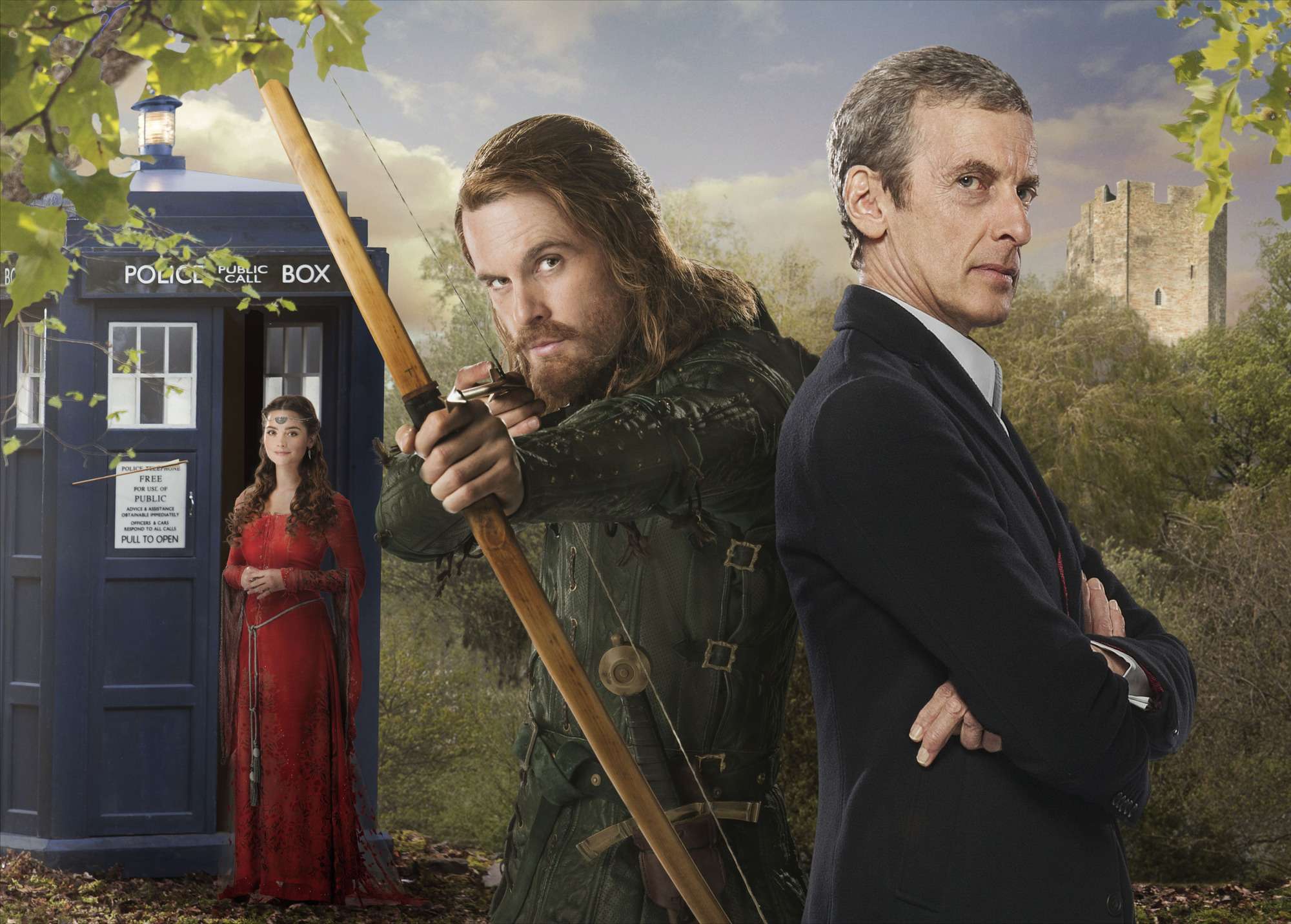
Offered a chance to go anywhere and meet anyone, Clara asks if The Doctor can take her to meet Robin Hood. Impossible, The Doctor says. Robin Hood is a myth. He isn't real. He never was. Still, The Doctor is willing to take Clara to Sherwood Forest around 1190-ish AD to prove the point... only to be confronted by an ever-laughing blonde bloke in green leathers with an immaculate beard and perfect aim.

There's also a Sheriff in Nottingham who is enslaving the peasants and taking their gold but The Doctor is less concerned about this injustice than he is about proving that he's right. Yet even after The Doctor discovers a castle disguised as a spaceship and robots disguised as knights, he still can't disprove the existence of a flesh and blood Robert of Locksley. But in a time of impossible heroes, will it be The Impossible Girl who saves the day?


THE GOOD PARTS

* The casting for this episode's guest stars was perfect.  Tom Riley is a picture-perfect Robin Hood and his Merry Men are all enjoyable for the all too brief moments we see them on-screen.  Ben Miller is an amazing Sheriff of Nottingham, who plays the villain as a glorious ham of the same school as Anthony Ainley's Master but not quite so hammy as Alan Rickman's famous take on The Sheriff.  One wishes BBC's most recent Robin Hood series had been more like this and one longs for a new Robin Hood spin-off to start with this cast.

* The script by Mark Gatiss is one of the most fun Doctor Who scripts we've had in a long time.  We get all the classic moments one would expect in a Robin Hood story (the duel on a log over a stream, the archery contest with a golden arrow as the prize, etc.) and Clara proves a grand expy of Marian as she undertakes all the tasks usually reserved for Marian in a Robin Hood story (i.e. milking the bad guy for information to tell Robin what he's up against).

* More than any script so far this series, Robots of Sherwood defines The Doctor and how much he has changed after 1000 years in Trenzalore without resorting to contrivances such as The Doctor having to ask Clara if he is a good man or not.  I believe most of the previous versions of The Doctor would be a bit more excited about meeting Robin Hood than they would be worried by the implications of his existence.  Matt Smith would be jumping through the trees shouting "Geronimo!" in an instant.  Tom Baker would smile and shake his hand vigorously excited at the honor of meeting such a great man.  Even Jon Pertwee's more patriarchal Doctor would probably offer a polite greeting and inquire about a sparring match later on. This new Doctor is a skeptic and a scientist with little use for romance or fun.

* Clara has gotten far more development in these past three episodes than she ever did during Series 7.  Here, Clara acts like - for lack of a better term - a real person confronted with their childhood hero.  Jenna Coleman plays the fangirl angle well, without ever going overboard.  And her attitude in handling The Doctor as he complains about her usual skepticism dropping in the face of an Impossible Hero is perfectly played.

* Along those lines, we see Clara acting like a school-teacher as Robin and The Doctor are acting like petulant schoolboys in the dungeon scene.  There is much hilarity here, particularly in how Clara demands answers on exactly what their escape plans are in the same tone in which she might demand a particularly difficult student answer a problem at the blackboard.

* It's an interesting change of pace for an episode in that, for once, The Doctor is the one lagging behind everyone else in his search for answers.  The Merry Men are the first to notice how odd it is that The Sheriff and his "men" are only interested in acquiring gold as opposed to any other valuable or rare objects.  And Clara proves far more effective in getting to the bottom of the mystery of what The Sheriff's game is.  Indeed, Clara is the one who saves the day, forced into action when her heroes are rendered inactive.

* This one is strictly personal, but The Doctor's duel with Robin Hood amused me for reasons beyond the writer's intent.  This past summer, I ran a Doctor Who RPG for the teens at my local library.  And one boy, informed that this was not the sort of game where you could arm yourself with all manner of guns or weapons and expect to win, asked if his character could always carry a spoon with him.  I agreed to this.  And circumstances contrived that this spoon would later prove to be useful in disabling a Cyber Controller.  And me, playing The Doctor, told the companions "And let that be a lesson to all of us - always carry a spoon with you."

* A subtle reference to the Classic Series - The Doctor claims to have studied swordplay with Richard the Lionheart, Cyrano De Bergerac and Errol Flynn.  The First Doctor met Richard The Lionheart in The Crusades and The Second Doctor met Cyrano De Bergerac in The Land of Fiction in The Mind Robber.  It's also worth noting that - like any historical Robin Hood that might have existed - these three men are better known today by the stories of their lives than the reality.

* Another reference to the Classic Series and the Pertwee era - The Doctor speculates that they might be in a miniscope as he's trying to figure things out.

* There are a lot of great lines in this episode, but none so grand as the final magical moment between The Doctor and Robin, where Robin lays out the moral of the episode - that it doesn't matter if a hero is real or not if the stories of that hero inspire others to become heroes -  and continues the season-wide theme of whether or not The Doctor is a good man or a hero and recognizing that there is a difference between the two.


THE PROBLEMS

* Capaldi's Doctor, for the first time, is a detriment to the story.  His skepticism here seems largely arbitrary given some of the equally impossible things he has been confronted with before.  This is a problem because as novel as it is for everyone else to be moving on with things around The Doctor, it is still worrying that he's digging for clues to prove himself right as everyone else is dealing with more pressing, serious issues.  In this regard, Capaldi's Doctor greatly resembles William Hartnell's First Doctor, who was (in his first few appearances, at any rate) an academic more concerned with his studies than playing the hero.  Of course Capaldi does finally play the hero but only after being convinced that not everyone around him are robots and that there is real danger to be found in the castle.

* On that note, The Doctor here seems to be written like Sherlock Holmes - more concerned with being right and solving a mystery than he is with saving lives or thwarting evil.  While The Doctor enjoys a good mystery, it should never be at the expense of other people's lives.

* The dodgy sound effects strike again, with the Wilhelm Scream being used at one point.

* Again - a personal point.  The archery stances and shooting techniques used by the actors are total crap.  Arrow has spoiled me on this point, I admit, but it drives me crazy when archers don't pull the string back properly


THE FINAL VERDICT

"History is a burden.  Stories can make us fly."

It is not without fault.  But since the moral of this episode is that looking for fault in a story that inspires you is pointless and that a good heroic tale is worth the telling in itself, I shall say nothing more than this - Robot of Sherwood is a good, inspiring heroic tale.

Sunday, August 31, 2014

Doctor Who, Series 8 - Episode 2 - Into The Dalek

THE QUICK, SPOILER FREE REVIEW

I am reminded of a line from my favorite comic series of all time, Starman - a line spoken by Oscar Wilde as he visited America.  "I've found there is much to admire in America.  However, on closer examination, I find that everything admirable has been imported from somewhere else."  

That is Into The Dalek in a nutshell.  There are good elements to this episode but almost all of them have been stolen from other, better Doctor Who episodes.  Capaldi does a fine job trying to sell it but even he can't fight the inertia that keeps this episode from going anywhere.


THE PLOT

En route to meet Clara for coffee, The Doctor slows down long enough to rescue soldier Journey Blue from The Daleks and return her to her ship.  Faced with a death sentence for invading their secure facility, The Doctor is temporarily spared so that he can tend to a patient captured by the soldiers - an injured Dalek who has somehow developed a capacity to appreciate beauty.

Can a Dalek be reformed?  The Doctor is skeptical but it's a question he'd like to answer.  Much as he would like a solid answer to a question that has apparently consumed him since his regeneration - Am I A Good Man?


THE GOOD PARTS 

* The opening scene before the credits is a good one and Peter Capaldi's talking down a soldier by firmly and politely (but with a bit of sarcasm) insisting that he will not be talked to in terms that involve orders or do anything because a gun is pointed at his head is perfect.  We're still getting a feel for this new Doctor and this is a great scene which lets us know that this is not a Doctor who suffers fools gladly but neither is he actively cruel towards them.

* Danny Pink - another teacher at Clara's school, who has been teased as having a big role to play in the coming series - is introduced quite effectively.  His background as a soldier who has returned home to become a teacher is an interesting counterpoint to the theme of the episode - the idea of change and someone who was trained to kill becoming a creator and nurturer.  If only Clara had been given this kind of depth when she was first introduced...

* Cliche as the "being-shrunk-and-going-inside-something's-body" troupe is (Classic Who already did it with The Invisible Enemy), the idea of exploring a Dalek from the inside is interesting enough and the Dalek Antibodies are delightfully sinister.

* The line "I AM NOT A GOOD DALEK.  YOU ARE A GOOD DALEK." is a great one, though it was shamelessly cribbed from the Series 1 episode Dalek.  If only Daleks had thumbs, so that Dalek could give The Doctor the snaps before rolling off.


THE PROBLEMS 

* If Deep Breath was Steven Moffat stealing from his own stories to create a "best of" Doctor Who episode, then Into The Dalek is Moffat looting the rest of the series' history.  Virtually every element of this episode has been utilized before and utilized far better in other Doctor Who stories.  An exploration of The Doctor being no better than his worst enemies morally?  Dalek from Series 1.  The Doctor's bias against soldiers for what they represent?  The Poison Sky and The Doctor's Daughter from Series 4   The concept of a broken Dalek turning good?  Moffat's own Asylum of the Daleks from Series 7!  I could go on, but I think that's enough to make the point.

* Granting that the series has always had an anti-authoritarian vibe and The Doctor has never had much use for military thinking in general, a lot of the anti-soldier talk here seems a bit over the top.  I can see what the writers are going for, drawing parallels between the human soldiers, The Daleks and The Doctor all being united in their common hatred and refusal to question the efficiency of that hatred.  But what they are trying to say and what they actually say are worlds apart in content and tone.

* The soldiers on The Aristotle are remarkably shallow even by the standards of soldiers in a Doctor Who story.  Journey Blue in particularly is woefully underwritten and could have benefited from some of the time used to develop Danny Pink.  And don't think we didn't notice the feminine/masculine colors being used as ironic contrast to the characters and their roles with Blue being a female soldier and Pink being a male teacher.

* I challenge every Rose Tyler hater out there who has dismissed her character as the biggest Mary Sue in history to watch this episode and make a convincing case that Clara Oswald isn't much worse in that regard, as we see an ordinary school teacher start crawling around inside a Dalek's brain and start pulling random things to unblock its memories without getting electrocuted.


THE FINAL VERDICT

Uninspired and a little bit dull at points, Into The Dalek will serve only to remind the fandom of stories that utilized the same story elements far more effectively.   Quite possibly the most generic Doctor Who story ever.

Monday, August 25, 2014

Doctor Who, Series 8 - Episode 1 - Deep Breath

THE QUICK, SPOILER FREE REVIEW

Deep Breath is not a good introduction to the series for newcomers, nor is it a good introduction to the new Doctor.  Yet Peter Capaldi and Jenna Coleman manage to make it all work despite a weak script that will be inaccessible to new viewers and redundant to the devout fans.  Serviceable but not quite good.


THE PLOT

A dinosaur running loose in the streets of Victorian Era London is unusual even by the standards of The Patemoster Gang.  And a dinosaur vomiting up The TARDIS is unprecedented!  This is how Madame Vastra, Jenny and Strax are introduced to the latest incarnation of The Doctor.

As The Doctor deals with the trauma of his most recent regeneration cycle going badly, Clara Oswald finds herself struggling to cope with the idea that the manic young man she knew as The Doctor is now a depressive older man who could be her father!  But they'll have little time to rest and recover, as a series of spontaneous combustions claim the lives of several Londoners and put The Doctor on the trail of an enemy that seems oddly familiar, though he can't explain why.


THE GOOD PARTS 

* From the very first minute he appears on screen, Peter Capaldi owns the role of The Doctor.  Capaldi has a great presence as an actor and he commands the center stage like no actor since the days of Tom Baker.  Indeed, comparisons can be made between Capaldi's performance here and Baker's performance playing an equally muddled post-regeneration Doctor in Robot,  Yet favorable parallels could also be drawn to Peter Davison's performance in Castrovalva.

* Talking of the classic series, there's a lot of nods to it throughout the episode.  Most of them aren't particularly subtle (like The Doctor's dismissing the idea of a long scarf as silly) but there are a few soft touches, such as the sound-effect of The Cloister Bell from The TARDIS when The Doctor first passes out while talking to the dinosaur and Madame Vastra repeating the words of The Brigadier when The Third Doctor regenerated into The Fourth Doctor - "Here we go again."

* With one exception, Clara isn't given much to do but bandy words with The Doctor and Vastra.  That said, Jenna Coleman does a fantastic job with the banter and her telling off Madame Vastra is the first real sign we've had in a while of the spitfire Clara from The Snowmen.

* The one thing Clara does get to do apart from be sarcastic (i.e the sequence in which we see her attempting to blend in among the clockwork androids) is a truly tense and exciting scene.  I put this down more to the direction than the script but Coleman plays it well and the whole affair is well-shot.  That later interrogation scene and the resulting flashbacks also give us our first glimpse of Clara's life outside the context of saving The Doctor.  It's a bit late to try and turn her into a fully-developed character but it's still a nice touch.

* The sequence with The Eleventh Doctor begging Clara to stay with his future self is surprisingly effective.  And it seems fitting that - after all the talk in this episode of The Doctor treating Clara like a pseudo-girlfriend or her viewing him as a sort-of boyfriend - The Eleventh Doctor should call up like a drunk-dialing ex, promising that things will be okay even if they are different now.  It also serves as an effective metatextual commentary on the fans who came onto the show during Matt Smith's tenure who may be reluctant to embrace Capaldi as the new Doctor.


THE PROBLEMS 

* Clara's drama in this episode - being unable to cope with The Doctor now being this combative older man - rings false.  Indeed, I'd go so far as to say it's complete hogwash.  Remember how she's supposed to be The Impossible Girl - the woman who scattered herself through space and time, throughout The Doctor's life, knowing every single face he ever wore including the one he tried to hide away from himself?   I ask, because Steven Moffat seems to have forgotten that point!  And yes - granting that knowing that The Doctor has worn other faces is a bit different than coping with a Time Lord in the midst of post-Regeneration birth pains - we're talking about the young woman who saw The Doctor even within the grizzled, cynical eyes of The War Doctor.  Clara should be the last person in the universe to doubt The Doctor.

* Moffat's script seems far too derivative of his previous work on the show.  Granting that he's apparently building toward something and has claimed in interviews that he's tying some of his earlier one-shot stories into the narrative for this Series, one can't help but feel that there's little originality at play here.  The clockwork robots from The Girl In The Fireplace come off as second-rate Cybermen.

* Unlike most of the other stories which introduced new Doctors, this episode is a poor introduction to Doctor Who for any newcomers who might have decided to give the show a shot with the start of the new Series.  Prior knowledge of who exactly Madame Vastra, Jenny and Strax are is rather essential to the episode's story and they're not given much introduction beyond "Grumpy dwarf", "the green one" and "the not green one".  One wonders if that is how Steven Moffat describes them in his own head.  It would explain a lot...

* Ironically, Moffat's attempt to develop Jenny and Vastra may prove to be annoying to long-time fans of the show, as said development primarily consists of continual reminders that "Yes, we are lesbians in a cross-species relationship".  Vastra, Jenny and Strax are all played like one-note parodies of themselves and the same old jokes are retold to diminished effect.

* While one can get away with slapstick in Doctor Who, one cannot get away with Hanna Barbera stock sound-effects when people are hit in the head.  The bit with Madame Vastra putting The Doctor to sleep is a mood killer.  Ditto Strax's method of taking the paper up to Clara.


THE FINAL VERDICT

The weakest introductory story for any Doctor since the series returned in 2005.  Steve Moffat's script is uncharacteristically weak, simultaneously focusing on established supporting players while giving them far too little to do as the plot slowly develops.  The only thing that saves it in the end is the performances of the cast; particularly Peter Capaldi, who manages to make the new Doctor into an engaging figure despite there being very little development of his character.  It's not a bad episode but it's unlikely to be as fondly remembered in years to come as The Christmas Invasion or The Eleventh Hour.