Showing posts with label The Shade. Show all posts

Sunday, December 18, 2016

The Flash #12 - A Review

Trapped in The Shadowlands, The Flash and Kid Flash find themselves in even direr straits when the denizens of the realm of fear and nightmare corrupt Iris West and abduct The Shade! The Fastest Man Alive and Fastest Boy Alive will have to reestablish some level of trust and learn some new tricks if they are to prove faster than... The Speed of Dark!


As a fan of The Shade and Hope O'Dare from James Robinson's Starman, I'm pleased by Joshua Williamson's take on the characters from that series. I wish we'd had more time with Hope O'Dare when she wasn't playing the shadow-controlled femme fatale but then I'd also love to see a series devoted to Shade and Hope traveling the world together. Still, the Shade/Hope relationship proves an interesting counterpoint to the Flash/Iris one and I'm anxious to see where that goes. Particularly since Barry doesn't seem all that concerned about the missing Dr. Meena anymore!

The artwork remains as impressive as in the earlier chapters. This issue featured two colorists, but you'd never know it the way Ivan Plascencia and Christopher Sotomayor match one another's work. Again, I must note the novel touch of using purples instead of blues and blacks to mark the shadows, giving Davide Gianfelice's artwork a brighter, more dynamic appearance than one would expect in a story set in The Shadowlands.


Tuesday, November 15, 2016

The Flash Episode Guide: Season 3, Episode 6 - Shade

For a summary of the episode guide layout & categories, click here.


Plot

When Wally West begins having dreams of having super-speed, Barry realizes he may have to break his promise and tell Wally, Joe and Iris precisely how things were different in The Flashpoint Timeline in order to keep Wally safe. Unfortunately, Dr. Alchemy may already have his Wally in his grasp and a new shadow-manipulating metahuman is on the loose in Central City. Meanwhile, Caitlin reveals her cold powers to Cisco and asks him to vibe her future.


Influences

The Flash comics of John Broome (creator of The Shade) and Mark Waid (creator of Savitar).


Goofs

No motive or explanation is ever given for the first man Shade kills. They don't even bother to name him.

If Shade's powers only create the illusion that he is a shadow, how is he able to lift a man off the ground and strangle him with one hand? Or appear as a giant shadow right underneath The Flash and lift him off the ground?


Artistry

The music in the confrontation between Alchemy and Wally is good.


Flash Facts


Barry says the first Shade murder occured in Chubbuck, on the corner of Palmer and Racine.  In the DC Comics Universe, Chubuck is a residental district in Central City and home to Central City Hospital.

In the original comics, The Shade was one of Jay Garrick's villains. He first appeared in Flash Comics #33 (September 1942). Originally, The Shade was just an ordinary thief with a magical cane that allowed him to animate shadows.

The Shade underwent a major retcon in the 1990s Starman series, where he was given a full background and his powers were revealed to be his own - not derived from a magic cane. The Shade was also revealed to be an immortal - a side-effect of his powers - and that he had been alive since the Victorian era.

Shade's powers are a manifestation of a strong connection to The Darklands - a mystic realm of malleable darkness and nightmares in the DC Universe. In addition to being able to fashion illusions of shadow-stuff and manifesting solid "terrors" in a manner similar to how a Green Lantern manipulates light, The Shade can teleport himself and others across great distances through The Darklands. According to one story set in the future - he eventually gains the power to travel through time using his shadowy portals.

The DCTVU "Shade" is but a shadow of the more intersting anti-hero from the comics. We are not given a name or any motive for his doing what he does in this episode, apart from acting as a distraction for Alchemy.  His only power appears to be creating the illusion of being a giant shadow.

HR identifies one piece of currency from his world as "a helbing". This is a nod to The Flash writers Aaron and Todd Helbing.

The villain who appears at the end of the episode says that he is Savitar, The God of Speed. In the Hindu religion, Savitr is the "lord of that which moves and is stationary".

Savitar was a villain introduced in the Mark Waid run of The Flash. A pilot for an unnamed Third-World country during The Cold War, the man who became Savitar as struck by lightning while testing a supersonic jet and developed super-speed. He took the name Savitar and began to study the applications of his powers, developing techniques no other speedster at that time had. Among these abilities were the creation of force-fields made of inertia and the power to drain the speed from moving objects. He developed a cult of followers, whom he was able to loan his speed to and sought to depower every other speedster on Earth who was not one of his followers.

We know little about the DCTVU version of Savitar so far save one thing - he is apparently so fast that ordinary humans cannot even percieve him. When he grabs a hold of Barry, everyone else sees an invisible force pinning Barry.  Even Barry only piercives Savitar as a white bolt of light when he is in motion.


Technobabble

Cisco constructed a set of power-dampening cuffs for controlling metahuman prisoners. Caitlin steals the cuffs to try and keep her powers under control.

Petechiae around the eye, a crushed larynx and finger-prints around his neck indicate strangulation.

Barry notes that despite this - in the case of the first Shade killing - there are no indications of an assailiant - no laceration or finger-nail marks or DNA evidence under the fingernails of the victim.

Earth 19 has facial transmogrification technology. This allows HR to use a hand-held device to give himself the face of his business partner, Randolf Morgan. He thinks it works because of light-refraction but isn't really sure how the science works.

According to HR, the Earth 19 version of Shade was able to vibrate at such a high frequency that it created the illusion that he was a shadow. This is the same thing that Barry Allen does to phase through solid matter.

Cisco determines the Earth One version of Shade is doing the same thing, due to a fluctuating heat signature and a ridiculous red-shift. Caitlin further states this means Shade must be slowing down his molecules when he attacks.

HR gives the rest of Team Flash a retina adjustment through a flash of light so they will see his real face while the rest of the world see Randolf Morgan.

Earth 19 has different currency than Earth One. HR Wells identifies one coin - an equilateral triangle of pink plastic - as a helbing.

Light slows down Shade's molecular vibrations.

By hacking the computers of all the cars in the park and turning on their headlights, Cisco is able to light up the area enough that Shade can't use his powers.

Caitlin gives Wally a dose of Lorazepam - a medication used for treating epilepsy and anxiety.


Dialogue Triumphs

Wally: (voice-over) I'm fast. Really fast. I might even be the fastest man alive. And when I'm running, there's no greater feeling in the world. I can move through the city like a guardian angel, protecting people who need me.
(Kid Flash runs in front of a truck just barely getting a girl on a skateboard out of the way in time.)
Kid Flash: Woah! You've got to slow down and watch where you're going, okay?
Girl: Okay.
Kid Flash: Okay.
(Wally kicks up the girl's skateboard and hands it back to her. It has yellow lightning bolts on it.)
Kid Flash: Cool skateboard, though.
Girl: Thanks!
Wally: (vocie over) They even have a name for me. They call me Kid Flash.

(Regarding HR)
Cisco: Do you think everyone on Earth 19 is missing crayons in their box or just him?

(Cisco accuses HR of stealing his power-dampening cuffs.)
HR: What - you think I took them? I didn't take them. What do I need cuffs for?  I just got to this Earth. I came alone. I haven't met anyone yet. It's going to take a while, even when I do meet them, to get to the cuffs stage.
(Caitlin makes a face at HR as she realizes what "The Cuffs Stage" means.)

(Barry and Iris are watching Wally in his cell through a security monitor.)
Iris: I hate that we have to do this. He so badly wanted powers and now, to keep him locked up so he doesn't get them, it's...
Barry: It's hard. I know.
Iris: I don't know if you actually do.
Barry: What does that mean?
Iris: All Wally wants to do is to help people. And to see you do that every day while all he can do is stand by and watch... it's hard being a bystander sometimes.
Barry: You don't... feel that way too, do you?
Iris: Barry.... c'mon. My contributions here are limited. I don't know science. I don't have powers. I don't know how to help you.
Barry:  I couldn't do this without you.
Iris: That's not true.
Barry: That is true. Whether you realize it or not, there is no Flash without Iris West.

Caitlin: Cisco, I am so sorry about how I reacted. I understand why you told everyone.
Cisco: Never helps when we keep things from each other.
Caitlin: You're right! And.. I'm glad that you told everyone. I'm just not very good at asking for help. I get that from my mother.
Cisco: You're better than your mother.
Caitlin: I don't know. I'm just so terrified because she said if I keep using my powers then it will be impossible to stop them.
Cisco: Your mother might be one of the most accomplished scientists on this planet. But when it comes to the impossible? We're the experts. (he takes her hands) We're going to help you Caitlin. Okay?
Caitlin: Okay.
Cisco: Let's go help Wally.
Caitlin: Okay.


Continuity

Joe refers to the dreams Frankie Kane reported having before her powers manifested in 303 and compares them to what Wally reports.

As the episode opens, Julian Albert is working on the sixth Alchemy husk discovered.

Barry is transferred to the metahuman CSI department full-time.

Joe finally asks Cecilia Horton out on a date to see The Shining at a "movie in the park" event.

Nobody told HR that the Earth Prime version of Harrison Wells was truly dead and that - thanks to Eobard Thawne - the public thinks he's a murderer.

HR suggests turning STAR Labs into a museum, to act as a front for their activities.

Barry tells everyone the truth about Wally West being Kid Flash in The Flashpoint Timeline in 301.

Julian Albert has a girlfriend.

HR drinks nothing but coffee, according to Caitlin. He also does inversion stretches in The STAR Labs intake and medtitates in his bedroom.

HR's partner in the STAR Labs on Earth 19 was a man named Randolf Morgan. Randolf Morgan was the brains of the operation while HR was the face of the company.

HR is apparently a practitioner of BDSM.

According to HR, Earth 19 had a villain called Shade who could seemingly change into a living shadow, like the mysterious killer.

Cisco has a vision of himself in a costume, fighting with Caitlin, who appears to have changed completely into Killer Frost. He lies to her about the vision at first but later confesses when she says he's acting strange around her.

Cisco says everything he's vibed has come true, except for the destruction of Earth 2.

Cisco was scared by the movie The Shining and couldn't make it past the scene with the twins.

Cecile Horton has an 18 year old daughter, who is a year away from going off to college.

HR introduces himself to Cecile as HR Randolf. He then goes on to take over Joe's date.

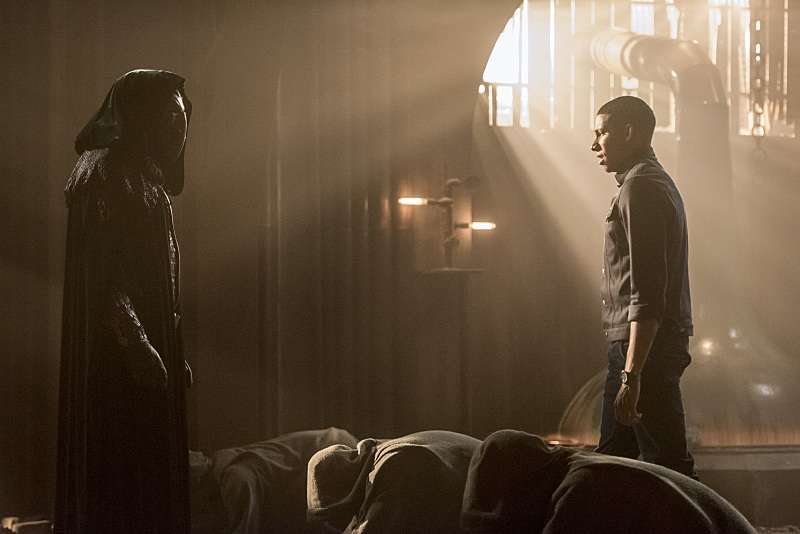
After Shade is captured, Joe guesses that means Alchemy has three other metahumans working with him. We later see three robed figures along with Alchemy during his fight with The Flash and the CCPD.

Cisco tells the rest of Team Flash about Caitlin developing cold powers and his vision of her being Killer Frost in the future.

Julian Albert is curiously absent as the CCPD gets ready to move on Alchemy.

There is a Gorilla Grodd on Earth 19.  According to HR, there are many sentient gorillas on his Earth.

Wally touches Alchemy's stone and is trapped inside a cocoon at the episode's end.


The Fridge Factor

The whole idea of Caitlin hiding her powers for this long and her inevitably becoming evil because of them feeds into a series of negative tropes involving women with ice powers and women with power in general being inherently evil.


The Boomerang Factor


The subplot with Shade is completely pointless and a waste of one of DC Comics' richer characters, even ignoring the crap explanation for his powers that completely contradicts what we see on screen.


The Bottom Line

A filler episode that serves no purpose other than stretching out several storylines that really should have been brought to a close sooner. Despite giving the episode its title, Shade is barely in the episode and is defeated right after the half-way mark. The only things that redeem this episode are the Cisco/Caitlin interactions and the drama of the last 10 minutes when the plot finally starts moving.

Sunday, November 13, 2016

The Flash #10 - A Review

The Flash has a new partner in the younger Wally West. Unfortunately, Wally is not as quick to think as he is to act and has started skipping school to go chasing down new super-villains like Papercut. Perhaps Wally will quickly learn the error of his ways... assuming he survives an encounter with a strange, shadowy figure...


The main plot of this issue is a solid piece of classic superhero conflict - the eager sidekick overstepping the boundaries set by his mentor. Joshua Williamson keeps the story fresh, despite its potential to be cliched. New Rogue Papercut is likewise an interesting twist on a classic superpower.

What really makes this issue interesting, however, is the hint at the return of classic Flash villain The Shade. There's enough here to suggest that Shade's characterization put forth in the classic 1990s Starman series may not be wholly forgotten but that changes are afoot for everyone's favorite shadowy gentleman thief. I look forward to seeing what Williamson does next.


The artwork for this issue is top-notch. Felipe Watanabe's kinetic style is a fine fit for The Flash and the colors by Chris Sotomayor are appropriately eye-catching. It is Oclair Albert's inks, however, that make the finished artwork pop, particularly in the sequences involving "the shadow man".

Sunday, September 16, 2012

The Shade #12 - A Review

I've avoided reviewing The Shade 12-issue mini-series since its' first issue because I wanted to consider the whole of the series before passing judgement on the individual parts of it. I've reconsidered that in light of this final issue, simply because I had to share the splendid irony of it all.


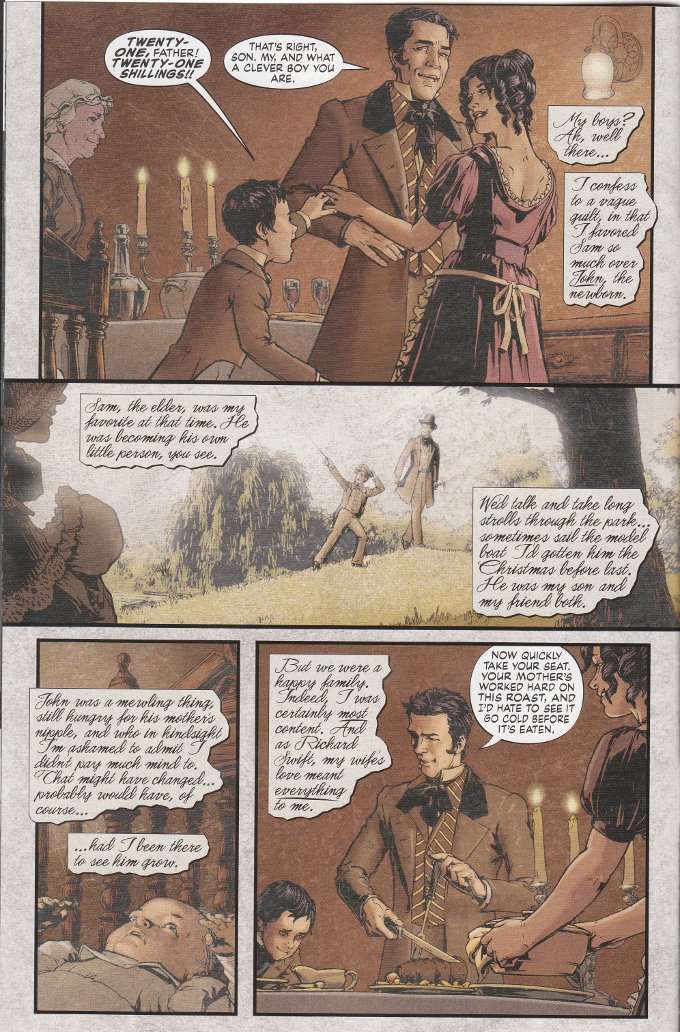
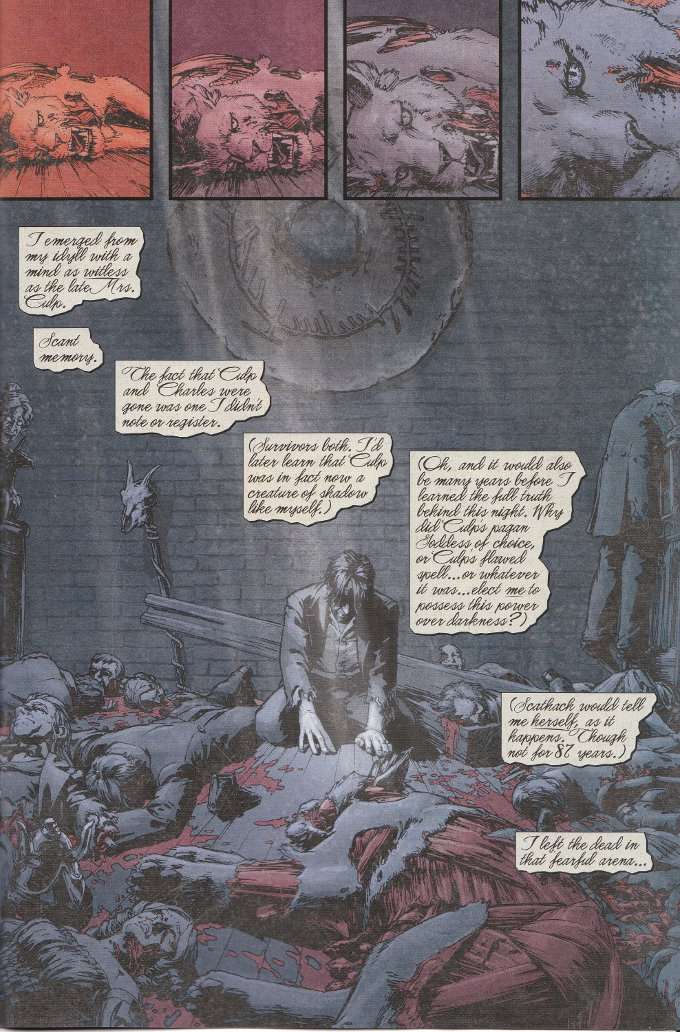
I do not know if it was by fortune or design that this issue - which details the origins of The Shade - should come out now in the middle of DC Comics' Zero Month. I am deeply amused, as I am sure The Shade would be, by the timing if it is a coincidence just as I'm sure everyone's favorite shadowy anti-hero would be amused that a mini-series detailing his life story ends with its' beginning. I think Shade would also be amused how - like the man himself - the story is a mixture of American and British sensibilities, curiously melding the styles of Dickensian drama with Lovecraftian horror.

Fans of the James Robinson's Starman series already know the generalities of how merchant Richard Swift was transformed into a being of living shadow who dubbed himself The Shade. But until now no story has ever gone into the sordid details of precisely how it all happened or described the role that Charles Dickens (one of the rare few who knew The Shade both before and after his transformation) had to play in those events. The grand irony is that while this is an origin story, long-time readers of Robinson's work are the only ones who may fully grasp the greatest of this story.


Robinson's script is once again ably illustrated by Gene Ha, who delivers the work of a lifetime. Ha wisely uses his inks sparingly, limiting his shadows while allowing the original pencils to be emphasized by the color. Colorist Art Lyon, too, deserves a lot of praise. The early pages, depicting the day-to-day life of London in the early 1800s are colored in muted grays (if one can be said to color anything in muted grays) that illustrate the mundane nature of Richard's early life. It also helps to throw the horror of the more colorful later-pages into sharper contrast.

Expect a full review of the entire mini-series at a later date. For now... well done, Mr. Robinson. Well done, indeed.

Friday, November 4, 2011

The Shade #1 - A Review

I've been reading comics long enough to have seen James Robinson write a lot of different stories. I've seen him write some of the greatest comics of all time in Starman. I've seen him write some of the worst comics of all time in JLA: Cry For Justice. I've even seen him write a Gen 13 story where Fairchild wound up in more clothes than usual! But as diverse a writer as Robinson is, it's been rare for me to see him write a comic that was instantly accessible to new readers.... until now.

Richard "Dickie" Swift is an ageless man who gained both his immortality and the power to conjure, manipulate and animate shadows as a Green Lantern controls light after an incident he is loathe to discuss. Going by the nom de plume of The Shade, he has been both a super-villain and a savior - frequently at the same time - for the better part of two centuries.


As the issue opens Shade is meeting with Mikhal Tomas (a.k.a. the alien hero now known as Starman), discussing Mikhal's return to Opal City. Mikhal notes that Shade is in a dark mood, even by his standards - a fact that Shade dismisses as being related to the anniversary of his "creation". Shade's girlfriend, OCPD Officer Hope O'Dare, thinks there is something more to it, having noticed the same mood for several months now. She suggests that The Shade should find something to do with himself to shake himself out of his malaise, like go have an adventure. As he ponders this,while taking a walk around town, Shade is approached by the assassin Deathstroke. Naturally the call is not a social one and the issue ends as the fight between the two seems to end suddenly.


Robinson is quick to establish the status quo for those old-timers like me who are wondering the fate of the old Starman series in the Brave New World of the New 52. Rest assured all is as it was! Jack Knight took up his father's name and became Starman and now alien hero Mikhal Tomas (most recently seen in Robinson's Justice League) has returned to Opal City to fight crime under the same name. Robinson also neatly explains away the surprise revealed in the Blackest Night tie-in Starman #81 , which revealed that Shade and Hope were now dating. So even if you're a Starman fan who missed that issue (and if you did, shame on you!), everything is neatly explained away so that new readers and old alike have some feeling for who The Shade is, what he's capable of and who is important to him.


Cully Hammer is a more than suitable substitute for long-time Starman artist Tony Harris, whose duties on this series are thus far limited to several stunning covers. Hammer's art is more stylized than Harris's photo-realistic approach, but it suits the story well. Of particular note is the inking, which is suitably thick and dark as one would expect in a Shade story, but it does not fall into the trap of being dark to the point that it looks like ink was spilled on the page - a trap too many artists working on a weird or (pardon the pun) "dark" book fall into.

Long-time Starman fans rejoice! The James Robinson we know and love is back in force! And for those of you unfortunate enough to only know Mr. Robinson from his more recent work on Cry for Justice, I urge you to give this title a shot. I think you'll be glad you did.

Wednesday, March 10, 2010

One Good Thing And One Bad Thing About Justice League: Rise And Fall Special


GOOD THING: J.T. Krul has a real feel for most of the characters and how they should sound. There's a lot of good character moments here, particularly the scenes written from Ollie and Dinah's perspectives and the scenes of Dick Grayson and Wally West working together.


BAD THING: Notice how I said MOST of the characters? There's a reason for that and the reason is that either Krul has seriously missed the mark on several characters or there's more going on here than meets the eye.


Case in point. Barry Allen and Hal Jordan go looking for The Shade, to see if he knows anything about how to find Prometheus. Shade helpfully takes them right to Prometheus' home in The Ghost Zone and notes that "they are not the first ones he's brought there." Cue the shot of Prometheus' body, with an arrow through the forehead.

Now, I know what you Starman fans are thinking - Since when is The Shade - granting that he is more anti-Hero than anti-Villain now - ever directly this helpful? Since when does The Shade rat people out for crimes? Particularly crimes of revenge? Particularly murders?

That's a very good question.

And when Shade says "first ones", is he referring to someone besides Ollie? If not, then why does he say "first ones" with the emphasis on the plural?

That's also a good question.

Yet another good question is what happened to Prometheus' helmet. The one that Ollie shot an arrow through which is now curiously absent, despite the arrow being intact inside Prometheus' shaven-skull.

And where is the drooling imbecile I.Q. (last seen in The Ghost Zone when Ollie killed Prometheus) in all of this?

It's possible that all of this is hinting at something bigger and - quite probably - Prometheus having found a way to cheat death and masquerade as another person... Perhaps The Shade? Unfortunately, it seems equally likely that Shade's characterization was screwed up and that the missing helmet is a MacGuffin that doesn't signify anything other than someone else is running around with a very dangerous weapon. Either way, it's a sad commentary that after two issues of handling these characters, I still can't tell if Krul is being clever or stupid.


The Final Verdict: Good character moments throughout, but one can't tell if there is something bigger going on here or if the clues are just plot-holes given some of the characterization. The art styles of the three artists don't blend well, either, with Black Canary's costume looking just plain ridiculous in the final pages.

Thursday, January 21, 2010

One Good Thing And One Bad Thing About Starman #81

I know I still haven't gotten around to reviewing most of LAST week's comics... but I think everyone is curious to note how I'll rate this book, being the source of my nickname and all.


GOOD THING: The Shade proving to be immune to the Black Lantern's main method of attack... and more, capable of turning his own black heart into a weapon against the Black Lantern who attacked him.


BAD THING: Fernando Dagnino is no Tony Harris. His style seems far too sketchy for my taste and - somehow - manages the trick of looking overly sketched AND over-inked, thanks to the colorist's choice in pallet. Granting that this is a Shade story, things don't need to look like ink was smudged on the page.


The Final Verdict: This is the James Robinson we know and love. A fitting continuation of the Starman saga, which doesn't change a bit of the original ending and indeed builds upon something that was hinted to be coming. A must read for all fans of the Opal City crowd, despite some artwork that is - much like The Shade - a bit dark and more than a little dodgy.

Thursday, June 11, 2009

...I'm a man of wealth and taste, I've been around for a long long year...


Well, I can hardly do Times Past stories without having The Shade in at least one, can I? ;)

In The Archer’s Quest, we find out that Oliver Queen made a bargain with The Shade in which he hired the immortal shadow-empowered semi-villain to take care of hiding/destroying various artifacts that would connect Oliver Queen to Green Arrow in the event of his death. Roy Harper asks why him instead of one of his loved ones? Ollie explains that being virtually immortal, Shade was more than likely to outlive any of Ollie’s loved ones and was emotionally detached enough to follow instructions on what Ollie would want destroyed.

This is sound reasoning. Unfortunately, this raises a troubling number of questions. How did Ollie find out that The Shade was more than a dangerous criminal who bothered The Flash? How did he find out The Shade was immortal? And why on earth would The Shade, mercenary as he is, feel inclined to play solicitor for Green Arrow regardless of how much he was being paid, given his long desire to remain neutral in dealing with superheroes when lives were not at stake?

The answer lies in Times Past. And not surprisingly, the answer involves a Spider. Alias The Spider, to be precise.

The Spider originally was a Golden Age archer hero, similar to Green Arrow. At least, that was what the public knew. The truth is that The Spider was a criminal mastermind who used his heroic identity to expose the crimes of his rivals while secretly taking over their turf with his own gangs.

The Shade took a hand in putting an end to his reign of terror in the 1950s, after The Spider grew bold enough to expand into Keystone City – partly because The Spider was part of a family of career criminals (The Ludlows) who had been trying to kill The Shade for the better part of a century and partly because The Spider had been planning to kill Keystone City’s resident retired superhero and Shade’s “enemy”, The Flash.

It later turned out that The Spider had an illegitimate son who decided to pick up where his dad left off and continued both family traditions – archery in the name of evil and trying to kill The Shade. And with the help of a few other villains, he came damn close to succeeding.

But before that – between the father and son – there was another Spider. A Spider who had no legacy to the Ludlows but had uncovered one of The Spider’s old hideaways, complete with the costume, the trick arrows and enough journals to reveal his secret criminal identity along with enough stashed loot to allow him to make a serious go as a super-villain.

Naturally, the report of a new villain called The Spider was enough to spark Shade’s interest. And the reports of an evil archer was enough to get Green Arrow’s attention. And so it was that a hero and a villain in name, if not in action (well, most of the time) did find common cause and form – if not a friendship – than an understanding of sorts as they dealt with their new mutual enemy.

Sunday, February 24, 2008

Fanboy Squee!

My thanks to all of you who pointed these articles out to me.

http://www.newsarama.com/dcnew/Wondercon08/DCNation.html
http://www.comicbookresources.com/news/newsitem.cgi?id=13096

Of course I'm excited at the possibility of another The Shade mini-series somewhere down the line. And I'll pick up Robinson's monthly Superman book even though I've never been much of a fan of the Big Blue Boyscout. But the real big news is the revelation that...

1) Robinson is doing a new book that he isn't allowed to talk about yet.
2) It is going to involve Green Lantern.
3) It is going to involve Green Arrow.
4) Mike Carlin said "We should get Neal Adams to draw it" and indeed had said elsewhere that Adams was reportedly looking to do a monthly book again.

Yeah. I know it's too much to hope that they're canceling Green Arrow/Black Canary, putting Dinah back into Birds of Prey and bringing back Green Lantern/Green Arrow and that my favorite writer of all time will be doing the writing along with the greatest artist of the late Silver/Early Bronze age...

... but I can dream.