Wednesday, January 4, 2012

Red Sonja #61 (Echos of War, Part 1)

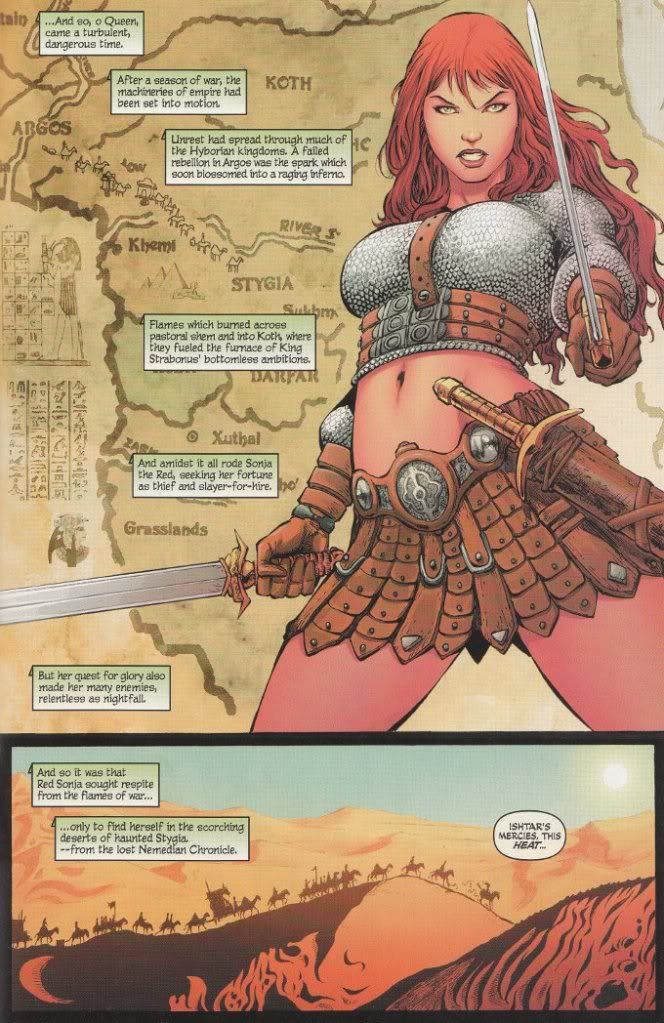
One thing I miss in many modern comics that the classic comics always provided was a recap page. Say what you will about Stan Lee's weaknesses as a writer but The Man was onto something when he said that a writer should treat every story they wrote as if it was going to be the first story somebody was ever going to read. Even in these days when reprint editions, trade-paperbacks, Internet shopping and on-line archives have made it fairly simple for a fan to read the previous issues of a series, the idea of making every single issue of a comic accessible to new readers is a novelty in these days of "writing for The Trade".


Thankfully, the recap page is alive and well in Eric Trautmann's Red Sonja. The above page neatly summarizes the last 10 months worth of issues and how Sonja wound up in her current position as a guard on a caravan bound for Stygia - a nation that long-time Conan fans know is not hospitable to outsiders under good circumstances but does have the advantage of being a good place to hide. Why? Because nobody would ever expect a non-Stygian to willingly flee toward Stygia.

This issue is mostly one extended action scene, as Sonja rides forth to delay a rival merchant who has hindered her current employer in the past. Despite the heavy focus on swordplay, riding and high adventure, Trautmann does a wonderful job of establishing Sonja's personality for new readers. Sonja is bold, a born leader and has a wicked sense of humor that comes to the surface when her life is in danger.
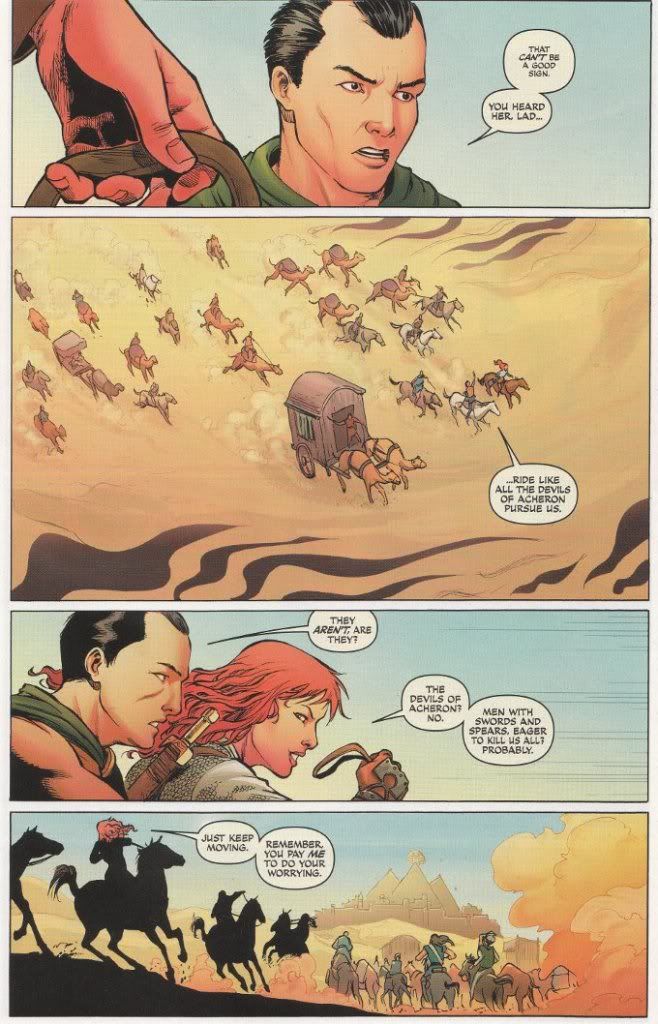


The artwork by Walter Geovani is perfectly suited towards this kind of book. He is a wonderful visual storyteller, who knows how to properly draw an action sequence where several things are happening all at once. Geovani also draws Sonja as a woman who is attractive yet athletic - a task that surprisingly few Red Sonja artists have proven capable of in the past! Too often artists either depict Sonja as a waif who shouldn't be able to lift a sword much less swing it or make her grotesquely muscular. It helps that Geovani has abandoned Sonja's infamous scale-mail bikini costume in favor of a chain-shirt and leather banded-skirt combo that more closely resembles the original character design from the days of Roy Thomas' Conan The Barbarian.

If you're a fantasy fan who has resisted the She-Devil With A Sword in the past because of the cheesecake heavy covers this series in infamous for or if you're someone who enjoys books centering upon strong heroines, I recommend this book highly. This issue is a perfect jumping on-point for new readers and a textbook example of not just how to make a good fantasy comic but how to create a good, accessible comic of any genre.

Tuesday, January 3, 2012

Super Stupor #4

There is no small irony that some of the most novel portrayals of a world where super powers are a reality I have ever seen came from a series that is meant to be comedic. And yet, this series has provided me with more honest drama than a good deal of the serious superhero books published by The Big Two. Such is the magic of Super Stupor, which is at times as funny as The Tick, as twisted as Nextwave and as thoughtful as Astro City.

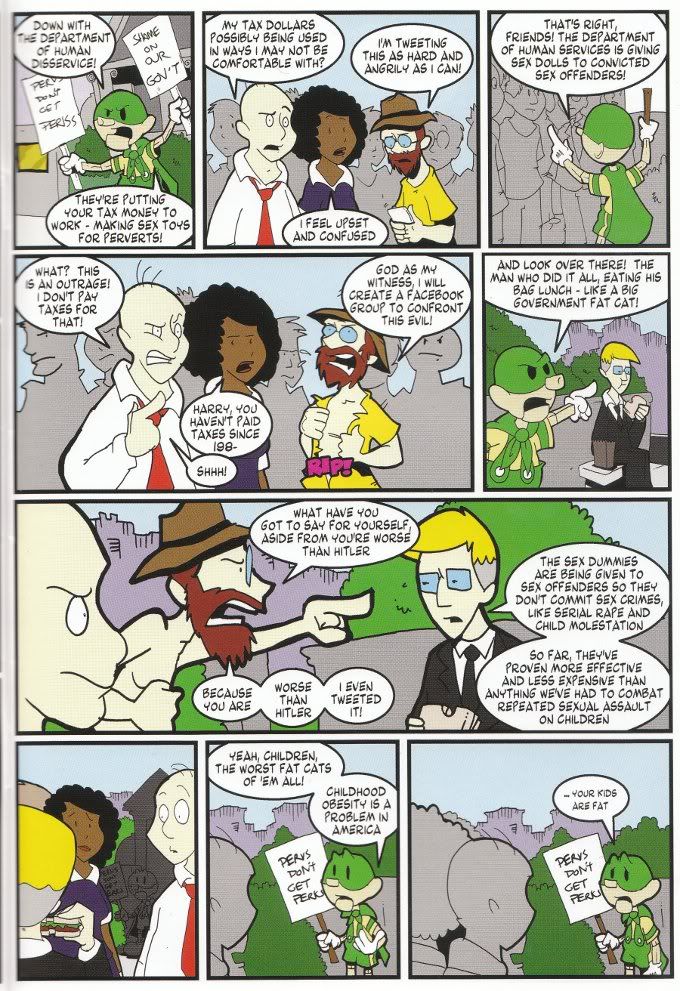
Case in point: one of the two subplots of Super Stupor #4 focuses upon the superhero Boy-Toy and the rights of artificial intelligence in a high-tech society. The end result of the final project of genius inventor Dr. Nolan Candle, Boy-Toy was created to be the first of a line of personal protectors/robot friends for children everywhere. But something went wrong and despite developing thousands of clones of the original, Dr. Candle never managed to build another robot with the innate intelligence of the first Boy-Toy. Now, over four decades later, someone has finally thought of a use for thousands of robotic boys with no free will - sex dolls for convicted child molesters!

Naturally, Boy-Toy is upset by the thought of his "brothers" being turned into sex slaves in the name of providing therapy to perverted criminals but he's virtually alone in his protest. And the government bureaucrat who is backing the program seems to take a disturbing glee in further upsetting Boy-Toy, noting that as an employee of the Department of Human Services, he doesn't have to care about what a non-human like Boy-Toy thinks.


Of course this is all played for laughs. And yet, there is still a certain level of serious Swiftian satire in the midst of this madness. After all, similar arguments have been made in the past about how the mistreatment of minorities justified noble ends. Slavery and Apartheid were justified because people with a different skin color weren't really people. The subjugation of women is still justified for all manner of philosophical and religious reasons. Like all great comedians, author R.K. Milholland's uses humor to expose the deeper truths about society and the sad truth is that we could justify some of the worst things possible for the right price.

This serious examination of the underpinnings of a super-powered society is one thing that separates Super Stupor from most other comedic superhero books. Another is Milholland's refusal to fall back on the tired jokes that countless other creators have run into the ground. There is no Batman analog who has a questionable relationship with his young ward. No bitter aquatic princes longing for respect. His characters are all unique creations and while it is possible to explain away the main characters of Super Stupor by using comparisons to other, more established heroes (Punchline is The Joker as a superhero, Angela is a Christian female Thor, etc.) this does a serious disservice to Milholland.

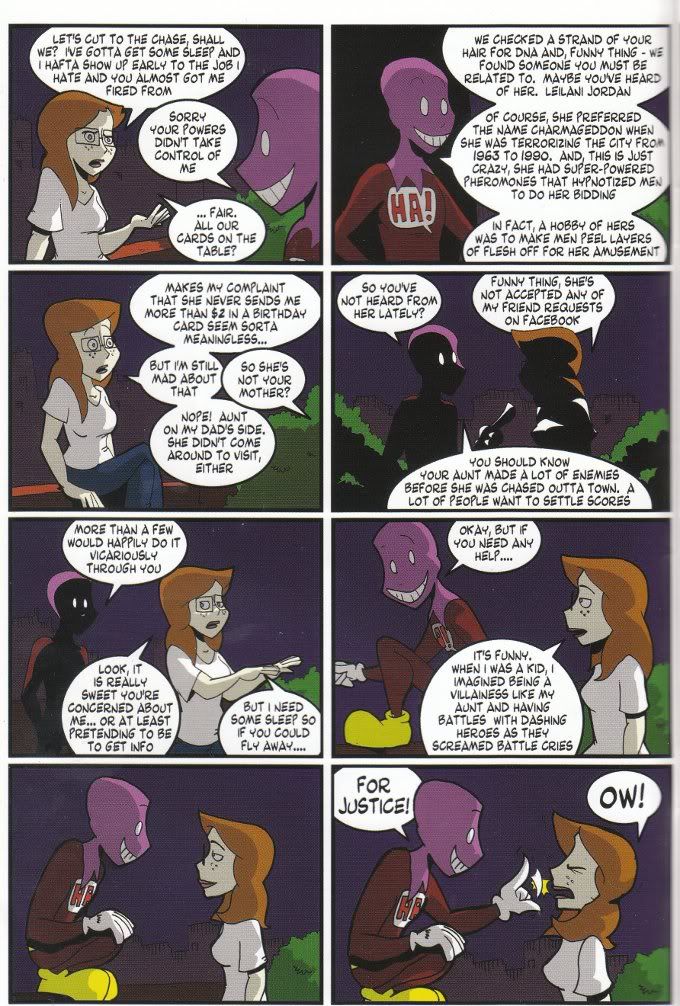
This is shown in the other main plot of Issue #4, which focuses upon Punchline, as he investigates a sports-bar waitress whose ability to influence surly customers seems to come from something besides her natural charisma and skimpy work attire. There is humor here, yes, but beyond that is the true heart of Punchline, who has already been revealed in Super Stupor #2 as being far wiser and kinder than his twisted sense of humor would suggest.


Punchline is far more than a heroic version of The Joker. In fact, as previous issues have shown, he is perhaps the most idealistic and honestly heroic character in the whole series. Which is quite ironic given his penchant for feeling up his female teammates and insulting everyone else in the hero community. And yet, when the chips are down, he'll be the first one to lead the charge and he's the last person to laugh at dead baby humor.

Do yourself a favor. Check out the numerous free comics at SuperStupor.com then drag thy buttcheeks to R.K. Millholland's web store to buy all four print comics. You'll be glad you did!

Monday, January 2, 2012

Doctor Who 2011 Christmas Special - The Doctor, The Widow And The Wardrobe

SPOILERS TO FOLLOW


THE PLOT

England. 1938. Having barely survived a violent explosion on-board a spaceship, a violent expulsion from said spaceship and a rather sudden reentry into Earth's atmosphere without the benefit of any kind of spaceship, The Doctor is aided by a kindly British housewife named Madge Arwell. Helped out of the crater he created upon impact and given a lift back to the TARDIS, The Doctor promises Madge that he will find some way to repay her kindness.

Three years later, Madge is a war widow. Her pilot husband was reportedly lost over the English Channel several days before Christmas and Madge is determined to spare her children the painful news until after the holidays are over. Relocating to a relative's house, Madge is surprised to find the house being watched over by a mysterious "Caretaker", who has "improved" the home to make it more enjoyable for the children. Madge doesn't recognize The Caretaker as the "space man" she helped three years earlier and The Doctor doesn't see fit to educate her as to why he is going out of his way to give her family the greatest Christmas ever. But when The Doctor's final present goes awry, it will fall to Madge to save not only her own children... but an entire world.


THE GOOD PARTS

* Despite the title and the image of walking through a door into a magical forest, this story has nothing to do with Narnia on any level.

* Part of the magic of Doctor Who is the various wonders that we see as we travel across space and time. It is quite rare for The Doctor to be entirely clueless about the various beautiful things that he shares with his companions. But when it does happen - as it happens here with Matt Smith's delight at finding a forest of Christmas trees that grow their own ornaments - it is a wonderful thing.

* Madge is easily the best character yet to headline one of the one-shot Christmas specials. She is strong, capable of holding her own against a number of heavily armed security agents in an alien world and not going to pieces even as she struggles to save her children... and more.

* The final scene, in which The Doctor proves himself to be more human than he ever thought, is picture perfect. Crying when you're happy. How human.


THE PROBLEMS

* The episode's greatest strength is also its' greatest weakness. Because as awesome as Madge is as she solves all the problems in the episode... when you get right down to it, all of the problems in this episode were caused by The Doctor being an idiot. He failed to consider that children always try to sneak a peak at their presents early. He didn't fully explore the forest or the time period before creating a time portal. And he doesn't really do anything to save the day. As The Doctor himself notes, it was all down to Madge. And a bit of dumb luck.

* This is a minor point, but I can't help but wonder what happened to the other two soldiers on Madge's husband's plane. Yes, the focus is upon how HE was able to make it home for Christmas and how his wife inadvertently became the guiding beacon he needed to make it home safe... but it still would have been nice to see them come out of the bomber and get an invitation to join the family for Christmas dinner.


THE FINAL VERDICT

Set on a smaller stage than the other recent Christmas specials, this episode is a more traditional Christmas story than we usually get. It's basically all about the power of a mother's love for her family and - ironically - it is the outsider Doctor who causes all of the story's complications. The implications that sometimes The Doctor would be better off not getting involved seem to be a likely foreshadowing of what is to come in Series 7.

Sunday, January 1, 2012

The Molting #1-5

I've been delaying writing this review for the better part of four months because - for once - I was at a loss for words. Typically when I write a review of a comic, I'll showcase some scans of the artwork, describe the main characters and summarize the plot and story. I can't do that this time.

I can't show off some of the artwork because Terrance Zdunich (the writer and artist of The Molting) specifically and respectfully asks the reader not to scan or otherwise reproduce the comic pages at the end of the first issue. Worry not - there are samples aplenty at http://www.themoltingcomic.com/

I can't really discuss the characters because most of them are - to some degree or another - cyphers. Most comics allow us to hear the internal monologue of at least one character, but The Molting is uniquely cinematic in that what we see is what we get. There is no internalization.

And I can't summarize the plot and story because The Molting defies summary and classification. You can say that it is a horror comic but I resist that label. Say the words "horror comic" to most comics fans and you'll inspire images of dismembered corpses, Lovecraftian aliens and zombie apocalypses. The horrors offered to us by Terrance Zdunich defy such casual classification. The Molting is a tale of the more subtle horrors that hide behind a veneer of normalcy. There are no monsters to be found here, save perhaps the ones that dwell within our own heads. There is nothing I can really compare it to save perhaps a strange blending of Clive Barker, Lemony Snicket and Arthur Miller.

The first issue is perhaps the most traditional horror story, detailing the sad and bloody childhood of a girl known as Guilty Susie. With Issue Two, we jump forward 30 years to the early 1990s, where Guilty Susie is now a housewife with two sons in Anaheim, California. From this point on, the focus shifts to her younger son, Joseph - an aspiring teenage artist whose talent far exceeds his opportunities. Issues Two through Five chronicle Joseph's disturbing home life, his difficulties at school and his worship of his older brother Trevor - a car thief with ethics whom Joseph equates to Robin Hood and Jesse James.

I really can't say more than that without giving a point-by-point, blow-by-blow retelling of every single moment of the issue. But I can say this in all honesty - I've never read any comic book like this and I enjoyed it immensely. If you're a fan of horror comics looking for something new or just an eclectic collector who enjoys oddities and rarities, this is a must read.

The entire series is available for purchase at http://www.themoltingcomic.com/ or Terrance Zdunich's personal website.

Because I don't think anybody made an image of this rather obvious joke yet...