Showing posts with label Seventh Doctor. Show all posts

Sunday, July 8, 2018

Doctor Who: The Seventh Doctor #2 - A Review

The Doctor, Ace and their friends in the Counter-Measures Group are still investigating the apparent crash of an alien spacecraft in the Australian Outback. Sabotage has delayed their efforts, but who is responsible? And could the alien menace they fear has come to Earth already be among them?


Christopher Jones continues to prove himself the consummate Doctor Who comic artist. His work on Titan Comics' Third Doctor mini-series was phenomenal and his work here is of equal quality. He perfectly captures the appearances of the actors from the classic television series and draws some fantastically imaginative visuals.

The story, I'm sad to say, will not be everyone's cup of tea. Unsurprisingly, Andrew Cartmel perfectly emulates the tone of a Seventh Doctor story. The problem is that what comes off well on film does not always work in a comic book.

While I personally love the sly Seventh Doctor and how he cunningly manipulated events while seemingly doing nothing at all, the pay-off in many Seventh Doctor stories usually came at the end when the conjurer's trick was revealed. I have no doubt we'll get a smashing reveal in the next issue but this issue comes off a little flat, with two page sequences of coded messages being silently translated and The Doctor not doing much beyond facilitating a high-speed escape.

Again, this is typical of the McCoy era, and fans of the Seventh Doctor will love it. Everyone else, sadly, will not see the point. In this, the comic perfectly captures the spirit of the era, though it does make it a bit inaccessible to new fans.

The Final Analysis: 8 out of 10. It's perfectly captures the feel of a Seventh Doctor television episode. For good and for ill. 


Friday, July 11, 2014

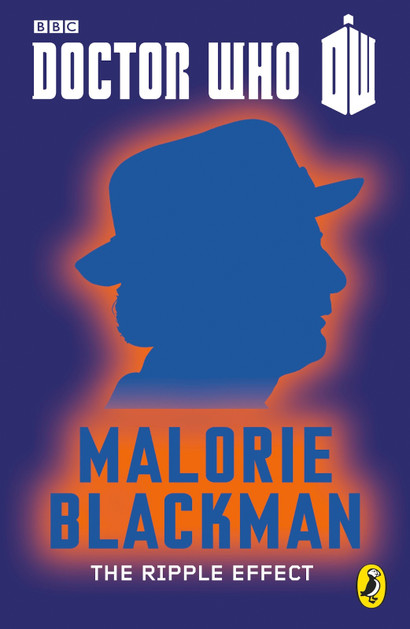
Doctor Who: The Ripple Effect - A Review

As The Doctor once noted, "Every great decision creates ripples. Like a huge boulder dropping in a lake. The ripples merge and rebound off the banks in unforseeable ways. The heavier the decision, the larger the waves, the more uncertain the consequences."  At the time he was speaking philosophically but now it seems his words were prophetic as an attempt to free himself and his companion Ace from the time-traveler's equivalent of sargassum seem to have blown them into an alternate universe... or maybe changed their own universe completely!

Naturally The Doctor feels a need to undo his mistake.  Particularly given how this new universe possess the most unnatural abomination The Doctor can think of - peaceful Daleks who are renowned as scholars and philosophers across the universe!  Ace doesn't see a problem, until it becomes clear that all reality itself may be at risk!


More than any other incarnation, The Seventh Doctor pondered issues of morality on a philosophical level and tried to challenge the beliefs of those around him.  It is ironic then that The Ripple Effect depicts The Doctor for whom a question-mark emblem seemed most appropriate as being unwilling to question his actions in this story.  In many ways, this story is reminiscent of the Eleventh Doctor episode Victory of The Daleks save for two important distinctions - The Doctor is not eventually proven right and Mallorie Blackman's script is far better written.

Ace and The Seventh Doctor are well-portrayed and the story is a thrilling one.  The only real flaw is that there isn't truly a conflict in the story.  There's a lot of arguing, with Ace trying to plead the case of this new universe and the new friend she's made who will both cease existing if The Doctor has his way.  But there's never any real possibility that The Doctor is wrong and it takes all of reality starting to collapse before anyone takes his claims of something being wrong seriously.

Seventh Doctor fans will want to give this one a look but it's not quite as riveting a read as other stories in the 11 Doctors 11 Stories collection.

Monday, December 16, 2013

Doctor Who: Remembrance of the Daleks - A Book Review

Coal Hill School. 1963. About 700 years (relative time, of course) after he left it, The Doctor returns with his newest companion, Ace, to take care of some unfinished business. Before he left Earth with his granddaughter and two of her teachers, The Doctor left something behind - a powerful Time Lord artifact known as The Hand of Omega, which holds the power the power to move the stars themselves.

Such power does not exist with notice and it has, much to The Doctor's chagrin, been noticed. Two rival factions of his greatest enemies - The Daleks - are even now taking root in the area around Coal Hill School. One has taken over the school itself and its headmaster. The other has recruited the aid of a neo-Nazi businessman. Both will stop at nothing to retrieve The Hand of Omega and, with it, the secrets of controlled time travel!

Can The Doctor recover The Hand before the Daleks get their plungers on it? If so, can he stop them from destroying London and The Earth in the process?  Time will tell.  It always does.
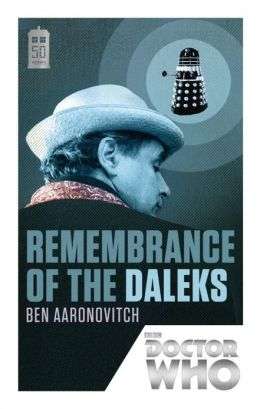

The television episode Remembrance of the Daleks is held as one of the best episodes of the Classic Doctor Who Series and is considered by many to be the best Seventh Doctor story of all.  The novelization - written by series writer Ben Aaronovitch - enjoys a similar reputation.  It was one of the first of the Target line of Doctor Who novels to be written with older readers in mind, making it a spiritual precursor to the Virgin New Adventures book-line.

As Aaronovitch notes in his introduction to this reprint edition, one can't take a television script and just add in "he said" or "she said" to turn it into a novel.  At the very least, HE couldn't do that.  Depth has been added to many of the characters in this novel version of Remembrance of the Daleks.  At the very least, they've been giving more detailing if not actual depth of character.

Perhaps the best example of this is the relationship between Ace and Mike - an army sergeant with secret ties to the neo-Nazi group aiding the Imperial faction of Daleks.  There is a hint of romance between the two characters before Mike's true colors are revealed and Ace turns on him.  Ace turning violently upon a racist is hardly surprising but the novel gives her a personal reason for loathing racists beyond culture shock.  Mike is likewise made into a more sympathetic figure, being painted not as a truly hateful man but a decent bloke who is led astray by a hate-monger, who plays on his fears of bad things happening to his friends and family.

Curiously, the only character who doesn't benefit from this increased depth is The Doctor himself.  Apart from one scene where The Doctor wonders why The Earth can't seem to go one day without it needing him to save it, we never really get into The Doctor's head at all and very little of his dialogue is offset with adjectives to describe how he says things.  This makes sense given that The Doctor's thoughts and actions for much of this episode are meant to be a mystery to everyone.  Still, this lack of perspective causes many of the best scenes in the television episode to fall flat in the novel.  Many readers will be left with a greater appreciation of how much depth Sylvester McCoy gave The Doctor through pure physicality.

My advice?  Treat this novel like the extras on a DVD.  Watch the classic episode and then read this book.