Showing posts with label Ben Oliver. Show all posts

Sunday, January 29, 2017

Detective Comics #949 - A Review

Trapped in The Belfry with the finest soldier the covert military group The Colony has ever trained, Kate Kane will find herself tested as never before. Can Batwoman best her father's greatest one-man-weapon?


This book hardly needed a two-part storyline to showcase how awesome Kate Kane is as a character. Still, this issue doses a fine job of setting up the upcoming Batwoman title by writers James Tyion IV and Marguerite Bennett while still being a brilliant story on its own terms. The artwork this month was produced by a team of two artists and three colorists but the styles blend together so seamlessly you'd never know it. Most enjoyable.

Monday, January 16, 2017

Detective Comics #948 - A Review

In the aftermath of The Victim Syndicate's attacks and The Spoiler's departure from The Belfry Team, Batwoman seeks to rebuild. It's hard to move on when the past keeps resurfacing, however, and Kate Kane is about to get a double helping of enemies returning to settle old scores. First, when The Monster Men seem to reemerge and again when one of her father's allies from the paramilitary Colony attack her and Batman!

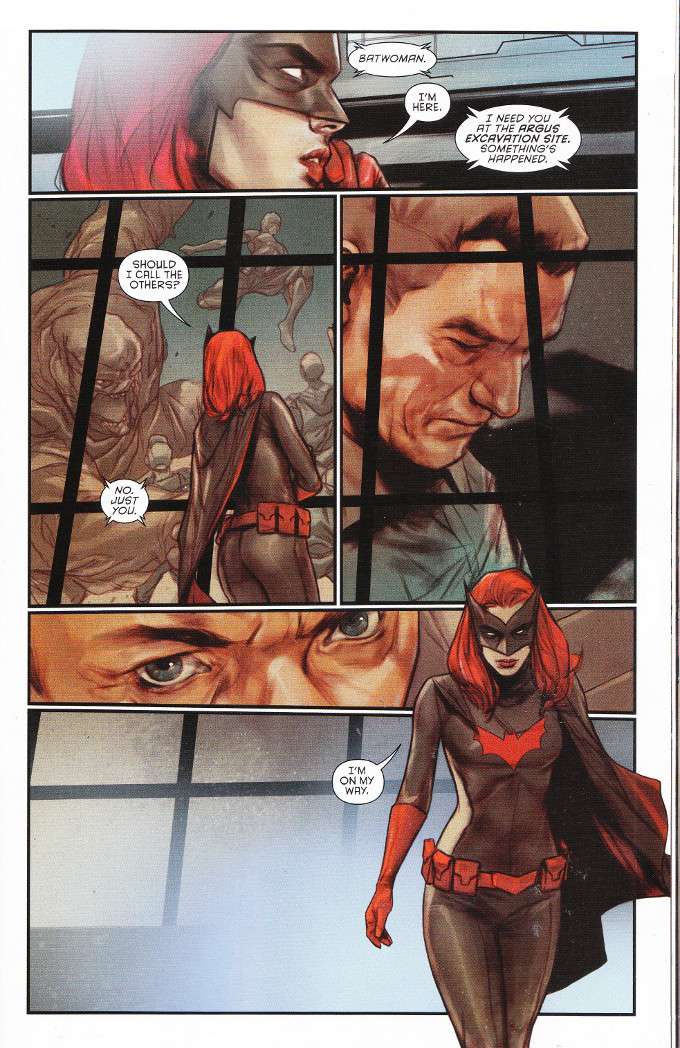
Marguerite Bennett - writer of Red Sonja and Bombshells - lends a hand on the writing duties this week. This is no bad thing, however, as James Tynion IV and Bennett play well off of each other and the story here is not an abrupt departure from the direction that Detective Comics had been moving over the last few months. The tale here is gripping and enjoyable beyond serving as a set-up of the upcoming Batwoman series, which will see both these writers teaming up once again.

Ben Oliver's artwork here is unusual for a Bat-book, boasting a unique style that is gently inked and softly colored. There is little in the way of solid black in either the outlines of the characters or the coloration, even on things that are traditionally depicted as being pitch black such as Batwoman's costume! This gives the artwork a greater sense of detail that catches the eye and sticks in the memory once the book is closed.

Thursday, December 31, 2015

Superman Annual #3 - A Review

There's two good comics contained within Superman Annual #3. One details the new origin of the immortal conqueror Vandal Savage, tying his origins indirectly into the Superman mythos.  The other showcases the problems Clark Kent faces as he continues to try and help people as Superman, despite his waning powers, lack of a secret identity and Lex Luthor running Justice League.

Unfortunately, these stories ultimately exist only as a set-up for the latest big crossover. And that proves to be to their detriment. It's apparently not enough to tell a story which shows that the meteor that empowered Vandal Savage came from a comet that was redirected from Krypton. We can't just tell a story where Clark Kent tells a teary-eyed Lana Lang that he can't just quit being Superman, even without his powers. It's all just build up for yet another excuse to boost sales.


It's a shame because there's some truly great writing on display in this issue.  The Vandal Savage story is just plain fun. And the modern story proves the point that what makes Clark Kent Superman isn't his powers - it's his ability to inspire other people to greatness. It also subtly disproves Lex Luthor's postulation  - that Superman's existence will cause common people to stop striving to be better - as Lex begins exploiting his power and authority to keep Clark Kent from trying to advance himself. Rarely has Luthor's evil and Clark's goodness been so well and simply exemplified.

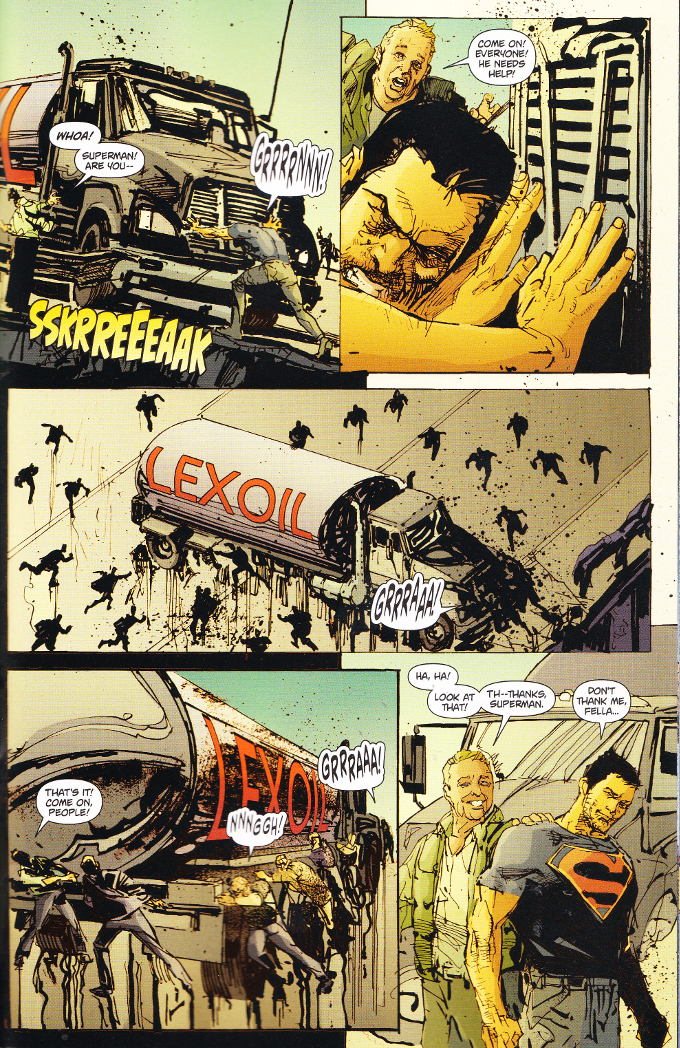
The artwork, sadly, isn't quite so evenly handled.  The artwork for the Vandal Savage story is grand, showing a good deal of variety as we follow Savage through the ages.  The artwork for the Clark story, while skillfully done, utilizes a gritty, more realistic style that doesn't really seem appropriate to the story at hand.


Superman Annual #3 is a model for everything that is right and wrong with DC Comics since the New 52 revamp. There's a number of brilliant innovations and reimaginings of classic concepts and this comic showcases the ideal that the hero aspect of a character is more important than the super one. Yet all of that is undercut by a relentless grittiness that is grim for its own sake rather than to make the light shine brighter and the fact that this story exists only as introduction to yet another sales gimmick.

Wednesday, September 12, 2012

Action Comics #0 - A Review

The origins of Superman are one of the most well-known stories in modern American culture. DC Comics has already told and retold this story several times in the last decade alone (Birthright, Secret Origins, Earth One). Just a year ago, Grant Morrison gave us a picture perfect introduction to everything Superman is in the New 52 universe with the first issue of the new Action Comics. One wonders then - what more needs to be said about how Superman became Superman? What CAN be said that hasn't already been said?

It is, perhaps, in answer to this question that Action Comics #0 breaks away from the standard template we've seen thus far in DC Comics's Zero Month issues. Morrison's focus in this issue is less upon the man himself and more upon the people he touches. More, it is an exploration of the idea of Superman and his greatest power - the power to inspire.
Italic


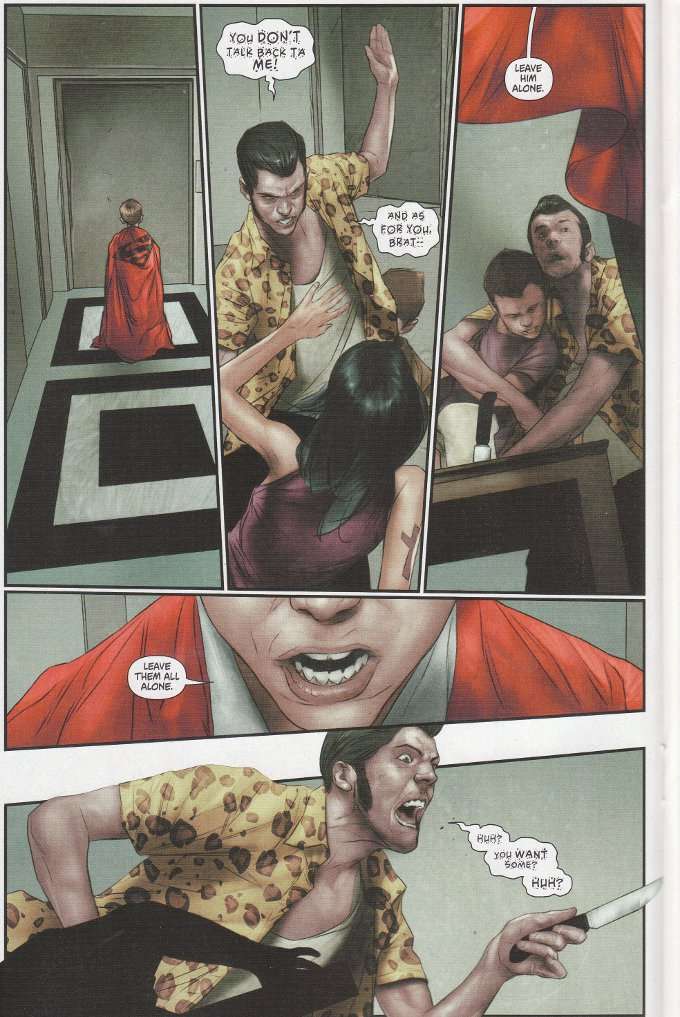
The Boy Who Stole Superman's Cape centers upon a young boy who, having witnessed Superman's first unsuccessful attempt at crime fighting and seen him survive close-range contact with an RPG, steals his cape. Why? Because he has an abusive step-father at home and he knows that cape can protect him and his family.

As with so many Morrison ideas, the conceit is brilliant in its' simplicity - take the conceit of so many children playing superheroes and make it into a practical reality. What comic fan didn't tie a blanket around our shoulders and pretend we could fly while stretched out across a bed or stand up to a hail of gunfire, fists firmly planted on our hips at some point in our childhood? Precious few, I'd think.

Morrison also adds a little polish to his development of the supporting cast. Jimmy Olsen's role as Clark Kent's "pal" (i.e. ex-roommate and only real friend in Metropolis) is expanded upon. Perry White is given a far larger role than I think he's had in the series until now (no surprise as he isn't Clark's boss yet). And Lois Lane - dear Lois Lane, I have missed seeing you be written to be this awesome.
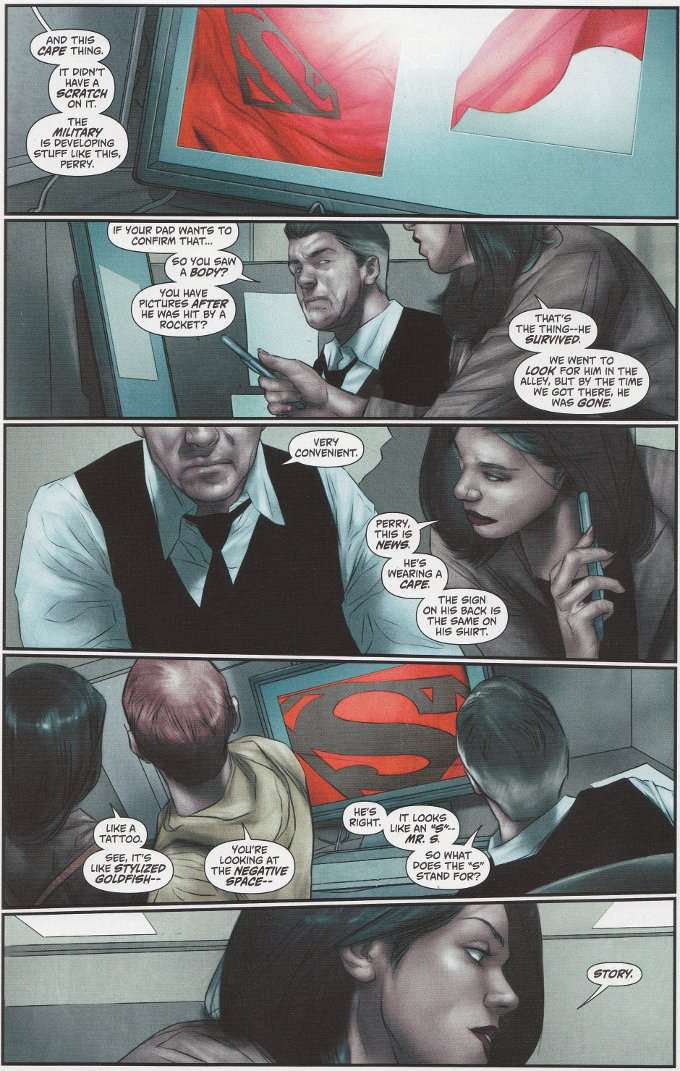


Ben Oliver & Brian Reber - the regular art/coloring team on Batwing - deliver what is easily the best work I've ever seen from their partnership and that is saying something. Oliver's crisp pencils are perfectly painted and brought to life by Reber. Letterer Steve Wands also deserves high praise for his unique method of demonstrating drunken, slurred speech.

If this issue has a downside, it's that the back-up story seems like something of an add-on to the meat of the main part of the issue. Origin of the Species details the creation of this universe's version of Captain Comet. It's not a bad story. Sholly Fisch is as great a storyteller as ever and Cafu's art is grand. There's just little emotional investment in an origin story for a character who is supposed to be a superbeing developed far beyond humanity's ability to comprehend or relate to.

Overall, this is a damn fine comic and a good jumping-on point if you haven't gotten into Action Comics yet. Give it a try. You'll be glad you did.

Sunday, September 11, 2011

Batwing #1 - A Review

As long-time readers of mine are well aware, Judd Winick and I have a long, sordid and disreputable relationship. It may surprise you to know that I’ve enjoyed much of his past work, including much of his run on Green Lantern and the vampire mini-series Blood And Water. Despite this, many of my past Green Arrow reviews focused upon Winick’s failure to research the basic history of established characters he wrote for DC Comics and his apparent inability in recent years to write any series without Batman being a guest-star. But that was all in the past and I am fully prepared to let bygones be bygones. New universe. New start.

Batwing #1 introduces us to one of the newest recruits for Batman Incorporated – a public company organized by Bruce Wayne that sponsors local heroes on a global level, providing them with equipment and resources. Batwing’s secret identity is David Zavimbe; a rare honest cop in the notoriously corrupt police department of Tinasha – a fictional city in the Democratic Republic of the Congo.


This central concept of the Batman name and equipment being out-sourced has been carried over from Grant Morrison’s pre-Revamp Batman book. So if all of this sounds needlessly complicated or confusing, don’t worry – none of that is mentioned in this book. Indeed, there’s no explanation exactly why Batman is in Africa offering assistance to a newbie vigilante who is using the same motif. I fear this may be confusing to new readers whose vision of Batman is not well known for being gregarious toward other heroes and for limiting his activities to Gotham City.

Another thing that may confuse new readers is the book’s timeline. The issue opens with Batwing fighting a masked villain called Massacre, before flashing back to six weeks earlier as Batwing (with Batman along to assist) investigates a series of brutal murders. The issue ends on a cliff-hanger while still in the middle of the flashback. This does little to aid the sense of suspense Winick seems to be crafting as we know our hero has already survived what the last page throws at him.

At least Winick seems to have rid himself of his old habit of having Batman do all the work whenever he’s a guest in someone else’s title. Indeed, Batman defers to Batwing, asking him how he wants to handle his case and sticking to the background, save for one action scene where he handles the clean-up as Batwing confronts a local warlord the locals call Blood Tiger... for some reason.


The artwork by Ben Oliver is all-around amazing but it is colorist Brian Reber who deserves special praise. The use of color on this book is wonderful, with the palette used giving Oliver’s pencils the feeling of a painting in every page. My one complaint is that many of the action sequences suffer for being zoomed-in. There are several panels that might have benefited from a wide-angle shot rather than the close-ups we get.

Sadly, good artwork is not enough to allow me to recommend this book. The action sequences are good but the mystery isn’t engaging enough to make up for a strange timeline and an underdeveloped hero. Batman Inc. fans might enjoy it but everyone else will likely walk away from this book confused.