Showing posts with label Joe Prado. Show all posts

Thursday, February 16, 2017

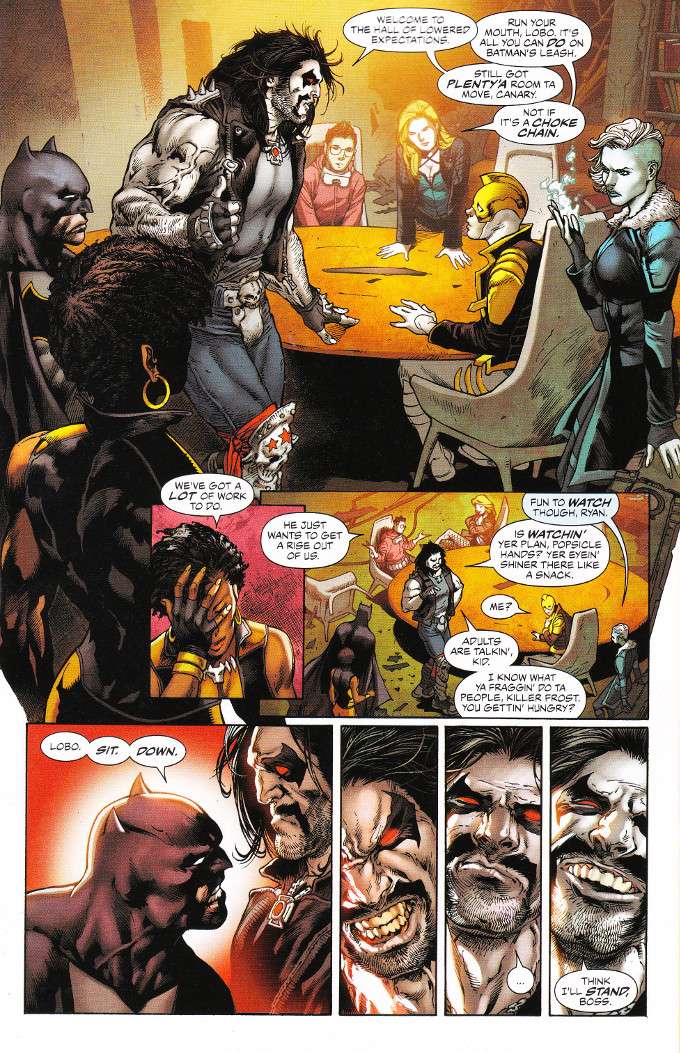
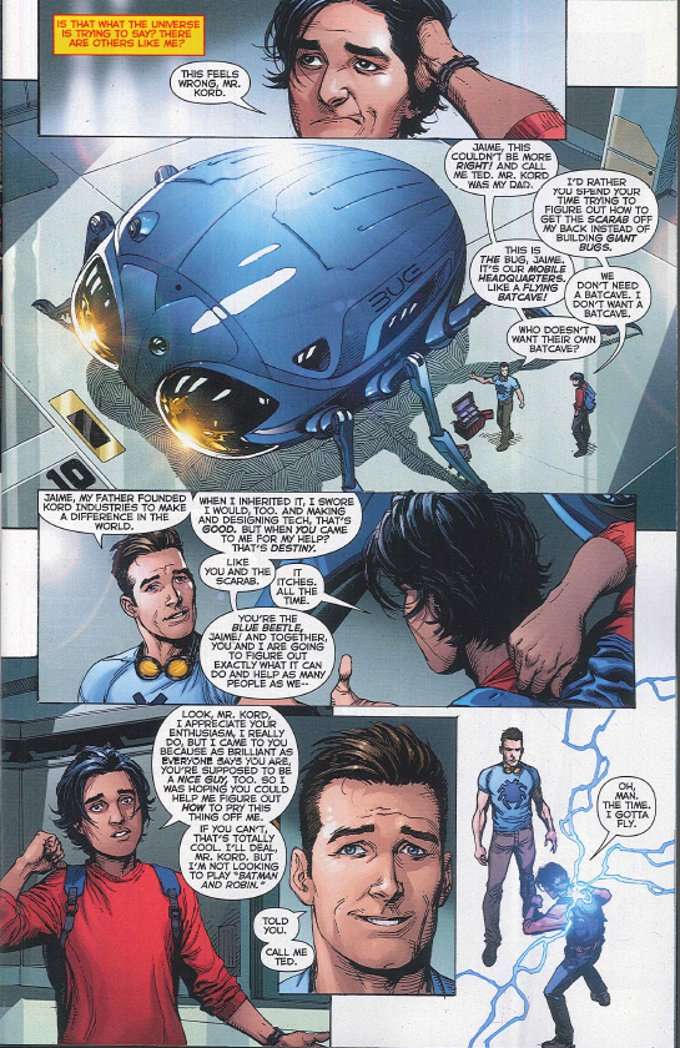
Justice League of America: Rebirth #1 - A Review

In the wake of the Justice League's battle with The Suicide Squad, Batman has come to realize the power of redemption and the need for heroes to act as a source of inspiration rather than mere peacekeepers. To that end, he has begun assembling a team, starting with a reformed Killer Frost. Their mission? To show that anyone can be a hero.

I missed this book the week it came out and I really did miss out! This first issue does little beyond introducing our cast and setting up some of the conflicts between the various volatile personalities. Standard fare for a superhero team book, of course, but Steve Orlando's command of the personalities in play makes this engaging reading despite the standard set-up.

The artwork proves equally amazing. This is no surprise given the creative team involved. I've been a big fan of Ivan Reis since his work on Green Lantern. His work with Oclair Albert and Joe Prado on the New 52 Justice League book was fantastic and it is good to see Marcelo Maiolo - whose colors were one of the few bright spots (no pun intended) of the New 52 Green Arrow series - at work again.

This book hooked me with the first issue. Hopefully it will prove as engaging once the plot kicks in.

Wednesday, May 25, 2016

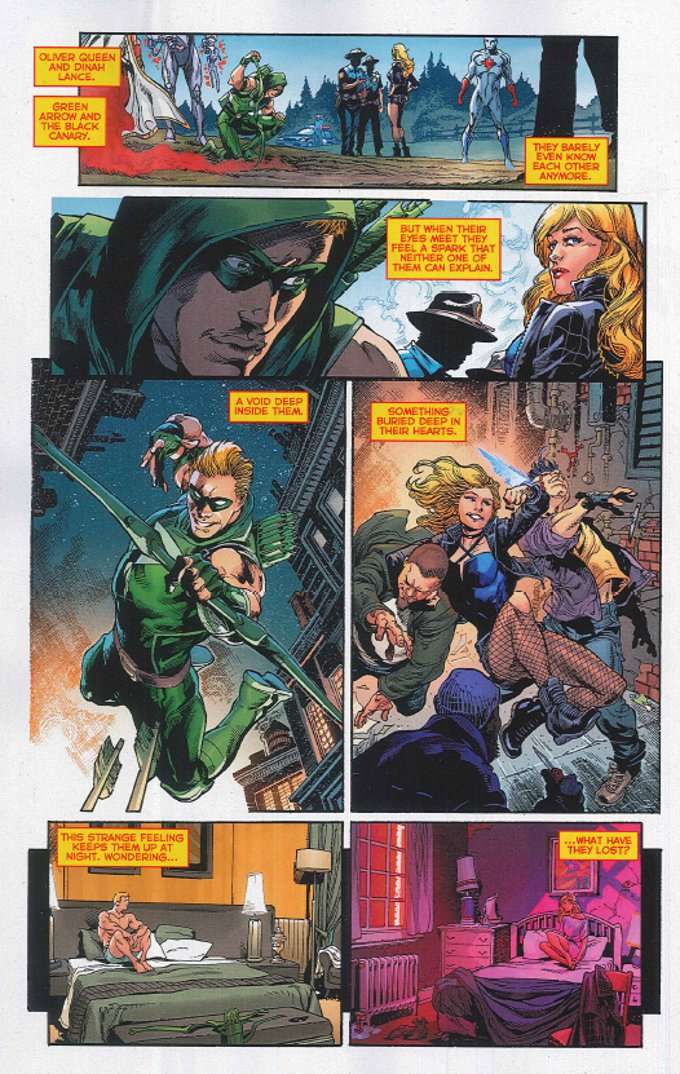
DC Universe Rebirth #1 - A Spoiler-Free Review

The cynic in me chuckled at the first page of DC Rebirth #1. First page of a new book meant to revamp the whole of the DC Comics Universe (again!) and - in theory - bring in new readers looking for an entry point, and what do we start with? An editorial note saying we should read Justice League #50 and Superman #52 before reading this issue.

 After that, the cynic didn't laugh once.


This book is good. Damn good. An all-star line-up of artists make every page poster-worthy. Textually and metatextually, the conceit at the center of this issue's story is brilliant. It is a great story, told by the perfect narrator to explain just what went wrong with the DC Universe as it is now.

Once the dust is settled I will do a more in-depth review, discussing what worked about this issue in detail. Right here, right now, I will say only this. Rebirth is the shot in the arm that DC Comics needed and the future is looking bright indeed.


I still have some reservations about what is to come. And the cynic does wonder if the various editorial teams will manage to hold to the vision of love and legacy that Geoff Johns put forth in this issue. But I have hope after reading this book that things will improve. And that is something new.

DC Rebirth #1, as a single story, is a good one. It's a love letter to everything I love about DC Comics and a renewal of many of the things we've been missing. And even if you're not a DC fan... in fact, especially if you're not a DC fan...you should check this issue out to get a sample of what we've all been missing.

Tuesday, October 29, 2013

Justice League #24 - A Review

Is it possible for a good fight scene to salvage an otherwise uninspired comic?  Perhaps, but Justice League #24 is not the book to make that case.  Geoff Johns has written many great books but this, I'm sad to say, is not one of them.

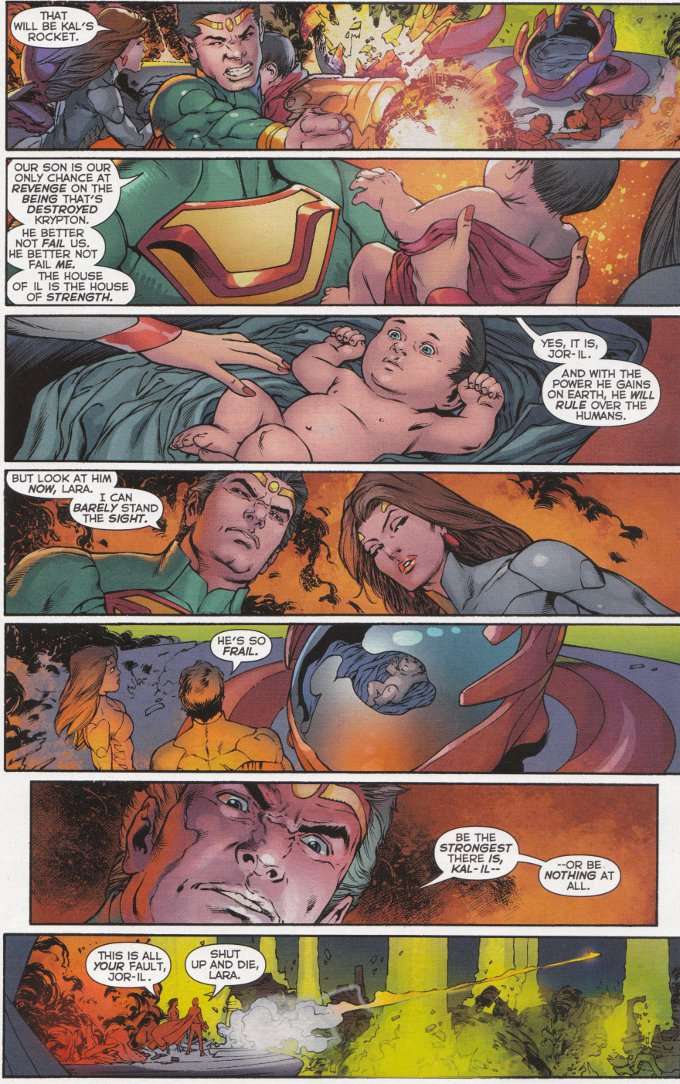
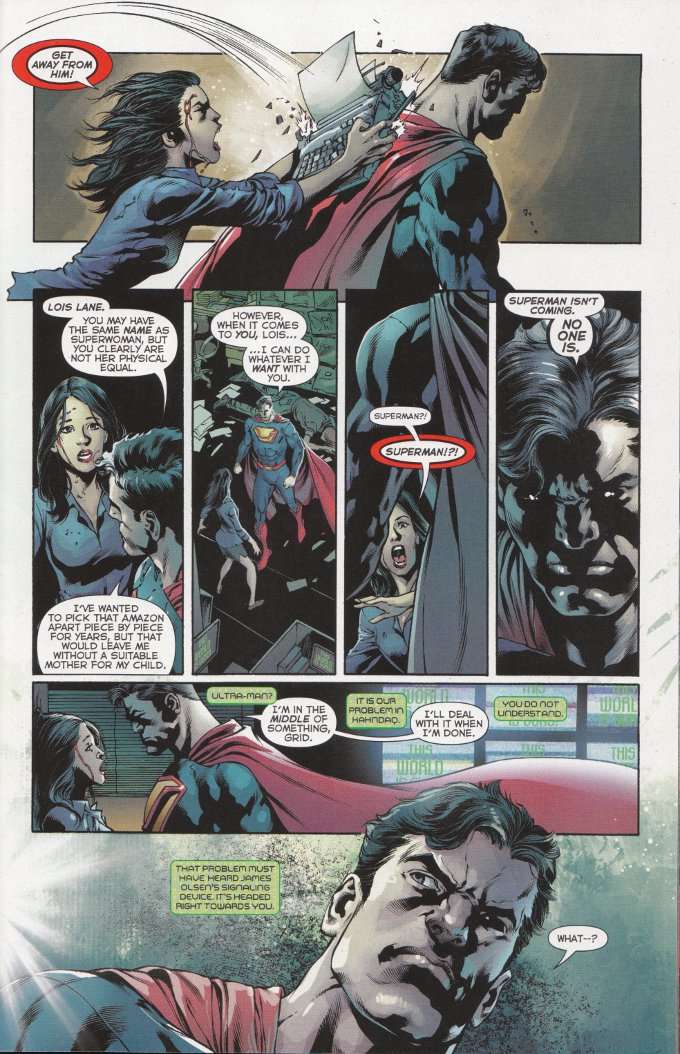
Most of the issue is devoted toward telling the detailed origins of the villainous Ultraman - Superman's evil counterpart from the parallel Earth Three.  Alert fans will note that this story is largely identical to the origins of Superman as depicted in Johns' own Superman: Secret Origin, with a little bit of Grant Morrison's Earth 2 thrown in for good measure.  We see Jor-Il (gedit?) fighting the equally evil masses of Krypton over the last escape pod off their world and The Kents as opportunistic drug addicts rather than as good and decent farmers. 


If this sounds bleakly depressing, it should.  Johns goes over the top in showcasing what a miserable a place Earth Three is and in establishing Ultraman as a conscienceless rapist and murderer.  The whole affair is technically well-written yet seems drab and dull in spite of that.  Most readers are already familiar with this story and discussing the details of how Superman and Ultraman's backgrounds differ, while undoubtedly a fun intellectual exercise for comic geeks, makes for a dull story.

Johns almost manages to salvage this affair with the eleventh-hour arrival of an unexpected hero.  Fans of Johns' excellent JSA run will appreciate this sequence and it is a good, old-fashioned superhero fight.  And yet, it is not enough to forgive the monotony of the early parts of the book. 


The artwork is similarly mixed.  Ivan Reis' pencils are excellent as always but this book proves that an inker can make or break your artwork.  Three different inkers worked on this book and the differences in their styles are obvious.  The Krypton sequences are under-inked.  The sequences where Ultraman terrorizes the staff of The Daily Planet are over-inked.  A few pages manage to be just-right but the credits page annoyingly offers no details as to which inkers are responsible for which pages.

All in all, this book is giving me little reason to continue reading Justice League and further reinforcing my opinion that skipping Forever Evil was a good idea.  With an uneven and overly familiar story backed by confoundedly inked artwork, there is little to recommend this book.

Monday, July 15, 2013

Justice League #22 - A Review And A Rant

Remember when super-heroes fought super-villains in the big crossover events?

Seriously.  When was the last time we had a big event book where the heroes fought actual villains rather than other heroes?  And no, alternate universe versions or alien clones of themselves don't count, Flashpoint and Secret Invasion fans.  It's been a while, hasn't it?

I have no objection to heroes fighting other heroes but it seems like that's all the heroes do anymore.  Have we come to the future Mark Waid predicted in Kingdom Come where the villains are underground running the world in secret and the heroes are fighting turf wars over who gets to protect what?  Reading Justice League #22, it's hard to argue that we haven't.

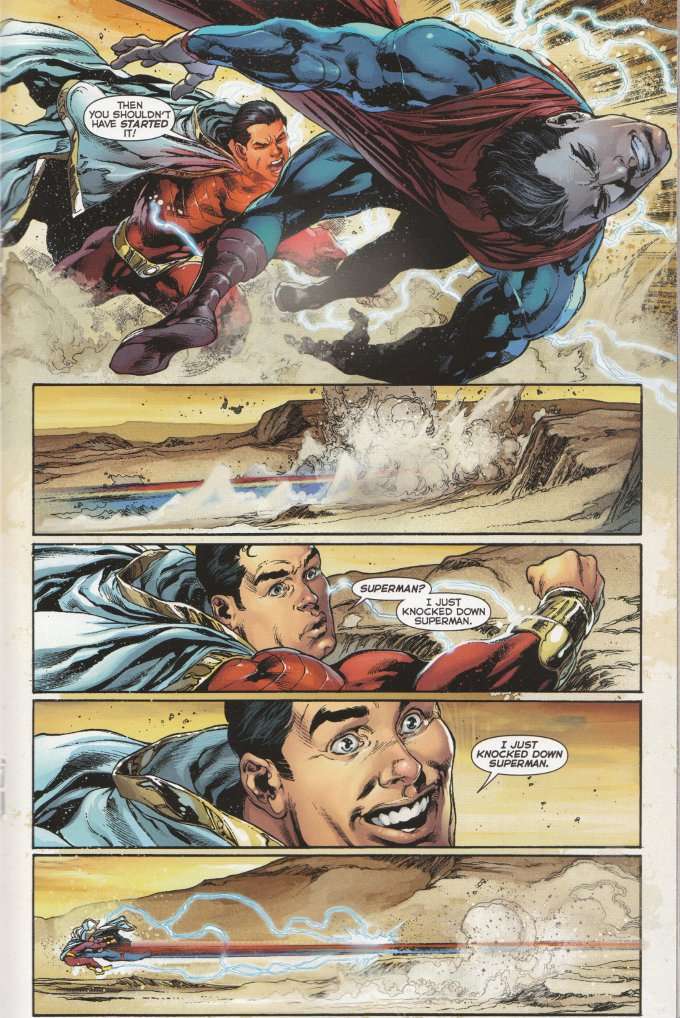
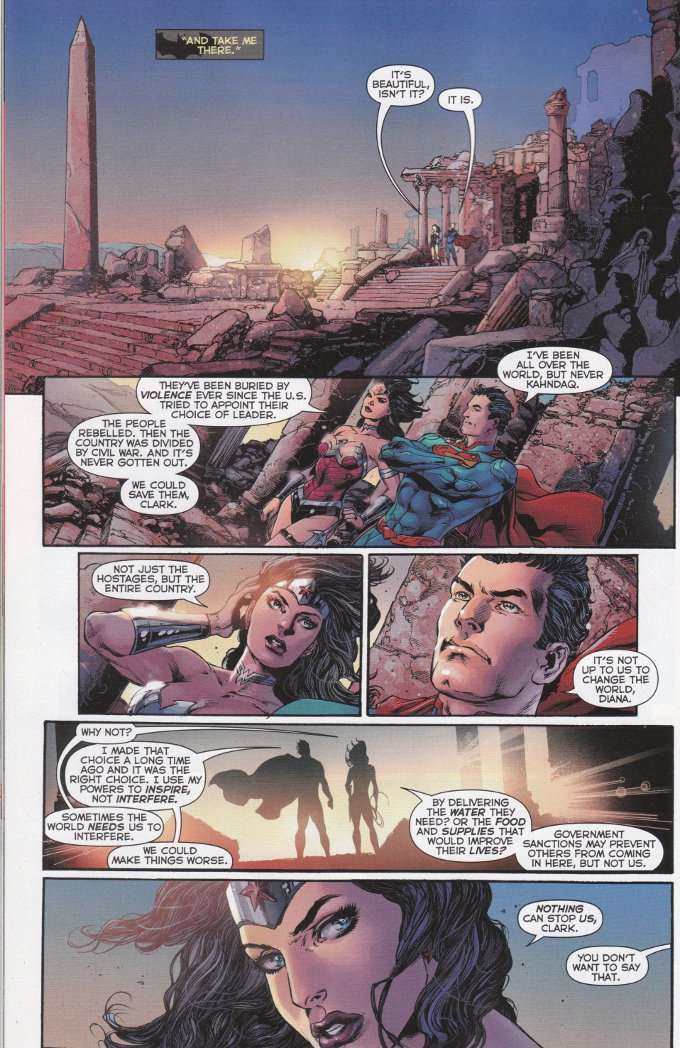
While the plot does feature some random bits involving the Trinity of Sin (i.e. The Question, The Phantom Stranger and Pandora), the main focus of the issue is upon the inevitable battle between The Justice League and the newly formed Justice League of America.  Inevitable, at least, in the eyes of Amanda Waller, who create the JLA specifically to counter the abilities of the original Justice League should they ever work against the interests of the USA.  When the entire Justice League travels to the enemy nation of Kahndaq after newbie hero Shazam crosses the border, Waller sees her chance and sends the JLA in to enforce America's embargo.  Hilarity ensues.   


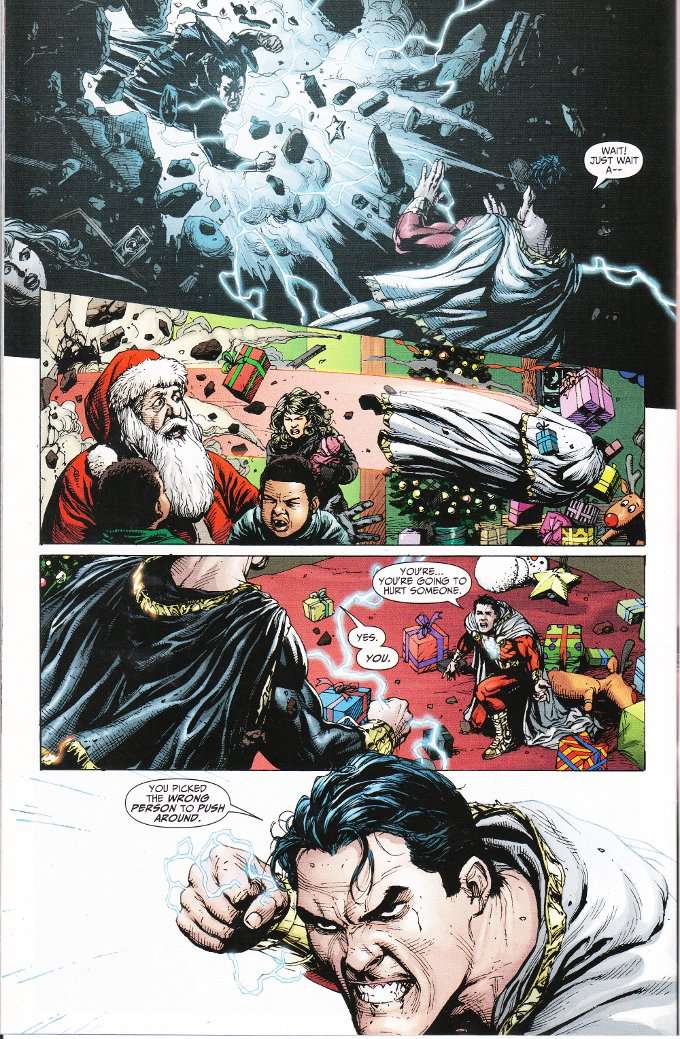
Thus far, Trinity War seems to be DC Comics' answer to Avengers Vs. X-Men -  a violent free-for-all born out of disagreements that could be solved in five minutes if the characters weren't written like complete imbeciles because that is what the plot demands.  While it isn't out of character for Amanda Waller to see The Justice League as a threat to the nation she serves, it seems uncharacteristically short-sighted for "The Wall" to send a group largely made of untested newbies like Vibe, Stargirl and the new Dr. Light into the field against a more experienced enemy.  Superman charges into battle against Shazam without trying to find out if the other hero instigated a battle with the Kahndaq Army - a question you'd think Superman would consider given that he and Wonder Woman were fighting the same army several issues earlier.  And if there was any doubt that the New 52 version of Billy Batson did not have The Wisdom of Solomon, this issue obliterated it.

Ironically, the only thing that makes this story tolerable and indeed prevents it from being  Avengers Vs. X-Men Starring The Justice Leagues  is same thing that makes it so aggravating - the writing of Geoff Johns.  Johns succeeds where Bendis and Company failed by evoking real ethos in a series of short scenes amid all the strum und drang.  Whereas it was hard to find sympathy for either the fascist Captain America or the single-minded Cyclops, one can't help but feel Billy Batson's guilt and admire his determination to do the right thing even as he goes about it in the worst way possible. 

Where Johns fails is by falling into the same trap of manipulation that turned off so many comic readers when Brad Meltzer pulled it in Identity Crisis.  With a single issue, Meltzer was able to do what so many writers had failed to do and make Ralph and Sue Dibny into something beyond a joke - characters who had earned their seemingly accidental place in The Justice League.  He then destroyed the miracle by setting us up to care about Sue and Ralph only to kill one off and turn the other into an shell of their former self.  Johns does the same thing here, sacrificing the brilliant conceit of turning Dr. Light - perhaps the most hated villain of the past 10 years of DC Comics - into a loving family-man, moralist and would-be hero.  There's no small irony that Dr. Light is the one who pleads for peace and tries to get everyone to discuss their differences before his sudden and grisly death, which triggers the superhero smackdown we were promised. 


Rest In Peace, Dr. Light.  We Hardly Knew Ye. 

The artwork by Ivan Reis, Joe Prado and Oclair Albert is as good as one might expect.  I haven't seen a bad issue yet from Reis in the past year, be it on Aquaman or Justice League.  But in this case the artwork is like a candy shell on a rabbit pellet.  Sure, it may look good... but it will leave a bad taste in your mouth.

Despite this, I will attempt to finish this crossover so that you, my readers, do not have to.  Not that I have much choice with it dominating so many of the books I read on a monthly basis.  Still, I will endure even as I wonder how two writers I enjoy so much can create something that leaves me so disgusted.


Monday, May 27, 2013

Justice League #20 - A Review

 Justice League #20 is something of a mess, in terms of both story and artwork.  Reportedly, the main story was laid out by one man and then illustrated by three different pencilers and three different inkers.  Art by committee works even less often than writing by committee and it really doesn't work here.  Even accounting for the differing styles at work, everything looks horribly uneven.


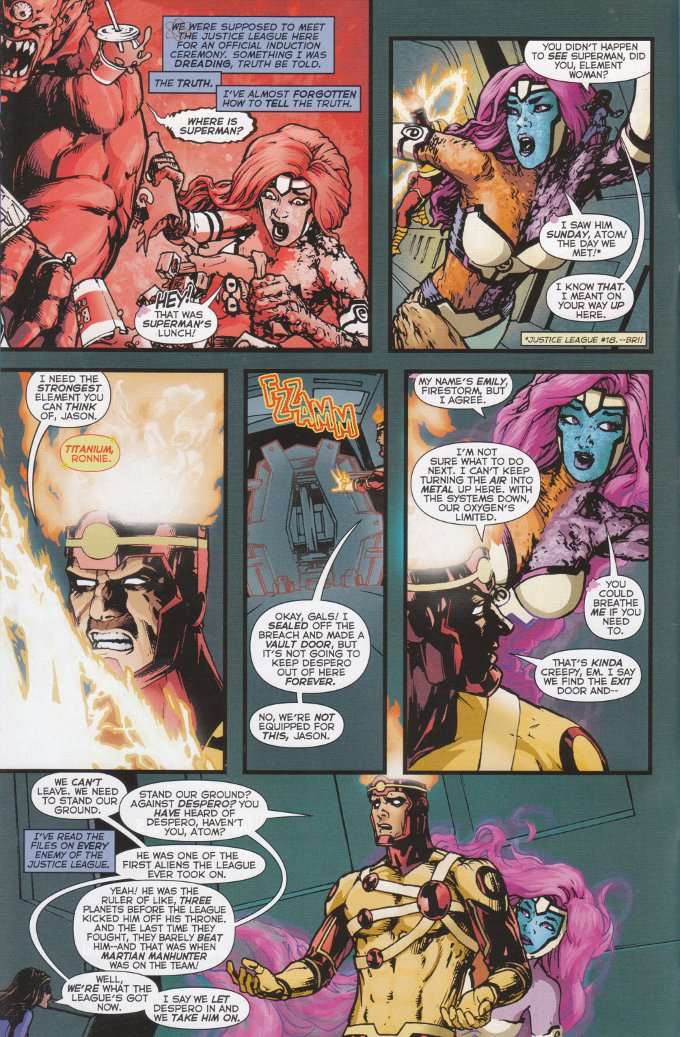
The story by Geoff Johns, focusing primarily upon the newest members of The Justice League as they fight the telepathic powerhouse Despero, isn't much better.  Johns does his best but the underdogs fighting outside of their weight class story has been done to death.  Not helping matters is that much of the "charm" of this issue depends upon your enjoyment of the flighty bimbo that is Element Woman or the continual squabbling of the two teenagers who make up Firestorm.  And given that Fury of Firestorm was cancelled this month, it appears that the vast majority of comics fandom find the antics of Ronnie Raymond as tiresome as I did when they played this exact same conflict out during Brightest Day. 

There's only two things that save this comic at all.  The first is the Shazam back-up story, which finally seems to be gaining some legs or maybe I'm just viewing it more sympathetically now that Billy Batson is beginning to act like the hero he should be.  The other bright side in all this is a scene involving several of the Justice League founders and Superman having a talk with Batman about his creation of protocols to take down every other member of the Justice League... including himself. 


This book seriously needs one artist, one inker and one person deciding its' look.  The multiple teams working on the main story this time around do not work well together.  And Johns would do better to develop his new characters alongside the established crew for a time rather than throwing them all into a spotlight that none of them deserve yet. 

Wednesday, April 24, 2013

Justice League #19 - A Review

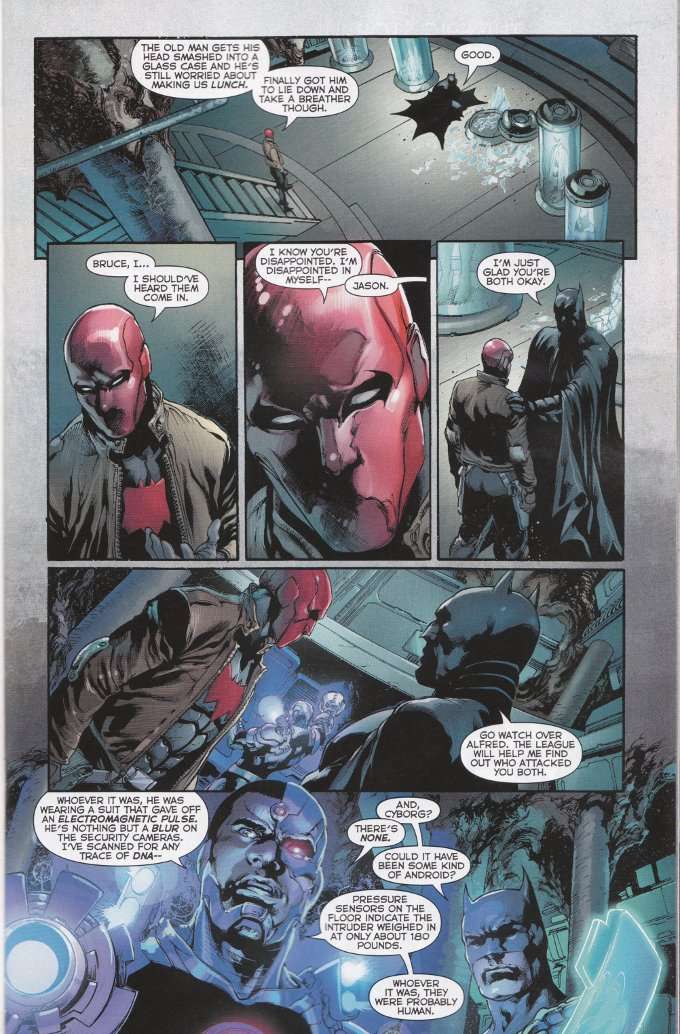
It is a credit to Geoff Johns' skill as a writer that he manages to do in two pages what Scott Lobdell and Judd Winick failed to do in two years - make Jason Todd into a sympathetic figure.  This is perhaps the most minor of the subplots we see in Justice League #19 yet it is perhaps the most compelling.  It's certainly more interesting than watching Ronnie Raymond and Jason Rusch arguing with one another (honestly, didn't we get enough of this in Brightest Day?) or the revelation that the new Atom can use her powers to play her favorite MMORPG from the inside... I think.  That sequence isn't particularly clear, though it is a nice nod to the old Sword of The Atom series.


The actual meat of the issue is more enjoyable, with Batman coping with a burglary in the Batcave that bodes ill for the entire team and Wonder Woman encouraging Superman towards a more proactive approach to crime-fighting.  There's a lot going on here and Johns is no doubt setting things up for the upcoming Trinity War storyline.  Thankfully, he does a good job keeping his ducks in a row.  I just wish he hadn't bothered with some of the story-lines that do little to develop the already well-established characters.

Ivan Reis continues to flourish as the series' new penciler, despite being somewhat crippled by a team of three inkers.  Does the book look bad?  No, but you can tell that three different artists were handling the inking duties.  There's little sense of continuity and cohesion visually.  Any who doubt the power of an inker to completely change the feeling of a penciler's work would do well to check out this issue.


I shan't bother offering my two cents on the Shazam back-up anymore.  You all know what I'm going to say at this point and I'm sick of saying it, over and over and over again..  Johns' script is good, but I loathe the new take on Billy Batson, who doesn't feel at all like he should.  Gary Frank's art is far better than the story deserves.  They had to call this Shazam because this mess sure isn't Captain Marvel.  Blah blah yakkity smackity. 

Tuesday, February 26, 2013

Justice League #17 - A Review

There's little I can say about Justice League #17 that I haven't said already about the other issues in the Throne of Atlantis mini-series.  There is much I fear to say for the sake of spoiling a story that did manage an honest twist or two in the tale.  However, I think I can safely say that this final chapter does rock the status quo of both the Aquaman title as well as Justice League.  Big changes are afoot - that much is certain!


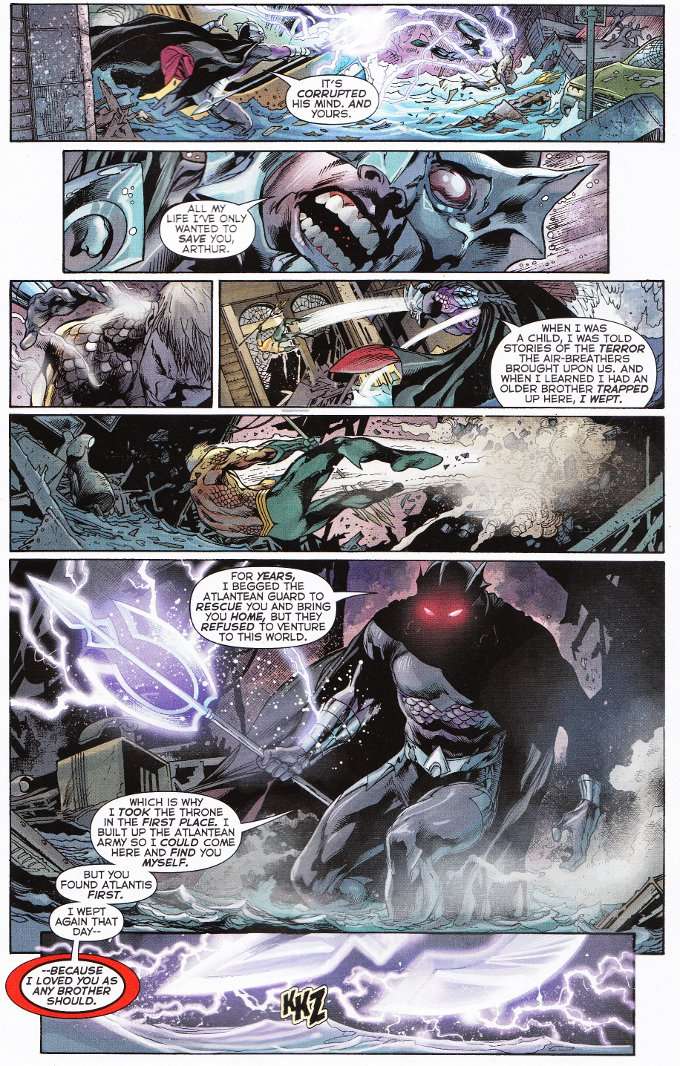
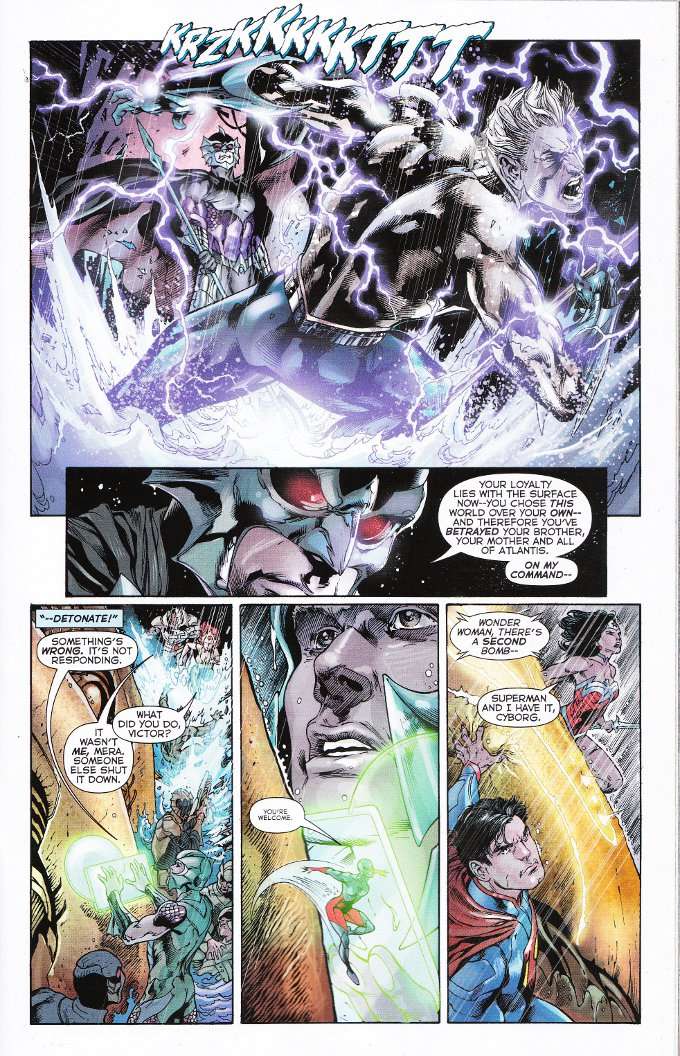
The plot is as good as one would expect from Geoff Johns.  The drama between Aquaman and his brother Orm is cranked up to 11 as the two do battle with words as well as with magical artifacts.  Johns has given Orm far greater depth than I think he's ever had in any other story and I thank him for it.  Indeed, Orm has become so sympathetic a figure, I find myself sympathizing with him more than I do Aquaman.


The excellent artwork of  Paul Pelleiter and  Ivan Reis brings this series to bed.  There's some amazing, poster-worthy pages here, my favorite being a spread of The League charging into battle.  And yet it's the little details - such as The Atom escaping from the inside of an Atlantean doomsday device - that make Reis' art so interesting.   

Sunday, February 3, 2013

Justic League #16 - A Review

Ocean Master has always had a rough time of it as a character. It's bad enough being an Aquaman villain to begin with.  Imagine being a bad guy whose sole motivation is being jealous of Aquaman's superpowers.  That was Ocean Master back in the Silver Age.  He was Arthur Curry Sr's son by a human woman.  No powers.  No resources.  Just a burning hatred for the bastard half-brother who got superpowers while you didn't.  Things weren't much better in the Dark and Modern Ages, where he was a thinly-veiled Loki rip-off  with vague magical powers fueled by a demonic trident.

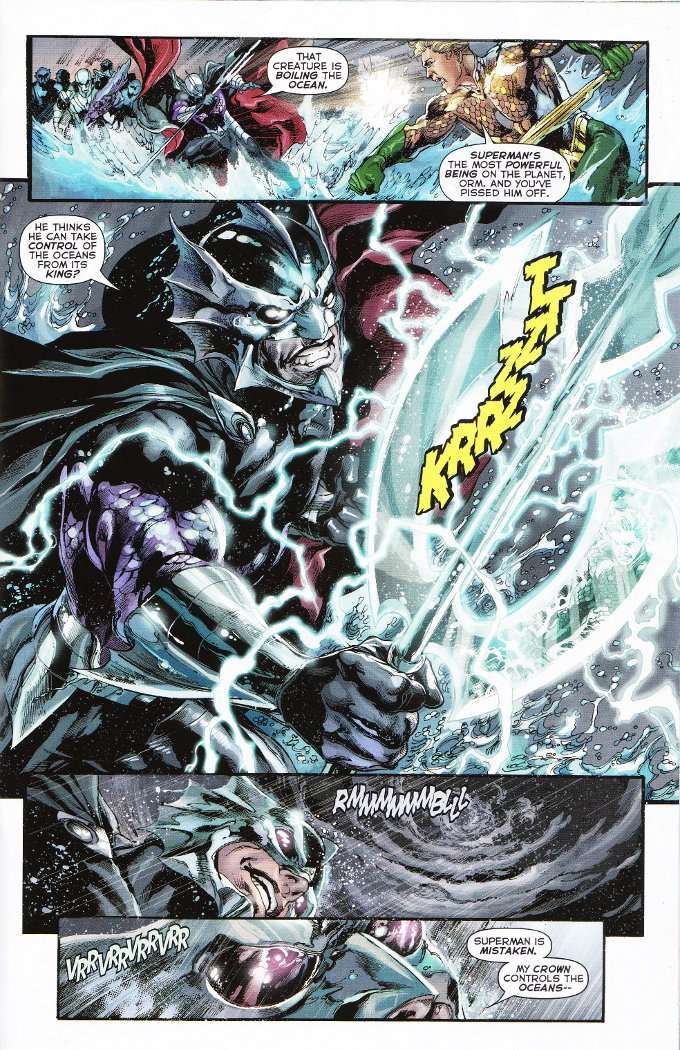
Geoff Johns has changed this all yet again in the New 52 reality but this time he has created an Ocean Master worthy of the name.  No petty criminal or scheming courtier this time!  This Orm, now Aquaman's half brother by the same Atlantean queen, is a credible threat even without the might of the Atlantean army backing him up.  With defined magical powers that let him influence both water and the weather, this Ocean Master proves menacing enough to hold the heaviest hitters of the Justice League at bay single-handed!  We're left with the impression that Aquaman's pleading for an end to the fighting is less out of a desire for peace but more from an honest fear he may not be able to stop his brother if things come to a head.  


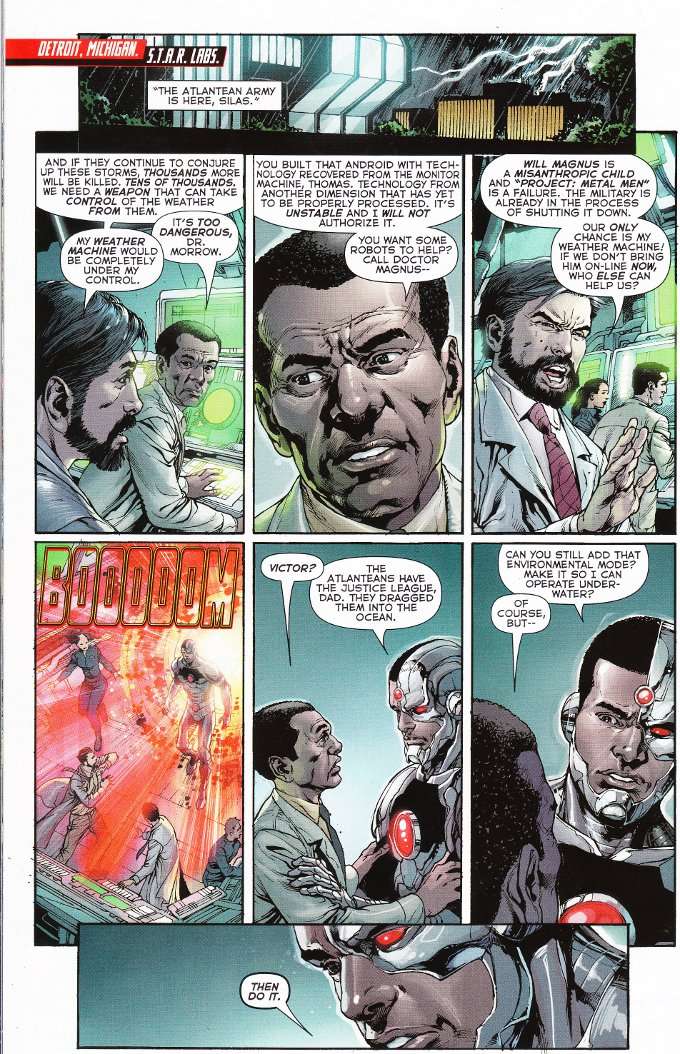
Johns has a gift for taking these classic concepts and redefining them and it's one of the things I find most enjoyable about his writing.  The other thing that makes Johns brilliant as a storyteller is the way he manages to work such wonderful character moments into his stories while hinting at things to come.  A good example of this comes in a brief interlude at S.T.A.R. Labs, where a certain Dr. Morrow is monitoring the Atlantean controlled-weather attacks and asks permission to test a robotic weather-control machine he's been working on. 

Longtime Justice League fans will appreciate the reference but everyone will appreciate the scene in which Victor Stone a.k.a. Cyborg confronts his father about upgrading his body to allow him to breathe underwater.  The on-going conflict regarding Vic's fears of losing his humanity as more and more of his body is replaced with mechanical parts has barely been touched upon in recent issues, save for occasional scenes of Cyborg refusing to discuss a newly developed upgrade.  It says volumes in this moment, when his superhero colleagues are in need, that Vic is willing to put all his fears and objections aside for the sake of his friends.  THAT is heroism in a nutshell as well as why Geoff Johns is one of my favorite writers.    


The artwork in this issue is excellent, as always.  Ivan Reis offers up the same breath-taking pencils that made his recent run on the main Aquaman book so memorable.  Everything is beautiful and this is one of the best-looking books on the shelves today.  Gary Frank is equally amazing in the Shazam back-up story.


The Shazam back-up story - long the millstone around this book's metaphorical neck - didn't bother me as much this time around.  I suspect it's because Billy, for all of his petty acts of crime in the past issues, finally began to act like the hero I expect him to be in this issue.  I think I'll be able to live with this new take on (not) Captain Marvel if things continue in this manner, with Billy taking his power more seriously and realizing what he can do to help people besides himself.

Sunday, December 30, 2012

Justice League #15 - A Review

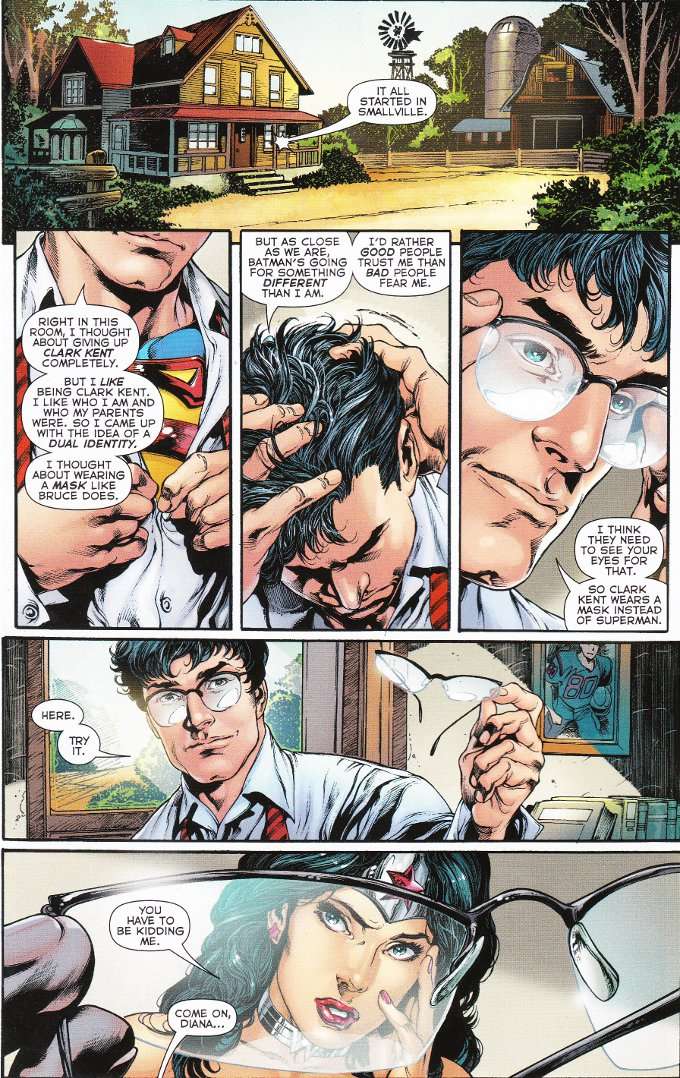
Justice League #15 kicks off the long-awaited Throne of Atlantis crossover between the Aquaman and Justice League titles.  Yet for my money, the best parts of the book have little to do with the crossover and everything to do with the people behind the costumes and superpowers.  Take for instance the page below, which has done far more to define Clark Kent as a character than anything I think I've seen in any other book in the New 52 so far.


It's the little moments like this that have made author Geoff Johns beloved as a writer and made this title worth reading, though it was far slower to get going than many would have liked.  The backbone of the issue is found in scenes such as this, the scene where Cyborg talks with his father and even the scene where Aquaman and Batman team up to take on several of The Scarecrow's minions.  But don't think for a second that doesn't mean the action-packed moments aren't good too.  Far from it!  And Johns' plot involving an Atlantean invasion of the surface world offers excitement aplenty to go with the fine character scenes.


The artwork by Ivan Reis and Joe Prado - most recently seen on Aquaman - can be summed up in only one word.  Phenomenal.  Reis has an amazing eye for detail  and Prado knows when to merely outline Reis' pencils and when to shade them heavily.  Reis is also a good visual storyteller, whose panels flow naturally and easily even on the two-page spreads.

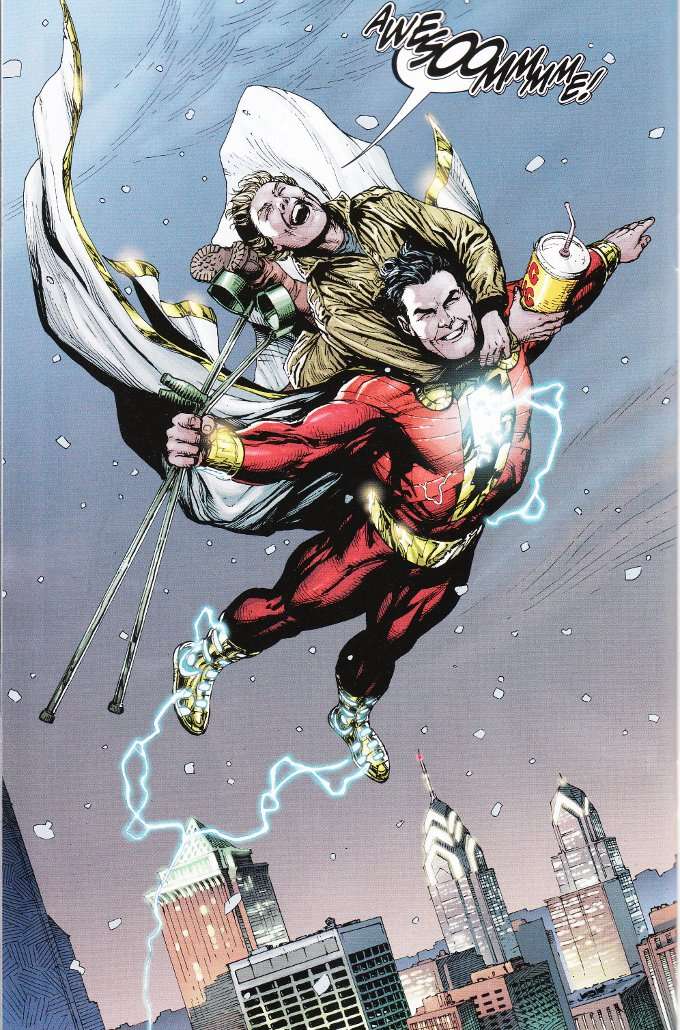
I wish I could praise the Shazam back-up story as highly.  The artwork by Gary Frank is as wonderful as Reis's work but the base concept of Billy Batson as a juvenile delinquent leaves me cold.  It doesn't add anything to Billy as a character to make him a smart-ass punk.  Indeed, his basic decency and inherent nobility was one of the things that set him apart from other teen heroes in the past.


Incidentally,  whatever happened to The Wisdom of Solomon that's supposed to warn Billy away from being dishonest or foolish?  I can't help but think it must have gone the way of Wally West and Donna Troy, since the plot of this story is dependent on the "hilarity" that ensues after Billy uses his powers to hack an ATM so he can get the money to buy beer.  There are some brief moments worthy of the Captain Marvel legacy, such as Billy and Freddy's joy at discovering that Billy can fly but these moments are too brief and too few in number.

This issue is worth picking up if you haven't given Justice League a shot before now.  But do yourself a favor and skip the back-up story.

Monday, December 3, 2012

Aquaman #14 - A Review

Despite being the first part of a multi-issue crossover with Justice League, Aquaman #14 doesn't feel like the start of a major storyline.  This is actually to the story's benefit, as this issue proves to be a wonderful jump-on point for those Justice League readers who haven't been reading this book.  Geoff Johns does an amazing job of establishing several important facts for new readers as well as establishing some trivia that suggests some major changes for the New 52 Aquaman continuity. 

My favorite sequence takes place in a brief interlude which confirms Black Manta's seriousness as a villain.  For all the grief Aquaman has received over how lame a superhero he is, I think Black Manta has gotten worse ribbing from the fandom at large.  After all, how lame do you have to be to repeatedly get your butt kicked by Aquaman?  In previous issues, Geoff Johns showed how Aquaman's true power has been frequently underestimated.  Now, he does the same for Black Manta, showing the lethal ingenuity of a man who - like Batman - must face all manner of threats with nothing but his fierce intellect, raw cunning and the best toys money can buy.


The main thrust of the issue centers upon Aquaman having a meeting with his brother.  Well, half-brother technically, but they address one another as brother.  One revelation we learn in these sequences is that Aquaman's brother rules Atlantis and Aquaman apparently refused the throne.  Those who have been reading Aquaman can't help but wonder how this jibes with the story in Aquaman #0, where it appeared that a young Arthur Curry was preparing to lead a violent revolt in Atlantis.  Presumably things came to a more agreeable end?


An early scene in this book holds a point of interest for long-time Aquaman fans as well as fans of the classic Teen Titans.  Arthur's brother makes mention of a boy with purple eyes named Garth and a prophecy which says that a boy with purple eyes will bring about the end of Atlantis.  This is clearly a nod to the original Aqualad, whose name was Garth and who did indeed have purple eyes.  Does this mean that Aquaman and Mera will soon be getting a new sidekick?  And if so, will the rest of the original Titans, absent from The New 52 thus far, be appearing soon?

You may have noticed at this point that I continue to refer to Arthur's brother as nothing more than Arthur's brother.  There is a reason for that.  He is not named once in the entire issue - not by his true name nor by the villainous nom de plume he went by in the old universe - The Ocean Master.  The artwork also makes a point of shadowing his face or obscuring it, despite his wearing a full helm that almost completely covers his face.  This is especially odd given that appears, unobscured, on the front cover.


The artwork of this issue seems somewhat uneven.  I suspect this is the end result of employing two pencilers and five different inkers.  None of the artwork is bad but the look between pages is inconsistent.  Some pages - such as the above throne room scene - are so heavily inked as to be almost completely black.  Others, such as the splash page below, seem overly stylized to the point of being cartoonish.  I half-expect the fish surrounding Aquaman to begin singing a jolly calypso number about the joys of living below the ocean.


Despite this, I'd still gladly recommend this comic to any curious parties.  If you haven't been reading this book before, now is the perfect time to dive in!

Monday, November 12, 2012

Aquaman #13 - A Review

Aquaman #13 doesn't feel like much of a conclusion to The Others storyline, with a resolution that solves little of the core conflict of the storyline.  This issue suffers from the main problem that has plagued this entire story arc.  The stories that Geoff Johns eludes to having occurred in Aquaman's past and his previous partnership with a team of outcasts empowered by Atlantean artifacts before joining the Justice League are far more interesting than the story he is telling where that team is killed off, one at a time, by Black Manta as part of his latest revenge scheme.


Despite this, Johns' greatest strength as a writer - a playwright's gift for character and dialogue - saves this book and this series.  Johns' introduces the great concept that for Arthur Curry, being Aquaman was an escape from the man he thought he was becoming.  Being a walking punchline and "the one who talks to fish" on the surface world was preferable to being the a killer who acted out of a vicious need for revenge and created his own worst enemy in doing so.  The man vs. himself angle adds an entirely new perspective on Aquaman's personality - one far more complex than even Peter David ever explored. 


Ivan Reis' artwork is, as always, amazing and a perfect complement to Johns' scripts.  The sketchiness from last issue is gone, presumably due to Reis' pencils only being worked on by a team of two inkers this time around.  Whatever the case, the artwork this time looks more polished and the shadows less random.

Aquaman continues to be one of the best books to come out of the New 52, with top-notch artwork by Ivan Reis and Geoff Johns' scripts exploring the hidden depths of the King of the Seven Seas.  Highly recommended! 

Sunday, July 8, 2012

Aquaman #10 - A Review

Geoff Johns is undeniably one of the greatest idea men in comics today. However, in the case of Aquaman #10, one is tempted to say that it might be better if Johns did not try to fit so many ideas into one storyline.

I'm not certain why the multiple plots that seemed to flow together so seamlessly in the previous issues of this series seem to be scatter-shot in this issue. Perhaps it was because, in writing my review of the previous three issues of this series, I had read all the issues together in one sitting. This may be one of those story-lines that reads better in the trades than it does as a monthly book. I certainly hope that's the case, for there is a lot to like in Aquaman right now. Perhaps too much...


By way of a for instance, let us consider The Others - a loose association of superheroes Aquaman was once part of. Apparently they all draw power from or own Atlantean artifacts and were forced into teaming-up due to the machinations of Black Manta. Johns throws out quick little scenes with these new characters - The Prisoner, The Operative, Ya"Wara The Jungle Queen - with little to no explanation of who they are, what their abilities are and what their motivations are past "stop Black Manta". What we see of them is intriguing and leaves me wanting to know more about them... but there's nothing there! As soon as we see these characters in action, we're cutting away to Aquaman fighting Black Manta in the present or Aquaman fighting Black Manta in flashback.

These action scenes, too, are well-written and well-paced, but far too short and broken up by the switching between the multiple points-of-view. And that's ignoring the fourth unifying plot, where Dr. Shin - a new supporting character who has a past with both Aquaman AND Black Manta - explains to an increasingly annoyed Mera (and the reader) about Aquaman's secret past, his association with The Others and how Aquaman and Black Manta are both responsible for killing one another's fathers. I think it might have been best if Johns had devoted one issue to the flashbacks, one issue to the explanation and one issue to the action in the present day after setting things up in Issue #7.


Thankfully, while I may quibble over how this story is laid out, I have no such problems with the artwork. Ivan Reis is as grand as ever and it's good to see him continuing to knock it out of the park every month. The inking team of Andy Lanning and Joe Prado also deserve high praise, as does colorist Rod Reis. Through lighter inks and differing palettes, the art team manages to break up Johns' script visually, using differing levels to depict the flashbacks and the high-action scenes from the more stilted talking-heads moments.

I'd still recommend Aquaman to most readers but I think, given this issue, it might be better to buy the monthly issues and save them up to read in one sitting or just wait for the TP collections.

Friday, June 8, 2012

Aquaman #7-9: A Review


In the 45 years since his creation, Black Manta has been many things.  An abused child driven to hate the sea after being trapped on a boat. An autistic man who found comfort in the texture of water while being tortured in Arkham Asylum by an incompetent psychiatrist.  A Black Separatist who wanted to form a new nation, free of the White Man's oppression under the sea.  And even a half-man/half-fish monstrosity.  But despite all this, there's one thing Black Manta has never really been - threatening.  Small wonder then that having established Aquaman as the badass as should be with his first story arc on this title, Geoff Johns should use his second story arc to build upon the background of both hero and villain and turn Black Manta into a villain worthy of the King of the Seven Seas.


These three issues move smoothly through four different story-lines.  Two are set in the modern day DCU.  Two are told in flashback.  In the first storyline, we focus upon Black Manta himself as he hunts and kills a series of superheroes - all of whom apparently draw power from Atlantean artifacts and all of whom were once part of an unofficial super-group called "The Others".


 The second arc focuses upon Aquaman, who was - not surprisingly - one of The Others.  He joins forces with Ya'Wara - a jungle-queen style heroine who was also a member of The Others -  and the two begin to track Black Manta.  This greatly annoys Aquaman's wife Mera, who doesn't seem to wholly believe that the only connection Aquaman and Ya'Wara ever shared was a telepathic one.


The third arc, depicted in flashback, showcases the adventures of The Others in the past.  We see exactly how Arthur and his fellow heroes used to work together and how they were all united in their efforts to stop Black Manta from exploiting the power of ancient Atlantis.  We also see how much Aquaman has changed in six years times, becoming much less savage and kinder in aspect - a scary prospect for those who remember that Aquaman is one of the few who can out-gruff Batman.


In the fourth arc, Mera is told of Aquaman's  life on the surface world as a child by Dr. Stephen Shin - a doctor to whom we have already been introduced.  We learn a little more of his background with The Curry Family and how he came to be hated by Aquaman mixed up with Black Manta.  I'll spare you any more details than that.  Suffice it to say that those familiar with how Geoff Johns rebuilt the Green Lantern mythos from the ground-up will not be surprised at how well Johns is beginning to do the same for Aquaman.

Ivan Reis continues to impress with his pencils, fitting more fine detail into several single panels than many artists attempt over whole pages.  He is ably assisted by inkers Joe Prado, Oclair Alber and Andy Lanning, whose work further refine Reis' pencils without becoming overly dark.  Colorist Rod Reis also deserves special praise, particularly for the sequences where he uses a water-down palette in conjunction with lighter inks in the flashback scenes showing Aquaman's childhood.  The effect seems to perfectly suggest the past without resorting to sepia tones or black-and-white imagery.

If you aren't already giving Aquaman a shot, now is the time to come on-board.

Tuesday, May 29, 2012

Justice League #7-9 : A Review


I think Justice League would be a better book if it had more of The Justice League in it.

That may seem an odd comment but I stand by it.  Since the opening six-issue story arc, this book - despite having numerous action scenes involving The Justice League - hasn't really felt like it was about The Justice League.  The Justice League is present but there is little depth to that presence.  And up until Issue #9, the main focus of the stories has been on someone other than The Justice League members themselves.

Case In Point; I just did a page count on Justice League #7 and determined that after cutting out the Shazam back-up story, just over half of this comic's pages are devoted to The Justice League fighting a monster created by mad science.  But it doesn't feel like it.  The action sequence is just fluff building up to the real focus of this issue.  And that focus is fixed firmly upon one Colonel Steve Trevor.

In the five years since the Justice League formed, Col. Trevor has become a sort of spokesperson/government liaison for the team.  In theory, this means his job is to field questions from reporters after every incident the Justice League gets involved in and deliver requests from the League to the US Congress and vice-versa.  In practice, Col. Trevor's job is to discourage reporters from openly questioning the efficiency of the U.S.A and convincing various Congressional committees that issuing demands to people who could potentially rip the planet in half is a bad idea.


This could be boring except for the fact that Geoff Johns has developed Steve Trevor far beyond his usual role as Wonder Woman's dude in distress.  Steve Trevor is, in a word, badass.  He's a man of action who chafes at being stuck in a glorified desk job and yet he sticks with it for reasons beyond merely serving his country or protecting the world.  I hesitate to make the obvious comparisons to Nick Fury because Col. Trevor, as written here, is much deeper than that.  

Gene Ha was the guest artist on this issue and he proves to be a fitting choice.  Perhaps most famous for his work with Alan Moore on Top 10, Ha's detail-oriented style is, for my money at any rate, a better fit for this material than Jim Lee's more bombastic pencils would have been.  Ha draws a mean action scene but his ability to put layers into scenes of people merely talking helps to elevate this book. 


Issue #8 may as well have been titled "Everyone Hates Green Arrow".  Again, the Justice League is present for most of the issue but the focus this time is upon a superhero who isn't a League member and his efforts to impress the team into asking him to join.  Again, we don't really get any insight into any of the League members beyond the basic information we've already gleaned in the opening story-arc.  Superman is a  nice guy.  Wonder Woman likes fighting.  Aquaman is a tight-ass.  Batman is a tighter tight-ass.  Hal Jordan is an asshole.  The Flash is a wimp.  And Cyborg... uh, is there.  


This whole issue feels really uneven, being chiefly comprised of a series of interludes where The League confronts some crisis taking up the main story of another DC Comics title (Night of Owls over in Batman, The Cultists from Justice League Dark, etc) and Green Arrow shows up to help out... much to the annoyance of most of the Justice League. Hints are dropped as to Aquaman having some prior dealings with Green Arrow (hints that were also dropped in the Green Arrow book) but no details are given.  Later, Oliver Queen refers to his own dark past and becoming Green Arrow to make amends for his own personal sins but we are not given an inkling just what his past crimes might have been.


What's really vexing to me is that despite so little being said about Green Arrow's backstory, Geoff Johns still gives the character of Oliver Queen more depth and development in this one issue than Ollie's gotten in his entire DCnU series so far.  And I'm uncertain if that's a complement to Johns or a commendation of the current Green Arrow book and all three writers who have worked on it in the past nine months.


The artwork by Carlos D'anda is as uneven as the story.  Consider the shifting size of Green Arrow's mask in the above page scan and how it seems, at times, to go over his hairline.  There's also a continuity error in the earlier pages, where the arrow Green Arrow shot into an Amazo robot is not visible in any far shots of the robot until Green Arrow points it out.


Thankfully, Jim Lee returns to the art duties with Issue #9 and with him returns the Geoff Johns we all know and love from JSA.  This time, the story is focused on The League.  This time, we get a lot of the little character moments Johns is famous for, as most of the team gets brief flashbacks amid the action of the issue that lend further insight into their characters and their backgrounds. 


These scenes give this issue a depth that the previous two issues lacked.  You wouldn't think that a quick panel or two of Clark Kent remembering being the last one picked for teams back in high-school could add so much to the story but it does.  And even though most of these scenes merely highlight what we already know about the characters (i.e. Hal Jordan has authority issues, Barry Allen is a goody-two-shoes, Cyborg has issues with his dad), we do get some new information, such as precisely why Wonder Woman and Steve Tervor's relationship fell apart.

Of course the one thing that everyone picked up on in this issue was one of Bruce's memories involved a letter - a letter that looks suspiciously like it might have been the one that the Batman of the Flashpoint universe, Thomas Wayne, asked Barry Allen to give his son.  What does this mean?  Who can say?  Personally, I'm less interested in the state of the universe and more interested in the state of the characters and this issue does give us more information on that.


In all this talk of character, it occurs to me that I've said little about how this issue sets up a storyline involving a new villain who is out to destroy the Justice League.  But then again, what little we see of the man called Graves is mostly set-up.  No doubt we will be seeing more of him in the coming months.  Yes, I am still reading this book.  For all it's faults and unevenness, it is still a good read.  And if you haven't given it a shot yet, I highly recommend jumping on with Issue #9.