Showing posts with label Ron Zimmerman. Show all posts

Sunday, January 14, 2007

Looking To The Stars - Religion, Politics and Chuck Dixon


It is no secret to you, my regular readers, that I am not a big fan of Judd Winick’s work – particularly his run on Green Arrow. However, a recent controversy in the comic book world has led me to a realization about exactly why I do not like Judd Winick’s work.

I’m not going to waste a lot of words on this because I’ve already said enough on the hows and whys in the past. Nevertheless this argument, already well covered by many other writers on the blogesphere - including our own Tim Stevens - has allowed me to reach a personal revelation.

Recently, writer Chuck Dixon was announced as the writer of an upcoming Grifter/Midnighter team-up book. This upset many fans of The Midnighter, whom had concerns about how Dixon – an outspoken conservative who has made statements against portraying homosexual characters in superhero comics in the past – would portray The Midnighter, an openly gay superhero.

Dixon was interviewed about the controversy earlier this week by Newsarama and was given a chance to explain his past statements, including what some perceived as personal attacks on writers Ron Zimmerman and Judd Winick.

Now I admire Dixon as a writer. Nobody today, for my money, can write a good simple action story like Chuck. That being said, while I agree with a lot of what Chuck has to say and think he is very reasonable in how he says it, I still think that there’s a wee bit of hypocrisy in Chuck Dixon being the messenger in the case of some of these messages.

Let us go down the interview, point by point.


1. Regarding his past comments and openly gay comic characters

”I was critical of Marvel’s presentation of Rawhide Kid as a homosexual. I thought that the limited series was done as a stunt and wound up demeaning both the Kid (a childhood favorite of mine) and the homosexual community. I committed some unforgivable sin by suggesting that perhaps a Howard Stern staff writer would not the ideal candidate for a sensitive portrayal of a gay western hero and that it was a mistake to retro-fit an established character rather than create a new one.”

“The Perpetually Outraged instantly labeled me as a homophobe and the label became permanent when I weighed in on Judd Winick’s introduction of an openly gay character in Green Lantern. My suggestion was that superhero comics are, whether die-hard fans like it or not, ostensibly children’s comics and perhaps not the forum to be informing children of homosexuality, heterosexuality, or sexually transmitted diseases. I think I incensed some people by saying that I didn’t want my kids receiving their sex ed from Judd Winick in the pages of a superhero comic book. I still don’t... And the introduction and retro-fitting of gay characters into established series has become an instant cliché. It’s done in a cynical manner strictly for marketing purposes in a way that should offend everyone...”


Now, here’s a little something that may shock all of you, who well know that your kindly Unca Starman is that rarest of all creatures; a fightin’ Texan Liberal.

I agree with 75% of what Chuck Dixon just said.

I agree that Rawhide Kid was an insult to the homosexual community and was as stereotypically offensive to gay men as Stepin Fetchit films are to those of African heritage. (Those who haven’t seen it already can read my original thoughts here.)

I agree it probably would have been better to tell the story used in Rawhide Kid with a new character instead of using an established name, not because I am against the idea of revamping a dead property but simply because the manner in which it was done smacks of cheap sensationalism.

And speaking of sensationalism, I agree that the introduction of gay characters to most recent comic titles has, for the most part, been handled in a less than graceful manner and is usually done more for the purposes of publicity than an honest attempt at inclusion. I point to the outing of Freedom Ring in the pages of Marvel Team-Up as ‘Exhibit A’.

And I certainly don’t want Judd Winick teaching a sex-education class if his portrayal of how he did so in Pedro And Me is at all accurate.

This begs the question of why Chuck chose to single out Judd Winick in particular. After all, Judd isn’t the first writer to introduce a gay character into the pages of Green Lantern. Ron Marz, whom Dixon co-wrote a number of stories with, holds that honor for introducing lesbian couple Lee and Li into the book as Kyle’s neighbors. And James Robinson retro-fitted Mikhal Thomas (aka Starman III) into a homosexual relationship with relatively little fuss as did Greg Rucka when he outted Rene Montoya in Gotham Central.

Perhaps it is because Winick seems to want to make a statement more than he wants to tell a story. As such, he makes himself a target because of his activist approach to writing. Winick specifically created Terry Berg to make a statement. He wrote Pedro and Me to make a statement. And he gave Mia Dearden HIV to make a statement. The problem is that if you keep giving the same speech over and over, people will get sick of it and stop listening.

Okay. I understand. Gay people are people too. Now what?

Of course Dixon’s main concern in all of this seems to be books aimed at younger readers. And with the exception of Marz’s Green Lantern, all these books were aimed at mature audiences. But ignoring all issues on whether or not comic books are still a children’s medium for the moment, I must take issue with the idea that a superhero comic would not be a good medium with which to teach pre-teens about sex, drugs and the other nasty things that we try and protect the innocent from until they become too big for us to pull along behind us.

Why do you think Stan Lee stumbled his way through the now infamous anti-drug issue of Amazing Spider-Man in defiance of The Comics Code Authority? Because someone at the Department of Health, Education and Welfare asked him to do so. And that was such a big hit, that it led to the entire industry following suit in an effort to discuss real issues in the funny books so the kids might learn something.

This begs another question; just what are the kids learning?


2. Regarding the portrayal of sex in comics...

“I’m no more in favor of a frank sexual discussion between Reed and Sue or Lois and Clark than I would be were it Gay Character A and his partner.”

“When I was writing Dick Grayson and Barbara Gordon’s romance I stayed away from stating that they were in any kind of sexual relationship. You could absolutely imply it. But you could just as easily tell yourself they were saving it for marriage. Is this method naïve? In movies made before the 60s it was the norm to present characters as romantically involved and then leave clear indicators that they were getting it on between scenes. Clark Gable and Jon Crawford go into a hot kiss and we fade to black. Cut to next morning and she’s making him breakfast and dressed in a different nightgown.”

“Now they could have kissed one and then played Monopoly until dawn. The audience was left to choose what they wanted to believe and there was no need to explain the facts of life to the kids after a Cary Grant movie. We used to call them “air force” scenes. Whoosh! Right over the kid's heads.”

“So Clark and Lois can be seen kissing and being affectionate and there’s no need to explain it. The sexual aspect of their relationship doesn’t have to be explored. But if Wonder Woman and Supergirl are seen kissing then that does call for an explanation. The sexual aspect of a relationship like that will call forth questions from the kiddies.”

“…There are a million different ways that the issue of sexuality of any kind can be introduced to children. But why can’t some comic creators resist the urge to do so in the pages of a superhero comic? It’s a genre where people wear capes and masks and have magic rings and lift buildings up over their heads. And no matter how much you wish the genre could grow old with you, these are still characters for children. They’re on pajamas and backpacks. They’re Legos, for God’s sake…”


Again, Dixon references children and wanting to protect them from what he sees as something that is not appropriate for young eyes. Now, this is a noble goal and one I know a little bit about from my current and previous positions as a comic book salesman and as a librarian.

Back when I was a comic shop guy, I had a responsibility to let parents know that Spawn was probably not appropriate for their five-year-old. In my current position as a librarian, I have the responsibility of making sure that children’s reading material is age-appropriate – i.e. making sure that Sin City is not filed in the children’s section, despite being an illustrated book. That said Dixon’s point here presumes two things that I know not to be true from personal experience.

First, Dixon seems to think that children are in serious danger of reading Green Lantern or Green Arrow. While Chuck’s concern for children speaks well of him he’s a day late and a dollar short. The new generation has very little use for $3 funny books. Much to my dismay, I can tell you that the number of children who came into my old store looking for something besides Yu-Gi-Oh cards was few and far between. Those few who were there for comics limited their reading material to kiddie-specific fare like Sonic the Hedgehog or the Marvel Adventures or Johnny DC lines. The average comic fan and target market these days is a lot closer to my age than that of Little Billy.

Secondly, Chuck seems to think that without parental guidance, children will be unable to comprehend the idea of boys or girls kissing one another. Now this is a major hornet’s nest and I’m a fool to even go near it. But for one moment, let us put aside all spiritual and religious considerations regarding homosexuality.

Given that, is it truly that more difficult to say "sometimes two people who love each other will kiss one another like that" instead of saying "sometimes a man and a woman who love each other will kiss like that"? To my mind, it isn’t.

To tell another story, I have a friend who has two children from two marriages. The first is almost twenty. The second has just turned seven. The first is a pre-op transsexual. The second is a young girl.

The second has no problem understanding that she used to have a brother but her brother had decided she’s really a sister. To the second one, this is not strange or complicated simply because everything seems strange or complicated at that age and most things adults do don’t make sense to you anyway. All of the younger children I work with are the same way.

Of course it is well within the parents’ rights to decide when such questions are answered and how such questions are answered for their child. This harkens back to Dixon’s earlier comments about not wanting Judd Winick teaching his children sex-ed.

And while I disagree with Dixon on how it is more complicated to explain two people of the same gender kissing or holding hands to young children than it is to explain a man and a woman kissing, I do agree I do not want to hear Reed Richards graphically explaining how he uses his powers to keep his wife happy nor do I want Man of Steel, Woman of Kleenex to ever come into discussion in an actual Superman comic.

That said, I have to wonder – is Chuck’s issue really with all sexual content and politics in the funny books? Or just sex that he himself finds offensive and politics beyond his own?


3. Regarding politics in comics...

“I’ve never backed away from my disdain for agenda-driven comics in what should be the medium’s primary escapist, mass appeal genre. Stand on your soap box all day long. But don’t stand on the shoulders of household-name icons. Write the characters in character and don’t write your world-view through them…”

“…Will the inclusion of gay characters in mainstream comics make homosexuality more acceptable? I haven’t seen a mainstream comic story yet with a gay character that wasn’t loaded with stereotypes and clichés. A wise editor I used to work with cautioned his writers, “don’t write about human relationships unless you’ve had one.” Most of what I’ve seen of the conscious-raising variety of comics on this subject has been dismal and pandering. Loaded with mock outrage and received wisdom and very little honest human interaction. It’s dealt with an in-your-face issue rather than a story.”


I believe most people do not want to be preached to and will resist any attempt to be told what to do out of general contrariness. I know people who voted for a political candidate simply because the opposition had an annoying advertisement. I’ve joked that many anti-smoking advertisements have made me consider taking the habit up as a form of protest. And I agree with Chuck that nobody wants to hear someone channeling their political opinions through a comic book in a ham-fisted manner.

Of course, Chuck Dixon would never do such a thing himself. Would he?
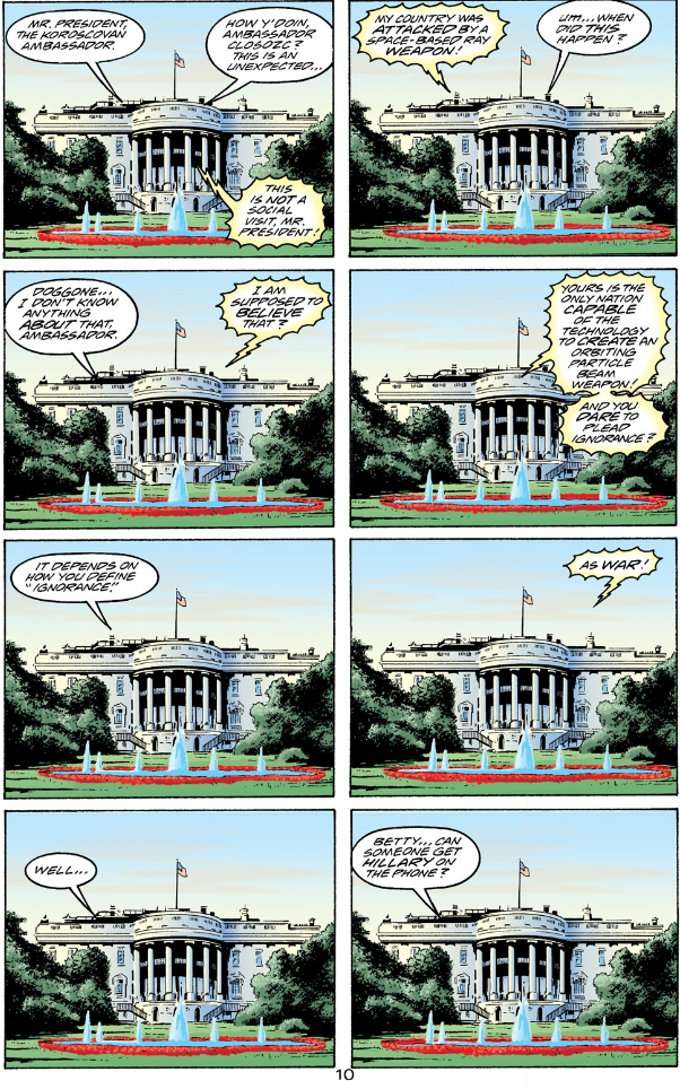


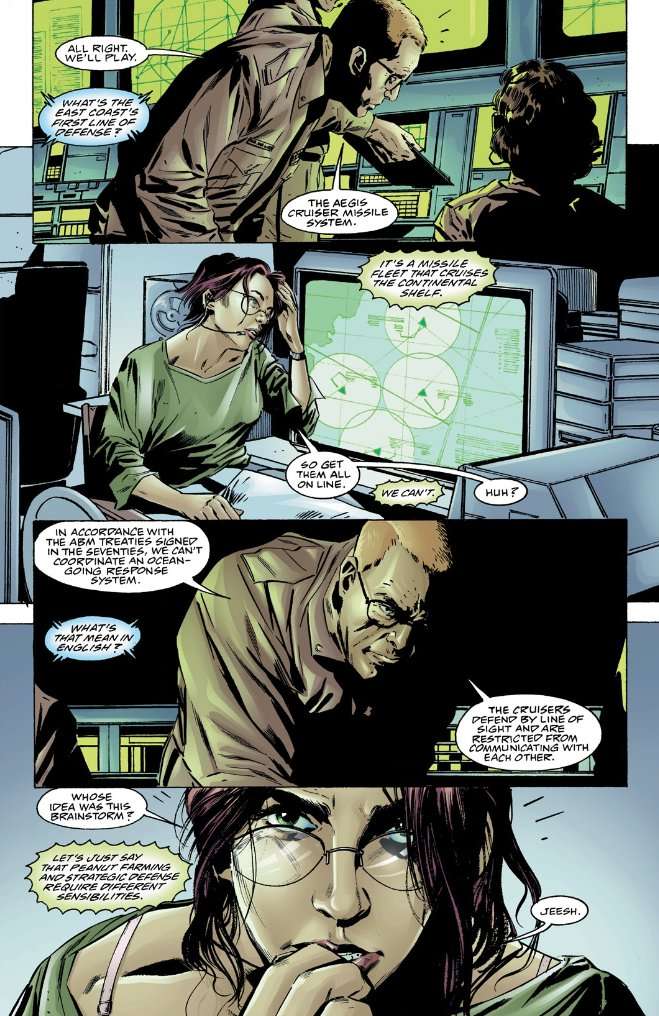
Birds of Prey #10


Birds of Prey #17


Ah. Well, apparently when he would when creating the circumstances for a story that allows him a chance to make a Democrat president look weak-willed and dependent on his wife.

Incidentally, I did some research and I could not find anything on ex-President Jimmy Carter (the peanut farmer in question) agreeing to a weakening of the ABM Treaty much less the addition of the specific, and I must say rather contrived rules, that Dixon refers to in the above panel. If anyone can provide me with proof that the United States is part of an international treaty of some sort that states that cruisers at sea are forbidden radio contact with one another during the time of a missile attack and how Jimmy Carter is responsible for it, I would appreciate it.

In reading some of the other articles about Dixon and his past work in the last week, I’ve seen quite a few stories I read in the past in a new light. I never thought about adult content in the issue of Green Arrow where Connor Hawke lost his virginity to a ghost - at least not in terms of how suggestive the artwork was. I never before thought about how the Planned Parenthood worker Stephanie Brown spoke to while she was pregnant seemed to be trying to push Stephanie toward having an abortion in a comically exaggerated manner much less how Chuck Dixon was tackling the issue of Teen Pregnancy. And thinking on all of this is what led me, ultimately, to my revelation.

This is what has, in the back of my head, made me so angry about Judd Winick. Ultimately, it has nothing to do with continuity or characterization. It is the fact that Winick is so backward as to what a liberal should be and that in turn influences how he writes Green Arrow.

Back in the Dennis O’Neil days, for all of his loud-mouth and reactionary ways, Oliver Queen did one thing that he does not do very well under Winick’s pen. He listened to the other guy and let him speak before letting him have a verbal sucker-punch. How did most of the fights with Hawkman start? The two were discussing politics and Ollie the hothead would start spouting off against “the feathered fascist”. But he always let Hawkman get a chance to say something before throwing out the accusations of how ignorant he was and saying he should be “Caveman” instead of Hawkman.

Not so with Judd Winick’s Green Arrow. Here, there is no room for discussion. Oliver Queen delivers his messages from behind a podium or to a sycophant in his employ with no reaction from the other side of the aisle. The conservative pundit on a talk show is silenced by a shouting liberal and we cut back to the action before any rebuttal can be given, leaving the liberal (and Winick by proxy) with the final word.

As a liberal, this behavior infuriates me even more than conservatives who consider that just because I identify myself as a liberal, that I must believe everything they consider to be a liberal cause. They never think that I might be in favor of the death penalty or that I think PETA goes too far because those aren’t things liberals are supposed to believe in, to their minds. They presume that because there is one liberal like this, than that is what we all must be like.

It’s a sad thing. And liberals do this with conservatives too. I’ve seen quite a few people I know to be of a liberal persuasion dismiss Chuck Dixon’s comments out of hand while banding about words like “Nazi”. They don’t stop to think that, hypocritical though he may be, he might have a few good points.

This happens on both sides of the political fence. It happens with the Bill O’Reillys who tell their liberal guests to shut up and turn their microphones off. It happens with the Al Frankens who would rather tell jokes about George W. Bush stuttering than talk to an intelligent conservative about real issues.

It happens with the Chuck Dixons who write Planned Parenthood counselors indulging in behavior that would get a real counselor fired. It happens with the Judd Winicks who make all their conservative characters cops on the take or amoral C.E.O.s.

And for all of us, if we’re going to solve these problems someplace outside of the funny books, it needs to stop now.

Monday, April 21, 2003

Looking To The Stars: A Not So Typical Viewer Mail Column

When I first started writing for 411mania, I never anticipated the amount of feedback and support that I would get for my writing for it. Oh sure, I got the occasional fan letter during my time with Fanzing (long may ‘er archives stand!). But since taking up my metaphorical pen here, I have gotten twice the response that I did back in the good ol’ days. But never did I anticipate that I would be getting letters from professional writers regarding what I said about their work.

And yet, this is what happened to me about two weeks ago. Just after the publishing of my review of The Marvelous Adventures of Gus Beezer with Spider-Man #1, I got the following letter.

Matt,

Just wanted to drop a note to say the reviews at 411 about Gus (even aside from being so kind!) were among the most insightful commentary the book has seen yet. Your opening paragraph was EXACTLY correct about what we were trying to do. I was very pleasantly surprised.

Thank you so much for the kind words. I'm certainly going to be keeping an eye on you and the site!

Best,

Gail

Gail Simone reading my work? I was floored! You see, I’ve been a big fan of Gail since she was writing You’ll All Be Sorry at Comic Book Resources and I’ve loved her work on Deadpool, Agent X and Killer Princess. So getting praise from her was a major ego boost.

I also have to thank Gail for having indirectly improved my image at work. As some of you may remember, Unca Stars does work for a comic book store. Last week, I came into the store that morning to find my boss with an odd grin on his face. Not that his grin is that odd, but having it directed at me is a somewhat rare occurrence. With few words, he showed me an e-mail sent in from his boss, concerning a “very good review” of the Gus Beezer series that should be used to help sell the comic in all our stores. The review began with a heading saying Written by “Starman” Matt Morrison.

It turns out my boss’s boss was one of several people Gail sent the review too, praising it and me. And the poor guy had no idea that this writer, whom he personally went on to talk about being very good, was working across the street from him.

Well, I hope you laughed as hard as I did at that. And yet there is even more. Just yesterday, I got another letter, though this one was not as complementary.

matt,
i was just sent your review of .... well, come on, me. not my work, but me. what a sad, bitter, tiny little man you must be inside. it must be awful to be you. please continue to hate me and my work. please don't buy it. please throw away any free copies you might recieve. it is not written for you. it is written ABOUT you. when you are allllllll grown up, ask your mommy what satire is. i wish you great success with your booming internet career and will make a point of reading all your reviews in the future as you seem to be a very entertaining humorless dolt.
ron zimmerman

Wow. Rawhide Kid was written about me? I thought it was about a gay cowboy.

In all seriousness, while I thank Mr. Zimmerman for his concern, I am not sad or bitter. I am quite happy, well satisfied with my job and have a diverse group of friends for whom I am very grateful. I am also not tiny or little, being above average height (5’10”) and weight. (180 lb), have the build of a linebacker and in good health. As such, I am as grown up as I think I am going to get.

As for my mother explaining satire to me, she has already done so. I was raised watching Monty Python and am well familiar with what satire is. I am also familiar with what is good satire and what is bad satire. And Ron? You write very bad satire.

For good satire, I highly recommend the new limited run YABS being put out by Gail Simone and some other writers (including Ron Zimmerman). You really should go and read all of her new and old work. I guarantee you’ll find some of the best satire about comics ever written as well as a critique of nuts on the Internet bad mouthing perfectly decent writers for no reason other than pure jealousy and certainly not because they are insecure hacks, with nothing better to do on Easter Sunday than insult their critics.

Tune in next week. Same Matt Time. Same Matt Website.

Wednesday, February 5, 2003

Rawhide Kid #1: A Review

You’ve all probably heard all the hype about this comic already. This is, how it stars the very first gay title character in comic book history. How it a western that, to quote the BBC News, “breaks the mold of traditional macho comic characters.” And how various religious organizations are now boycotting Marvel because of their attacks on family values and how various gay rights organizations are cheering Marvel for this attempt to add diversity to their comics.

What you may not have heard, and what my job as a critic is to tell you, is how the book actually is. Because let’s face it: this book is a historical footnote if nothing else and will probably make Marvel a ton of money on the first issue alone. But all of the above is totally meaningless to me: all I care about is how good the story and art are.

Now those of you who read the Starry Awards in “Looking To The Stars” a few weeks back probably recall that I’m not too big a fan of Ron Zimmerman. In fact, I closed the awards with a tearful plea to Joe Quesada to please stop publishing anything that the Z-Man had penned. You might imagine then, that Unca Stars went into this book with a certain amount of dread.

Give yourself a no-prize on that guess, buckaroo. Cause the writing on this book stinks like a two-day-old cow pie. In fact, I think the wrong organizations are protesting the release of this book and I can only assume that nobody at GLAAD actually read this before they spoke about how great it was to see more homosexual characters being represented in mainstream comics.

Why? Well, the anachronistic dialogue sticks out like a sore thumb, along with various other minor anachronisms. The Rawhide Kid’s sleeping attire, for example. I don’t think they had bikini briefs for men back in the Wild West days.

Then there’s the just plain creepy-crawliness of some scenes… like the scene with The Kid doing a semi-suggestive “can’t see anything” faux strip act with his robe at a group of young boys that must have Dr. Wertham of “Seduction of the Innocent” fame saying “See! See! I was right”, in his seat next to Joe McCarthy in Censors’ Hell.

No, what really sticks in my craw about this comic is that… well, it’s the same thing that makes me avoid watching Will and Grace. This book doesn’t shatter the stereotypes of the macho male main character. It reinforces all the stereotypes of the gay male character.

Reference is made to The Kid’s fine dress sense and accessorizing skills on three separate occasions. The aforementioned crowd of boys start asking him about how he compares to other famous gunmen and The Kid talks about how much he’d love to meet the Lone Ranger and how much he loves his outfit and can “see why that Indian follows him around.” And the dialogue… I can’t bring myself to quote any more of the “Oh fabulous!” dialogue that makes up most of The Kid’s speech.

The real shame of the book though is that John Severin’s artwork is gorgeous and really does a good job of conveying character and scenery. Would that the story and concept could match it in quality. In fact, the only comparison I can make between the two is to ask you to imagine an episode of Robert Smigel’s “The Ambiguously Gay Duo” as painted by Alex Ross.

Personally, I think the best we can hope is that in thirty years, this comic will be viewed like the old Power Man comics featuring jive-talking bad-ass Luke Cage: Offensively stereotypical today, but a big step forward from what had come before.

Sunday, January 19, 2003

The First Annual Starry Awards

The Golden Globes. Mr. Blackwell’s Best & Worst Dressed List. And now: The Starries. Because it’s just not the start of the new year without yammering about the best and worst of last year.

Welcome, dear reader, to what I hope will become a yearly staple of 411 Comics: The Starry Awards for Excellence and Disgrace in Comics Writing.

Now Stars, you might well ask… We have the Eisners. We have the Eagles. We even have (though I’m not sure why) the Wizard Awards. Why on Earth 2 does the comic industry need another award? Because those other fine awards aren’t based on my opinions as to what stories are good and which ones are not worth the trees that were killed to see them printed.

The Starries name ten stories in total. Stories, for the purpose of this award, can be single or multiple issues of one book or multiple books relating to one plot-line. The Starries are based solely upon the personal opinions of Matt “Starman” Morrison and do not necessarily reflect the opinions of anyone else.

Five Staries are awarded to stories which, more than any other stories this year, made me stand up and cheer, burst into tears or just stopped me in the middle of reading to say “This is damn good stuff.” Five Staries are awarded (if you can call it that) to stories that, for some reason, I found disappointing. Stories that left me feeling that a mark had been missed and missed badly. Some of them are stories that, in fact, I think are just plain terrible!

That said: Here are the winners and losers!


The Best of 2002

Best Moment All Year: The Restoration of Oa and the Guardians.

As told in Green Lantern #150 by Judd Winnick, Dale Eaglesham & Rodney Ramos and Legacy – The Last Will And Testament of Hal Jordan By Joe Kelly, Brent Anderson & Bill Sienkiewicz

Probably the biggest comic news story this year in terms of impact to the DC comics Universe, Winnick and Kelly both had ideas on how to bring back the Green Lantern Corps in some form or another. Working on their stories separately, the two learned of the other’s plans and agreed to write their stories to play off another.

Both stories were as different as brightest day and darkest night. One dealt with a young man given omnipotence trying to find the way to best use his new power. The other dealt with an older man fighting his own sense of powerlessness, seeking redemption for himself and for the greatest man he had ever known. But both these men would come to find something within themselves that let them prove to be the equal of any Green Lantern to come before as they each undid the mistakes of the past.


Funniest Read All Year: Understanding Gamers

As told in Dork Tower #18 by John Kovalic

A success as a straight comedic story, as a semi-serious guide to gamer culture and as a parody of Scott McCloud’s Understanding Comics, Dork Tower #18 had me laughing and crying. Laughing at such bits as the Gamer Type Identification Chart and crying as I saw myself in the “How To Date A Non-Gamer” section (I swear.. I only told her about my Morrowind character ONCE!). Don’t worry if you missed this book though. It will be coming out soon in an expanded Trade Paperback edition.


Best Team-Up: Green Arrow, Hawkgirl & Hawkman.

As told in Hawkman #5-6 by Geoff Johns, James Robinson, Rags Morales & Michael Bair

They met again for the first time in years in Kevin Smith’s Green Arrow run, these two heroes. Both were recently returned from the dead, both are masters of archaic weapons and both needing only the drop of a feather-bedecked hat to start trying to kill each other.

Still, as good a job as Smith did, Robinson and Johns did him one better with a not-quite so acclaimed team-up story in the pages of Hawkman a few months later. Titled “Slings And Arrows”, the two-part story centered on a reluctant partnership between the Emerald Archer and the Feathered Fighter as they looked for a murderous archer.

But that’s just the plot: the real meat of this issue is watching two of the greatest heroes in the DC Universe grate on each other’s nerves as they try to do the right thing. And a round of applause for the oh-so-ironic scene where Oliver Queen tells off Carter Hall for chasing after a younger woman (Hawkgirl) for the same reasons that he once used to keep him away from a then-as-young Dinah Lance (Black Canary).

And for those of you who are wondering why I put Hawkgirl in this team-up when most of the story involves Carter and Ollie arguing… credit where credit is due. She’s in the background most of the story, but when she does show up she does most of the butt-kicking.


Best New Take On A Book That Needed A Make Over: Fantastic Four

As told in Fantastic Four #60-63 by Mark Waid, Mike Wieringo & Karl Kessel

I’ve never been a big fan of the Fantastic Four. I’d read it from time to time and always found the stories rather formulaic. Ben Grimm moans about his fate. Reed Richards is out of touch with reality as he builds gizmo after gizmo. Johnny Storm… well, you get the idea.

Still, because my comic shop was giving away free copies of Issue #60 to good customers like me and because I’ve always like Mark Waid’s work, I decided to give it a read before donating it to some needy youth.

Smart move on my part, because for some reason the book found it’s way on to my subscription list in just two issues. Maybe it’s because of Waid’s infusion of some much needed humor into the book. For instance, the lack of irony of some truly insane situations…like Reed Richard’s idea of a quiet Sunday Afternoon drive and a washing machine that has settings for Warm Cold, Cold Cold and Unstable Molecules. (“Honey, how do you get rid of Skrull blood stains?”) Maybe the characters seem more alive and less whiny or aloof than before. Maybe it was just the sheer coolness of seeing Reed Richards getting confused trying to play “Magic: The Gathering” with Franklin.

Whatever the reason, this book will be on my pull list for a long time.


Best Retelling of a Classic Tale: Spider-Man: Blue

As told in Spider-Man: Blue #1-5 by Jeph Loeb & Tim Sale

One of the prizes of my collection is the Essential Spider-Man Trade Paperbacks. Thanks to these five thick volumes, I’ve been able to read the entirety of Stan Lee’s legendary run on his most famous character for far less than the thousands it would take me to track down the original issues. I’ve also gotten to read nearly the entire life span of the girl whose death turned the comics world on its’ ear. I’m talking, of course, about Gwen Stacy.

Jeph Loeb and Tim Sale created this story in order to retell the original issues where Peter and Gwen first started to fall in love. Why? Well, they both confessed that it was a labor of love. There was a time when the Gwen Verses Mary Jane debate was as highly contested and active as the eternal battle between Betty and Veronica, and Loeb and Sales both came down in the Gwen camp. And both were bothered that with all the hype over the upcoming Spider-Man movie and Peter’s romantic problems in the core Spider-Man books, that everybody was forgetting about Peter’s first love.

Now me, personally… I’ve always liked Mary Jane better. But me being a theater major and having a fondness for redheads, I’m willing to admit that I may be a bit biased. But I think it says something that reading this story, I’m starting to see the point of everyone I’ve ever heard say “Gwen and Peter were made for each other.”

Reading this story, the tragedy of Gwen’s death really hits you deep. Deeper than it has in the countless flashbacks of previous storylines over the last few years. Not that there’s anything wrong with referring to it: more than anything except than the murder of Uncle Ben, Gwen Stacy’s death represents the reason why Peter Parker is Spider-Man. But too many writers fall into the trap of trying to make their own works seem important by drawing parallels between their work and the image of Gwen falling off a bridge. They tell us why the event shook Peter so badly. Here, without ever showing so much as a bridge wire, Loeb and Sale show us why Gwen’s death was so tragic by showing how wonderful her life was.


The Worst of 2002


Most Likely To Cause Continuity Robots Heads To Explode: The Archer’s Quest

As told in Green Arrow #16-20 by Brad Meltzer, Phil Hester, & Ande Parks.

Ollie Queen has always been one of my favorite heroes. And for the most part I’ve been digging the new Green Arrow book since issue #1. And I think that Meltzer has met the high standard of quality set by Kevin Smith and managed to up the ante on getting the book out on time.

That said, the die-hard fan in me is irked by a few small points in Meltzer’s “Archer’s Quest” storyline. Namely, the story centers around Oliver Queen and former sidekick Roy Harper traveling around the country, gathering up various relics from Ollie’s past with the excuse that Ollie is getting things that could reveal his secret identity to the world. Of course the story has been hinting at Ollie having some deeper purpose in mind than this… but even so, there is a tiny detail that should have had Roy Harper asking Ollie “Who are you and what have you done with my absent father figure?”

Now it could be that only Scott McCullar and I are the only ones on the planet who spotted this or indeed, care… but Oliver Queen’s secret identity is a non-issue. Even ignoring the now “out of time” stories from the Mike Grell’s Green Arrow stories that had Oliver Queen’s identity exposed to the world after being accused of treason by the first Bush administration, there’s a problem. It’s a matter of record that Oliver Queen’s identity was printed on the The Daily Planet’s front page after he died saving Metropolis.

So why is this an issue? Lots of old DC plot points are being ignored as part of an effort to make the stories more accessible to new readers. Well, I am well behind that idea. But there’s one little hitch: it’s something of a double standard to ignore such details in a story that is so heavily dependent upon other details of similar obscurity. Consider exhibits A and B: the special arrow and special ring that Oliver tracks down in issue #19.

I can’t even tell you what story the ring comes from, but the arrow is from an early issue of JLA. You can’t have it both ways.


The “What The Hell Just Happened?” Award: The Obsidian Age

As told in JLA #69-75 by Joe Kelly, Doug Mahnke, Tom Nguyen, Yvel Guichet & Mark Propst.

Well, the title says it all. I tried to read this story. I got lost and put it on hold. I read the last issue to see the ending and was totally confused. I read the whole thing and was still confused. Can someone explain to me what the heck was going on in this thing without a flow chart?


The “I Waited For This?!?!” Award : The Ultimates

As told in The Ultimates #5-7 by Mark Millar, Bryan Hitch & Paul Neary

I was a little late in getting into this book. Too bad it’s been just as late getting into my mailbox down at Ye Olde Comic Shoppe. But with a writer as proficient as Millar and an artist with the detail-oriented style of Hitch putting this book out every three months, I’d like to say the wait is always worth it.

I’d LIKE to say that…

Honestly, while I see The Ultimates as being a very technically proficient book, no comic depresses me so much when I read it. And until recently, I haven’t been able to put my finger on why. It’s because in their effort to recreate the success they had on The Authority, Millar and Hitch have turned The Avengers into The Authority. And that just doesn’t work on so many levels.

Sure, it’s funny to hear Hulk screaming about how he’s so horny for Betty and how he wants to kill Freddie Prinze Jr…and who doesn’t after “Scooby Doo”? And yes, Hawkeye does look so much “cooler” now in his new Matrix rip-off costume instead of the old purple H-cowl. But all they’ve done is put a dark black coat on a team that has always been a shining light of hope in the Marvel Universe.

All Millar has done with the stories is taken over 40 years of the angst that made up various Avengers plots and crammed the worst of it into seven issues. Wasp being a battered wife, Cap feeling out of place in modern times, Tony Starks alcholism and Mutants being snubbed from the team because of anti-Mutant feelings in the public: it’s all been done before. And all the references to using Giant Man’s head as a toilet or references to the Wasp’s disgusting personal habits won’t change the fact that this book is a pale imitation of both the A-teams it draws inspiration from.


Worst Retelling of a Classic Tale: Ultimate Daredevil/Elektra

As told in Ultimate Daredevil/Elektra #1-4 by Greg Rucka, Salvador Larroca & Dany Miki

Call me an old-fashioned traditionalist, but I expect certain things of my comics. I expect a monthly comic book to actually come out once a month. I expect a certain allegiance to past continuity, to the point where characters dead for more than three years are brought back with an explanation as to why they aren’t feeding worms somewhere. And I believe that if you put a character on the cover of a book, they should show up somewhere in the story. This is especially true in an origin story.

Explain to me then why Daredevil does not appear at any point in this story?

Okay. Matt Murdock is there. I will grant you that. And he does run around in all black and fight for justice. But if he ain’t in the tights, he ain’t Daredevil. In fact, Matt Murdock himself is barely in the story and we get no insight into Matt’s tragic past or how he was blinded. We don’t learn much about him except that he’s blind but still able to function normally despite it and is pretty good at kicking ass and taking names.

And I know that most of us out there DO know that, but I’m assuming for a moment that a book like this might attract someone who has never read a Daredevil story before. Too bad nobody at Marvel had the same thought…

The story would be more honestly titled Ultimate Elektra, since the action does center on My Big Phat Greek Assassin. Then again, if we didn’t put Daredevil on the cover with the artwork that has Elektra wearing something suspiciously like the Elektra movie costume…and if we didn’t say the name Daredevil (which is nowhere in the story, I might add), what would happen? Well, then we might not be able to pawn this off on the poor rubes that will wander into the comic shops and bookstores after the Daredevil movie comes out.

Ignoring the reek of cheap commercialism, I have a question. Is it just me, or does it seem like the supporting cast of this book was rolled out of a Multi-Cultural Sitcom Cast Generator? It’s almost like Greg Rucka had a check list…

Tough as nails Greek chick from Brooklyn ? Check.

Add One Blind Guy from Hells Kitchen. Check.

Add One Fat, clumsy guy for Comic Relief. Check.

African American musician from Texas? Check.

Sweet country girl, new to the big city? Check.

Rich jerk who thinks he owns the world? Check.

Throw in a Irish punk with poor hygiene and a Cuban fitness model and you have a pretty good cast for “The Real World”. Throw them into this story and it’s just a mess.


The Worst Comic Of the Year Award : Spider-Man: Get Kraven!

As told in Spider-Man:Get Kraven #1-6 by Ron Zimmerman, John McCrea & Garry Leach

I know I’m far from the first person to talk about this story being horrible. I doubt I’ll be the last. There are no words to describe everything that went wrong with this story, from the planning phase up until the final product got put on the shelf.

Still, what makes me say that it’s the worst comic to come out all year?

Is it because I despise Ron Zimmerman, who has not written a single good Spider-Man story to date? A man who’s most distinguished writing endeavor to date is a story that involved Spider-Man and Jay Leno fighting ninjas… and Spidey crying like a baby on the back of a Motorcycle? No.

Is it because the entire plot of this story involved Zimmerman’s retconned-the-heck version of Kraven the 2nd wanting to get into the movie business and teaching us the lesson that “Most people in Hollywood are phonies”? No.

Is it because of the blatant name dropping of celebrities we could care less about? No. And on a side note, I’d honestly be amazed if Scott Baio had enough money to have his own beach house anytime after 1989.

Is it because it violated my rule about a story actually involving a character whose name is in the title? No, that’s not it. But Spidey is only in two issues of this miniseries. And he only shows up in the last one after Kraven calls him to ask for back-up in a fight.

Oh yeah… Kraven apparently knows that Spider-Man is Peter Parker now. But that’s a side note. Not a reason why this is the worst story ever.

Is it because it started out as a light comedy with no jokes and turned into a revenge tale of a man going to hurt the men who raped his girlfriend and killed his dog in the penultimate chapter? No.

Is it because of the references to castrating thugs, cutting tounges out and the fact that Peter Parker willingly allies himself with a guy who uses has The Vulture as a flunkie?

Not even that.

No. It’s because of ALL of that and more.

So please, please Joe Quesada… stop Ron Zimmerman before he writes again. Think of the children! And if you won’t think of them, think of me. I don’t think I can take one more story where wanted super villains sit around a bar in costume and nothing happens!

Tune in next week. Same Matt time. Same Matt website.