Showing posts with label Douglas Adams. Show all posts

Friday, November 15, 2013

Doctor Who: Festival of Death - A Book Review

The G-Lock - a way-station in hyerspace notable only for being the site of a mysterious mass disappearance back in 2815.  Now, nearly 200 years later, The G-Lock is home to the galaxy's most popular theme-park ride - The Beautiful Death - which claims to offer tourists a glimpse of The Great Beyond.

None of this is of much interest to The Doctor and Romana until they find themselves in The G-Lock in the aftermath of a great disaster.  To The Doctor's delight, he is credited with having saved the population of the G-Lock from total destruction by a horde of zombies.  At least, he's delighted until it is pointed out he hasn't actually saved everyone yet and that the bureaucrat running the G-Lock has just issued a "kill-on-sight" order for a saboteur wearing a long scarf.

In order to save millions of lives, prevent the destruction of the space-time continuum and stop Ramona from giving him yet another lecture about the consequences of violating the First Law of Time (or is it The Second?), The Doctor must go back in time to a slightly earlier point and figure out what he's done.  He must then figure out how he did what he's done.  He also has to figure out how to do what he's already done without causing a paradox. 

There's just one problem - once he's done that, he still has to actually do what he's already done even if it kills him.  And it will.  Confused?  So is The Doctor.  Except for the part about his imminent but heroic death. 
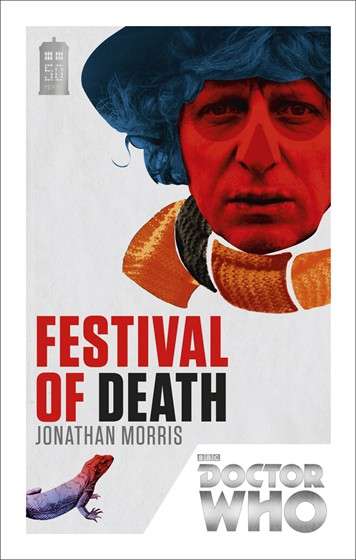


In his introduction to this reprint edition of Festival of Death, Jonathan Morris admits "a clear and obvious debt to the works of Douglas Adams"  This is a bit of an understatement.  Indeed, to say that Douglas Adams was an influence upon this book would be as great an understatement as saying that Matt Smith was an influence on the sales of bow-ties over the past three years.

There's several direct tributes to "The Guide", with a supporting cast that includes a suicidally depressed computer named Eric and a space-hippie lizard named Hoopy.  But do not make the mistake of thinking this book is a simple pastiche of the Adams' style, packed with in-jokes for the fanboys.  While Morris perfectly emulates the Adams style of humor he does it while tackling an original plot more complex than all five books in The Hitchhiker's Trilogy put together.

That being said, fans of Adams' work will notice a lot of the same themes dominate the plot of Festival of Death.  The plot centers around an Adamsesque concept - a theme-park ride through the afterlife.  As in most of Adams' fiction, the most dangerous villains are not the mad-scientists or the world-conquerors but the bureaucrats who destroy the universe a little at a time with every bad decision they make.  There's also the classic theme of technology not working properly and everything designed to be idiot-proof underestimating how very good idiots are at hastening entropy. 

Morris perfectly captures the characters from the show and fans will undoubtedly hear Tom Baker and Lalla Ward bickering in their head as the story progresses.  The plot is a complex affair and was something of an anomaly when this story was first published in 2000, with The Doctor rarely indulging in "Bill and Ted" antics such as deciding to go back in time after being captured to provide the means for his escape in the present.  Modern Doctor Who fans shouldn't have any trouble keeping up.  Indeed, this novel might be a good introduction to The Fourth Doctor for fans of the New Series who have yet to be exposed to the Classic Series. 

Bottom Line: If you're a fan of old Who, new Who, Douglas Adams, funny stories or stories involving Time Travel, you'll want to give Festival of Death a try.

Saturday, August 18, 2012

REVIEW: Doctor Who: Shada - The Lost Adventure by Douglas Adams


This is the story of Shada, perhaps the most remarkable, certainly the most reworked story ever to come out of the great mind of the late Douglas Adams. What makes Shada so remarkable (or infamous, as some would have it) is precisely how it has been adapted and readapted, often without the permission of the author and - in at least two cases - without his participation. This sort of thing is bound to happen when an author is deceased, although rumors persist that Douglas Adams may have had himself declared legally dead in order to stop his editors calling him about his deadlines.

The story of Shada centers upon The Doctor (currently in his Fourth incarnation, with the long scarf and big smile) and his companion Romana (currently in her Second incarnation, with the blonde hair and haughty aura) as they pay a visit to Professor Chronotis. A retired Time Lord who shared The Doctor's fascination with Earth, Chronotis took up a position as a professor at Cambridge, where presumably an absent-minded old man who horded books and rambled about impossible things would do well or, at the very least, not arouse suspicion.

But Chronotis has somehow aroused the suspicion of Skagra - a would-be tyrant who needs a special Time Lord book that is in the professor's possession. A book that has an odd effect on any equipment used to analyze it and the flow of time around it. A book that is now in the hands of graduate student Chris Parsons, who intends to use it to impress his crush,
Clare Keightley. A book that holds the secret to the mysterious Shada...

Originally scripted as an episode of Doctor Who, a technicians strike at the BBC left Shada largely unfilmed. Though he was largely critical of it at the time and expressed his relief that the episode would never be released, Adams apparently thought enough of Shada as a broad concept to rework the story into the first of his Dirk Gently mysteries. Since that time, Shada has seen life as a direct-to-video special (which Adams claimed to have been tricked into signing away permission for) and an Internet radio play, which was reworked into a story for The Eighth Doctor after Adams' death.

It is no small irony that the main plot of Shada involves the hunt for a book the sends its' reader's mind projecting through time and space. For in turning the first few pages of this book, I found myself transported back through time and space...


It's 1990, I'm 12 years old and taking my first tentative steps into browsing in the "grown-up" parts of the Taylor's Books in Lincoln Square. My mom might debate that, as I'm edging around the Science-Fiction and Fantasy section but she said she'd let me get whatever I wanted so long as it wasn't from the kids section and didn't have a half-naked amazon on the cover. Pressed for time, I decide to start at the beginning and grab the first thing that looks interesting. And that's when I see it.

The Hitchhiker's Guide To The Galaxy By Douglas Adams.

The cover with the green-round thing doesn't inspire confidence but the title is interesting so I flip it over to read the summary on the back. There isn't a summary but there are some names I recognize instantly. John Cleese. Eric Idle. Michael Palin. Terry Jones. Graham Chapman. All members of Monty Python's Flying Circus!

Naturally being 12 years old and a brazen smartarse, I think that Monty Python is the epitome of fine comedy and that anything five of them cared to crack-wise on the back cover of was bound to be something I'd enjoy. I opened the book and was grinning madly as Arthur Dent described how he found the order to demolish his house on display in a filing cabinet in a flooded basement bathroom with no power when my mom finally got tired of waiting and told me to come on.
..

Fans of Adams' work may find themselves similarly overwhelmed by nostalgia as they read this book. Gareth Roberts perfectly replicates Douglas Adams' style from page one onward. It is on the first page that Roberts describes Skagra - a severe and serious man who hordes his smiles as a miser does his coins. We are informed that Skagra came to the conclusion that there is no God at the age of five and that rather than feeling total despair or quiet relief, as most people who come to this conclusion do, Skagra thought "Hang about - that means there's a job opening."

With this first chapter, Roberts - himself a writer on Doctor Who - elevates himself far above the others who have tried (and failed) to write like Douglas Adams. The book largely follows Adams' original scripts and dialogue with Roberts' contributions blended into the narrative seamlessly. Roberts' contributions to the actual story are minimal, primarily concerned with tying the story more strongly into the continuity of the television show, adding in a few references to both the classic and modern Doctor Who series. Roberts also addresses some questions left open in the original script, such as who Skagra is, how Skagra seems to know so much about the Time Lord's history as well as why (apart from sheer stubbornness or paranoia) The Doctor doesn't call The Time Lords for assistance given the threat Skagra poses.

Generally speaking, I'm against one author attempting to ape another author's style or playing with their toys, as it were. I was therefore pleasantly surprised by how well this novel adaptation turned out. This is the closest thing we shall ever have to a new Douglas Adams novel in this world. I would recommend it highly to any fan of Doctor Who, Douglas Adams or science-fiction in general.