Showing posts with label Daniel Acuna. Show all posts

Friday, November 20, 2015

Sam Wilson: Captain America #3 - A Review

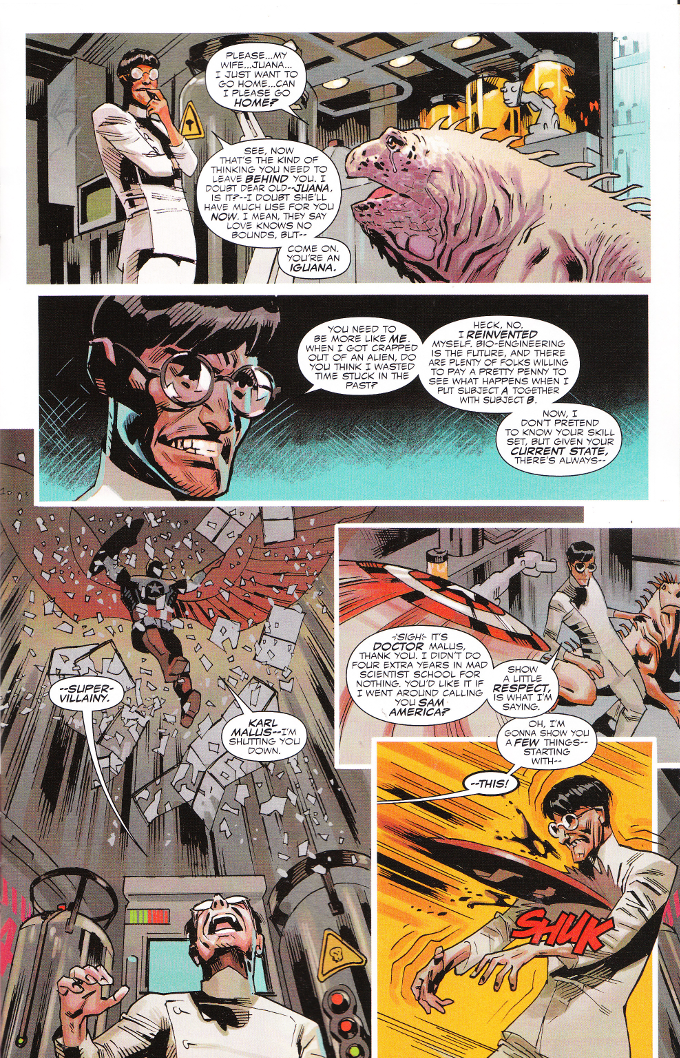
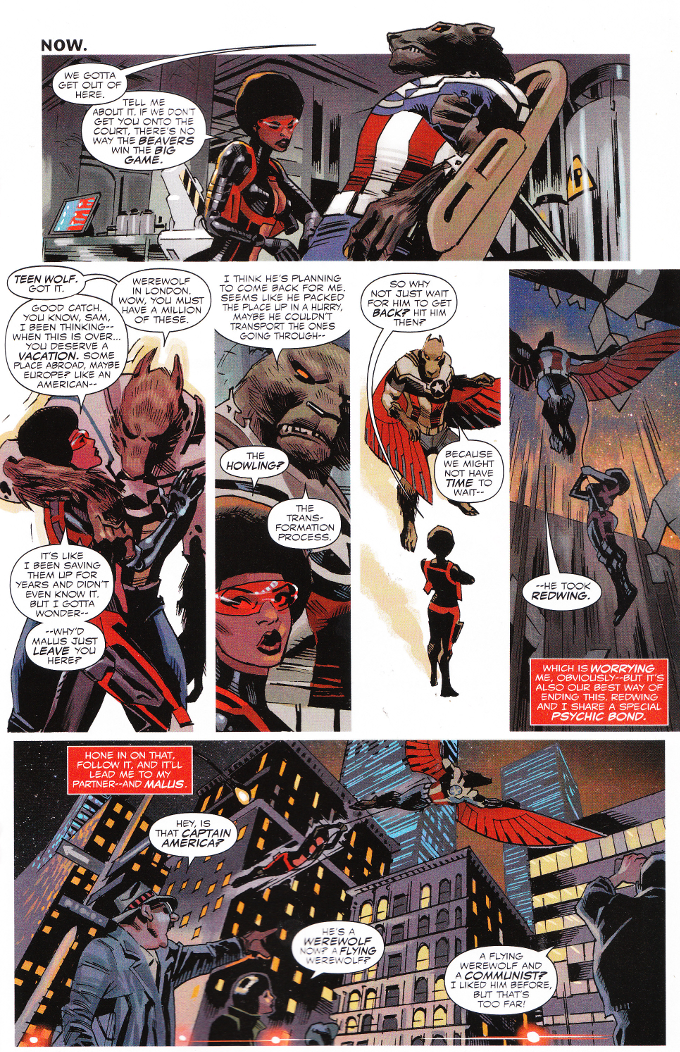
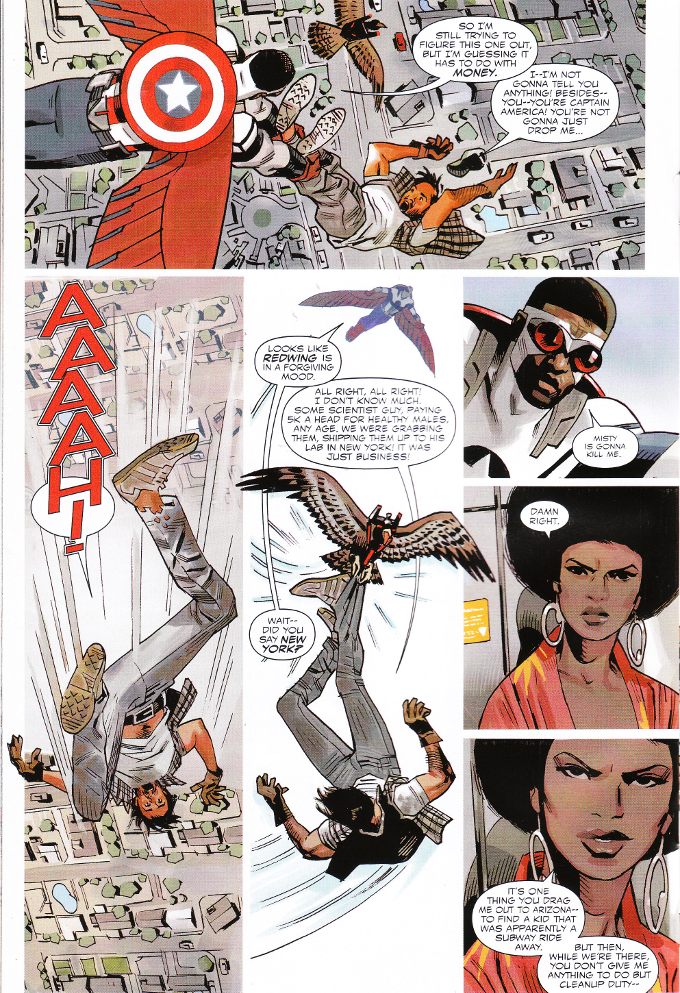
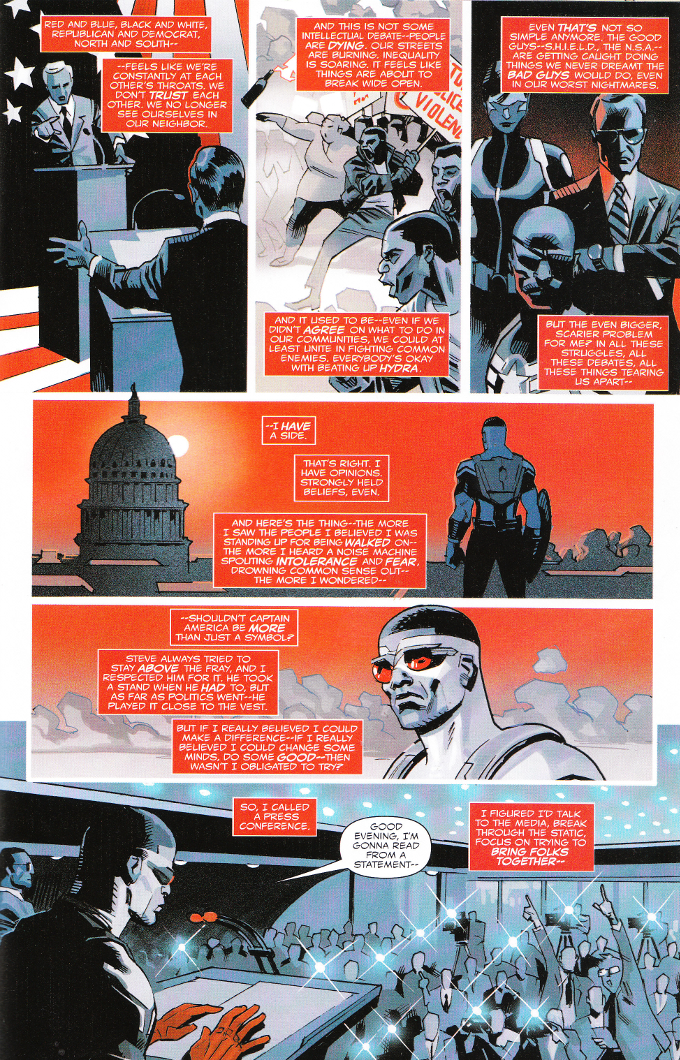
Captain America is on the trail of Dr. Malus - one of many mad scientists using captured refugees fleeing to America as test subjects for their twisted experiments! But Malus is cannier than most and had a trap set for any heroes who came after him. Now Sam Wilson has become another of the bad doctor's experiments... and The Cap-Wolf has returned!

After two mostly serious issues dealing with current events, Nick Spencer delivers a story more in line with his usual comedic flair. Spencer revels in the lunacy of the Marvel Universe like few other writers and the humor takes center-stage this time around. After all, if you can't laugh at a flying werewolf Captain America, what can you laugh at?

Daniel Acuna does his usual fantastic job on the artwork, with an assist from Mike Choi this time around. Acuna's style is well suited to the stories Spencer crafts, being gritty and rough in design yet brightly colored.  Symbolically, it's as if the hope and idealism of America is shining through into the dark world that Sam Wilson inhabits.

Saturday, October 31, 2015

Sam Wilson: Captain America #2 - A Review

Sam Wilson's never been one to turn away from a fight but he may be taking on more than he can handle as the new Captain America. From publicly opposing SHIELD's reported plan to use Cosmic Cube fragments to secretly alter reality to protecting illegal immigrants from human traffickers, Sam's been stirring up controversy in the press with his every action. But when he backs the work of a secretive whistle-blower known as The Whisperer, Sam will find himself fighting the man he respects most in the world - Steve Rogers!


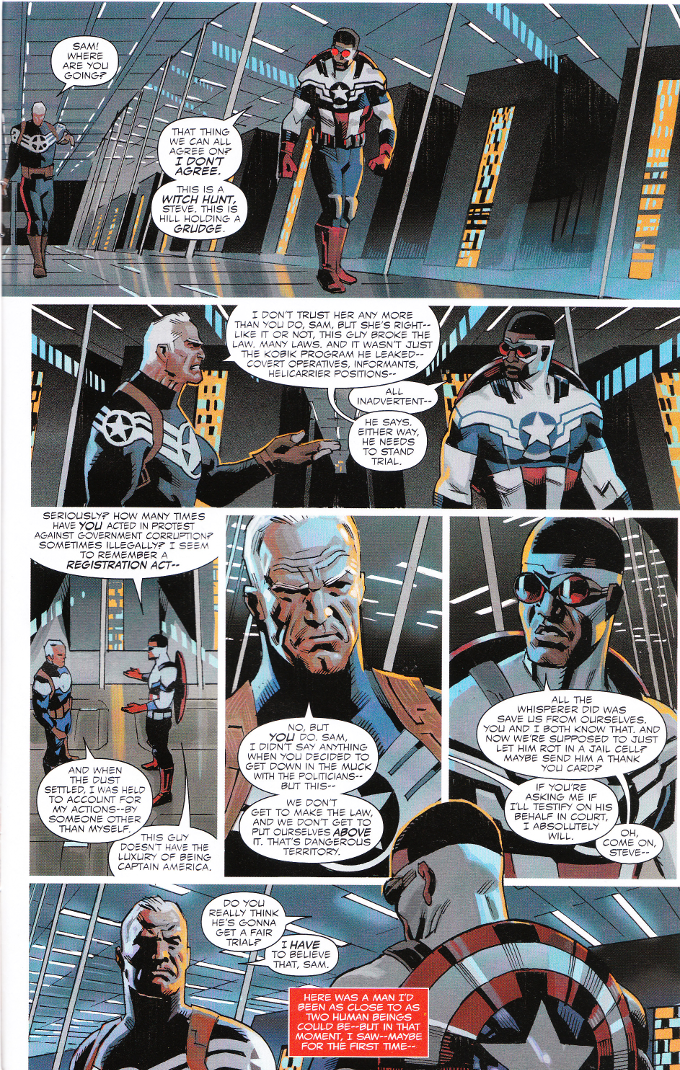
You can say this for Nick Spencer - he is not one to shy away from controversy. Though his script is filled with metaphorically equivalencies, his real-world targets are clear. To Spencer's credit, he does not stand upon a soapbox but does allow for some reasoned discussion of differing viewpoints. Of particular note is the discussion between Sam and Steve Rogers, where Sam argues that sometimes you have to work outside the system to do the right thing while Steve argues that one still has to be held accountable to the laws regarding exposing corruption within a system.


Whatever your opinions on the story itself or the politics involved, it cannot be denied that the artwork is top-notch. Daniel Acuna draws some powerful figures. And his colors, mostly a variety of reds, white and blues, subtly reinforce the visual theme of the series.

Sunday, October 25, 2015

Sam Wilson: Captain America #1 - A Review

Confession time, kids. I've never been a big Captain America fan.

I don't dislike Captain America. I just never really connected with Steve Rogers the same way I did Peter Parker or Dick Grayson. I preferred heroes I could relate to rather than ideals to live up to.

As such, the new Sam Wilson: Captain America title didn't hold much interest for me. Most of the Marvel Now! campaign has left me cold and the idea of Sam Wilson taking up Steve Rogers' shield just seemed like a cheap publicity stunt. It was the sort of event that would be quickly ended as soon as the next Captain America movie hit the big-screen.

Then the controversy started. And various media outlets began waxing wroth about this book. And it wasn't because of a black man bearing Captain America's shield.

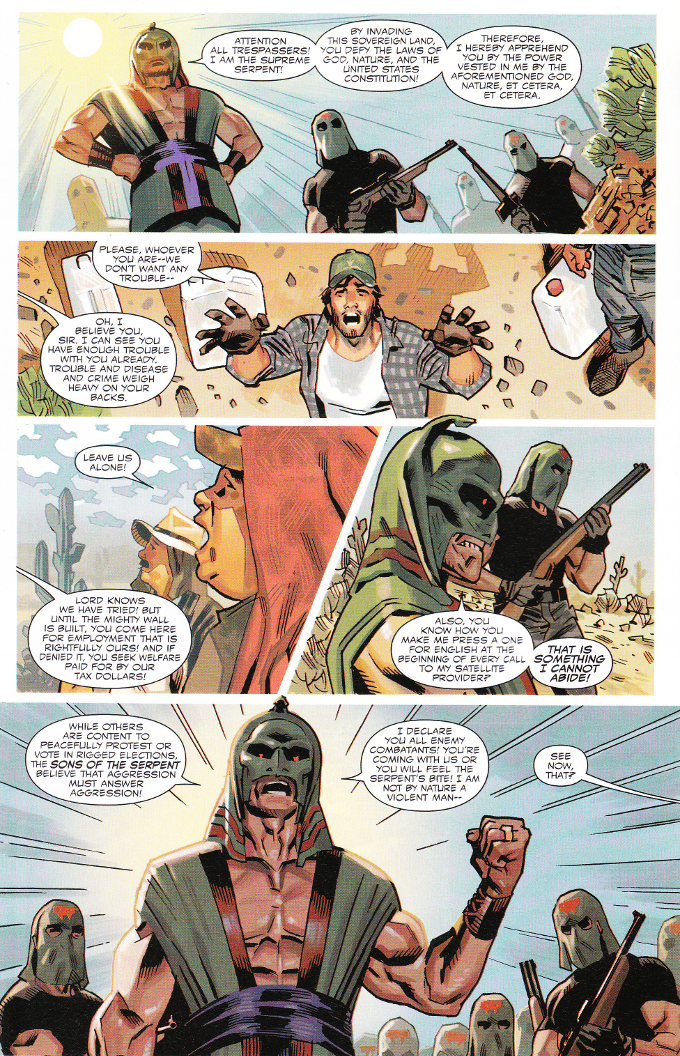
No, it was because this Captain America marched in a gay pride parade. And sympathized with the Black Lives Matter movement. And dared to stand against a white-supremacist group that was killing people they suspected of being illegal immigrants along the United States' southern border.


This is hilarious to me on multiple levels. Any reputable scholar of American comic book history can tell you that Captain America's origins are steeped in New Deal liberalism. Steve Rogers was the original social justice warrior, punching Nazis not because they were enemies of America but because they were enemies of everything America stood for - Freedom, Equality and Justice.

Here's a fun fact - the famous cover of Captain America #1 where Steve Rogers is punching Hitler? That came out a year before the USA joined World War II. Joe Simon and Jack Kirby got death threats from conservative groups such as The German-American Bund because of it. In fact, the Timely Comics offices received so many bomb threats that New York City Mayor Fiorello La Guardia saw fit to give Captain America's creators round-the-clock police protection.

So if anyone tells you that Captain America has always been a proponent of conservative values - at least what we define today as conservative values - they're ignorant at best and disingenuous at worse. Yes, Captain America always tried to uphold the Law of the Land. But when the law conflicted with the ideals America stood for, Captain America always backed the ideal. And it's hard to believe that anyone could defend the actions of The Sons Of The Serpent in this issue - threatening unarmed civilians with torture and death - as being in line with any system of morality worthy of consideration.

Politics aside, this is a damn good comic.  Nick Spencer's script quickly establishes the new status quo for Captain America, who is now free of SHIELD and free of direct government influence over his actions. Daniel Acuna is a fantastic visual storyteller and the action of the story flows naturally from panel to panel.

I'm not sure if I'll keep picking this book up. I'm still not that big of a Captain America fan. But this issue did make me think and lead me to a greater appreciation of what the character and The American Dream means. And that's something I can't say about a lot of modern comics.

Thursday, October 18, 2012

X-Men: Schism - A No Flying, No Tights Review

SOURCE: X-Men: Schism
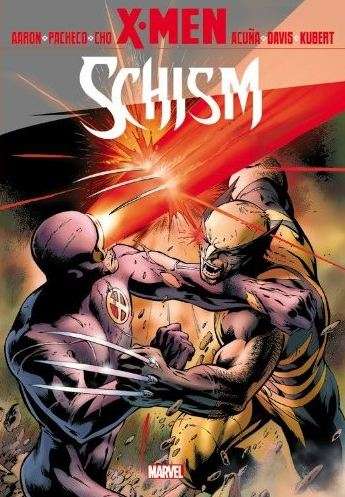


Mutants – those beings born with natural super powers – once represented the future of humanity. But as a wise man once said, “the future isn’t what it used to be,” and various circumstances have reduced the number of mutants world-wide to just about 200. Most of them now live on an artificial island dubbed Utopia, located just off the coast of San Francisco. With Mutantkind in such dire straits, their de facto leader, Scott Summers (a.k.a. the X-Men leader Cyclops), intends to go before the United Nations and ask for the recognition of Utopia as a peaceful nation. More, he plans to ask for the destruction of any weapons technology that specifically targets mutants.

An attack on the UN by a telepathic mutant terrorist leaves the rest of the world largely unsympathetic and leads to a run on the sale of Sentinels, the robotic assassins built exclusively to hunt and kill mutants. This is all according to the machinations of Kade Kilgore, a young munitions magnate and owner of most of the world’s remaining Sentinels. As Kilgore’s plans develop, the X-Men find themselves stretched increasingly thin trying to protect a world that hates and fears them from an army of malfunctioning Sentinels. And as the threat of total destruction builds and Cyclops forces more and more young mutants into battle, Wolverine will find himself taking a stand against his leader and starting a fight for the future of Mutantkind.

I’ve never been a big X-Men fan. In fact, it would be fair to say that I believe that X-Men comics in general are the epitome of everything that is wrong with American superhero comics. The storylines are dominated by characters who had far more thought put into their powers than their personalities. You need to read more than a doctoral student working on her thesis to have even a basic grasp of the continuity. And on the rare occasions a creator tries to do something unusual or thoughtful with the concept (I’m thinking Grant Morrison’s New X-Men or Joss Whedon’s Astonishing X-Men), the fandom revolts and demands more of the same epic storylines where Everything Changes Forever.

X-Men: Schism is guilty of all of these generalizations. And yet, I found myself enjoying it anyway. The story Jason Aaron tells here is remarkably accessible, despite being mired in some complex continuity. While most of the supporting cast doesn’t get much definition and there are a few bits where only long-time X-Fans will get the joke, the action flows well and Aaron takes the time to show off the hidden paternal side of the team badass, Wolverine. Indeed, some of the best scenes in this story involve Wolverine and his efforts to try and give some sense of normalcy to the life of a 14-year-old girl who considers herself a monster because of her powers.

While the script flows well enough, the art doesn’t always aid the story. Each of the five chapters of X-Men: Schism is drawn by a different artist, each of them possessing a completely different style. They are all good artists, but the differences seem jarring at times as the story transitions from one scene to another.

Kieron Gillen, who wrote the final issue in this TP collection, fares somewhat better in his story, detailing how the two factions of mutants are formed in the wake of the titular schism. There are a lot of effective character moments here and some good humor. Sadly, the artistic metaphor of the B-story of this chapter – an odd sequence depicting the various X-Men as a tribe of cavemen rallying around two of their fellows battling for supremacy – seems to be less about tribalism as a metaphor for the current state of the Mutant population taking sides with either Cyclops or Wolverine and more about giving artist Billy Tan a chance to draw the X-Men as fur-clad barbarians.

Despite this tiny bit of fan service and the general sense that we’ve seen a lot of this story before in various pieces (Wolverine bonds with a troubled teenage girl, Wolverine fighting Cyclops, the return of The Sentinels, etc.), I’d still recommend this book. It isn’t the greatest X-Men story ever written, but it is a must-read for those who wish to know the current status quo of the team. It is good for what it is, a well-paced action flick on paper.

X-Men: Schism
by Jason Aaron and Kieron Gillen
Art by Carlos Pacheco, Frank Cho, Daniel Acuna, Alan Davis, Adam Kubert and Billy Tan
ISBN: 9780785156680
Marvel Comics, 2012
Publisher Age Rating: T (13 and Up)