Showing posts with label Andres Guinaldo. Show all posts

Monday, July 1, 2013

Justice League Of America #4 & #5 - A Review

WARNING: SPOILER HEAVY REVIEW.


I resisted reviewing Justice League of America #4 last month, during the height of some rather heated discussion during a major controversy.  The subject of "fridging" (i.e. killing off, depowering or otherwise causing bad things to happen to a female character purely to create drama for a male character) had come up and this time the victim was Catwoman - apparently killed in action as she was infiltrating the hideout of the Secret Society of Super-Villains.  I say apparently because I suspected from the start that the death would be some kind of fake-out. 

Why?  Well, I couldn't discuss the clues without spoiling the whole story but there was some cynicism at play as well.  You can't kill off a major character well-known to the public without the comic publisher releasing a press release these days and Catwoman's "death" took everyone completely off-guard.  If they were really going to kill off Selina Kyle, they would have made a bigger deal about it.

I was also reluctant to review the book because I disagreed with discussing the "death" and labeling it as a fridging, because the larger part of the issue lacked the unsubtle sexism that lies at the heart of every fridging I've ever seen.  For the majority of the issue, I thought Catwoman was portrayed as the adaptable badass she should be.  She was able to free herself from captivity easily enough and was continuing her mission without needing to be rescued by the team that was coming in after her.  She even took down one super-villain by herself before superior numbers proved her undoing.
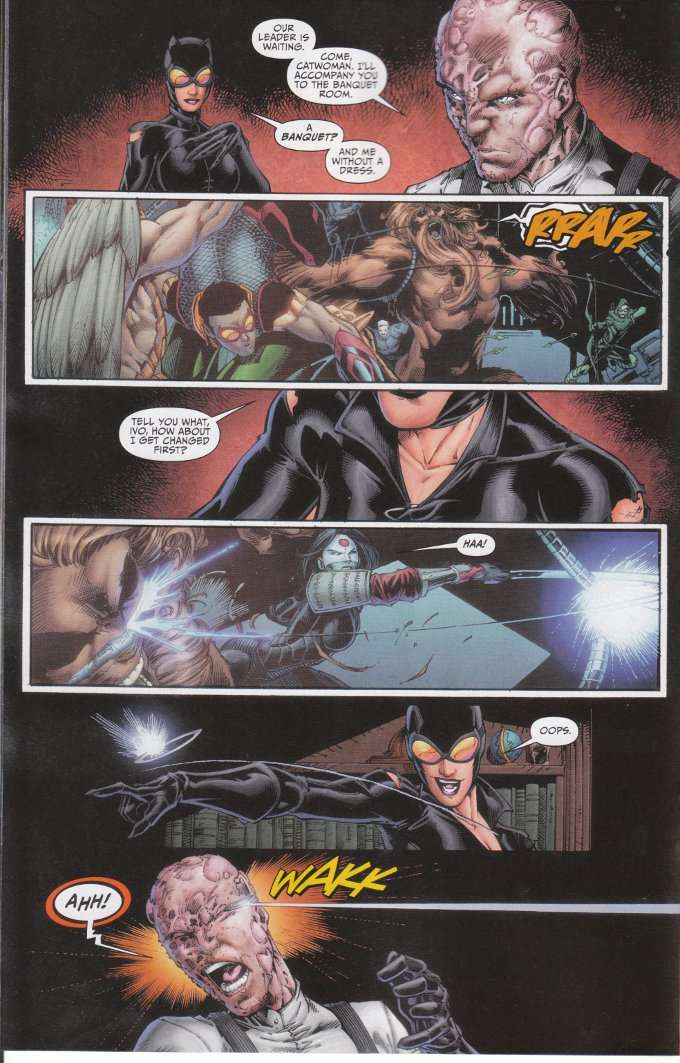

After being captured, Catwoman tried to play off of the fears of her captors, knowing as well as Batman that criminals are a superstitious, cowardly lot.   She said that killing her would only bring Batman down upon them like a ton of bricks.  To her surprise, this gamble achieved the opposite of what she wanted..  The leader of the villains said that getting Batman's attention was their entire goal just before shooting Catwoman in the head.

I didn't consider this scene to be a fridging by the technical definition.  While the bad guys said that killing her was a means toward creating drama for a male character (i.e. kill her to make Batman angry) they had just as much reason to kill Catwoman for what she had done and what she had seen as a result of her actions throughout the issue.  Annoying Batman was just a bonus.  

Now, I DID find the artwork and layout of the scene to be incredibly exploitative.  The final shot of a dead Selina was particularly disturbing, being almost fetishistic in how it was drawn by artist Brett Booth. And yet, I resisted writing a review and condemning the book on that point because it didn't add up.  I couldn't believe that Geoff Johns - who is usually so good about avoiding this sort of thing in his writing - would allow the fridging of a major heroine this early in a major storyline.  Particularly given that another major subplot of Justice League of America #4 involved Stargirl's rebelling against her assigned role as the team's poster-girl/spokesperson and sneaking along on an actual combat mission.


As you can see from the above scan, Justice League of America #5 rewarded my faith.  Stargirl kicks major ass and proves her worth to the team beyond Public Relations.  And I shan't spoil how but rest assured that Catwoman is alive and kicking and the rumors of her death have been greatly exaggerated.  I'm still not too crazy about how the fake-out was milked but I must admit some honest surprise at the resolution, despite some foreshadowing that was obvious in retrospect.      
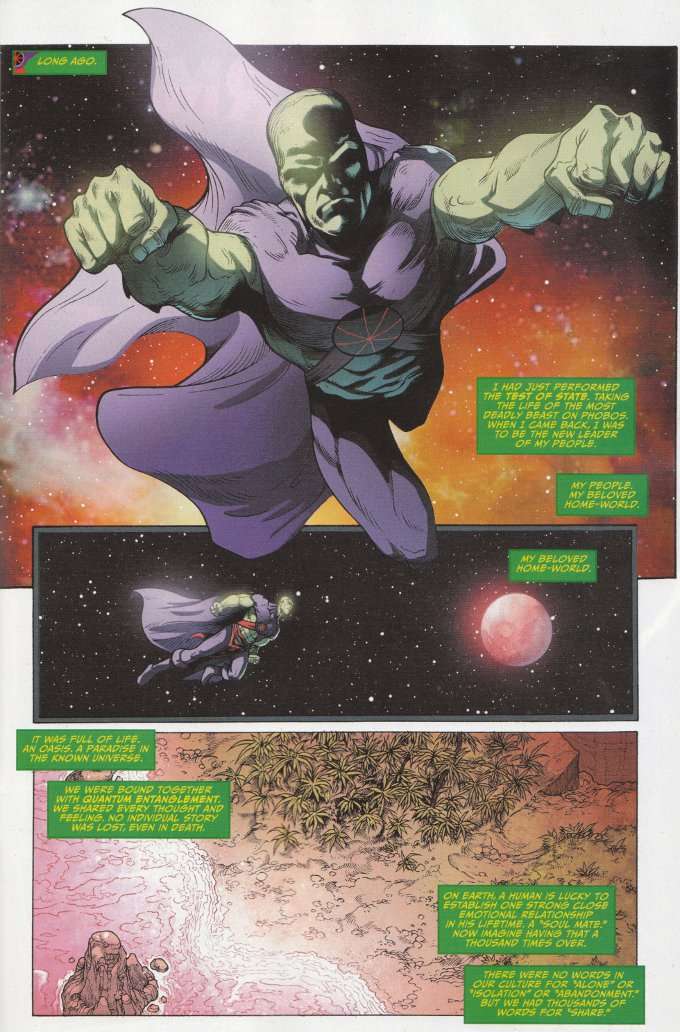

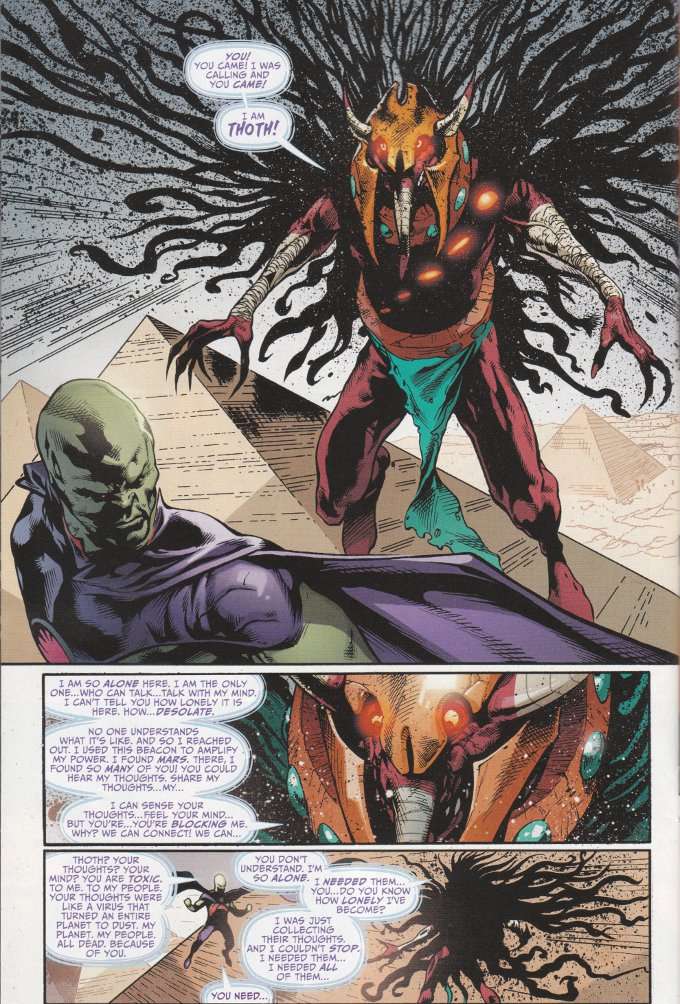
The back-up story by Matt Kindt, focusing upon the origins of The Martian Manhunter is impressive as well.  Kindt has revamped the origin somewhat, changing the specific cause of death for the entire Martian race and giving The Martian Manhunter a new means of traveling to Earth.  Issue #4 gives us a look at a Martian culture that is truly alien yet instantly recognizable and sympathetic once it is lost.  Issue #5 has him following the trail of the killer to Earth and discovering a malevolent telepath who may prove to be his greatest enemy ever.  Issue #4 and Issue #5 have different art teams, but they're both top-notch and incredibly good.


Bottom Line: If you were scared away from Justice League of America because of any fears of sexism, I'd say you should give it a shot.  I'm not happy about how the otherwise skillful Brett Booth laid out the aforementioned scene but otherwise I found his art to be quite good.  Apart from that one Trigger-Warning worth scene, there's nothing objectionable in this book and between Stargirl, Catwoman, Katana and Amanda Waller there's a lot for lovers of strong female characters to enjoy.  Now, if only it had Black Canary too...

Monday, May 27, 2013

Justice League #20 - A Review

 Justice League #20 is something of a mess, in terms of both story and artwork.  Reportedly, the main story was laid out by one man and then illustrated by three different pencilers and three different inkers.  Art by committee works even less often than writing by committee and it really doesn't work here.  Even accounting for the differing styles at work, everything looks horribly uneven.


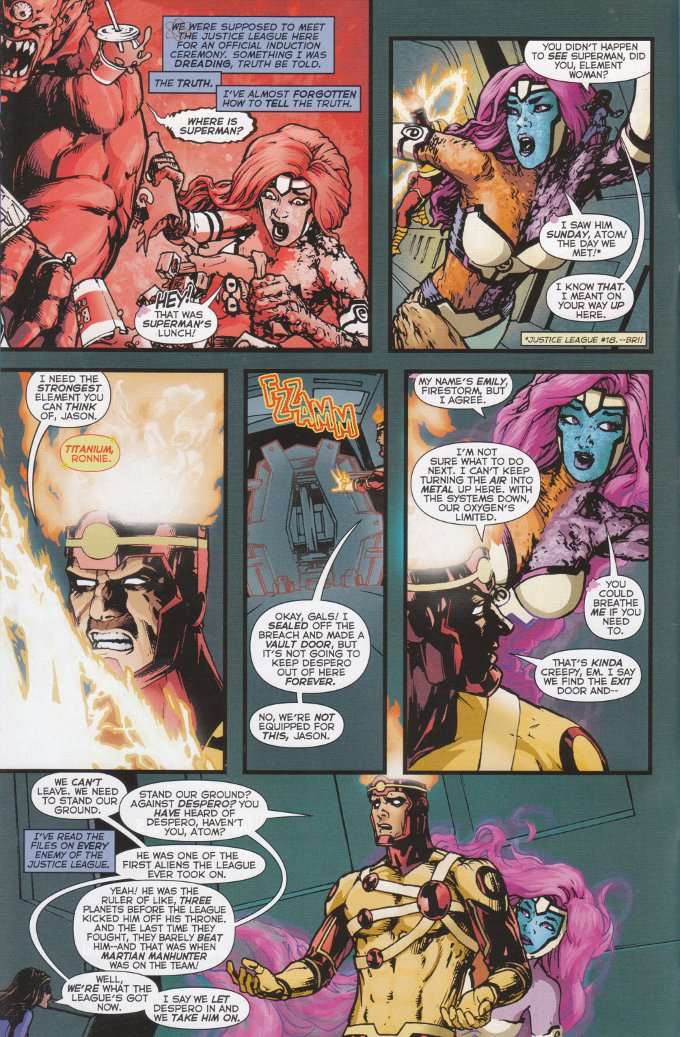
The story by Geoff Johns, focusing primarily upon the newest members of The Justice League as they fight the telepathic powerhouse Despero, isn't much better.  Johns does his best but the underdogs fighting outside of their weight class story has been done to death.  Not helping matters is that much of the "charm" of this issue depends upon your enjoyment of the flighty bimbo that is Element Woman or the continual squabbling of the two teenagers who make up Firestorm.  And given that Fury of Firestorm was cancelled this month, it appears that the vast majority of comics fandom find the antics of Ronnie Raymond as tiresome as I did when they played this exact same conflict out during Brightest Day. 

There's only two things that save this comic at all.  The first is the Shazam back-up story, which finally seems to be gaining some legs or maybe I'm just viewing it more sympathetically now that Billy Batson is beginning to act like the hero he should be.  The other bright side in all this is a scene involving several of the Justice League founders and Superman having a talk with Batman about his creation of protocols to take down every other member of the Justice League... including himself. 


This book seriously needs one artist, one inker and one person deciding its' look.  The multiple teams working on the main story this time around do not work well together.  And Johns would do better to develop his new characters alongside the established crew for a time rather than throwing them all into a spotlight that none of them deserve yet. 

Thursday, May 31, 2012

Resurrection Man #7-9 - A Review

As I noted before, the original Resurrection Man title was one of the great lost treasures of late 90s DC Comics and the current series, through the first six issues at least, was proving to be a worthy successor to that legacy.  No small surprise given that the new series was written by the same creative duo as before - authors Dan Abnett and Andy Lanning.  Have the issues since then continued the trend of excellence?  For the most part, yes.


 Issue #7, much like Issue #6, is a perfect jumping on point for new readers.  The opening pages not only establish the setting but also explain Mitch Shelley's circumstances and powers. In brief, Shelley is amnesic and remembers very little of his life.  What little he has started to remember suggests he wasn't a very nice person. In addition to his inability to die permanently and his ability to be reborn with a new superpower every time he does die,  Mitch Shelley has also developed a sixth-sense that seems to be guiding him to places where a hero is needed .  In this case, the sense has guided him to Metropolis, where he quickly finds himself stuck in a fire-fight between a MPD SWAT team and Intergang - an organized criminal group who use advanced technology in their crimes.


You couldn't ask for a better one-shot superhero story than this issue.  Abnett and Lanning quickly establish Mitch as a likeable protagonist and a man of principle. Despite his confusion over his past and his desire to get back his life, Mitch is equally determined to be a good man in his new life no matter what he might have been in the past. 

The artwork by Fernando Dagnino matches the story thematically.  Mitch's world is a dark one and the artwork reflects this.  Dagnino's pencils offer many fine details that are brought into sharp relief by the shadowy inks, while still being somewhat obscured in darkness, like Mitch Shelley's memories.


Issue #8 is another good jumping-on issue, with the opening once again reiterating Mitch's amnesia, his powers and his desire to find out who he was and how he became what he is.  The action centers upon two new players - a necromancer/bounty hunter called The Butcher and a clairvoyant detective named Kim Rebecki.  Both of them seek Mitch Shelley, having been apparently hired by separate parties for differing ends.  By issue's end, Mitch has almost formed an uneasy alliance with Rebecki, who seems to know more of Mitch's past than he does.and has come to the conclusion that he isn't the man he once was.


The quality dips a little bit with Issue #9, in which the Body Doubles catch up with Mitch shortly after he is brought down by The Suicide Squad and hilarity ensues.  While Abnett and Lanning's script is strong as ever, the narrative flow is ultimately ruined by the artwork provided by two pencilers and three inkers.- all of whom have completely different and conflicting styles.  Of the two guest artists, Jesus Saiz is by far the least offensive.  His pencils aren't bad but the heavy inks used on his pages do not do his particular style any justice.


More problematic is Andres Guinaldo's pencils, which are under-inked to the point of sketchiness at times.  What is more maddening is that the colorist (surprisingly, there is only one) seems unable to decide on a consistent skin-tone for Kim Rebecki from page to page.  What is worse, he's elected to depict Amanda Waller with a shade of skin that is more orange than brown.  Perhaps, not having read the new Suicide Squad book since the first issue, I have missed out on something?  Did Amanda Waller have some sort of accident with a Cheeto-bomb?  Or was she perhaps bitten by a vampire carrot?   I want to know!

 
In the end, Resurrection Man is still one of the best books DC Comics has to offer.  It is much better when it is depicted a single artist but even the worst issue of this series has proven to be better than most.  Highly recommended.  Pick up Issue #7 or #8 if you want a good place to jump in.