Showing posts with label Luke Lieberman. Show all posts

Wednesday, July 15, 2015

Red Sonja #1973 - A Review

Anthology comics are usually mixed blessings and Red Sonja #1973 proves no exception. Thankfully, this volume is more good than bad.  In fact, it's far better than most! But where this collection fails to please, it fails spectacularly.


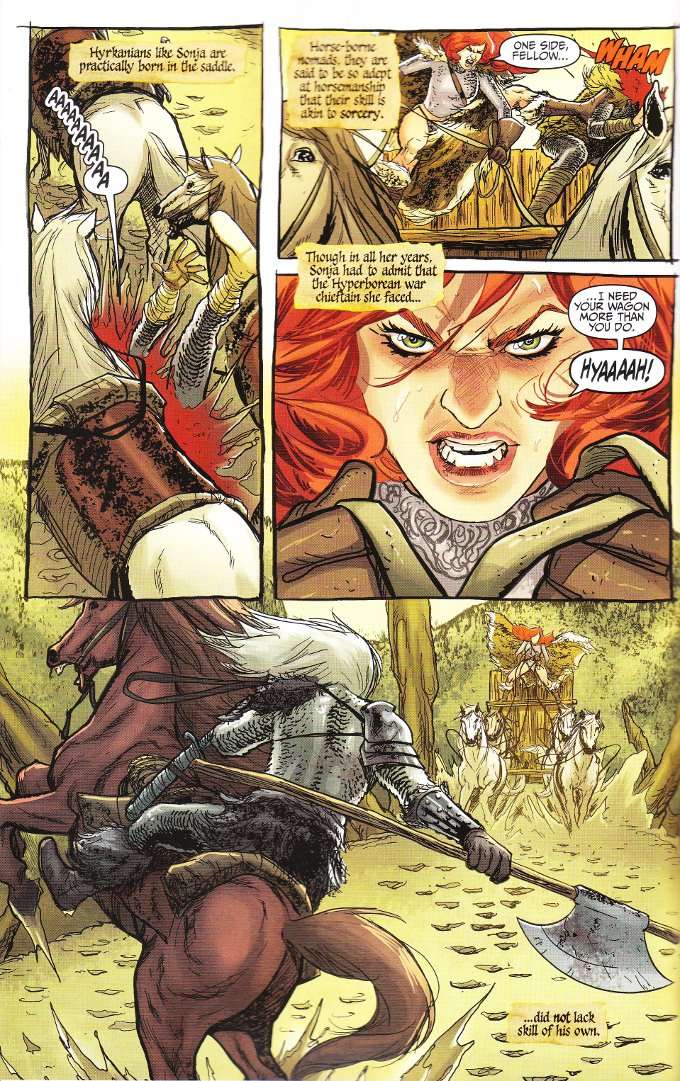
The first story - The Raiding Party - is a fairly straight-forward tale by former Red Sonja writer Eric Trautmann.  More than any other modern writer, Trautmann delved into the rich history and mythology of Robert E. Howard's Hyboria, filling his tales of Red Sonja with well-researched references to the original countries and peoples of Howard's fantasy world. But worry not, new readers!  This tale of Sonja raiding the raiders is easily accessible to everyone and a damn fine ripping yarn, with amazing artwork by Ivan Rodriguez and Marcio Menyz.
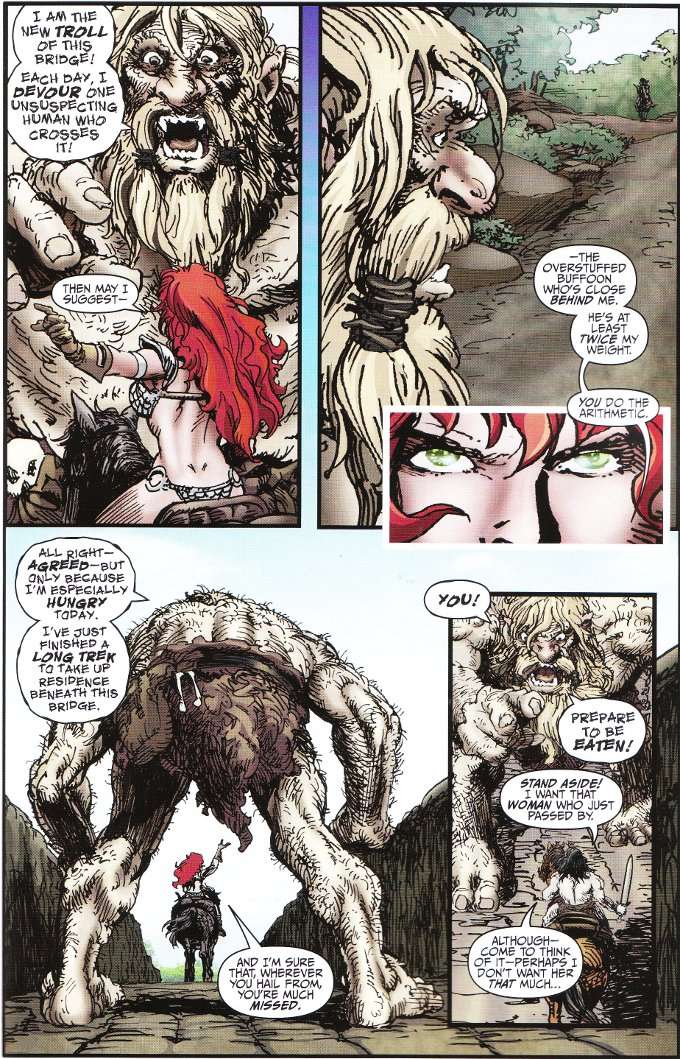


The second tale - For Whom The Bell Trolls - proves that Roy Thomas still has it some forty-plus years after he first adapted the character of Red Sonya for his Conan comic. As is his habit, Thomas has put a twist on another classic tale in spinning his own story, with Sonja performing her own more action-packed version of The Three Billy Goats Gruff. Rich Buckler does a fine job illustrating this tale, though the colors by Arison Aguiar seem oddly muted apart from the red of Sonja's hair.


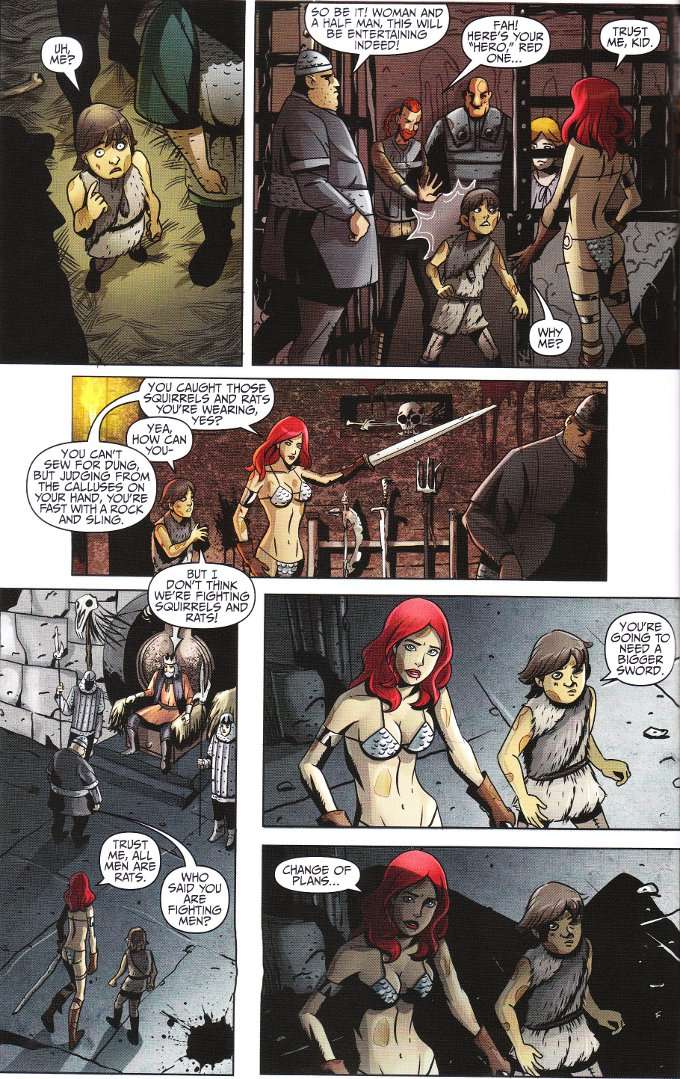
The third tale - Simple Life - was also colored by Aguiar and has similar troubles, with all the characters being so pale that an elderly peasant's white hair is the same color as his skin! Despite this, the art by Rod Rodolfo is vividly detailed. And the story - centering around Sonja being taken in by a farming family shortly after killing the bandits who killed her own family - is probably the best Luke Lieberman has ever written, pitting Sonja against a would-be adventurer who has everything Sonja has lost and little appreciation of it.
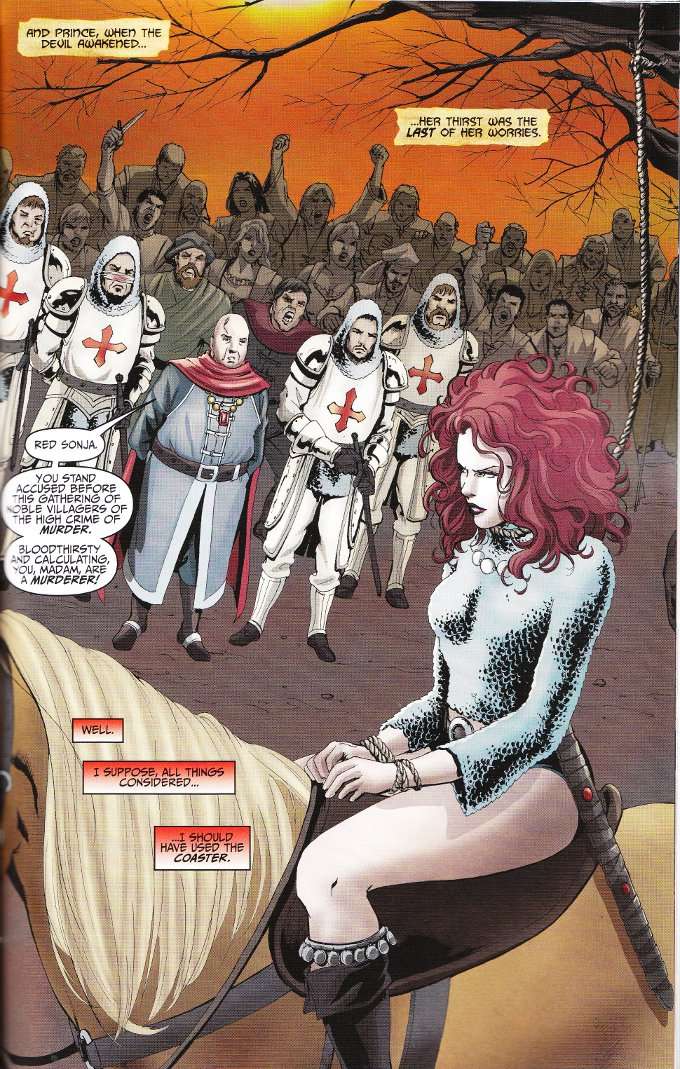

Gail Simone's The Hanging Tree proves a welcome comedic palate cleanser after the earlier action-centered stories. Here we find Sonja on trial for her life, showing her wit and humor as she struggles to prove her innocence on charges of murder. The story is an enjoyable one and the artwork by Kewbar Baal is amazing. There is one oddity - for some reason Sonja speaks of herself in the third person throughout, like Sheena in the old Irish McCalla TV show.
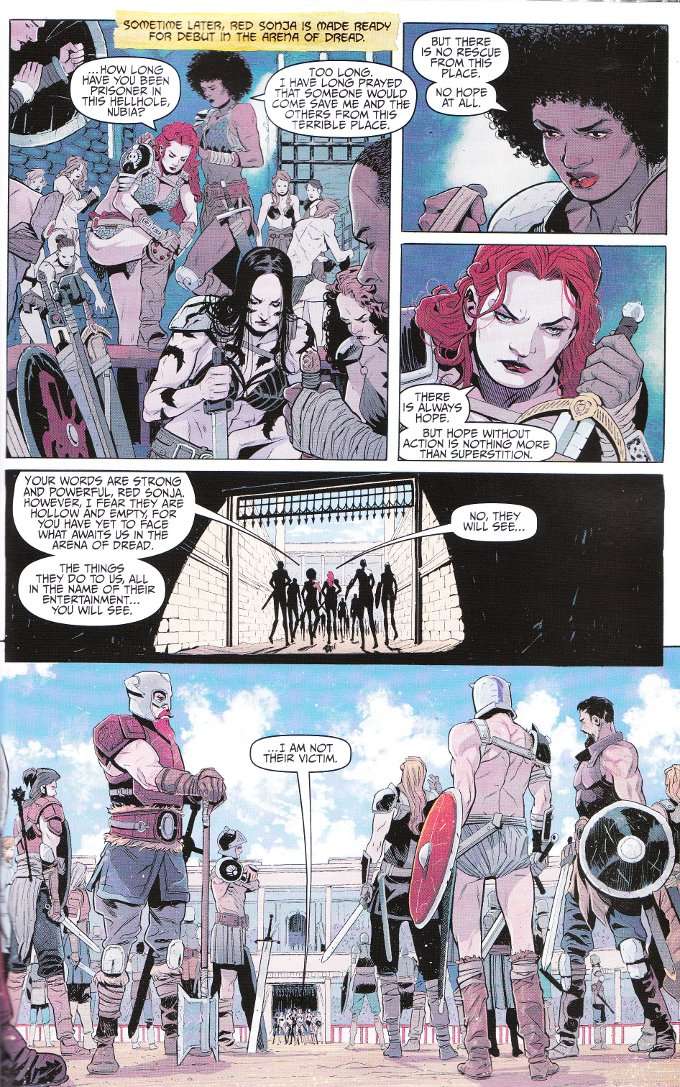

The penultimate chapter is undoubtedly the weakest and the fault of that lies entirely with writer David Walker. The Arena Of Dread (a.k.a. Red Sonja & The Nubile Barbarians) is little more than a brazen rip-off of the Roger Corman "classic" The Arena (a.k.a. Naked Warriors), with an enslaved Red Sonja thrown into the arena alongside a Pam Grier look-alike named Nubia. There's other women warriors as well, but none of the other titular Nubile Barbarians are give names or lines. This negates any positive message that may come of Sonja's efforts to teach these warrior women (who already know how to fight and were apparently condemned to the arena for resisting rape) that there is "more to life than being made to serve the whims of any man." Perhaps this is meant to be satirical but if that's the case it comes off as one of the stories it is meant to mock rather than a parody.

There is little good I can say about a story where the main villain is named Lord Sadisto and an entire scene is devoted toward "preparing" enslaved women, with particular attention being paid to seeing unsightly hair removed. Thankfully, artist Bilquis Evely takes the high road in depicting these scenes. While Walker's script is pure exploitation, Evely's artwork treats Sonja and the other women with respect and depicts them as powerful women rather than sexual objects. Hopefully we'll see Evely at work on another Red Sonja book someday, but not the return of Red Sonja and the Nubile Barbarians threatened on the final page.
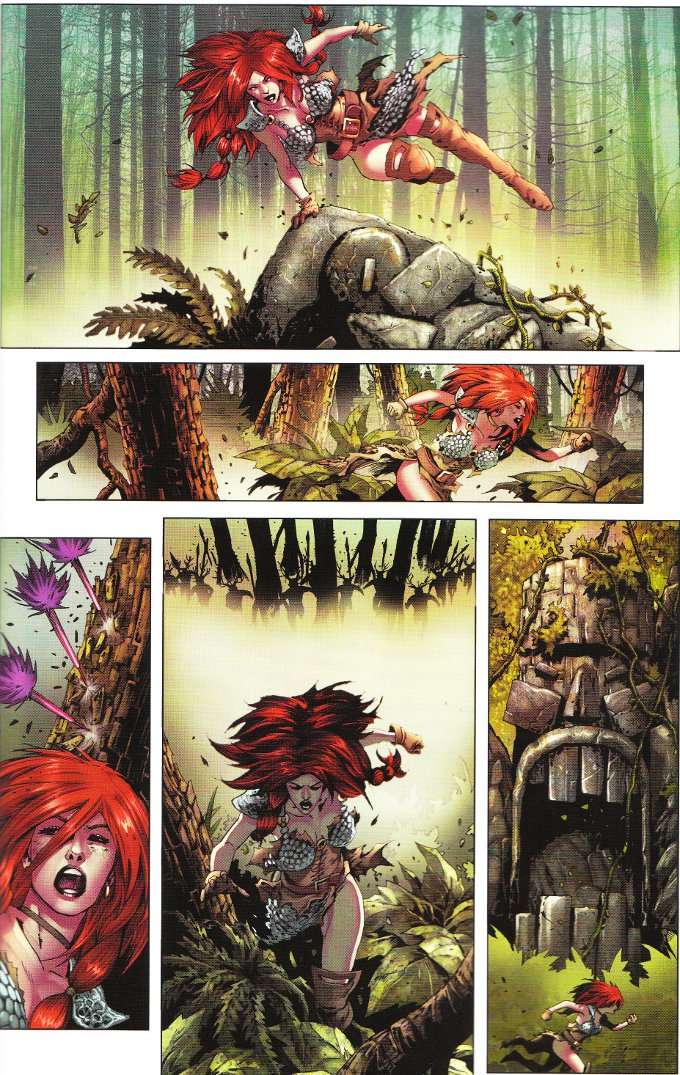

The last chapter, Silent Running, is less a tale and more an extended montage of scenes of Red Sonja dealing with various threats - either running into battle or running from threats like falling boulders or poisoned darts. The first Red Sonja story written by Cullen Bunn, it is ably illustrated by Jonathan Lau with colors by Ivan Nunes. It's enjoyable for what it is, though it's no sprawling epic.

All in all, Red Sonja #1973 is a veritable bargain. Six stories for $7.99 is a pretty good deal, even if one of them is best looked at and not read if you can avoid it. The other five stories, however, make this book well worth the reading.

Saturday, June 6, 2015

Red Sonja: Vulture's Circle #5 - A Review

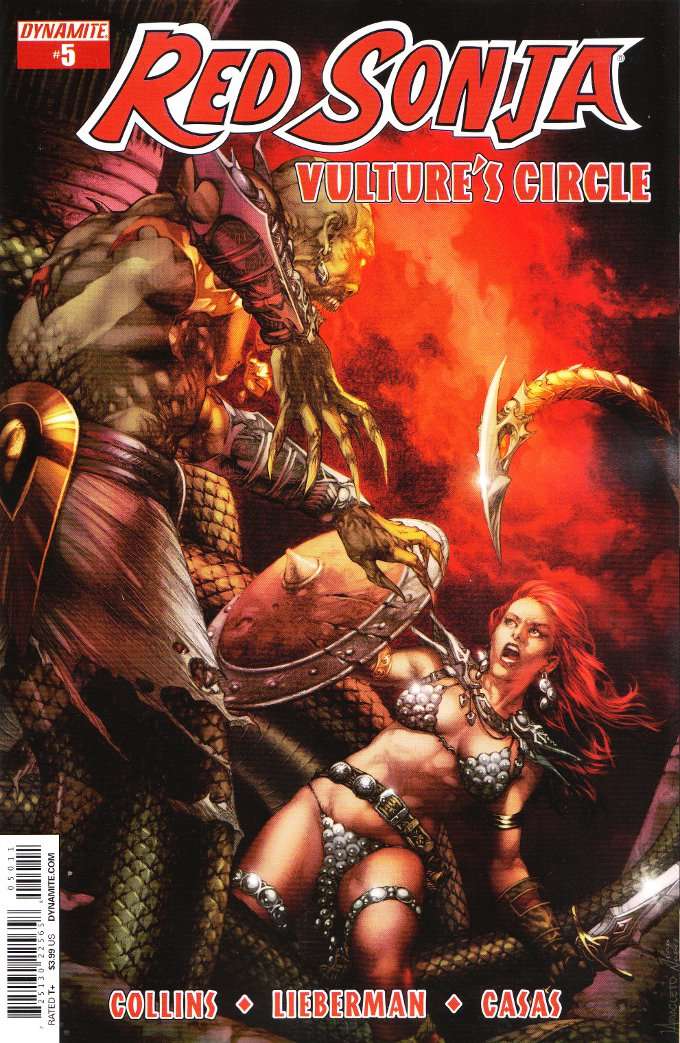
In my review of Red Sonja: Vulture's Circle #4 , I said I was done with this series. Ultimately, I decided to go ahead and pick up the conclusion. Not out of some blind hope that it might somehow make-up for old mistakes in the final chapter but because the cover art was amazing.


That's about the only nice thing I can say about this book, apart from the color art by Adriano Augusto being good.  The story is still a mess, with Red Sonja herself replaced by a blood-thirsty avatar of her goddess. The artwork is unintentionally hilarious, with Fritz Casas unable to agree upon Sonja's figure from panel to panel, drawing a voluptuous valkyrie and an emaciated waif with visible ribs in the next. And the action scenes are cluttered and difficult to follow.

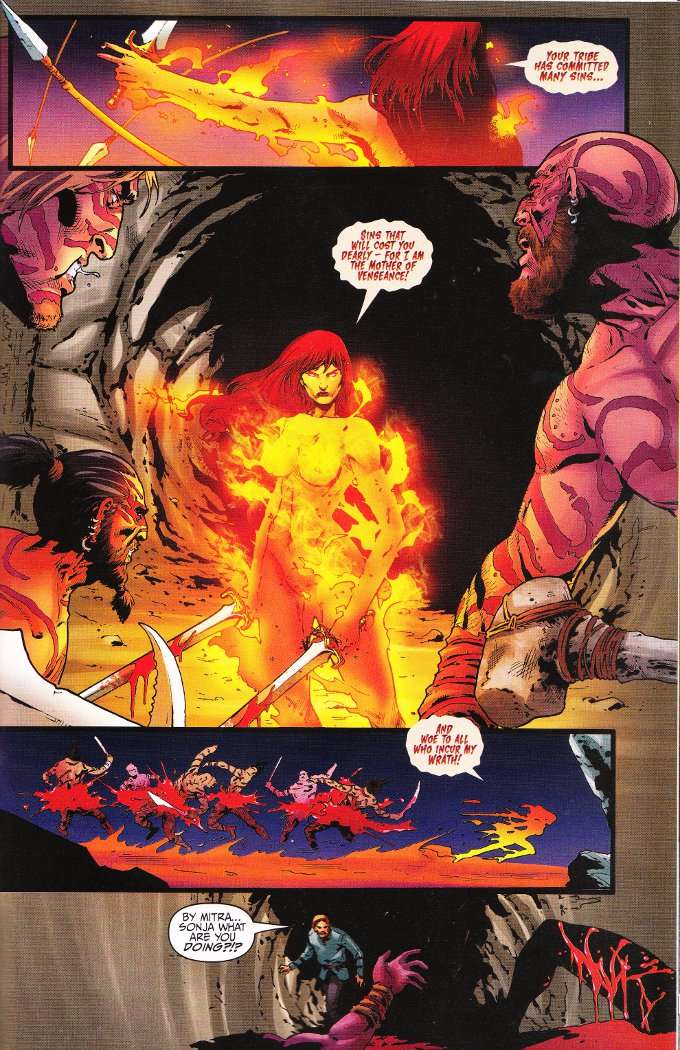
I love how blasé the king of Zingara is about a naked redhead on fire standing before him.


Ultimately, this is just another Red Sonja mini-series that was penned only to be forgotten. If you're looking for a good Red Sonja story, check out the current monthly title by Gail Simone. Or the new Swords of Sorrow mini-series.

Thursday, April 9, 2015

Red Sonja: Vulture's Circle #4 - A Review

Red Sonja is dead! Replaced by a being known as The Queen of Swords, this avatar of The Red Goddess must journey to Stygia with Sonja's companions in search of answers on how to defeat the dread demigod Sutekh. But they had best be swift, for the armies of Set are already at the gates of Aquilonia - the only civilized nation yet to fall to the will of Sutekh!


Regular readers will recall some months back I reviewed a Red Sonja mini-series called The Black Tower. Featuring time-travel, robots, light-sabers and flying saucers, I declared that while it might not be the worst Red Sonja comic ever written it was certainly the most incongruous in regards to the Robert Howard oeuvre and the sword-and-sorcery aesthetic.

With this issue, Vulture's Circle has become worse than that series. Much worse. And while I've come to expect this sort of thing from any story Luke Liberman is involved in writing (i.e. He Who Has Been Trying And Failing For A Decade To Sell Us On His Anti-Hero Version of Thulsa Doom), even I never anticipated something this antithetical to the characters involved.

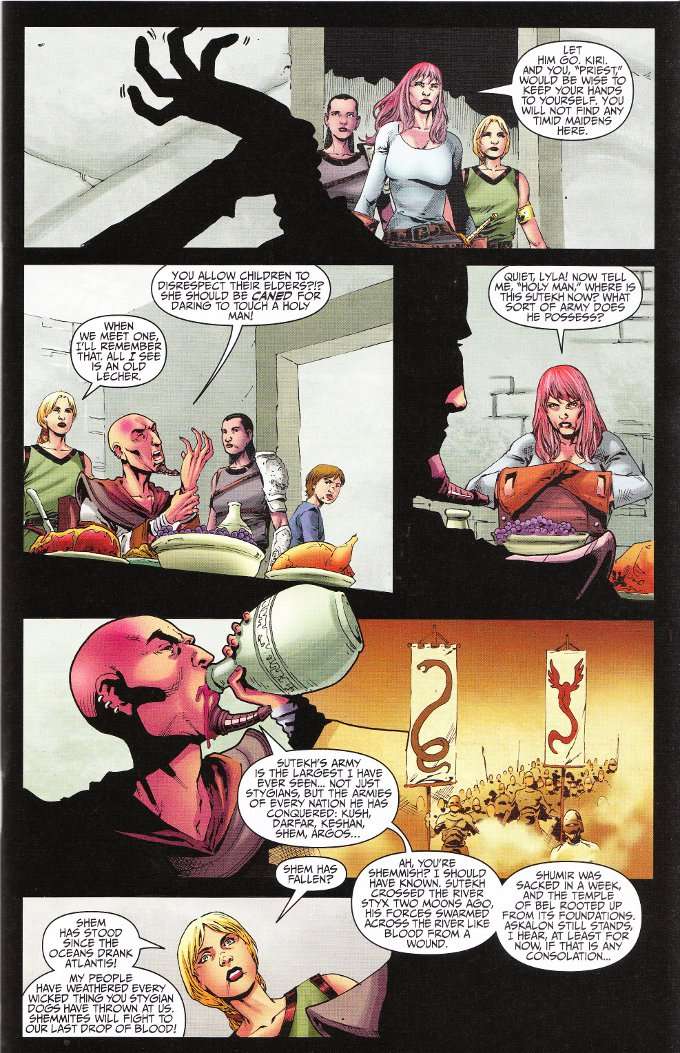
It does pose something of an interesting question for debate - which is the more anathema concept from the perspective of the REH purist? That the proud king of Aquilonia should surrender his armies and subjects into the hands of the Stygians as in the page above? Or that the largely indifferent gods of the Hyboria age should be invoked to create a holy god-slaying sword as in the page below?


The art by Fritz Casas does offer one bit of hope. Despite last issue making lawyer-friendly jokes about the Aquilonian king still owing Red Sonja a favor and the prominence placed on said king in this issue, the artwork makes it clear that this king is not the sullen-faced barbarian we were expecting. Which, in retrospect, makes sense, as he was always inclined to lead from the front and would likely face an army lead by a demigod personally. Yet why make the joke last issue if this was not meant to be a reference to King Conan?

In the end, it matters little. I am done with this Red Sonja series. In truth, it can't even be called a Red Sonja story now that Sonja has been replaced by The Queen of Swords. And unlike The Black Tower, it can't be considered a curiosity worth of mockery.

Sunday, March 22, 2015

Red Sonja: Vulture's Circle #3 - A Review

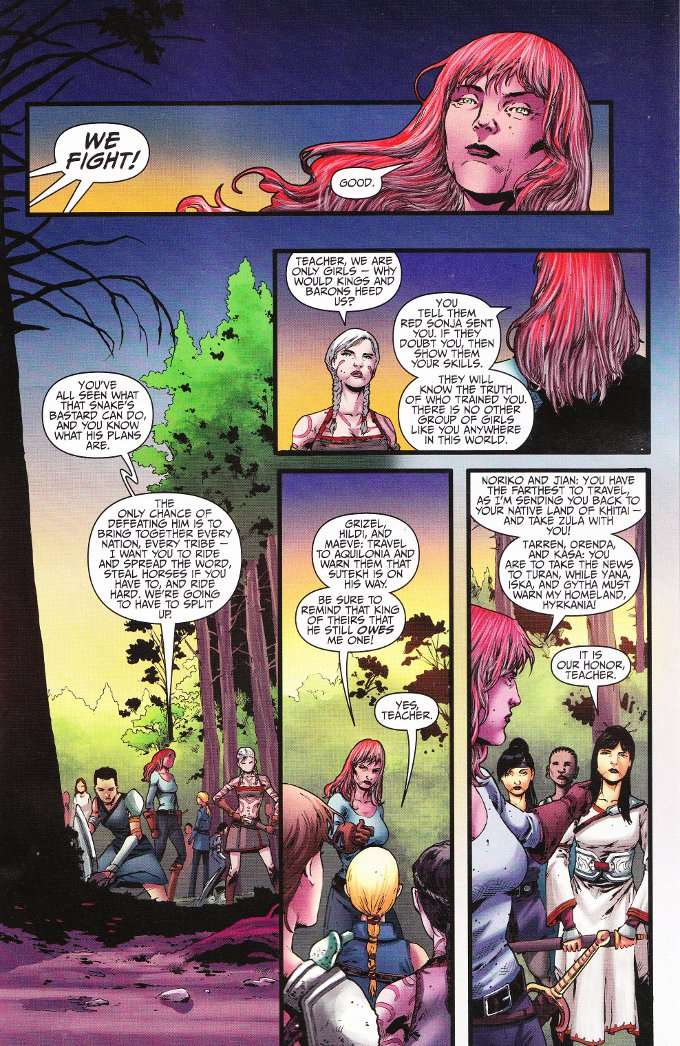
With her school for warrior women destroyed and the forces of Sutekh posed to overtake the northern Hyborian continent, Sonja reluctantly scatters her students to spread word of the coming evil. A solution may be found by communing with the gods themselves. But is Sonja ready to sacrifice the life she has built for herself or to face the goddess she has spurned for so long?


It is unfortunate that after an interesting second chapter that put a truly unique spin on the Red Sonja legend that this third chapter should sink into the malaise that damns so many mini-series starring the Scourge of Hyrkania. I had thought this series based on the more modern take, where Sonja is not beholden to the whims of a goddess and she fights merely because someone must.

Here we learn that Sonja has been taken to the temple of Scathach since childhood. This is, I think, the first time any reference has been made anywhere to Scathach having temples. The implication in previous Sonja stories has been that she was an obscure goddess who chose her champions directly and didn't bother with such finery.

And it seems curious that Sonja's father - by most accounts an ex-warrior who took little pleasure in the soldier's life and gladly became a farmer - would be taking his daughter to the temple of a goddess who represented everything he was leaving behind or that Sonja's mother - who was trying to force the tomboy Sonja into behaving as a girl should - would ever agree to Sonja going to such a place. But whatever.

The real problem comes with the end of this issue, where the Luke Liberman influence becomes most clear and artist Fritz Casas is once again allowed to indulge himself with a little cheesecake.  Now, I have no objection to a little skin in a sword-and-sorcery comic.  It's a part of the fun of the genre.


That being said, depicting Sonja - now a full avatar of Scathach - as naked save for a discrete layer of fire (With flames that grow curiously thinner whenever we view Sonja from behind) seems a little gratuitous. At the very least, it eliminates Sonja's agency and very little is made of the choice she apparently makes without discussing things with the alleged love of her life.

Oh, do you remember him? The man who inspired Red Sonja to give up her life of wandering?  I'm pretty sure they mentioned his name at some point. But the fact that this character is so unmemorable points to the larger problem with this series. There is a saga just waiting to be told about how Sonja didn't just give up her life of adventure for this man - she defied a god oath for her love of him!

Alas, this man is given no more thought than the lawyer-friendly shout out to Conan - aka the unnamed King of Aquilonia who owes Sonja a favor - as we rush to more boobs and blood. This is typical for Red Sonja stories, I know. But this one had been shaping up to be far better.

Sunday, February 22, 2015

Red Sonja #100 - A Review

The trouble with anthology books is you can never be certain of the quality of all of the book's contents.  That certainly proves the case with Red Sonja #100.  While this issue boasts stories by some of the finest scribes to write tales about Red Sonja since her resurgence at Dynamite Entertainment, it appears that less care went into procuring artists of a similar temper.


Thankfully that doesn't prove to be true of the book's first tale, "The Snare".  The story by Eric Trautmann pits Sonja against a beguiling evil as she flees from Hyborean slavers.  The artwork by Chastity artist Dave Acosta proves a fair match to the weird horror roots of Trautmann's script.


Sadly, the artwork of Pablo Marcos proves to be a little too weird in the next chapter, Tresses.  This story by Roy Thomas comes closest to capturing the feeling of a classic Red Sonja comic and   Marcos's artwork has a hand in establishing that aura.  Marcos does a grand job depicting the Lovecraftian beast at the heart of Thomas' story but his human figures are oddly distorted, with Sonja's neck stretching to odd lengths in some panels only to disappear completely in others!


The middle chapter - Sticks and Stones - is definitely the weakest in the collection.  The story by Michael Avon Oeming is built around that most overplayed of sword-and-sorcery cliches - the hero fighting for their freedom in an arena. The cartoonish artwork of Taki Soma proves worse, however, delivering a Sonja whom looks more like Codex from The Guild than a seasoned warrior woman.


The penultimate chapter - The Torch - proves the strongest in the anthology, no doubt due to the pairing of current Red Sonja writer Gail Simone and experienced Red Sonja artist Noah Salonga.  This epic story (which features some epic poetry worthy of Robert E. Howard himself!) centers upon Sonja's chance meeting with a warrior woman who inspired her as a girl and Sonja being given a chance to bring a measure of peace to her idol.


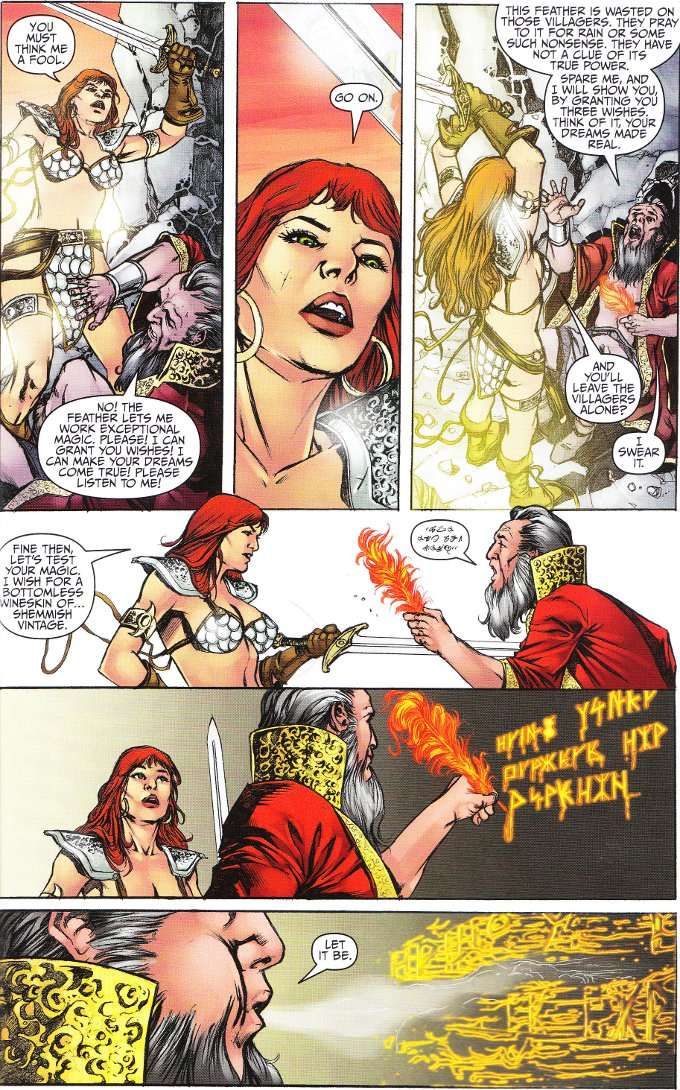
The book's final chapter - Three Wishes - proves to be the most erratic.  The artwork by Injustice artist Sergio Fernandez Davila is all over the place in terms of proportions and appearances.  The story by Luke Liberman is serviceable but the action - centering around a wizard who has found a seemingly endless steam of wishes - is resolved far too quickly, though it ends sweetly enough.

All in all, Red Sonja fans will find much to enjoy in this centennial issue.  It is not without its flaws but the good far outweighs the bad.  And even the bad is not truly that bad.

Sunday, February 15, 2015

Red Sonja: Vulture's Circle #2 - A Review

The Son of Set - Sutekh the Unclean - has risen!  Now an army of the undead parades before a north-bound army of the conquered Southern nations of Hyboria, hell-bent on enslaving the free nations and spilling enough blood to free Set from his celestial prison.  Their next target?  A school that trains young women to become warriors, run by a woman warrior long retired to the role of Sensei. But for the sake of the world, Red Sonja must fight once more!


A remarkable thing about Red Sonja: Vulture's Circle #2 is that it recaps the action of the first issue as part of its narration.  It is rare to see that done these days in a monthly series, let alone a mini-series such as this.  It's a nice touch and the script by Nancy A. Collins and Luke Leiberman handles it naturally. It also reveals a number of interesting details about Sonja's life before this and how she found love with another unconventional figure - a male medic who preferred healing to swordplay. One wishes we could see more stories set in this continuity in the future, as it's such a novel change from the usual Red Sonja tale.


Of course no Red Sonja tale would be complete without a little action and this issue does contain that!  The fight scenes by Fritz Casas are well-depicted and well-blocked. The only real flaw in the artwork is that many of the smaller panels lack the vivid detail that Casas packs into his full-page spreads.  Thankfully, the line-work is never busy despite that detailing.

Thursday, January 8, 2015

Red Sonja: Vulture's Circle #1 - A Review

It has been some years since Red Sonja tread the jeweled thrones of the world under her booted feet. She has traded her life of adventure for one of simpler pleasures and the joys of teaching the next generation of young warrior women. But when a demon rears its' ugly head in a nearby village and rumors speak of the Son of Set come to Hyboria to open the way for his father from the Outer Dark, Sonja may have to take to the open road one last time.


Red Sonja: Vulture's Circle #1 gives us a glimpse at the future of Red Sonja.  A future that is thankfully free of robots and laser guns, unlike some other comics about an older Red Sonja we won't mention. Thankfully, Nancy A. Collins - who wrote the excellent Red Sonja: Berserker - seems to be reigning in the worst impulses of Luke Lieberman, whose previous Red Sonja stories have left much to be desired.

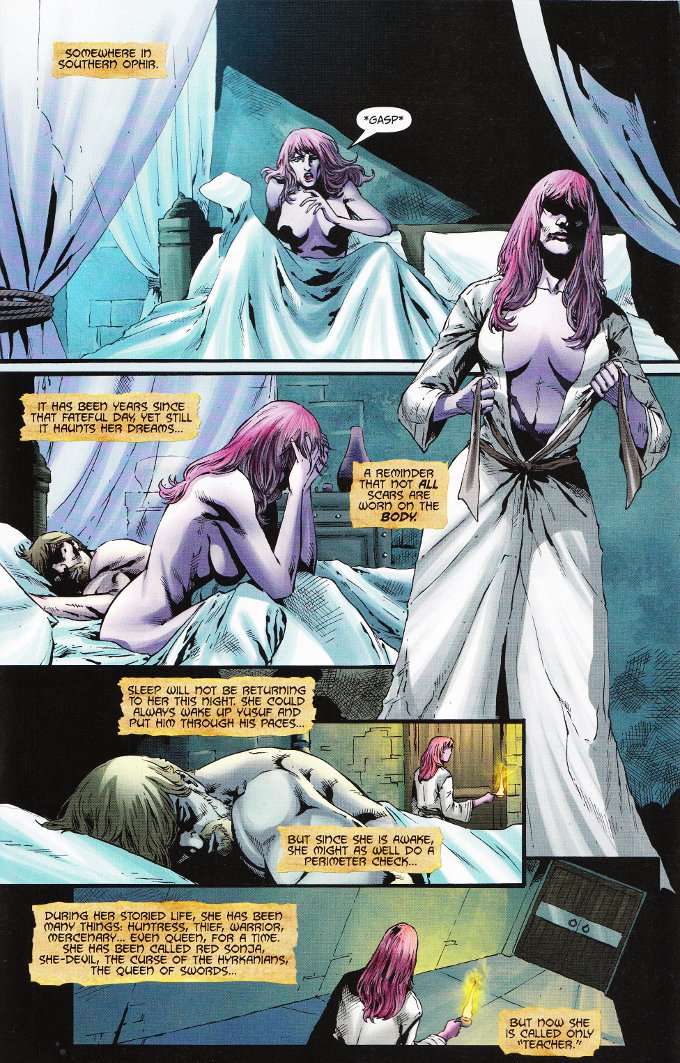
Unfortunately, the artwork for this issue seems conflicted on a number of levels.  Frtiz Casas - who also worked on Red Sonja: Berserker - is a skilled artist with a good eye for action.  Unfortunately, there are some points where the artwork doesn't quite match the script.  Casas' Sonja, for instance, seems remarkably free of scars from what we see of her her body... and we see quite a bit of it!  This doesn't match up with Sonja's monologue about the scars on the body.  Indeed, the only visual signs of Sonja's advanced age are her crimson locks being somewhat faded and tinged with grey - a wonderful effect on the part of color artist Adriano Augusto.


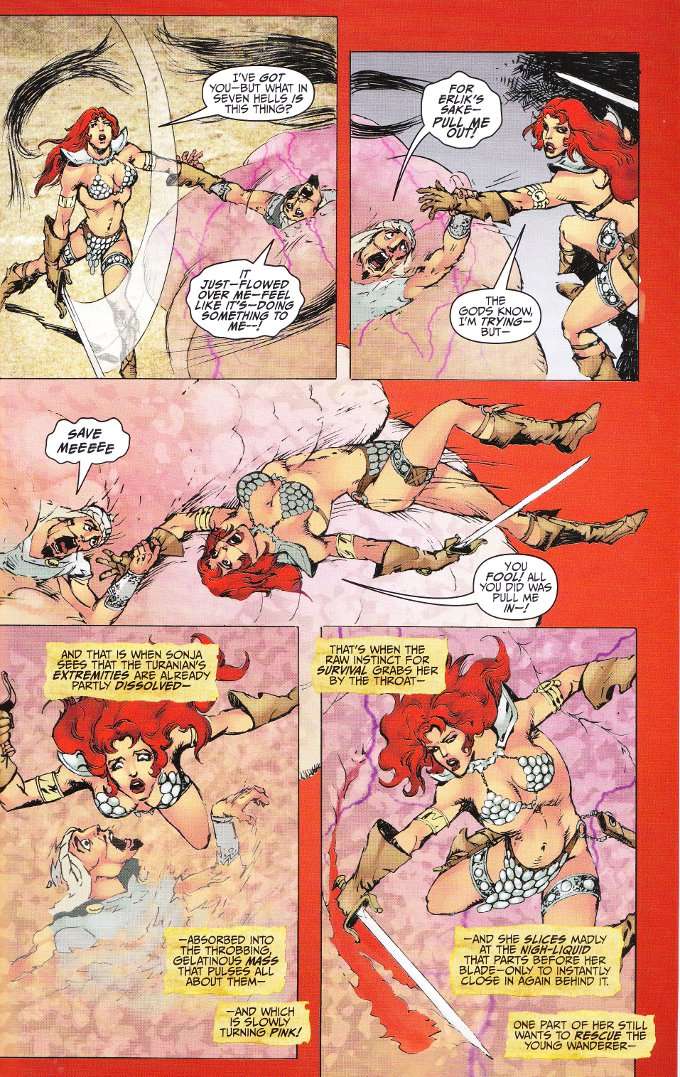
The biggest problem with this issue is the apparently random censorship of the artwork. The opening pages (available here) depict a scene in which a temple virgin is magically impregnated and forced to give birth to a snake demon even as the life is sucked from her body. It is a horrific moment and the artwork is suitably disturbing. And yet, some censor apparently found the idea of uncovered women's nipples more disturbing than a the images of a young woman rotting away to nothing even as her belly bloats like an enormous egg!

How else do you explain the hapless virgin - and Sonja when we first see her getting out of bed later in the issue - having their breasts covered with oddly precise black dots that do not match the inking or shading in the rest of the panel?  There is no explanation, save that even on a 16+ book, someone is perfectly happy to depict a man's throat being ripped-out in vivid detail in a close-up panel but afraid that people will complain about the sight of bared breasts!  I am no prude nor pervert but it seems a silly division to me and the book suffers for the disparity.

Sunday, August 12, 2012

Red Sonja: Atlantis Rising #1

Within the first five pages of Red Sonja: Atlantis Rises, Atlantis does indeed rise from the depths, elevated by the recently deceased (though not for long) sorcerer Thulsa Doom. This is one thing I can say about this book - it does deliver on the promise of its' title! Yes, that's one good thing I can say about it. And it is one of the only good things I can say about it.

For a book that has Red Sonja's name on it, there's precious little Red Sonja in it. This has been the case before in other Red Sonja stories written by author Luke Lieberman, who is also the credited creator of this particular version of Thulsa Doom. Most of this issue depicts Sonja reacting to Doom's actions, somehow knowing he's responsible for the sudden flooding of the lands she's traveling through. This issue also brings us the return of Talos, a bard first seen in Lieberman's Doom of The Gods, whose main contribution here is also somehow realizing Doom is responsible for the flooding and going to tell some king that the only hope they have is getting Red Sonja to lead his armies against Atlantis.

All of this adds up to a fairly fractured narrative. Characters know things because they know them and do things because the script says they should. Despite some good action scenes of Sonja saving people, Sonja comes off as a very ineffectual heroine. As is frequently the case in Lieberman's stories, Sonja is less of a character and more of a tool of the male characters who have all the knowledge and make all the decisions. And yet, she still fares better than Thulsa Doom.


Thulsa Doom, as depicted here, comes off as the stupidest evil wizard in the history of evil wizards. It is unclear exactly what his plans were in raising Atlantis from the deeps and raising its' inhabitants from the dead. One thing that is clear is that if you are a necromancer capable of raising whole sunken continents and waking the dead, presumably in anticipation of forming an unstoppable army of darkness, you should probably do so on a continent whose destruction you are not directly responsible for. And if you choose to do this anyway, you should have access to some kind of magic that ensures your would-be undead minions cannot turn against you.

Less clear is why the newly risen King of Atlantis doesn't just kill Thulsa Doom and be done with it. Nor why he decides "Well, that evil, untrustworthy guy I just threw in the dungeon wanted us to do this for some reason. What the hell! We're awake. Let's go ahead and do it!"


I will not say that Max Dunbar is a bad artist but I will say his particular style, which reminds me of the films of Don Bluth, is ill-suited towards this kind of tale. It is hard to take a grand epic of continents rising and zombie armies marching seriously when everything is depicted in so cartoonish a manner. Our heroine is drawn less like a well-muscled valkyrie and more like a Barbie doll, with a freakishly thin waist and pencil-neck! And Thulsa Doom, even granting that he's probably a bit tuckered out and might be a bit emaciated from raising a continent and creating a new body for himself (which begs the question of why he didn't grow his arm back), looks more like Dhalsim from the Street Fighter video games than the well-muscled Nubian demigod we're used to seeing.

Let's not beat around the bush. This may well be the worst comic I've read all year. Ignoring my own antipathy for Luke Lieberman's version of Thulsa Doom, every character in this story is paper thin and their actions are driven entirely by the plot, with no concern about logical motivations. The artwork is better suited toward a children's graphic novel than a dark fantasy epic. All in all, it's a waste of good paper and/or hard drive space.

The Many Lives Of Thulsa Doom!


Thulsa Doom was originally created by Robert E. Howard as an "eternal foe" for his second most famous barbarian hero, King Kull of Atlantis. Doom only made one appearance, in the short story The Cat And The Skull, but the story suggested that this was not the first time Kull and Thulsa Doom had met in battle. Small wonder then that Thulsa Doom was chosen to be Kull's chief antagonist when the adventures of Kull were adapted and expanded upon by Marvel Comics in the 1970s.

This second version of Thulsa (who you can read a full history of here) was a lich - a necromancer whose power allowed him to defy death and be continually reborn. This allowed him to continue on, long after Kull's death, to plague other heroes (including Conan The Barbarian and Red Sonja) in the world of what became known as Hyboria after the fall of Atlantis.

The third version of Thulsa Doom is undoubtedly the best known. Portrayed by James Earl Jones in the first Conan The Barbarian movie, this version of Doom is a charismatic cult leader and reportedly a powerful sorcerer. This take on Doom seems to be much closer in personality and power to Conan's arch-enemy, the wizard-priest Thoth-Amon. Presumably they decided to use the name of Thulsa Doom for their villain because they had bought the rights to the entire REH library and it just sounded better.

The fourth and final version of Thulsa Doom was created by Luke Lieberman. A filmmaker by trade, Lieberman holds the film rights to the Thulsa Doom name and has been attempting to make a movie starring his version of the character for several years now. I think it best to quote Lieberman himself in describing his version of Doom.

We have a bold new vision for this character and plan to bring him back in a very Fresh and Big way. The film will take him back to his origins which involve the destruction of Atlantis. It is basically the Godfather meets Conan, exploring the paradox of Doom's character and confronting the deep inner conflict - oh and there will be monsters, explosions and fight scenes of course!

The Sonja Vs Doom Series I am writing with Peter [David] will introduce the younger Thulsa, along with reintroducing the more familiar, and older version. It will have some connection to the Conan Film, as Doom will be interested in the "Riddle of Steel" but beyond this we are forging into new territory.

Thulsa is a fascinating and complex character, his horrible charisma, his villainous sincerity. Thulsa Doom long ago sold his soul for power - he knows what the moral choices are, he is just beyond Good and Evil as it were.

This version of Thulsa Doom, described by Lieberman as "the ultimate anti-hero" has primarily appeared in the pages of various Red Sonja comics, originally appearing for the first time in the Red Sonja vs. Thulsa Doom mini-series. He later returned, attempting to overthrow the gods themselves in Doom Of The Gods. He was next seen in the pages of Queen Sonja, attempting a mass sacrifice in order to bring about the end of the world at the behest of the god Set. Finally, and most recently, he appears in the new Red Sonja mini-series Atlantis Rises.